

News
Communications is Springboard for Industrial Revolution- Shittu, Comms Minister


Mr. Adebayo Shittu, minister of Communications, has said that the communications sector is a springboard for industrial and administrative revolution.
Shittu made this statement during his maiden meeting with the management staff of the ministry on Wednesday in Abuja.
According to him, God has blessed Nigeria with a large population that if explored in a fair manner communications can become the cash cow of the nation in place of petroleum.
“There are many graduates without the knowledge of ICT; many of them end up paying exorbitant fees to engage in entrepreneurial ventures to learn these things.
“We must evolve a policy that will engage the usage of ICT in our universities and polytechnics, which can generate a lot of income for government without being oppressive in our charges.
“The current economic downturn may be an inhibiting factor; however, we must be resolute in our resolve to make a difference serving Nigerians with utmost dedication, transparency and honesty.
“This we must do in order to achieve for our people the highest good possible in our circumstance, ‘’ he said.
Shittu frowned at a situation where just about ten per cent of the budget is capital project and the rest stands as overhead.
He stressed that if there were no capital projects, it would be difficult to achieve any level of development because hardly would jobs be created.
“It will not be business as usually, there will be zero budgeting, every budget must outline its programmes and everything budgeted for must be actualised to its last detail.
“We all must key into President Buhari’s plan of a society where jobs are created and readily available to make life less burdensome for those of us with many dependants.’’
Speaking on the influence of the civil service on governance, the minister said it was a critical machinery of government.
“The civil service has the crucial responsibilities of initiating, formulating and implementation of public policies, programmes and projects.
“It is, however, a fact that the performance level of any government cannot go beyond the level of competence, commitment and efficiency of its civil service.
“The government, therefore, needs you on its side to do things differently and lift our ministry to a lofty pedestal of performance, as true agents of change.”
Also Mr Sunny Echono, permanent secretary of the ministry in his maiden meeting with the staff, assured the minister that the entire staff would be mobilised to carry out the president’s mandate.
Echono encouraged staff to give a sense of direction to what ought to be done to achieve great results and move the ministry and Nigeria forward.


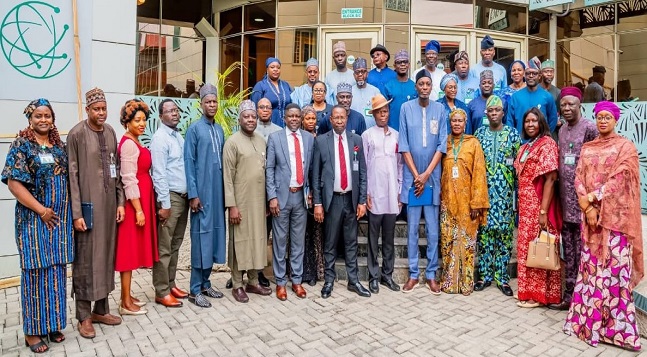
The National Information Technology Development Agency (NITDA) has reinforced its commitment to advancing Nigeria’s digital transformation agenda through strengthened collaboration with key strategic institutions, as it hosted the Director General of the National Institute for Policy and Strategic Studies (NIPSS), Professor Ayo Omotayo, alongside participants of the Senior Executive Course (SEC) 48, 2026.

The visit, which builds on an earlier strategic study tour, provided a platform for in-depth engagement on the role of digital innovation in driving sustainable economic growth, with particular focus on the Orange Economy.
Representing the Director General of NITDA, Kashifu Inuwa CCIE, the Director of Stakeholder Management and Partnerships, Dr Aristotle Onumo, highlighted the Agency’s commitment to fostering a vibrant digital ecosystem through inclusive policies, strategic partnerships, and capacity development initiatives.
“NITDA is committed to creating an enabling environment where innovation can thrive by bringing together government, private sector, academia, and creatives to drive Nigeria’s digital economy,” he stated.
Inuwa underscored the growing importance of the Orange Economy, describing it as a critical driver of innovation and economic value through intellectual property. He identified sectors such as digital content creation, film, animation, and digital art as key contributors to national development.
“The Orange Economy represents a powerful opportunity to transform our rich cultural heritage and creativity into sustainable economic growth,” he noted.
He further highlighted Nigeria’s unique advantage, particularly its youthful and creative population, while calling for stronger collaboration among stakeholders to fully harness the sector’s potential.
“With our youthful population and rich cultural assets, Nigeria is well-positioned to become a global leader in the Orange Economy if we deepen collaboration and investment across the ecosystem,” he added.
During the engagement, NITDA also presented its strategic initiatives aimed at supporting the digital and creative sectors, including digital infrastructure development, promotion of digital literacy, and implementation of policies that enable startups and innovators to scale.
Addressing challenges facing the sector, Inuwa pointed to issues such as limited access to funding, infrastructure gaps, weak intellectual property protection, and ecosystem fragmentation, while emphasising the need for coordinated action.
“Addressing challenges such as funding gaps, infrastructure deficits, and intellectual property protection is critical to unlocking the full potential of Nigeria’s creative economy,” he said.
The Agency reiterated its target of achieving 70 per cent digital literacy by 2027, noting that ongoing programmes are equipping millions of Nigerians with essential digital skills, including those in underserved and informal sectors.
In his remark, Professor Omotayo described the visit as an important opportunity to deepen understanding of how digital technologies are reshaping economic sectors, particularly the creative industry. He noted that the insights gathered would contribute significantly to policy recommendations aimed at strengthening Nigeria’s economic framework.
Participants of the SEC 48 programme engaged actively during the session, raising questions on capacity development, access to tools, and frameworks for protecting digital content. NITDA highlighted its ongoing collaborations with industry stakeholders to provide training, innovation hubs, and access to digital tools for young Nigerians.
The engagement concluded with a renewed commitment from both NITDA and NIPSS to strengthen collaboration in research, policy development, and capacity building, aimed at positioning Nigeria as a globally competitive force in the digital and creative economy.


Nigeria Revenue Service (NRS) has assumed responsibility for collecting mineral royalties from mining operators nationwide, following new tax laws effective January 1, 2026.

NRS
The shift emerged from a Thursday meeting between Solid Minerals Development Minister Dele Alake and NRS Chairman Dr. Zacch Adedeji. Their joint statement, endorsed by both, confirms NRS now administers all federally collectible revenues, including royalties.
Enacted by President Bola Tinubu on June 26, 2025, the Nigeria Tax Laws 2025 empower this transition. The Ministry of Solid Minerals Development remains a key partner, supplying pricing data, geological insights, and sector coordination.
NRS Special Adviser Dare Adekanmbi’s statement outlines collaborative steps: a nationwide sensitization program for operators on filing and payments; development of a digital royalty system; and regular joint technical sessions to address issues.
Both agencies pledge orderly, transparent implementation to boost the mining sector. Operators must comply with obligations and join upcoming programs.
The move aims to streamline revenue collection while fostering mining growth.
Microsoft has rolled out a new set of features for its Microsoft 365 Copilot platform, including tools for complex, multi-step work and deeper research tasks, as competition in workplace artificial intelligence (AI) intensifies.

The update introduces Copilot Cowork, a capability aimed at handling long-running tasks across Microsoft 365 applications.
The feature is being made available through the company’s Frontier programme, which typically gives early access to experimental tools.
Microsoft is also integrating technology linked to Claude – an AI model developed by Anthropic –into Copilot, signalling a broader shift toward using multiple AI systems within a single product rather than relying on a single model.
Jared Spataro, chief marketing officer for AI at Work at Microsoft, says the company is positioning Copilot as a system embedded directly into workplace software, rather than a standalone tool.
“Microsoft 365 Copilot is your AI for work,” he says, adding that it draws on multiple AI models and is integrated into existing workflows.
Alongside this, Microsoft has upgraded its Researcher feature, which is designed to analyse information from multiple sources and generate structured reports.
A new “Critique” function separates the drafting and review process between different AI models – one generates an initial response, while another evaluates and refines it.
The company says this approach improves output quality, with Researcher showing gains on its internal benchmark for accuracy, completeness and objectivity.
Another addition, called Model Council, allows users to compare outputs from different AI models side-by-side, highlighting differences in responses and reasoning.
The updates form part of what Microsoft calls “Wave 3” of Copilot, as it pushes to embed generative AI deeper into enterprise software. The move reflects a wider industry trend towards combining models from multiple providers, including OpenAI and Anthropic, to improve performance and reliability.

Union Bank Looted: How Former Directors Gambled with Billions and Nearly Destroyed a National Bank

N4.65 Trillion in the Vault, but is the Real Economy Locked Out?

FG, Others Say Nigeria Wastes 38m Tonnes of Food Annually

Ecobank Assures of Seamless Easter Banking Services

Anchor Gets Nigerian, Canadian Licences as Transactions Crosses $2.5Bn

Spotify’s Loud & Clear Report Reveals Over ₦60Bn Revenue for Nigerian Artists in 2025

Madonna University Taps Tech Guru Adote for Strategic Board Role

China Threatens to Shut Nigeria’s Satellite Over $11.44m Unpaid Debt

Healthcare Under Attack: Why Cybersecurity is Now Critical Care

Police Says Victims Enable Cyber Attacks Out of Ignorance




 E-Financial2 days ago
UBA Beefs Up Mobile App Security to Stop Fraudulent Debits, Withdrawals

 Telecom2 days ago
Bharti Airtel Crosses 650m Users

 General News2 days ago
FG Orders Installation of 5000 CCTV Cameras for Surveillance in Plateau

 E-Financial2 days ago
Ghana Makes History as First African Country to Integrate Payment National Identity Card

 E-Financial2 days ago
CBN Plans New Payment Systems Vision

 E-Financial2 days ago
Flutterwave Secures Nigerian Banking License, Boosts Financial Autonomy

 E-Business2 days ago
Nigeria Mulls National Cybersecurity Council

 Broadcasting2 days ago
Appeal Court Upholds Ban on NBC’s Power to Fine Broadcast Stations