

Telecom
Confusion as Thugs Vandalise MTN Office over Xenophobia Attacks

MTN Nigeria’s office in Abuja was attacked by some suspected thugs on Thursday in reprisal to the xenophobia attacks on Nigerians in South Africa.
The thugs, according to reports, catered away phones, cash and also destroyed vehicles and office equipment.
They invaded the premises of the telecom giant at 4 Madeira Street, Maitama armed with sticks and rods in retaliation for the xenophobic attacks on Nigerians in South Africa.
An MTN worker said the staff ran to safety when the vandals invaded the premises. Police operatives however stopped the attack shortly afterwards.
The attack came as MTN Group expressed implicit confidence in its Nigerian operation, despite the grim challenges arising from the N330billion fine imposed on it by telecommunication regulator, Nigerian Communications Commission (NCC) last year.
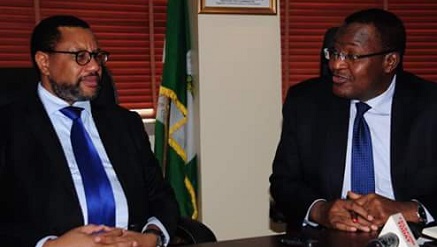
Mr. Phuthuma Freedom Nhleko, group chairman/chief executive, who was received by Prof Umar Danbatta, executive vice chairman (EVC) of the NCC and top management of the Commission said the Group has faith in Nigeria and will be willing to invest more in the sector in the years to come.
“We had challenges in the past, during the period of the fine, and we are grateful for the role, the Commission played towards an amicable resolution”.
Nhleko whose visit to the NCC management is a valedictory one as he steps down as Group Chairman in March, 2017 said MTN Group has injected over $16billion into the Nigerian operations and “we have a very long way to go and so ask for spectrum which is the oxygen and life blood to navigate this long and tedious investment journey, without spectrum, the sector will suffocate”.
Nhleko specifically solicited for more spectrum allocation and a release of the one that belonged to Visafone, whose equity shares MTN acquired in 2015.
He also canvassed for a more level playing field “despite being dominant player”.
He said MTN has made its mark in voice and data services and that more services like mobile financial services are underway.
In his response, Prof. Danbatta welcomed the delegation and assured them that the Commission will always play by the rules and support every operator within the ambits of the law.
“I like to state that our word is our covenant. When we take decisions, we are concerned about the stability of the industry and there is no way we can guarantee it without considering the dominant status of MTN and its obligations and if the dominant status is becoming stringent, we are open to engagement, we will be guided by what is happening in the market, to ensure the growth and development of the sector”.
He said “the sector has contributed very well to the National Gross Domestic Product (GDP) and has shown remarkable resilience in this recession”
Danbatta said the NCC made a case for relaxing fiscal policies towards the sector to the Central Bank of Nigeria (CBN) “and the CBN Governor is favourably disposed to our request and further engagement especially towards major players who desire to import equipment to aid deployment of broadband infrastructure services and others”.
The Commission, he explained, will always carry out interventions to cushion the operators request to provide necessary services.
On spectrum assignment, Danbatta, said MTN got six slots in the 2.6 GHz auction and full utilization of that spectrum is envisaged.
“We are open to further discussion on the areas of spectrum assignment.” He advised MTN to put across request for spectrum of interest and “we will check its availability”.
The Commission “is here to protect the interests of the operators as well as consumers, consistent with our mandate, the trust reposed on us by the government and people of Nigeria; protecting their interests and ensuring a level playing field and respect for our laws”.
The EVC said the Commission only resorts to sanctions as a regulatory action of last resort after allowing time for checking compliance.
The EVC received the delegation in company of Executive Commissioner (Technical Services), Mr. Ubale Maska, his counterpart for Stakeholders Management, Mr. Sunday Dare, Directors: Mr. Tony Ojobo (Public Affairs), Ms. Funlola Akiode (Licensing & Authorisation), Ms Josephine Amuwa (Policy, Competition & Economic Analysis), Mr. Austin Nwaulune (Spectrum Administration), Mrs. Yetunde Akinloye (Legal & Regulatory Services), Mr. Ayuba Shuaibu (Universal Service Provision Fund – USPF) and Mr. Usman Malah (Chief of Staff to EVC)
The MTN delegation included Mr. Pascal Dozie Chairman, MTN (Nigeria), Col. Sani Bello (Vice Chairman), Board members: Chief Victor Odili, Chief Gbenga Oyebode, Mr. Ferdi Moolman (CEO) and others.


Kenya’s High Court has ruled that mobile phone numbers are not disposable assets, but constitutionally protected digital identifiers, striking at the core of a long-standing industry practice of arbitrarily reassigning inactive SIM cards without the owners’ consent.

In a landmark decision that could reshape telecom regulation and digital identity frameworks across Africa, sitting at Milimani Law Courts in Nairobi, Justice Lawrence Mugambi declared that reassigning a phone number without the original owner’s consent violates the right to privacy.
The ruling effectively elevates a SIM card into the same legal category as personal data tied to an individual’s private life.
At the heart of the ruling is Article 31 of the Constitution, which safeguards citizens from unnecessary disclosure of private information and interference with communications.
The court found that in today’s digital economy, a registered mobile number functions as a critical gateway to sensitive personal data, linking users to mobile money platforms like M-PESA, banking systems, email accounts, and social media profiles.
“When mobile digital identity is lost through reallocation or recycling without interrogating the reasons behind inactivity, it creates an avenue for unauthorised disclosure of delicate information,” the judgment stated.
The case, brought by Erastus Ngura Odhiambo, petitioner and former prisoner, challenged the routine telecoms practice of deactivating SIM cards after prolonged inactivity and reassigning them to new users.
Odhiambo lost access to his mobile phone number due to inactivity while serving his lengthy sentence.
He argued that the practice exposes individuals to serious risks, including misdirected financial transactions, intercepted one-time passwords, and unintended access to private communications.
The court agreed, highlighting how recycled numbers can result in strangers receiving confidential messages, authentication codes, and even being added to private messaging groups, effectively inheriting fragments of another person’s digital life.
Justice Mugambi also criticised the rigidity of SIM deactivation policies, calling them “arbitrary” for failing to consider legitimate reasons for inactivity such as incarceration, studying in restricted environments, or living abroad.
“Incarceration does not strip an individual of their constitutional rights to privacy and identity,” he noted.
For telecom operators, including Safaricom, the ruling introduces a significant compliance burden. The court outlined three strict conditions before any number can be reassigned.
Telcos must obtain informed and verifiable consent from the original owner, issue a public notice and conduct traceability efforts over a reasonable period.
More importantly, the court further directed that telecoms firms must implement technical safeguards to prevent data exposure to the new user.
The Office of the Attorney General has been given six months to translate these directives into enforceable regulations.

Binance Earn offers cryptocurrency users an accessible way to generate rewards on idle digital assets without active trading or constant market monitoring.

Binance Earn
As the crypto market matures, more holders seek productive uses for their assets rather than leaving them dormant in wallets. Binance addresses this through Binance Earn, where users allocate supported cryptocurrencies to various reward products for automatic yield generation.
The platform emphasises simplicity with a “set-and-forget” model: users select assets, pick a product, and rewards accrue passively in the background. This appeals especially to long-term holders aiming to enhance portfolio value over time without day-to-day involvement.
Binance Earn provides flexible options for instant liquidity access alongside fixed-term products for defined commitments, catering to diverse strategies and risk appetites.
“We’re seeing growing interest across Africa in ways to make crypto holdings more productive without active trading,” said Larry Cooke, Africa Head of Legal at Binance. “Simple, ‘set-and-forget’ solutions are becoming increasingly relevant as more users take a longer-term approach to digital assets.”
The feature reflects shifting user behaviour towards holding and gradual growth amid volatile markets, where reward rates fluctuate based on conditions, liquidity, and structures.
Users must assess risks and alignment with personal goals, as crypto remains volatile. Binance Earn positions itself as a key tool in Africa’s rising digital asset adoption, enabling hands-off participation in the ecosystem.

Cybersecurity researchers at Malwarebytes Labs have exposed a sophisticated new Gmail scam where fraudsters send fake Google security alerts via phishing emails, texts, and pop-ups, tricking users into a deceptive four-step verification process that harvests login credentials, GPS locations, contacts, and other sensitive data for account takeovers.

Gmail
Disguised as routine checkups, these alerts mimic Google’s official pages to create urgency, prompting victims to install malicious “security tools” that grant hackers real-time access to Gmail and linked services—Corey Donovan, president of Alta Technologies, warns legitimate checks never come unsolicited or demand downloads, urging users to close suspicious prompts immediately and verify via official Google account pages instead.
The scam’s rise amplifies risks during travel, where public Wi-Fi hotspots—especially “evil twin” fakes like slight misspellings of “Airport_Free_WiFi”—enable interception of banking details, emails, and malware installs; Donovan advises disabling auto-connect, using VPNs for HTTPS sites only, avoiding logins altogether, and crafting strong passwords with mixed characters plus two-factor authentication.
Shoulder surfing on public transport and outdated devices compound threats, as fraudsters glimpse screens or exploit unpatched vulnerabilities—keeping phones updated with post-update privacy reviews limits app access to location or commutes, while skipping work emails in view maintains confidentiality on the go.
Nigeria’s heavy reliance on digital banking and crypto heightens vulnerability, as scammers exploit rushed travellers; Donovan stresses: “Cybercriminals target busy airports and stations knowing guards drop—stay cautious, update devices, lock privacy, and never rush links to protect against these advanced breaches.”

Court Jails ‘Colonel’, ‘Major’ of Global Money-Laundering Ring

Court Bans Kenyan Telcos from Recycling SIM Cards

Providus Bank Fully Meets CBN Capital Requirement, Sets Record Straight

African Tech Start-ups to Receive $46m of Speedinvest Africa Fund

Binance Earn: Simple Way to Earn Rewards on Idle Crypto Holdings

Kaspersky Discovers New Phishing Campaign Exploiting Google Tasks Notifications to Steal Corporate Credentials

esentry 2025 Report Shows Healthcare, Financial Services and Telecoms as Staging Grounds for Increased Cyberattacks in Africa

AfDB, UNDP Launch $10Bn AI Initiative for Africa

Mutual Benefits Assurance Settles ₦5.9bn Claims in January 2026

MultiChoice Suspends Yearly DStv Price Hike as Canal+ Pushes Growth




 E-Financial2 days ago
Kuda MFB Increases Kuda for Her Business Grants to ₦10 Million

 Telecom2 days ago
Vitel Wireless Lures Subscribers with “Data that Never Expires” Campaign

 News2 days ago
BoI, MTN Foundation Launch N1Bn Fund for Women Entrepreneurs

 News2 days ago
NSIA Sign MoU with UK’s Asset Green Ltd to Develop $496M Integrated Dairy Livestock Production Platform in Nigeria

 General News2 days ago
One SA Bank Equals Nigeria’s Entire Banking Sector – Why Recapitalisation Is Critical for Global Competitiveness

 Broadcasting2 days ago
Nigeria tops global rankings for USDT, USDC ownership

 General News2 days ago
Luno Launches First Crypto Prediction Market in Nigeria

 General News2 days ago
FG Deploys Technology, Approves $54m Drugs to Tackle Tuberculosis