

Broadcasting
Creating Conditions for Sustainable and Inclusive Growth in Nigeria’s Digital Economy – An Urgent Call for Action


By Engr. Gbenga Adebayo
The renewed Hope Agenda clearly recognizes the power of technology and innovation to enable inclusive economic growth and development. It is an important acknowledgement that if we can create the conditions within which innovation can thrive, we can maintain, or even accelerate the already rapid growth in the digital economy.

Since the liberalisation of the telecoms sector in the early 2000s, the ICT sector’s contribution to GDP in Nigeria has grown progressively. Today, it delivers 17.89% of annual GDP. That is more than double the contribution of oil and gas. From the initial development of connectivity infrastructure and services, the sector has catalysed the emergence of innovative technology businesses across a range of sectors. From financial technology, to data, logistics, transportation, healthcare and education.
It also provides the infrastructure that enables the delivery of critical national development projects, from national identity enrollment and management, to elections and financial inclusion programmes that provide access to vital services for marginalised and vulnerable communities.
While this growth is impressive and the impact on socio-economic development so far has been clear, the journey is far from over. The recognition within the renewed hope agenda is that the sector has the potential to drive a new wave of inclusive economic development that can be the foundation of Nigeria’s economy for decades.
To deliver this, the government has clearly and publicly acknowledged the importance of creating an enabling environment for investment and taken a number of bold steps to address investment bottlenecks. From the tough decisions to unify the exchange rates, to the tightening of monetary policy and a focus on reviewing the tax regime to make it smoother and more efficient. They have also created target investment funds to support key sectors of the economy, from healthcare and agriculture to the small businesses that drive the economy.
The specific role of the digital economy is captured in the Federal Ministry of Communications, Innovation and Digital Economy’s 4 year 2023-27 growth plan, which envisages a further 15% increase in the contribution of the ICT sector to GDP growth, as well as 15% YoY increases in investment in the sector, both of which are projected to support a 100% increase in the annual net revenue that the sector delivers to government.
These are laudable and ambitious objectives, but they are impossible to achieve without deliberate sustained strategic and tactical action. If these actions are not taken, then the foundations that have been built are vulnerable and not only will these objectives be missed, but the industry will stagnate.
If you look carefully at the investment trajectory in the telecoms industry you can see two clear and concerning trends, which are being further exacerbated by the recent short term economic shocks. Between 2021 and 2022 industry CAPEX declined by 30.37% while industry Foreign Direct Investment declined by 46.9%. This happened at a time when operational expenses have surged and it has been exacerbated more recently by rising interest rates increasing the cost of debt. What that means is that industry expenditure has been diverted from capital (expansion and growth) to operations and that the investment environment has deteriorated. The ultimate manifestation of this has been the recent losses declared by major operators for FY 2023 and HY 2024.
This is further exacerbated by the multiple taxation ecosystem that continues to exist across Nigeria, with operators exposed to 54 different federal/state/local government taxies or levies, many of which are technically illegal. There is a perception that the telecoms industry is highly profitable and so can be treated as a ‘cash cow’ – we are now seeing the impact of this, and even though it is clear operators are suffering, more new taxes continue to be considered by the national assembly.
This is a critical moment. It is an inflection point. If we act, we can establish the platform for growth and the delivery of the government’s ambitious objectives. If we delay, or fail to take the decisions necessary, then the industry is likely to go in the wrong direction. This will not only damage the interests of investors, many of whom are Nigerian, but also impact the emergence of the innovative services and products that ride on telecoms infrastructure.
We believe that decisive action can turn this moment from a crisis into an opportunity. Following extensive research, the Association of Licensed Telecom Operators of Nigeria (ALTON), has developed a clear set of recommendations that can catalyse the next wave of growth in the industry, and for Nigeria. These are:
- Take immediate action on retail pricing: In the short term, this means an industry wide increase to retail tariffs, which were last reviewed in 2016, when the exchange rate was N373/$ and inflation at 18.4%. No industry can survive indefinitely in a rapid inflation environment and not be allowed to increase retail prices. Regulators have denied all recent requests, despite approvals being granted in other critical industries from power to fuel and transportation.
- Make industry pricing sustainable: Every price increase requires individual pre-approval from the regulator, which continues to use 2016 pricing guidance. This is an outdated regulatory model that is not representative of global best practice. ALTON recommends the implementation of a general authorization regime for tariff administration under which the NCC sets general pricing principles and requirements and operators independently align their tariffs with the set pricing requirements through self-certification, eliminating the need for prior approval.
- Provide concessionary funding to enable CAPEX investment: To continue to drive investment and growth in infrastructure, the industry needs access to concessionary finance. Establishing a dedicated financing facility will help mitigate the impact of recent interest rate increases and enable more investment.
- Build and expand regulatory capacity: With technology driving rapid change, we need to rapidly upskill the sector’s regulators to ensure the implementation of well structured regulation that provides the right balance between protection and investment incentive. Regulations need to be co-developed more constructively with industry on a regular basis.
If we can deliver each of these things, then we will have established the basis for long-term sustainable growth in the telecoms sector, and through it catalyse dynamic growth in Nigeria’s broader digital economy. This is achievable, and the time is now.
Engr. Adebayo is the Chairman of the Association of Licensed Telecom Operators of Nigeria (ALTON)


Broadcasting
Global South Alliance Launches $72,000 Datafication and Democracy Fund to Support 2026 Research Projects
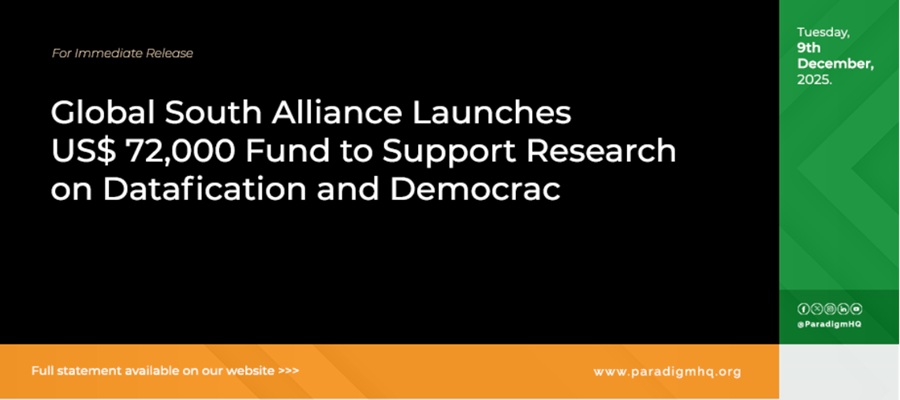
The Global South Alliance, a coalition of 26 digital rights organizations, launched today the second edition of the “Datafication and Democracy Fund” on December 9.

Global South Alliance
The Fund will provide more US$ 72,000 to support research and advocacy projects focused on datafication and democracy to be implemented in 2026.
The Datafication and Democracy Fund was launched during the fourth edition of the Data Privacy Global Conference, organized in São Paulo, Brazil. The Global South Alliance is jointly managed by Data Privacy Brasil, Aapti Institute, and Paradigm Initiative.
The members are Asociación por los Derechos Civiles, Bolo Bhi, Center for Communication and Governance, CIPESA, Derechos Digitales, Digital Rights Foundation, Dukingire Isi Yacu, Internet Bolivia, Pollicy, Research ICT Africa, Fundación Multitudes, InternetLab, Thraets, Jokkolabs Banjul, Aláfia Lab, Centre for Policy Alternatives, KICTANET, Tech Global Institute, Freedom Forum, TEDIC, Digital Access, Center for AI and Tech Innovation for Democracy and Masaar.
The call for proposals is open to non-profit, non-governmental organizations based in the Global South working on digital rights and related public policy issues. Previously supported organizations have addressed topics such as online child protection, data governance in electoral processes, biometric technologies in stadiums and large events, mandatory biometric data collection of migrants, and discriminatory surveillance and datafication practices.
According to the launch announcement, the Datafication and Democracy Fund “aims to finance research and public policy analysis projects that address critical questions arising from the impact of datafication on democracy.” The Alliance emphasizes that “datafication is a deep and complex process of social transformation: it shapes the provision of public services mediated by information technologies, the emergence of digital public infrastructures, the data-driven nature of elections, the reconfiguration of markets and platforms, and many aspects of civic life. Beyond deliberative processes and elections, datafication exacerbates democratic challenges such as transparency, due process, and respect for citizens’ autonomy.”
Selected applicants will receive grants of up to US$ 8,000 to support their research projects. Depending on the proposals submitted, between 8 and 12 projects will be funded. All funded projects must be carried out during 2026.
Applicants are required to submit:
A one-page cover letter outlining the organization’s background, experience, and motivation for participating in the research program;
A proposal of up to five pages detailing the topic, scope, methodology, expected results, and relevance of the project to digital rights and democracy in the Global South;
A detailed budget, not exceeding US$ 8,000, specifying how resources will be allocated across the proposed project’s components.
Applications must be submitted in English by January 30th 2026, through the designated online form.

South Africa’s leading pay-TV operator, Multichoice, owner of DStv and Showmax, will officially delist from the Johannesburg Stock Exchange (JSE) this week following its acquisition by French media giant Canal+.

DStv
The delisting, scheduled to take effect on Wednesday, Dec. 10, 2025, also applies to Multichoice’s ordinary shares on the A2X Markets.
The move comes after Canal+ completed a Squeeze-Out of remaining shareholders, securing full ownership of the company after nearly two years of acquisition efforts.
According to the company, the delisting remains subject to regulatory approvals from the JSE, the A2X, and the South African Reserve Bank. Canal+ has pledged to comply with conditions set by South Africa’s competition authorities and intends to proceed with a secondary inward listing on the JSE within nine months of the delisting.
Founded in 1985 with the launch of M-Net, Multichoice has been a household name across Africa for four decades. It introduced DStv in 1995, expanded into multiple African markets, and launched its streaming platform, Showmax, in 2015.
In 2019, Multichoice was spun out of Naspers, South Africa’s most valuable company, and later began secondary trading on A2X in 2020.
The acquisition by Canal+ marks a significant shift in South Africa’s media landscape. Local investors will no longer be able to hold direct stakes in Multichoice, but will only gain indirect exposure once Canal+ completes its planned inward listing.
Industry analysts say the takeover underscores the growing consolidation in global media markets, with Canal+ strengthening its footprint across Africa through Multichoice’s extensive subscriber base and sports broadcasting rights via Supersport.

By Kehinde Ogundare, Country Head, Zoho Nigeria
Artificial intelligence is everywhere–in polished social media posts, in the recommendations that guide our viewing habits, and in the bots that handle customer queries before a human agent steps in. On LinkedIn, AI-assisted writing has become standard practice. A year ago, more than half of English long-form posts that went viral were estimated to have been written by or assisted by AI. If that’s the norm on the world’s biggest business network, it’s no surprise that AI is driving conversations in Nigerian boardrooms as companies move from experimentation to embedding AI into their daily operations.

Kehinde Ogundare, Country Head, Zoho Nigeria
Part of the package
The Nigeria Data Protection Act (NDPA), modelled on the European Union’s General Data Protection Regulation, together with the Nigeria Data Protection Commission, requires companies to build privacy into their systems from the outset rather than adding it later. This clear regulatory framework has evolved alongside a rapid rise in AI adoption.
New research from Zoho on responsible AI adoption highlights the impact of the regulations. As per the report, 93% of Nigerian companies have already started using AI in their daily operations; 84% have tightened their privacy controls after adoption, and 94% now have a dedicated privacy officer or team, which is well above global averages.
The survey, conducted by Arion Research LLC among 386 senior executives, shows just how deeply embedded AI has become in Nigeria. One in four companies already uses it across several departments, and nearly a third report advanced integration. Financial services firms are pioneers in this sector, using AI to automate client interactions, streamline operations and sharpen their marketing, while staying compliant with data protection rules.
The NDPA has helped make privacy part of business planning. Four in ten companies now spend more than 30% of their IT budgets on privacy. Regular audits, privacy impact assessments and explainability checks are becoming standard practice.
Skills, compliance and capacity
Rapid adoption brings challenges. More than a third of businesses say that their biggest obstacle is a lack of technical skills, and another 35% cite privacy and security risks. Instead of outsourcing, most are building capacity in-house: nearly 70% of companies are training staff in data analysis, more than half are improving general AI literacy, and 40% are investing in prompt engineering for generative tools.
The understanding of the NDPA regulation, which came into force in 2023, has also improved. 65% of organisations see compliance as essential. Many voluntarily apply data-minimisation and transparency standards even when not required to do so, aligning more closely with international norms and easing collaboration with global partners.
Privacy is increasingly influencing business decisions — from investment priorities to system design. Companies are asking tougher questions: is specific data essential? How can exposure be limited? How can fairness and transparency be proven?
Trusted systems
As privacy becomes part of how technology is built, companies are being more cautious about the tools they use because they now want systems that protect customer data, with clear boundaries between data and model training, straightforward controls, and reliable records for compliance teams.
Demand for business software that balances productivity with privacy is also growing. Zoho, among others, has seen strong customer growth as more organisations are looking for platforms that support responsible data handling.
The study identifies three main reasons behind AI adoption: to make work more efficient by automating routine tasks, to support better decision-making by identifying patterns sooner, and to improve customer engagement through faster, more relevant interactions. But none of this can succeed without trust. Nigeria’s experience shows that privacy and innovation can reinforce each other when they’re built together.
There’s still work to do because some industries are moving faster than others, and smaller businesses often face the biggest hurdles in time, cost and skills. Enforcement is also patchy; while the law is clear, application across sectors and geographies is a work in progress.
The next steps are more practical, requiring investment in skills – from data analysis and AI literacy to sector-specific training – and for governance to be put in place, with clear responsibilities, written policies, and a plan for managing errors or breaches. Privacy impact assessments should become part of every new system rollout, enabled by technology.
As AI becomes fundamental to doing business, Nigerian companies that build it carefully and responsibly will be better able to compete at home and abroad.

FG to Use Digital Economy Initiatives to Curb Corruption Among Youth

SEC Urges IST to Freeze all CBEX Bank Accounts in Nigeria

CBN Rejigs Financial Inclusion Strategy to Boost Economic Growth

Financial Sector Faced AI, Blockchain and Organised Crime Threats in 2025 – Report

TETFund Moves to Tighten Security in Tertiary Institutions
Kaspersky Introduces Cyber Pathways to Support Career Development in Cybersecurity

NITDA DG Tasks Youths to Drive Africa’s Digital Transformation

Firm Urges Organizations to Check Protection of their Websites Amid Search Engine Optimisation Attack Schemes

Hackers Breach Phones of Dangote and Otedola, Demand Ransom

FCCPC Sets Deadline for Digital Lending Regulatory Compliance




 General News3 days ago
NiDCOM Launches Diaspora Startup Challenge to Boost Nigerian Talent

 News2 days ago
Lagos Launches Tele-Vet, Nigeria’s First Veterinary Call Centre

 E-Financial3 days ago
CAC to Shut Down Unregistered PoS Operators by January 2026

 Telecom3 days ago
Nigeria Lacks AI-Ready Data Centres, Trails in Capacity – Nnamani

 Telecom3 days ago
Anambra Leads Southeast in Digital Governance Under Soludo’s ICT Agenda

 General News3 days ago
Optimus AI LABS CEO Showcases AI Breakthroughs in Nigeria’s Financial Sector

 General News3 days ago
PromoPrint Rekindles Nigerian Resilience @ 25th Anniversary

 Telecom2 days ago
Nigeria Dominates 2025 TikTok Sub-Saharan Africa Awards with Six Wins