

E-Business
Cyberoam Shows Security Mastery with CR1000iNG-XP

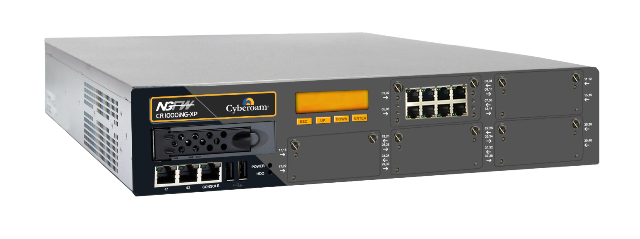
Cyberoam CR1000iNG-XP delivers high performance network security to mid and large sized businesses and gets it absolutely right on multiple fronts.
Cyberoam, enjoys a reputation for delivering firewalls that are a unique combination of price and high performance.
The CR1000iNG-XP is the latest appliance to join the ranks of Cyberoam appliances that are making their impact felt in the world of enterprise security with their next-generation security features.
Offering a massive firewall throughput of 120Gbps, it makes a great pick for growing mid and large sized businesses.
CR1000iNG-XP
The CR1000iNG-XP offers businesses, an EAL4+ certifiedStatefulPacket Inspection firewall, coupled with a truckload of next-generation features like anti-malware, ready-to-use IPS templates, industry leading web and application filtering, on-appliance IPsec and SSL VPN and anti-spam.

Add to that, Cyberoam’s patented layer 8 technology, which offers an extra layer of identity-based security and you have a network security solution that is difficult to beat.
Users can choose the levels of support they want with the device. The Total Value Subscription (TVS) offers 8×5 cover while the Comprehensive Value Subscription (CVS) offers 24/7 cover. With the CVS, you also get the added benefit of Cyberoam’s on-appliance Web Application Firewall (WAF) that safeguards websites and business-critical web applications from attacks like cross-site scripting (XSS), OWASP top ten web application vulnerabilities and more!
Hassle Free Deployment
Ease of deployment is one of the hallmarks of this appliance. This appliance can be deployed in the network in two modes, Route (gateway) and Bridge.
The former ensures the appliance provides the entire spectrum of security functions including firewalling.
If necessary, deploying the appliance in the bridge mode will ensure this appliance sits behind an existing firewall.
The CR1000iNG-XP deployment wizard offers a choice of two base security policies including a general policy and strict policy. While the former activates anti-malware scanning and web filtering for common undesirable categories, the latter ensures only authenticated users are allowed access.
Identity Based Security
Cyberoam’s identity and policy based network security enables application of firewall rules and security policies to users and groups. For e.g. its web application filtering feature can be tailored to specific users and groups.
The appliance offers a wide array of security features, which include web filtering, internet access and bandwidth usage policies that can be defined as per specific users and groups.
If you want to restrict the amount of uploads and downloads and set limits on data transfer, you can do so for daily, weekly, monthly and even yearly usage.
One useful benefit is that you can assign different category based actions. For e.g. the appliance’s web filtering rules support both HTTP and HTTPS and you can actually block HTTP access to websites that belong to a certain category but allow secure HTTPS connections for the same websites.
You can even drill down on the policies meaning you can apply a global policy for anti-spam, and then make subtle changes to this policy as per requirement.
You also have the option of dropping, rejecting or quarantining suspect messages in the1 TB hard disk on the appliance.
Another useful security feature is the spam digest service that keeps users updated with the latest spam advisory.
Comprehensive Reporting
The user-friendly nature of this appliance is taken a notch higher with full on-appliance reporting courtesy the embedded iView syslog server.
All logs are stored on the internal hard disk and accessible from the web console of the appliance.
The reporting is in-depth in its scale and scope and includes graphs of allowed and disallowed traffic and information that gives insight into firewall details, web content filtering, virus and spam activity and more.
Another reporting feature that offers tremendous value to an organization, especially those that have to adhere to regulatory compliance –on-appliance reporting to meet global regulatory compliance for PCI, HIPAA and SOX.
The Verdict
This network security appliance is a great buy for mid and large sized businesses that are looking for a solution that offers a wide range of features and at a price that is well within their budgets.
It brings unmatched mix of Security, Productivity and Connectivity capabilities and offers desired manageability and ease of deployment. Moreover, its Extensible Security Architecture allows businesses to add new security features to meet the growing needs of businesses.


E-Business
Kaspersky Reveals a New Malicious Framework Targeting Cryptocurrency Users with the Use of OkoSpyware


At its recent annual Cyber Security Weekend for the Middle East, Turkiye and Africa (META) region, Kaspersky Global Research and Analysis Team (GReAT) shared insights about the new OkoBot campaign targeting cryptocurrency users.

The new sophisticated framework employs TookPS to exfiltrate seed phrases and uses a new OkoSpyware module to monitor Chromium-based browsers and deploy various malware strains, including the Rilide stealer.
It has already targeted hundreds of victims across over 25 countries, with the highest number of affected end users recorded in Brazil, Vietnam, Canada, Mexico and Turkiye. According to Kaspersky experts, the threat remains active and primarily poses a risk to cryptocurrency users.
In January 2026, experts from the Kaspersky Global Research and Analysis Team (GReAT) identified multiple attacks involving a previously unknown malware capable of capturing the contents of cryptocurrency wallet windows. Dubbed Okobot, the new sophisticated malware framework comprises more than 20 malicious payloads and implants designed to perform a wide range of functions, including collecting local files, executing remote commands, downloading arbitrary browser extensions, stealing cryptocurrency wallets, harvesting seed phrases and credentials, recording video and carrying out other malicious activities.
One of the new implants used in the campaign is a loader that modifies browser memory to load and hide malicious extensions. OkoBot also includes a new OkoSpyware module, which captures keystrokes and the video stream of a target application’s window.
Currently available information does not allow the campaign to be attributed to any known crimeware actor with high confidence. However, the techniques and infostealer involved are widely used by Russian-speaking threat actors, and technical analysis has also revealed code artifacts in Russian.
The initial infection typically occurs through two main vectors: ClickFix attacks, in which threat actors use social engineering to trick users into running malicious code, and malware distributed via GitHub under the guise of legitimate software. During the investigation, researchers identified one such case involving a fake installer for SQL Server Management Studio (SSMS), a widely used Microsoft database management tool.
The malicious framework includes SeedHunter, a malware component that monitors active system processes and injects an implant into Trezor Suite, Ledger Wallet, and Ledger Live, – official applications used to manage cryptocurrency assets. When it detects a connected Trezor or Ledger hardware wallet, it triggers the hooked functions to display a hard-coded phishing page aimed at stealing the user’s seed phrase, using a distinct layout for each wallet type.
“The OkoBot campaign has been active for more than a year and remained ongoing as of July 2026. The observed infection vectors strongly suggest that developers are among its primary targets. Of particular concern is the malware’s continued evolution, which indicates that the framework is being actively maintained. As distribution efforts persist, the campaign has the potential to reach more users and expand into additional countries in the near term,” says Dmitry Galov, Head of the Russia and CIS unit at Kaspersky Global Research and Analysis Team.
PalmPay, one of Africa’s leading digital financial services companies, is considering a listing on the Hong Kong Stock Exchange after attaining a valuation of more than one billion dollars, according to a Bloomberg report.

PalmPay
The report, citing sources familiar with the matter, said the fintech company was also seeking to raise between 150 million dollars and 200 million dollars in fresh funding ahead of a potential Initial Public Offering (IPO).
According to the sources, the additional capital is expected to support PalmPay’s next phase of expansion across Africa and selected Asian markets.
If completed, the IPO would rank among the most significant public market debuts by an African fintech company and could encourage other technology firms on the continent to explore listings beyond the traditional financial centres of London and New York.
Founded in 2019, PalmPay has emerged as one of Africa’s fastest-growing consumer fintech platforms, providing digital payments, money transfers, savings, lending and merchant payment solutions.
The company has established its strongest market presence in Nigeria while expanding operations into Ghana, Tanzania and Bangladesh as part of its international growth strategy.
PalmPay says it currently serves more than 35 million registered users and supports over one million businesses and merchants, processing millions of transactions daily.
Its rapid growth has positioned it among Africa’s leading fintech firms, alongside companies such as Flutterwave, Moniepoint, OPay, Wave and Onafriq.
Unlike many technology startups that have prioritised rapid customer acquisition over profitability, PalmPay reportedly achieved profitability in 2025, a development analysts say could enhance investor confidence as the company prepares for another fundraising round and an eventual stock market listing.
The report noted that Hong Kong could offer strategic advantages for PalmPay due to its strong commercial ties with Asian investors and the company’s growing presence in emerging Asian markets.
PalmPay’s early investors include Transsion Holdings, the maker of the Tecno, Infinix and itel smartphone brands, as well as investors linked to NetEase and MediaTek.
Industry analysts believe these long-standing relationships could make Hong Kong a natural destination for PalmPay’s public listing while broadening access to investors already familiar with its business model.
The company’s IPO plans come as venture capital investment in African startups has slowed considerably since the record funding years of 2021 and 2022, prompting many technology firms to focus on profitability, stronger balance sheets and sustainable long-term growth.
Against that backdrop, PalmPay’s proposed fundraising and listing are expected to serve as an important test of international investor appetite for profitable African fintech companies.
The company’s valuation also underscores the resilience of Africa’s digital payments sector, driven by rising smartphone adoption, expanding internet access and increasing demand for cashless transactions across the continent.
Although PalmPay has yet to make a final decision on either the fundraising or the IPO timetable, the reported preparations indicate that the company is positioning itself for its next phase of growth.
Industry observers say a successful Hong Kong listing could provide fresh momentum for Africa’s technology sector and create an alternative pathway for high-growth startups seeking access to global capital markets.
E-Business
CMS T&M Launches TMO Rides to Enable a Faster & Cashless Transport Experience for CMS – Ajah Passengers


CMS Transport Management (CMS T&M), one of Lagos’ longest-standing and most trusted transport operators, officially launches a new service known as TMO Rides.

This new initiative is designed to simplify the daily commute by introducing seamless cashless payments for passengers across its bus network.
For over 58 years, CMS T&M has played a significant role in moving millions of passengers daily along the CMS – Ajah routes through its fleet of high-capacity buses popularly.
The launch of TMO Rides marks another milestone in the company’s journey toward building a smarter, more efficient transport experience.
Through the initiative, passengers will have access to TMO Cards for a seamless transport. This is more exciting because TMO launches with 2 consecutive apps.
These apps help to eliminate the need for cash transactions while reducing boarding delays and create a more convenient experience for passengers.
Beyond introducing digital fare payments, the initiative reflects CMS T&M’s broader commitment to modernize public transportation through innovation, operational efficiency and improved customer experience.
CMS T&M operates within Nigeria’s regulated transport ecosystem as a registered member of the BRT Association of Nigeria (BRTAN), where it is also an equity stakeholder, reinforcing its commitment to a cooperative-driven transport system.
The company is equally registered with the Lagos Metropolitan Area Transport Authority (LAMATA), the agency responsible for planning, regulating and franchising public transportation in Lagos State, and is also a member of the National Union of Road Transport Workers (NURTW) that promotes safe and organized road transport operations.
Speaking on the launch, Andy, Managing Director of CMS T&M, said: “For nearly six decades, our focus has remained the same, which is moving people safely and efficiently.
“As the transportation needs of Lagos continue to evolve, we must evolve with them. TMOx Rider is about making everyday commuting easier by giving our passengers a faster, more convenient way to pay while improving the overall travel experience.
“This launch represents another important step in our commitment to building a smarter, more accessible transport system for everyone.”
The launch of TMO Rides forms part of CMS T&M’s long-term vision of embracing technology to improve public transportation without compromising the trust and consistency the passengers have relied on for generations.
The cashless payment infrastructure empowering TMO Rides is enabled by Treepz, whose mobility technology supports digital fare collection and operational efficiency.
By providing the technology behind the initiative, Treepz is helping CMS T&M expand access to modern, seamless transportation while advancing a shared vision of making everyday mobility more connected, convenient and accessible across Lagos.
Visit our website: https://www.cmstaxiandmotor.com/

Dimension Data to Channel Funds to Support Nigerian Fibre Expansion

FG Commences 90,000km Fibre Optic Rollout within Weeks

Kaspersky Reveals a New Malicious Framework Targeting Cryptocurrency Users with the Use of OkoSpyware

PalmPay Targets Hong Kong IPO after $1Bn Valuation

NITDA Reaffirms AI Commitment, Launches MSME Training

NRC, Ponzi Scheme Collapses Resulting Loss of Billions of Naira

From Scarcity to Scale: What Africa Can Learn from India’s Agricultural Transformation

EFCC Busts NIS Visa Overstay Racket, Uncovers N700m in an Account

BON Establishes Six Ad Hoc Committees to Modernize Broadcasting

NELFUND Investigates 34 Universities Over Students’ Missing Tuition Refunds




 News2 days ago
Atte, Nigerian Develops AI Algorithm for Hair Transplants

 News2 days ago
FG to Abolish Subsidies in Power Sector in 2027 – Minister

 E-Financial2 days ago
CBN Exposes over 13,000 BVNs Tied to Fraud as Banks Tighten Security

 E-Financial2 days ago
FCT Court Awards Ex-Customers N15m against Stanbic IBTC over Data Privacy Breach

 Telecom2 days ago
Starbase Technologies Introduces Yolly, a Reward-Based Social Entertainment Platform

 General News2 days ago
Dare Tackles Onaiyekan over Criticism of Tinubu, Says Economic is Working

 General News2 days ago
SERAP Asks Tinubu to Probe Alleged N6.79Bn Missing Police Funds, Firearms

 Telecom2 days ago
Adefolarin Ogunsanya and the Allegations of Shareholder Interference and Self-dealing @Pan African Towers