

Telecom
Durability and Reliability of Nokia Phones in the Past are Still the Core of Our Promise Today – Umunakwe

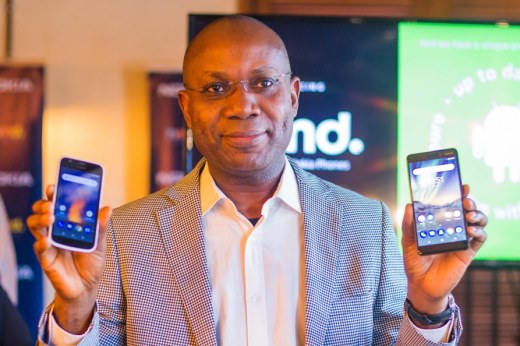
Joseph Umunakwe is the General Manager, HMD Global: West, East and Central Africa. He spoke to chike Onwuegbuchi about HMD Global’s commitment to building on its heritage and delivering trusted and secure Nokia smartphones that are built to last, in 2021 and beyond.

How did HMD Global deal with the effects of the pandemic, the quietness and the launch of its new products?
2020 did change the entire global business operating landscape and shifted mind-sets on ways of working. We are proud of the team at HMD Global – we came together and pulled through an extremely challenging year. Now, we are stronger than ever.
In 2020, we were the first brand to launch a truly universal 5G device capable of global roaming and optimized for the future. In a world that is now more dependent on virtual, seamless, always-on connection, the ability to connect from anywhere has become vital to so many Consumers.
Nokia smartphones led the Counterpoint Research 2020 trust rankings based on the four pillars of software, security updates, build quality, and devices recommended for enterprises for the second year running.

In August 2020, as an affirmation of their trust in us, our partners – this includes Google, Qualcomm and Nokia – invested 230 million in our business.
Despite the challenges of an extremely difficult year, we were able to strengthen our position and commitment to delivering trusted devices that are secure and built to last, across our range of Feature phones and Smartphones.
Improving Nokia brand market share and visibility in Nigeria
Nokia Mobile is well known in the Nigerian market. Our Finnish heritage of quality, durability and trust continues to resonate with our fans. We believe that mobile technology can enhance the lives of consumers everywhere and we continue to focus on bringing the best innovation that will usher in digital inclusiveness in Nigeria and other markets in our region.
We give consumers reason to choose us by focusing on eliminating their pain-points, offering premium experiences at affordable price-points and lowering the cost of ownership. Consumer experience is at the heart of our strategy. We innovate for the benefit of the consumer.
For example, we are expanding our affordable 4G smartphone range and working hard to ensure our fans get top specifications at the right price point because 4G is the new baseline, leaving users of 2G and 3G more vulnerable to uncertainty.
Uniqueness of Nokia mobile devices from other smartphone brands in Nigeria
Simply put, Nokia devices are trusted, secure and built to last. The durability and reliability that you remember from Nokia phones in the past is still the core of our promise today. Your Nokia phone stays with you for longer.
Each Nokia smartphone receives three years of monthly security updates and two years of software upgrades. In addition, we offer our standard one-year product warranty thereby giving peace of mind to our fans.
Our devices have a purposeful Nordic design characterized by functionality. With our signature two-day battery life, the latest Android operating software – we recently released Android 11 on our Nokia 8.3 5G, our customers can unleash their creative instincts and stay connected to what matters most to them.
In fact, in October 2020, Counterpoint Research revealed that Nokia phones led the trust rankings based on the four pillars of software, security updates, build quality, and devices recommended for enterprises for the second year in a row.
We deliver the fastest and most regular software and security updates among Android devices. We have released over 1000-plus software updates in the past four years to ensure phones are updated longer than the industry average.
Engagement with dealers some of whom also market other phone brands
We are a company built on a unique partnership model. Our dealers are our partners and partnership is very important to us. They are an extension of our promise to enhance the lives of our consumers.
As a result, we place a priority on building close relationships with each of them, working to understand their businesses. Our market representatives are almost constant fixtures at their stores, seeking to understand and clarify their needs.
It comes back to our values of trust and building on our heritage of reliability. Nokia is a brand people already trust. We intend to maintain that across the spectrum, whether with our partners or our fans.
Support to dealers with the required advertisement and promotions, considering the possible conflict of interest that would exist
We take the responsibility of supporting our partners seriously. Our various marketing and communication activities are aimed at creating awareness and driving foot traffic to our local partner stores.
We support our dealers through our communications activities, including them where necessary in our promotion content and signposting them. Our priority is to develop and build win-win relationships that will stand the test of time. As mentioned earlier, trust is an important value for us as a business.
As our fans trust us to deliver quality devices, we trust our partners to deliver our promise to the last mile consumer anywhere they may be. For example, during the Covid-19 pandemic and the attendant lockdowns, we stayed close to our channel partners and continued to deliver much needed products to both people on the frontlines and our consumers.
What Nigerian consumers should expect from Nokia mobile this year
Our focus on enhancing the lives of our consumers remains core to our business. Therefore, we will continue to deliver on our strategic pillars in both 5G, and affordable 4G.
We want to make mobile technology accessible to Nigerians. Our fans in Nigeria can certainly expect to see affordable smartphones with premium features that provide them with innovative experiences.
We will continue to innovate across multiple platforms and business segments to deliver value to our fans both in Nigeria and elsewhere.


Dimension Data has said that the proceeds from its Series 1 corporate bond, will support the expansion of the company’s fibre infrastructure to meet Nigeria’s growing demand for digital connectivity.

This followed the successful subscription of the corporate bond.
Recall that Dimension Data Limited said that it has completed the signing ceremony for the issuance of N4.05 billion (approximately US$2.9 million).
This sum marks the first tranche of a N20 billion (US$14.7 million) bond programme announced earlier this year.
The bond programme was raised under Dimension Data SPV Funding Plc, following approval from the Securities and Exchange Commission (SEC) of Nigeria.
The company says the proceeds will support the expansion of the company’s fibre infrastructure to meet Nigeria’s growing demand for digital connectivity.
Speaking at the ceremony, Olugbenga Olabiyi, managing director of Dimension Data Limited, said the investment reflects the company’s long-term commitment to strengthening Nigeria’s digital economy.
The planned investments will fund the continued expansion of Dimension Data’s fibre network, supporting increasing demand from financial institutions, fintechs, enterprise customers and other technology-driven sectors.
Founded in 1983 and headquartered in Johannesburg, the company has grown its footprint across the Middle East and Africa.
Today Dimension Data is a member of the NTT Ltd Group, one of the world’s leading technology companies.
As cloud adoption, digital financial services and data-intensive applications continue to grow, the company believes resilient fibre infrastructure will remain a critical enabler of Nigeria’s digital economy.

The Federal Government has announced that work will commence within weeks on a 90,000-kilometre fibre optic network expected to connect every state, local government area and ward in Nigeria, marking what officials describe as one of the country’s most ambitious digital infrastructure projects.

Dr Bosun Tijani, Minister of Communications, Innovation and Digital Economy, disclosed this on Tuesday after briefing President Bola Tinubu at the State House, Abuja, on the progress of three flagship digital transformation initiatives being implemented by his ministry.
According to the minister, all resource mobilisation and contractual processes for the nationwide fibre project have been completed, paving the way for physical deployment.
“We’re now at the point where, in a few weeks’ time, we should start to lay those fibre, so people will start seeing us around the country deploying the fibre. This is going to transform Nigeria for good,” Tijani said.
He explained that the project would deliver fibre optic infrastructure to every geopolitical zone, state, local government area and ward, significantly expanding broadband access and improving the quality of internet connectivity across the country.
“This is a project where every state, every geopolitical zone, every local government and every ward in this country will be covered with fibre optic cables, which will transform the quality of connectivity,” he added.
Bosun Tijani attributed the progress in the digital economy to a series of reforms approved by President Tinubu, including the designation of digital infrastructure as Critical National Infrastructure, tariff adjustments and tax harmonisation measures sought by industry operators.
“I think our sector has been extremely fortunate. Mr. President has given us quite a number of things that the sector has been demanding for a long time. Whether it’s the Critical National Infrastructure designation for all digital infrastructure, the slight adjustment in tariff, or the tax harmonisation, these are reforms the industry has long requested.
“I think it’s probably the sector that is most appreciative of this government because when we came in, the sector was contributing between 16 and 18 per cent to our GDP, but today it is tracking close to 21 per cent. That represents significant growth,” he said.
The minister noted that the reforms had also improved the financial performance of major operators in the telecommunications sector.
On efforts to bridge the digital divide, Tijani disclosed that the government would begin deploying about 3,700 telecommunications towers from October to provide network coverage for more than 20 million Nigerians currently living in underserved communities without access to telecom services.
He said the President had approved the project after months of capital mobilisation and planning.
“Today we’re at a point where, before the end of the year, we’ll also start to deploy close to 3,700 towers. It’s taken a lot to put this project together and raise the required capital, but we are now ready to begin deployment around October,” he said.
The minister also announced that Nigeria would officially launch an alphanumeric postcode system on October 1, a move he said would place the country among a select group of nations operating an advanced digital addressing system.
“Nigeria will be amongst maybe 10 or 15 countries in the world with an alphanumeric postcode. It’s the latest design in postcode systems, where we can identify every property in this country. We’re hoping to launch that on the 1st of October,” he said.
Tijani explained that the new system would assign a unique address to every property nationwide, enhancing logistics, accelerating e-commerce, improving emergency response and strengthening public service delivery.
“Inability to locate places comes at a cost. You can imagine what this will do for e-commerce. It means goods can now be delivered in record time,” he said.
He added that integrating the postcode system with existing government identity databases would improve security and make public services more efficient.
“Our alphanumeric postcode is unique because it allows us to assign a unique address to every property. In many countries, such as the UK, postcodes cover clusters of buildings. What we are introducing will uniquely identify every building, and that will be a game changer for Nigeria in terms of security, commerce and public service delivery,” the minister stated.

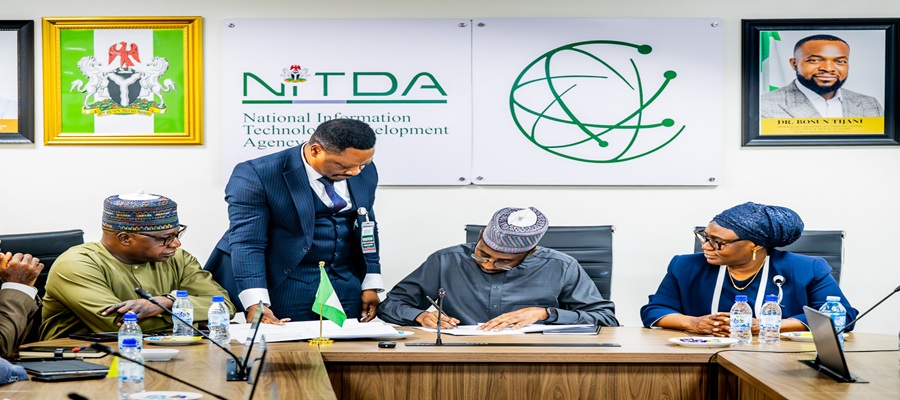
In a bold move to strengthen Nigeria’s digital sovereignty and the digital economy, the National Information Technology Development Agency (NITDA) has formally unveiled the National Sovereignty Cloud Initiative (NSCI) Regulatory Instruments, thereby setting a new benchmark for the country’s digital future.

NITDA
The NSCI is a strategic programme of the federal government coordinated by NITDA. It is designed to bolster Nigeria’s digital sovereignty and accelerate the country’s adoption of reliable cloud infrastructure. The initiative consists of the National Computing Guideline, the National Cloud Technical Guideline, the National Digital Infrastructure Assurance Framework, and the National Cloud Investment Strategy.
Speaking during the ceremony in Abuja, the Director General, Kashifu Inuwa Abdullahi CCIE, described the NSCI as a strategic move to safeguard Nigeria’s digital future. He noted that the instruments will stimulate innovation, encourage investment in local cloud services, and enhance digital resilience.
“These instruments provide the regulatory certainty, technical standards, and assurance framework required to build a trusted cloud ecosystem that safeguards Nigeria’s digital sovereignty while creating new opportunities for investment, innovation, and sustainable economic growth.
“We should position ourselves not to serve Nigeria alone, but to serve West and Central Africa. Nigeria is already the digital gateway to West Africa and can extend to every part of Africa. But we can only realise that goal when we build our infrastructure. So, today’s event is the first step in that direction,” he stated.
Abdullahi appreciated the support of relevant stakeholders and the efforts of the NSCI Technical Working Group, which culminated in the successful development of the regulatory instruments. He emphasised that collective action of regulatory agencies is necessary for a seamless implementation of the initiative.
Speaking earlier, the Permanent Secretary of the Ministry of Communications, Innovation, and Digital Economy, Engr. Nadungu Gagare, declared that the launch of the NSCI underscores the federal government’s commitment to safeguarding Nigeria’s data borders and digital economy.
“By ensuring that government data remains strictly within national jurisdiction and under local operational control, we are guaranteeing data sovereignty and regulatory compliance. It will catalyse local cloud capacity, foster local job creation, and empower indigenous investors and innovators to build solutions on a secure, locally hosted foundation,” Gagare said.
The Permanent Secretary commended the management team of NITDA, the NSCI Technical Working Group, and other stakeholders for their collaborative spirit in driving the initiative. He promised that the Ministry would ensure that the strategic objectives of the NSCI are fully realised across all ministries, departments, and agencies.
In a message, the Governor of the Central Bank of Nigeria (CBN), Dr Olayemi Cardoso, congratulated NITDA for promoting a collaborative approach, adding that modern digital regulation succeeds through coordinated regulatory actions for common national objectives.
Cardoso, who was represented by Dr. Rakiya Opemi Yusuf, the Director of the Payment System Supervision Department, acknowledged that the launch testifies to the robust collaboration existing between the apex bank and other government institutions.
“CBN regulates the financial ecosystem. NITDA provides the national framework for digital infrastructure, cloud governance and assurance. These responsibilities are complementary, not competing. Together, they create a coherent national architecture.
“Together with NITDA, and with the continued cooperation of industry, we will continue to build an ecosystem that protects Nigeria’s financial system today and positions our nation as Africa’s trusted hub for digital finance and cloud innovation.
One of the most encouraging aspects of today’s event is the strong institutional collaboration between NITDA, the CBN, and other relevant government institutions. This collaboration demonstrates an important principle.”
Cardoso reiterated that as a responsive regulator, the CBN remains committed to providing clear expectations, firm principles, proportionate implementation, and constructive engagement with all stakeholders to position Nigeria as Africa’s trusted hub for digital finance and cloud innovation.
Also, the Managing Director/CEO of Galaxy Backbone Limited, Prof. Ibrahim Adeyanju, noted that the NSCI couldn’t have come at a better time than now, especially considering CBN’s recent directive mandating banks and financial institutions to localise their data.
Adeyanju expressed confidence that the initiative would push the ecosystem to greater heights by encouraging investment, developing indigenous talent, and creating employment opportunities akin to the gains brought by the deregulation of the telecoms sector.
NITDA will constitute the Sovereign Cloud Governance Committee (SovGov) within the next two weeks to oversee the implementation of the NSCI. The committee would comprise representatives from relevant Government institutions, sector regulators, industry, and the private sector, with NITDA serving as the Secretariat

Dimension Data to Channel Funds to Support Nigerian Fibre Expansion

FG Commences 90,000km Fibre Optic Rollout within Weeks

Kaspersky Reveals a New Malicious Framework Targeting Cryptocurrency Users with the Use of OkoSpyware

Nigeria CommunicationsWeek Retracts Story on Pan African Towers Litigation

PalmPay Targets Hong Kong IPO after $1Bn Valuation

NRC, Ponzi Scheme Collapses Resulting Loss of Billions of Naira

From Scarcity to Scale: What Africa Can Learn from India’s Agricultural Transformation

EFCC Busts NIS Visa Overstay Racket, Uncovers N700m in an Account

BON Establishes Six Ad Hoc Committees to Modernize Broadcasting

NELFUND Investigates 34 Universities Over Students’ Missing Tuition Refunds




 News2 days ago
Atte, Nigerian Develops AI Algorithm for Hair Transplants

 News2 days ago
FG to Abolish Subsidies in Power Sector in 2027 – Minister

 E-Financial2 days ago
FCT Court Awards Ex-Customers N15m against Stanbic IBTC over Data Privacy Breach

 E-Financial2 days ago
CBN Exposes over 13,000 BVNs Tied to Fraud as Banks Tighten Security

 Telecom2 days ago
Starbase Technologies Introduces Yolly, a Reward-Based Social Entertainment Platform

 General News2 days ago
Dare Tackles Onaiyekan over Criticism of Tinubu, Says Economic is Working

 General News2 days ago
SERAP Asks Tinubu to Probe Alleged N6.79Bn Missing Police Funds, Firearms

 E-Business1 day ago
Kaspersky Identifies Cyberespionage as a Growing Threat Across Africa, Others