

General News
e-Payment Increases Efficiency of Port Operations


The result of e-payment system introduced by the Nigerian Ports Authority recently is now manifesting positively according to report releases by the Nigeria Port Authority (NPA).
An International Trade Monitor report shows that cargo throughout from 1,327 vessels during the first quarter of the year stood at 19,659,946 million metric tonnes, an increase of 14 per cent over 17,245,923 metric tones of the entire 2013.
The breakdown of cargo throughout at the ports within the period showed that general cargo, containerised cargo inclusive, contributed 32.2 per cent to cargo throughout at 6,324,366 metric tonnes, indicating a slight increases of 1.4 percent over 6,234,814 metric tonnes recorded in the corresponding period of 2013.
Also, Dry Bulk Cargo stood at 2,302,609 metric tonnes as against 1,971,015 metric tonnes achieved in 2013, contributing 11.7 per cent to cargo throughout.
Liquefied Natural Gas (LNG) shipment accounted for 27.4 per cent of cargo throughput at 5,389,137 metric tonnes compared with 3,748,437 metric tonnes in 1st Quarter of 2013, showing an increase of 43.8 per cent.

Refined Petroleum products stood at 4,613,567 metric tonnes. It also contributed 23.5 per cent to cargo throughout.
Container traffic, including empty containers, amounted to 426,976 TEUs, showing a growth of 15.1 per cent over the 2013 figure of 371,085TEUs.
A total of 78,754 units of vehicles were handled during the period under review. It indicated an increase of 32.1 per cent over the same period of 2013 figure of 59,608 units.
During the period under review, , a total of 1,327 oceans going vessels with a total Gross Registered Tonnage (GRT) of 33,940,386 called at Nigerian Ports, compared with 1,172 vessels with the GRT of 28,830,386 in 2013.
Within the same period, the Lagos Port Complex (LPC) recorded a Gross Registered Tonnage of 8, 472,229, showing an increase of 5 per cent over 8,307,011 gross tons achieved in 2013. A total of 364 vessels were handled in the period under review as against 357 vessels in 2013.
Tin can Island Port recorded a Gross registered tonnage of 11,220,946, indicating an increase of 28.3 per cent over 8,742,953 gross tons recorded in the corresponding period of 2013. A of 435 ocean going vessels were handled within the period.
Calabar Port complex recorded a total GRT of 800,578, a rise of 33 per cent over 614,150 gross tons of 2013, leaving the port with 65 Ocean going vessels in the period under review.
Rivers Port complex recorded a total Gross registered tonnage of 1,262,899, while Onne Port complex recorded a GRT of 10,092,281 reflecting an increase of 18.3 per cent over 8,529,225 gross tons recorded in the corresponding period of 2013 with 181 vessels handled within the period.
The Delta Port Complex recorded 2,091,453 gross tons, showing an increase of 163 per cent over the 2013 figure of 794,877 gross tons, with 151 vessels handled.
The positive variance in port operations during first quarter of this year over that of last year could be the result of the implementation of E-payment in January 2014 which has reduced turnaround time of vessels from 5.3 days to 4.6 days within the period under review.
Also significant increase in LNG shipment re-sulting from the European economic recovery efforts after the debt crises contributed remarkably to the increase in cargo traffic.
MaritimeFirst Newspaper also quoted Mallam Habib Abdullahi, managing director of Nigerian Ports Authority (NPA), while receiving Mr. Diru Verheyen, Belgium Ambassador to Nigeria, recently, said that the successful Port reforms programme embarked upon by the Federal government some years ago has resulted in the improved operational activities.
Besides, it opened many investment opportunities for investors and urged prospective investors to explore areas in the Port industry to invest in.
Abdullahi said that the Authority will continue to focus on research based policies and measures that will ensure uninterrupted 24 hour port operations, fast tracking automation of port operations, continuous dredging and removal of critical wrecks along the channels to guarantee conducive business environment needed to actualize its vision to be the leading port in Africa.



Central Bank of Nigeria (CBN) has yet to publish its annual financial statements beyond the 2022 financial year, despite legal provisions requiring the apex bank to release its audited accounts annually.

An annual report is a comprehensive report on a company’s activities throughout the preceding year.
Annual reports are intended to give shareholders and other interested people information about the company’s activities and financial performance.
The most recent annual report and financial statements of the CBN available to the public remain those for the 2022 financial year.
Under Section 50 of the Central Bank of Nigeria (CBN) Act, the bank is required to prepare, submit and publish its audited annual financial statements.
Section 50(1) stipulates that the CBN must transmit its annual accounts, certified by an external auditor, to the President and the National Assembly within two months after the end of each financial year.
Section 50(2) further provides that the annual report submitted to the President and the National Assembly should be published in a manner determined by the CBN Governor, while Section 50(3) mandates the CBN Board to ensure the accounts are published in the Federal Government Gazette as soon as possible.
Despite these statutory requirements, the apex bank has not made public any annual financial statements after the 2022 reporting year.
The development comes after the CBN, on August 11, 2023, released its consolidated financial statements covering seven years the first such publication since 2015.
President Bola Tinubu appointed Olayemi Cardoso as Governor of the CBN on September 15, 2023, following the removal of former Governor Godwin Emefiele in June of the same year.
Emefiele is currently facing trial over alleged corruption-related offences.
Last week, the Supreme Court ordered the final forfeiture of several of Emefiele’s properties, along with $2.045 million in cash.

Dangote Petroleum Refinery and Petrochemicals has successfully completed a landmark US$2.5 billion private equity placement, in what is believed to be Africa’s largest publicly disclosed primary equity private placement by value.

This marks a major milestone in the company’s long-term expansion strategy.
In a statement issued on Thursday, the company said the offering was 3.7 times oversubscribed relative to its initial offer size, reflecting strong investor confidence in the refinery’s growth prospects and resulting in the issuance and allotment of approximately US$2.5 billion in new equity.
The fundraising follows the recent equity capital raise in which existing investors expanded their holdings alongside new institutional investors, strengthening the refinery’s capital base to support its next phase of growth.
According to the company, proceeds from the private placement will finance the continued expansion of its refining and petrochemical operations, reinforce its capital structure and enhance financial flexibility for future investments.
The transaction attracted broad participation from international and African institutional investors, sovereign-related investment vehicles, development finance institutions and long-term strategic partners.
Among the key investors were the Africa Finance Corporation (AFC) and India Infra Buildco, an investment vehicle facilitated by the African Export-Import Bank (Afreximbank). The offering also drew participation from a diverse mix of institutional and individual investors, underscoring strong market confidence in the refinery’s long-term strategy.
Chairman of Dangote Petroleum Refinery and Petrochemicals, Aliko Dangote, described the successful capital raise as a strategic move to deepen and institutionalise the company’s shareholder base while complementing internal cash flows and external financing.
“This further demonstrates our profound commitment to developing domestic refining and petrochemical capacity, reducing Africa’s reliance on imported refined products and strengthening the continent’s energy security,” Dangote said.
Managing Director and Chief Executive Officer of the refinery, David Bird, attributed the strong investor response to the company’s operational performance and leadership.
“The exceptional demand we saw is a testament to our operational excellence, execution capacity, and investor confidence in DPRP’s leadership,” he said.
Following the completion of the transaction, the company said it is well positioned to continue executing its long-term growth strategy by expanding world-class refining and petrochemical capacity while strengthening Africa’s energy security.

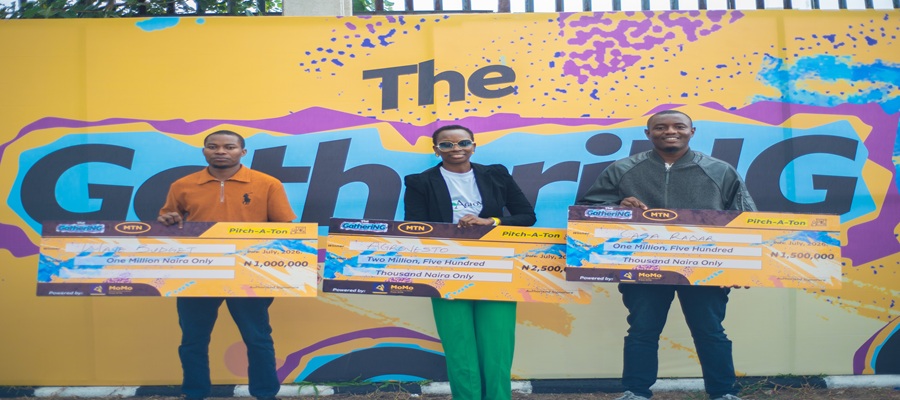
Once again, The Gathering on 100 Pitchathon has rewarded some of Nigeria’s most promising young entrepreneurs, with three startups sharing ₦5 million in funding.

Pitchathon
The pitchathon took place at the Abuja edition of the Gathering on 100 held between July 18 and 19, at This Day Dome, Central Business District, Abuja.
The competition brought together founders from different sectors to pitch their businesses before a panel of judges.
The Pitchathon remains one of the most sought after experiences at The Gathering on 100, an MTN Nigeria initiative that connects young Nigerians with opportunities for entrepreneurship, innovation and personal development.
Omolola Rebecca, founder of Agrovest, emerged overall winner, receiving ₦2.5 million for her agritech solution, which provides funding for farmers to improve access to capital and boost agricultural productivity.
Reacting to her victory, Rebecca said the recognition would give her business greater visibility and open doors to more investors. “Winning this competition means more people will notice what we’re building.
“It puts Agrovest in front of potential investors and partners, and gives us the opportunity to grow our impact by supporting even more farmers,” she said.
The second prize of ₦1.5 million went to Agbo Obinnaya, founder of Case Radar, a legal technology platform that uses generative artificial intelligence to simplify access to legal services in Nigeria.
The platform enables users to obtain legal guidance, understand legal documents and connect with legal professionals through a single digital platform.
Abdulmuiz Adam secured third place and ₦1 million with WaveBudget, a fintech platform that combines savings and responsible financing.
The platform allows users to save towards financial goals, access buy now, pay later services through partner merchants with a 50 per cent down payment, and manage their savings in one place.
Presenting the prizes to the winners, Lanre Coker, Manager, Customer Acquisition and Compliance, North-West, MTN Nigeria, said the initiative reflects MTN’s commitment to supporting young Nigerians with the resources they need to grow their ideas into sustainable businesses.
“The Gathering on 100 is about helping young Nigerians achieve the height of their endeavours, whatever they may be.
“We know there are brilliant ideas across the country, and through initiatives like the Gathering on 100, we are creating opportunities for innovators to access funding and the confidence to keep building,” he said.
The Abuja edition builds on the success of previous Pitchathons held during The Gathering on 100 across the country.
In Lagos, eight startups received a combined ₦45 million in funding, while three startups shared ₦5 million at the Aba, Enugu, and Kano editions. With the Abuja winners now joining the growing list of recipients, the Pitchathon continues to position itself as a platform for discovering and supporting the next generation of Nigerian entrepreneurs.

Senate Moves to Compel Social Media Companies to Open Offices in Nigeria

Nigeria Leads Africa in Online Gambling Regulation – GCI

CBN Has Not Published Annual Financial Statements Since 2022 despite Legal Requirement

ChatPay Unveils Public Waitlist for WhatsApp-Based Banking Platform

GSMA Says High Smartphone Costs Threatens Africa’s AI Future

NRC, Ponzi Scheme Collapses Resulting Loss of Billions of Naira

NASENI Moves to Digitize CCB’s 5m Assets Declaration and Operations

Tokenization, Blockchain Technology will Transform Financial Institutions – IMF

EFCC Busts NIS Visa Overstay Racket, Uncovers N700m in an Account

From Scarcity to Scale: What Africa Can Learn from India’s Agricultural Transformation




 General News3 days ago
FG Launches C.L.I.C.K.D., Consumer Credit Scheme for Tech Devices

 Telecom3 days ago
Airtel Nigeria Expands Retail Footprint to Strengthen Customer Access Nationwide

 News3 days ago
NPC Opens Nationwide Digital Birth, Death Registration Platform

 Telecom3 days ago
MTN Nigeria Opens Applications for Next Afrobeats Star Season 2 with Bigger Prizes

 Telecom3 days ago
Kaspersky Survey Highlights the Need for Smartphone Security

 E-Business3 days ago
Ovaloop Technologies Unveils Digital Tools to Formalize SMEs Operations Across Africa

 E-Financial3 days ago
CBN Retains Interest Rate at 26.5% as Cardoso Cites Global Uncertainty Despite Inflation Drop

 Telecom2 days ago
Court Dismisses Pan African Towers’ Bid to Halt Ex-CEO’s Suit, Awards ₦500,000 Costs