

Telecom
eBusiness Life Girls In ICT: Stakeholders Call For More Action On Girls Participation In ICT

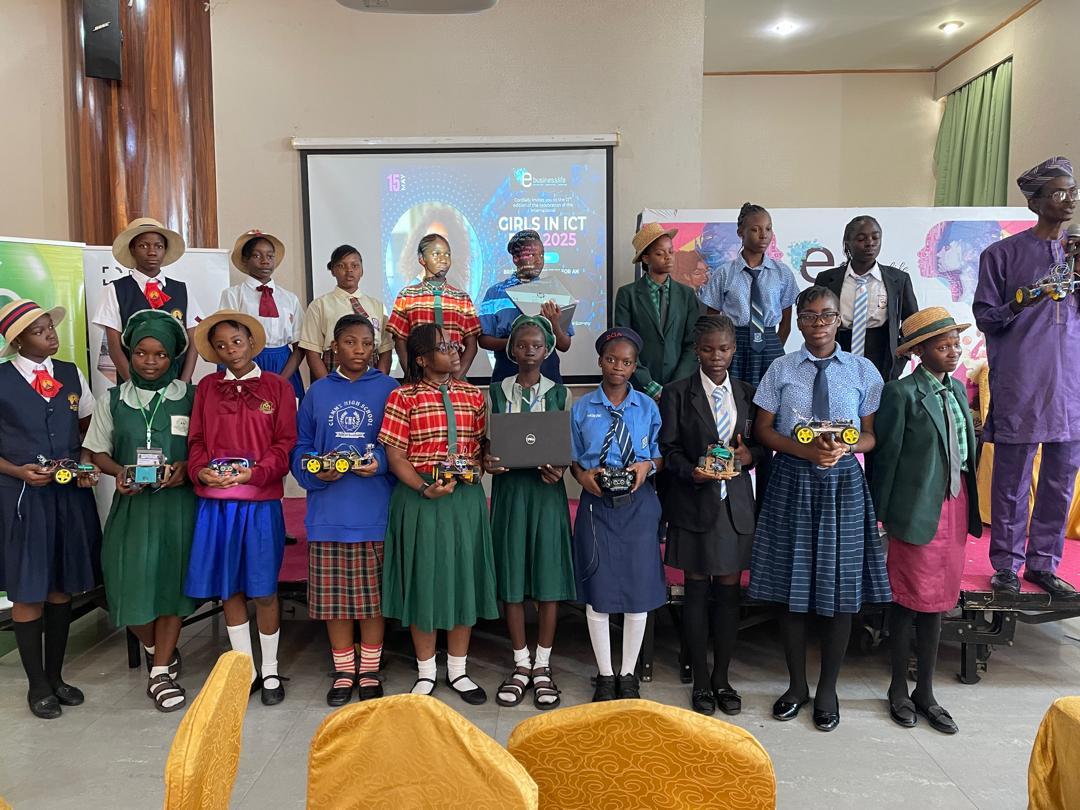
After 13 years of organizing the Girls in ICT Day celebration, a campaign that seeks to mentor young girls to develop interest in STEM (Science, Technology, Engineering and Mathematics); and seek careers in information and Communications Technology (ICT), stakeholders that gathered for the 13th edition which recently held in Lagos, has applauded the successes recorded in Nigeria.

The stakeholders, who also noted that more work need to be put in, further disclosed the need to have young girls ascribing for roles in ICT as a means of guarding their future and contributing to the growth of all sectors in the economy.
Speaking in her opening remark, Convener and CEO of eBusiness Life Communication Limited, organisers of the campaign, which had girls from 10 different schools in and around Lagos State and corporates from the ICT industry in attendance, Mrs. Ufuoma Emuophedaro noted that calls and letters from participating students from past editions of the event are testaments to the impact the campaign is having on Nigerian girls.
“From this very platform, we have been able to raise a lot of girls. Some of them are already working. I have received a good number of mails from them thanking me for how that helped them change their perceptions, and they are now studying ICT-related causes. The numbers are getting better and it will continue to get better. We will continue to do this campaign to see it getting better,” Mrs. Daro disclosed.
“We cannot gather all the girls in Nigeria in one room, but there is a need to spread the news, even as we are streaming this activity live on YouTube and Instagram.”
Reeling out the figures, she quoted an ITU statistics that showed the progress made, disclosing that since its inception in 2011, there has been 377,000 girls and young women taking up careers in ICT and 11,400 celebrations in over 171 countries. It is not just in Nigeria, but all over the world.
While encouraging the girls to change the stereotype that bequeaths ICT careers to boys, she noted the abysmal statistics that need to change. “While women make up about 47% of the global workforce, they are underrepresented in STEM. Just 3% of students joining ICT courses globally are women.”
This year, the theme, ‘Girls in ICTs: Bridging ALL Divides for an Inclusive Digital Transformation’, underscores the need not just to participate, but to lead the world in digital transformation.
Mrs. Emuophedaro called on corporate bodies, governments and other stakeholders to create a conducive environment and an inclusive tech space for girls everywhere.
She also charged the girls to believe in themselves and take up the challenge.
“Do girls use technology? Yes! But that is not all we want. Apart from using, we want them to create technology. Also no matter what sector you are in, you need to have some in-depth knowledge of technology. “
In her global message Secretary General of the International Telecommunications Union (ITU), Doreen Bogdan-Martin noted that ITU is committed to empowering 100 million girls with digital stills and called on partnerships to achieve this.
She stated: “We celebrate the power and potentials of girls and young women as leaders, creators and change-makers in the digital age. 189 fewer women than men are using the internet in 2024. That is too many missed opportunities to learn.”
She encouraged governments and corporate organisations to support the campaign to build a crop of girls of the future.
Also speaking at the event, Vertical Head, High Net-worth Individuals, Globacom, Adeboye Adeniji, noted that Globacom that believes in the power of Nigeria’s talents, especially the amazing potentials in young, vibrant, brilliant and beautiful girls.
“We live in a world powered by technology, from the phones we use, to the Apps we love, to the networks that connect us, for example, Globacom. ICT is everywhere. You belong in that world, you are the future, not just as users, but as leaders, creators and innovators,” she encouraged the girls.
She further noted that when girls have the tools, the training and the confidence, there is no limit to what they can achieve. “Whether you dream of becoming a Software Engineer, a Robotic Expert, a cyber-security Analyst, or even the next big tech CEO, everything is possible. Don’t let anyone tell you tech is only for boys. That is simply not true.
You are smart and smart enough to work in tech, to build your own tech company. You are strong enough, and you have every right to dream as big as you want. So, keep learning, stay curious, ask questions, and never be afraid to try. Because the future of technology isn’t just built in Labs and Boardrooms, it is being built here in classrooms like yours. From all of us in Globacom, we believe in you, we support you, and we can’t wait to see how you change the world.”
In her presentation, Head, Cybersecurity & Compliance Advisory, Digital Encode, Bisola Oladejo, encouraged the girls to stay on top of any career path they may choose, and to research the available options in the field of ICT, as there are so many career paths in ICT.
Speaking on why girls matter in ICT, she said they bring uniqueness and colour, making Apps interesting.
She also noted that ICT is important to girls because it affords and empowers them with skills, opportunities and confidence to thrive in a digital world, breaking gender barriers and unlocking social and economic potentials.
Oladejo however noted the root causes of low female participation in ICT to include, limited STEM education in schools; social media distraction; low funding, lack of adequate access to internet and ICT gadgets; gender bias from families; cyber-bullying, among others.
She called on governments to formulate deliberate initiatives that target female inclusivity in ICT, and to partner with NGOs and ease private sector initiatives.
The event saw the girls compete in STEM Quiz competition, Robot programming competition and Students’ Roundtable, winning prices and receiving gifts from the organisers.
Also, Awards were also giving to two deserving women in ICT – Funmilola Victoria Omojola (ICT Touch Holder Award) and Dr. Nihinlola Mary Fafore (ICT Advocacy Award).
The International Girls in ICT Day is an initiative of the International Telecommunications Union (ITU) that seeks to bridge the gender divide in ICT related careers by encouraging girls to build a foundation that will position them in tech-related jobs of the future.



National Agency for Science and Engineering Infrastructure (NASENI) has announced the launch of an Inter-Agency Innovation Competition and Awards to stimulate creativity and technological advancement among Ministries, Departments and Agencies (MDAs) of the Federal Government.

NASENI
In a statement issued on Wednesday in Abuja, NASENI said the initiative was designed to harness innovative ideas from public servants that can drive indigenous industrialization, job creation and national progress.
According to the agency, the competition will provide a platform for MDAs to propose solutions in critical sectors such as health, agriculture, education and infrastructure, leveraging science and technology to improve public service delivery and enhance the quality of life for Nigerians.
“The competition seeks to promote collaboration and creativity among MDAs while addressing pressing national challenges through innovation,” the statement said.
NASENI urged interested MDAs to submit their entries through its innovation portal at naseni.gov.ng/innovation.
The agency reiterated its statutory mission “to develop and maintain a dynamic infrastructure to drive Nigeria’s indigenous industrialization, job creation and national progress,” adding that the competition would further strengthen efforts to unlock the nation’s potential through science and technology.


Users of satellite internet service provider Starlink in Nigeria are being required to complete a biometric Know Your Customer (KYC) process as a precondition to continue enjoying their services, according to .biometricupdate.

According to local reports, more than 66,000 Starlink subscribers in the country had a December 31 ultimatum from the Nigerian Communications Commission (NCC) to complete the biometric verification or have their connection discontinued.
The process essentially entails linking a Starlkink account with the subscriber’s national digital ID.
The NCC, which is Nigeria’s telecoms industry regulator, is said to have first issued the directive in August last year, setting a three-month deadline which was to elapse on November 19, TechCabal reports.
The body however later extended it to December 31 after consultations with industry stakeholders. The internet account-NIN linkage, the NCC said, is to enhance identity verification and strengthen security within the country’s telecoms space.
Just a few days to the December 31 deadline, Starlink’s Nigeria office sent an email to its subscribers reminding them of the KYC requirement, and warned that all those who fail to comply would be disconnected.
And that once disconnected, reconnection would depend on network capacity in the concerned area.
The service provider said in its email that the process takes less than two minutes and users can complete it by logging in to their account via an app.
One user, quoted by TechCabal, said one needs to upload their selfie biometrics, provide their national identification number (NIN) and then give their consent for the account to be linked to their ID information.
Starlink’s internet service is present in about 155 countries with nine million users, as of 2025. Its growth in Nigeria is said to be rapid, making it the second largest internet service provider in the country, according to The Traffic.
Biometric identification for Starlink subscribers could become a continent-wide trend given that some countries have expressed reservations in opening up their internet space to the company over security concerns.
There’ve been fears that jihadists in countries like Mali and Nigeria may have exploited Starlink terminals to coordinate terror operations, and cybersecurity experts have also warned of risks related to weak regulation, digital sovereignty and data breaches.
The requirement for Starlink internet users to have their accounts linked with the NIN is similar to the SIM-NIN linkage policy which the Nigerian government battled to implement for many years, with many deadline extensions.
In October last year, the NCC, which is was at the forefront of the policy implementation, announced that all active SIM cards across all network providers had complied with the directive which was issued in 2020.
The idea, the federal government argued, was to strengthen security and curb criminality such as kidnappings which are aided and abetted by improperly identified mobile phone numbers.

Mr. Kashifu Inuwa, Director General of the National Information Technology Development Agency (NITDA), has urged Northern Nigeria to pivot urgently from traditional commerce to an innovation-driven digital economy for sustainable growth.

NITDA
Inuwa issued the call at the Future Map Foundation Roundtable 1.0 (North-West Edition) in Kano, attributing the region’s sluggish digital adoption not to talent deficits but to the lack of deliberate, coordinated strategies.
He stressed deeper collaboration across academia, private sector players, entrepreneurs, and government, positioning the private sector as the primary innovation engine while government supplies robust policies and an enabling ecosystem.
Inuwa advocated for people-focused, locally tailored innovations that tackle regional challenges head-on, enabling global competitiveness by transitioning from mere technology users to creators of homegrown solutions.
The roundtable convened policymakers, tech founders, and ecosystem stakeholders to forge a comprehensive roadmap for North-West digital transformation, yielding firm commitments to bolster regional innovation policies and public-private synergies.
Inuwa’s push dovetails seamlessly with the Federal Government’s Renewed Hope Agenda, which sets an ambitious target of 95 per cent nationwide digital literacy by 2030, fostering inclusive economic empowerment.
Participants hailed the forum as a pivotal step toward unlocking Northern Nigeria’s tech potential, with NITDA poised to lead implementation through strategic interventions and partnerships.

Fidelity Bank Completes N500Bn Capital Raise ahead of Deadline

PalmPay Deepens Its Long-Term Commitment in Nigeria with New Office @ Yaba

Kaspersky Shares AI Cybersecurity Predictions for 2026

Youth Talent Takes Center Stage as T2 Ignites High-Octane Rap Battles @ Carnival Calabar

Nigerians with Albinism Reject Pity, Demand Dignity at Empowerment Forum

Banks quietly move to enforce new ₦50 transfer levy from Jan. 1

FIRS says NIN, CAC Numbers to Serve as Tax IDs from 2026

Financial Sector Faced AI, Blockchain and Organised Crime Threats in 2025 – Report

PalmPay Launches N400 Million World Travel Carnival, Rewarding Users with Free Global Trips

Check Point Reveals Nigeria as Second Most Targeted African Country for Cyberattacks in November




 News3 days ago
Court Sends Faleti, Ex-Lagos Director to Jail for Stealing ₦48.9m from Access Bank

 E-Financial3 days ago
Remita Powers over ₦100 Trillion in Payments as Nigeria’s Digital Economy Expands

 E-Financial3 days ago
Why 2026 Must Be the Year Nigeria’s Economy Works for All

 E-Financial3 days ago
Flutterwave Acquires Nigeria’s Mono in $25m-$40m All-Stock Deal

 E-Financial3 days ago
2026: SEC to Review Rules to Incentivise SME Listings

 General News3 days ago
Nigeria Targets Satellite-to-Mobile Services in Draft Spectrum Roadmap

 Telecom3 days ago
Samsung Plans to Double AI Mobile Devices to 800 million Units this Year

 Telecom3 days ago
MENXTT NG to pre-install Bitdefender Antivirus on all laptops from 2026