

Telecom
Empowering Youth: Highlights from Meta’s First Youth Summit in Lagos

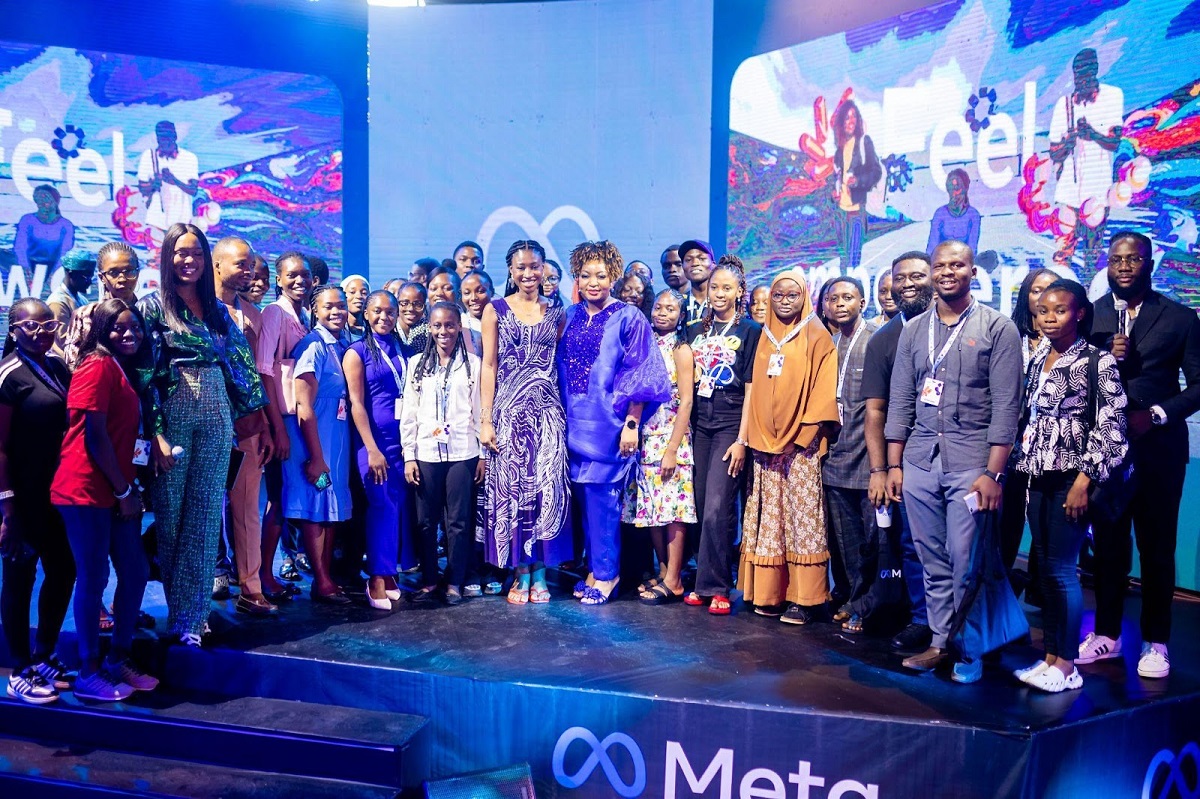
Meta recently hosted its first Youth Summit in Lagos, Nigeria, bringing together over 200 young professionals, students, recent graduates, creatives, tech enthusiasts and aspiring entrepreneurs.

A cross-section of some of the attendees and the Meta team.
Themed ‘Empowering Youth Through Technology, Innovation and Entrepreneurship’, the summit included a series of thought-provoking panel discussions, a mentoring session and an interactive workshop designed to equip young Nigerians with the skills, insights and networks needed to thrive in today’s tech-driven world.
Commenting about the event, Phil Oduor, Head of Policy Programs, Sub-Saharan Africa said, “At Meta, we believe that today’s youth are tomorrow’s change-makers.
“Through initiatives like the Youth Summit, we aim to foster innovation, promote digital literacy and empower young Nigerians with the tools and opportunities to realise their potential and contribute to Nigeria’s growing digital economy.”
Delivering the keynote address, Femi Aluko, CEO/Co-Founder, Chowdeck, shared his journey of breaking barriers to achieve success in tech. He encouraged attendees to embrace the limitless opportunities within today’s technology ecosystem.
A panel discussion, led by Chinny Francis, Public Policy Manager at Meta, featured panellists Nifemi Akinwamide, Head of Operations, Alt School; Adaora Mbelu, Co-Founder of Lumination Global and Obaloluwa Adeagbo, Marketing Lead at Talstack.
They shared valuable insights about the future of work, emphasising the importance of storytelling to build a personal brand, practicing self-awareness, developing soft skills, lifelong learning and honing problem-solving skills to thrive in a digitally transformed world.
Francis Sani, Technical Adviser for Innovation, Entrepreneurship & Capital at the Federal Ministry of Communications, Innovation & Digital Economy, spoke at the event.
He highlighted the 3 Million Technical Talent (3MTT) program, emphasising that the program aims to build Nigeria’s technical talent backbone to drive the digital economy and position Nigeria as a net talent exporter. He encouraged youth to take advantage of this opportunity.
Another panel of industry experts took the stage during the ‘Lunch and Learn: Navigating Entrepreneurship in a Rapidly Changing Landscape’ session, moderated by Sade Dada, Head of Public Policy for Anglophone West Africa at Meta.
Seye Bandele, CEO of PaidHR and Damilola Teidi-Ayoola, Head of Platform and Networks at Ventures Platform Fund, shared their invaluable insights.
Seye highlighted the importance of grit, curiosity and candour, while Damilola reinforced the need to understand one’s target audience, deliver value through their business and embrace data-driven decision-making in the dynamic entrepreneurial landscape.
The event also featured inspiring conversations with leading figures in the creative industry. Miss Techy, an award winning tech content creator and Salem King, a creator, storyteller, author and speaker, shared their experiences and advice on achieving long-term success.
Attendees also benefited from an interactive workshop and a mentoring session, where industry experts shared practical advice and strategies for entrepreneurs and tech enthusiasts.
Meta’s Youth Summit 2024 highlights a commitment to driving positive change, championing youth empowerment and advancing economic opportunities in Nigeria. Through investments in key areas—such as the creative industry, digital literacy, economic impact and youth job training—Meta is dedicated to empowering young Nigerians to thrive in today’s tech-driven world.



After nearly 30 years on the Zimbabwe Stock Exchange (ZSE), Econet Wireless, the country’s biggest technology company, is preparing to leave the bourse and move its property and infrastructure assets to the US dollar-based Victoria Falls Stock Exchange (VFEX).

Econet plans to spin off its towers, property and power installations into a new company, Econet InfraCo, which will be listed on the VFEX. Its mobile network operator business will be delisted from the ZSE.
Econet believes the market has failed to properly value its business and its assets. At the time Econet first released a cautionary on December 3, its market capitalisation was the equivalent of US$628 million.
A rally over the past days has lifted it to a market capitalisation – the number of shares times the share price – to around US$1 billion.
“For the last several years, the company has traded at a significant discount to its peers across Africa which trade at 6 – 8x EV/EBITDA.
“These peers have all already separated and realised value from their tower infrastructure whereas the company still owns its tower and other passive infrastructure which the company has now housed under a separate infrastructure company to be listed on the Victoria Falls Stock Exchange,” Econet said.
Econet will keep 70% of Econet InfraCo, with up to 30% used to settle an offer to shareholders who do not wish to remain invested.
The company argues that infrastructure assets are better suited to the VFEX, which trades in US dollars and attracts investors familiar with property and long-term infrastructure.
“Unlike the mobile network operator business in Zimbabwe, infrastructure assets represent a different class of investment, one that is better understood and valued within USD-based property and infrastructure markets.
“This is demonstrated by the higher Price-to-Earnings multiples at which listed real estate and infrastructure companies trade on the VFEX,” the company said.
Econet dominates Zimbabwe’s mobile market, with 88% of voice traffic, 82% of data usage and 73% of all subscribers. It has built the largest portfolio of telecoms assets.
By the end of the second quarter, it had 234 5G sites, 1,700 LTE sites, 1,900 3G towers and 2,860 2G locations.
In the half-year to August alone, it added 27 new 2G–4G sites and 100 new 5G sites.
In addition to these locations, Econet also holds other properties and power assets, including solar installations, Tesla batteries and generators.
The move follows a well-established trend in Africa.
MTN and Airtel Africa sold towers in Nigeria, Ghana, Uganda and Kenya to independent operators like IHS Towers and Helios Towers. Vodacom, Orange and Telkom South Africa have also carved out tower units through sale-and-leaseback deals.
Credit: Newsday

Qualcomm Technologies Inc. has announced the successful completion of its third annual Make in Africa (QMIA) Startup Mentorship Program, marked by the virtual Make in Africa Finale 2025. The initiative underscores Qualcomm’s long-term commitment to fostering Africa’s vibrant innovation ecosystem through the broader Qualcomm Africa Innovation Platform.

Highlights:
- The 2025 Qualcomm Make in Africa program supported ten innovative startups from Kenya, Tunisia, Nigeria, Benin and Senegal, each addressing local challenges by developing tech-enabled solutions across critical sectors such as healthcare, sustainable agriculture, climate resilience and mobility.
- This year, the program attracted more than 400 applications from 19 countries, showcasing remarkable talent across the continent.
- Farmer Lifeline, of Kenya, was announced as the 2025 Wireless Reach Social Impact Fund winner, recognizing its impactful use of wireless technology.
- Applications for Qualcomm Make in Africa 2026 are now open. Applicants can visit the Qualcomm website to apply.
As a flagship initiative of Qualcomm, the equity-free program shines a spotlight on the creativity and drive of African founders leveraging advanced technologies such as AI, 4G/5G, robotics, connectivity and IoT to address pressing real-world challenges.
Now in its third year, the program remains steadfast in its mission to accelerate early-stage technology startups by providing tailored mentorship, targeted business coaching, expert engineering consultation and comprehensive intellectual property protection guidance – exemplified by resources such as Qualcomm’s L2Pro Africa training. This holistic support empowers founders to transform their visionary ideas into sustainable, market-ready solutions.
“This year’s cohort has demonstrated incredible ingenuity, transforming complex challenges into scalable, tech-driven solutions that will drive social and economic impact across the continent,” said Elizabeth Migwalla, Vice President International Government Affairs, Qualcomm Incorporated.
“Innovation is the driving force behind Africa’s future, and this year’s startups are a brilliant demonstration of that. The African Telecommunications Union (ATU) is proud to partner with Qualcomm for the Make in Africa 2025 program,” said John Omo, Secretary General of the ATU. “We are working to harmonize spectrum management policies, regional standards, and open data practices, but we know that true progress relies on large-scale support. That’s why we call on governments, universities, investors, and industry to support these initiatives – and any endeavor that places African ingenuity at the forefront.”
The 2025 cohort includes the following groundbreaking startups:
- Aframend (Nigeria): Uses AI to explore African medicinal plants for new drug discovery and aims to turn local remedies into safe, affordable treatments for diseases.
- AmalXR (Tunisia): Offers AI-powered virtual rehabilitation sessions on everyday devices, enabling easy patient and clinician progress tracking.
- Archeos (Benin): Automates fish farming with solar-powered sensors and feeders, providing real-time data on water quality and feeding levels for improved fish health.
- ClimatrixAI (Nigeria): Installs connected weather and flood stations with an AI platform to forecast street-by-street risk, enhancing early warnings and disaster response for local communities.
- Ecobees (Tunisia): Builds smart hive monitors and a digital platform for real-time insights into beehive-health, to protect bees and crops that depend on them.
- Edulytics (Senegal): Applies AI on handheld ultrasound devices for early detection of liver disease, aiming to make this special screening widely accessible.
- Farmer Lifeline (Kenya): Deploys small, solar-powered devices that scan fields for pests and diseases and send alerts straight to farmers’ phones to protect crops.
- Pollen Patrollers (Kenya): A women-led agritech startup using connected hive technology and AI to keep bee colonies healthy.
- Solar Freeze (Kenya): Provides solar-powered cold rooms with remote monitoring enabling farmers to keep fruits and vegetables fresh and increase earnings.
- Pixii Motors (Tunisia): Designs electric scooters with smart batteries that can be swapped in and out at local stations, aiming to revolutionize urban mobility.
Wireless Reach Social Impact Fund Winner
Kenyan innovator, Farmer Lifeline, was announced as the winner of the 2025 Wireless Reach Social Impact Fund. The fund, sponsored by Qualcomm® Wireless Reach™ Initiative, champions the innovative use of wireless connectivity to address pressing community. As the winner, Farmer Lifeline will receive dedicated funding and tailored technical support to scale its groundbreaking solution.
“Farmer Lifeline stood out with its innovative small solar-powered devices that scan fields to detect pests and diseases. This technology enables local farmers to effectively protect their crops, significantly increase yields, and improve food security”, stated Erica Ciaraldi, Vice President, Wireless Reach, Qualcomm Incorporated.
“Their visionary approach and dedication to agricultural resilience have positioned them as leaders in their field. They are driving meaningful change for smallholder farmers and inspiring others across the continent. This fund will empower them to scale their impact further, enabling broader reach and deeper influence across Africa and the world.”
In recognition of the groundbreaking innovations demonstrated by all finalists, each will receive stipends designed to accelerate their growth, support strategic development and safeguard their intellectual property. This comprehensive support underscores Qualcomm’s commitment to fostering innovation and ensuring these visionary projects can thrive sustainably.
Looking ahead: Launch of Qualcomm Make in Africa Startup Mentorship Program 2026
Building on the significant success of previous years, Qualcomm is excited to launch the fourth year of the program in 2026.
Applications for the 2026 Qualcomm Make in Africa cohort can be found at the Qualcomm website.

Fynd, an AI-native retail technology platform backed by Reliance Retail Ventures Limited, today announced its official expansion into South Africa, onboarding Surtee Group – one of the region’s most established luxury and fashion retailers – as its first strategic customer in the market. This milestone marks a pivotal moment for African retail, as legacy brands begin embracing digital transformation to meet the demands of a rapidly evolving consumer landscape.

Fynd
Fynd’s entry into Africa reflects its commitment to enabling digital transformation in high-growth retail markets worldwide. The move also comes at a turning point when South Africa’s e-commerce sector is projected to exceed R130 billion ($7.48 billion) in 2025, capturing nearly 10% of total retail sales – a fourfold increase since 2020.
According to Statista, South Africa is expected to have 11.7 million e-commerce users in 2025, with projections reaching 21.5 million by 2029. This growth is being driven by rising internet penetration, mobile-first shopping behaviour, and increasing trust in digital platforms. To meet rising consumer expectations, businesses are investing in AI and unified commerce platforms. Fynd’s scalable, AI-native stack is built to support this shift, enabling agility, personalisation, and operational efficiency.
“South Africa’s retail landscape is evolving fast,” said Ronak Modi, Chief Business Officer – Global at Fynd. “Consumers expect seamless, personalised experiences across every channel, and retailers need agile, intelligent infrastructure to keep up. Our platform is built to unify disconnected systems, speed up fulfilment, and elevate customer engagement; all without adding operational complexity.”
“South Africa is an exciting addition to our global footprint. The market is digitally ambitious, brand-forward, and ready for intelligent commerce infrastructure. Our goal is to help local retailers unify siloed systems, personalise engagement, and accelerate fulfilment without adding complexity.”
Surtee Group operates 94 boutiques and 2 e-commerce sites, comprising the multi-branded stores Levisons and the mono-brand boutiques, namely, Giorgio Armani, Michael Kors, Lacoste, Hugo Boss, VERSACE, TOD’S, Salvatore Ferragamo, Versace Jeans Couture, Emporio Armani, Burberry, Jimmy Choo, Luminance, Paul Smith, Coach, and Armani Exchange. They will implement Fynd’s unified commerce stack, including Storefronts, Order Management System (OMS), Warehouse Management System (WMS), and Clienteling tools to connect in-store and online operations, streamline inventory visibility, and launch brand-specific ecommerce storefronts across its brand portfolio.
While online retail continues to surge, offline sales still represent the vast majority of revenue for retailers in the country. Fynd will enable Surtee Group to unify its offline inventory online, power ship-from-store capabilities, and improve both margins and sell-throughs. Additionally, products like Clienteling will empower in-store teams to engage customers better and drive incremental sales through personalised recommendations and seamless omnichannel experiences.
Fynd’s entry into the market is designed to meet this demand. Its AI-native platform enables real-time stock visibility, ship-from-store capabilities, dark store orchestration, and intelligent customer engagement all within a single scalable solution.
As part of its digital transformation roadmap, Surtee Group aims to consolidate its leadership in luxury and fashion retail while expanding into e-commerce and improving omnichannel agility.
“We were looking for a partner who understood both the technical and strategic dimensions of unified commerce,” said a Surtee Group spokesperson. “Fynd stood out for their proven scalability, consultative approach, and deep experience with global fashion brands, many of which align with our portfolio. Their unified stack enables us to modernise operations while building a connected, brand-first customer experience.”
Fynd has already scaled across India, the GCC, and Southeast Asia, and now adds Africa to its regional presence. With Surtee Group leading the transformation, Fynd is positioned to play a key role in powering unified commerce adoption across South Africa’s growing digital economy.

Nigeria Police Arrest Okitipi, Nigerian Allegedly Linked to Microsoft 365 Hack

NITDA Partners OGP to Drive Presidential Digital Goals

Why Econet Wireless is Switching to VFEX

Customs Slam 3 Percent Surcharge on Banks over Delayed Revenue Remittance

World Bank to Approve $500m Loan for Nigeria Today

Nigeria Records Highest Weekly Cyberattacks in Africa — Report

Cyber Tsunami Hits Nigeria as Breaches Surge 1,047%, esentry Q3 Report Reveals

MTN Nigeria Has Invested Over ₦32.23 Billion in National Priorities Through Its Foundation

Group Deepens Digital Rights Advocacy in Ghana Through Judicial Training and Policy Dialogue

Jumia’s Data Shows Nigerians Turning to Digital Retail to Navigate Inflation Pressures




 E-Business2 days ago
Check Point Reveals Nigeria as Second Most Targeted African Country for Cyberattacks in November

 Telecom2 days ago
Airtel Africa Partners Starlink to Launch Direct-to-cell Service in 14 Markets

 News2 days ago
REA, NBS Partner to Deliver Comprehensive Energy Data for Nigeria

 E-Financial2 days ago
CBN Revokes Licenses of Two Mortgage Banks, NDIC Begins Liquidation

 E-Financial2 days ago
CBN Revokes Licences of Aso, Union Homes Mortgage Banks Over Regulatory Breaches

 General News1 day ago
FirstCap Acts as Joint Issuing House on Veritasi Homes & Properties Plc’s ₦30 Billion Bond Programme

 E-Business2 days ago
Microsoft Empowers 350,000 more Nigerians with AI Skills

 Broadcasting2 days ago
MultiChoice Talent Factory Calls for Entries Into Fully Funded Film Training Programme