

General News
Expo 2020 Survey Shows Nigerians Believe Technology is Crucial to Confront Humanity’s Challenges

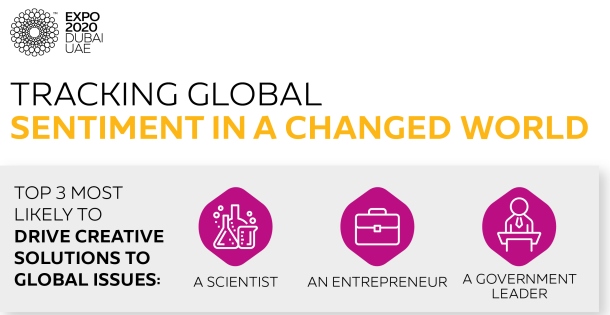
Seventy-five per cent of Nigerians believe that greater knowledge sharing between communities and individuals can help build a better future.

Expo Infographic_Nigeria
The 2021 survey of more than 22,000 people across 24 countries tracked sentiment in a world irrevocably changed by COVID-19. Conducted in partnership with YouGov, it followed a similar study carried out in 2019, before the pandemic.
On the topic of global cooperation, almost 100 per cent (96 per cent) said that countries must work together to tackle worldwide crises such as a pandemic. The sentiment was reflected in Nigeria, with the majority (72 per cent) expressing that greater partnership between individuals and communities is key, and mirrored by responses elsewhere in Africa.
Her Excellency Reem Al Hashimy, UAE Minister of State for International Cooperation and Director General of Expo 2020 Dubai, said: “Expo 2020 has developed this latest global study to help us understand how the citizens of the world believe we can shape a better future. Overall, the findings are encouraging, and show a collective desire to work together, broaden our horizons and exchange ideas.
“In less than two months, when Expo 2020 opens its doors, we look forward to welcoming millions of visitors from across the globe, and harnessing the kind of diversity this study reflects, as we join together to build a new world, with a brighter future for both people and the planet.”
In line with this, the study highlights that 73 per cent of Nigerian respondents believe that technological advances and inventions will continue to play a role in building communities around the world – higher than the average responses of 57 per cent and 44 per cent in Asia and Europe respectively.
Elsewhere, half of Nigerian respondents (50 per cent) ranked increasing opportunities for youth as a higher priority than any other for the future (out of 11 options).
His Excellency Mohammed Dansanta Rimi, Ambassador of Nigeria to the UAE and Commissioner General for Nigeria at Expo 2020 Dubai, said: “During the 182 days of Expo, Nigeria will use its pavilion to showcase the technology sectors that are propelling our creative youth, the future of our country, towards a more prosperous future.
“Results from Nigeria, a diverse nation of more than 200 million people, under Expo 2020’s latest Global Survey exemplifies this inherent optimism, with nearly three-quarters of all Nigerians asked citing technological advancement and innovation as central in building the better communities of tomorrow – not just for Nigerians, but communities across the world.”
Despite the breadth and diversity of topics of the survey, it appears global respondents are united in their belief that greater knowledge-sharing, communication and collaboration can tackle global challenges.
Sustainability and greater mobility appeared as dominant themes across all regions, while in Nigeria the desire for technological advancements to bring people together also stood out.
The survey delves into a range of subjects, also including health and wellness, sustainable travel, efficient food supply chains and the development of both urban and rural communities, all of which will be focuses of Expo 2020’s programming.
Under Expo 2020’s Programme for People and Planet, Expo’s participating countries, organizations, partners and visitors will collaborate to discuss future-proofing solutions to the world’s biggest challenges.
Nigeria’s presence at Expo 2020 will propel conversations in other areas such as agriculture, manufacturing, and the creative industries by showcasing the country’s culture to the world. Nigeria has scheduled 23 customized events, featuring Afrobeat music and the burgeoning ‘Nollywood’ film scene, as it highlights its abundance of culture, creative and economic opportunities.
One of the first global mega-events to take place since the beginning of the COVID-19 pandemic, Expo 2020 will run from 1 October 2021 to 31 March 2022, inviting visitors from around the world to join the making of a new world, experiencing a six-month celebration of human creativity, innovation, progress, and culture.


General News
Union Bank Looted: How Former Directors Gambled with Billions and Nearly Destroyed a National Bank

The former directors and owners of Union Bank did not just fail, they engineered a financial disaster. They manipulated reports, hid massive losses, diverted foreign loans and treated depositors’ money like a private wallet.

Union Bank
Investigators uncovered billions of dollars in misconduct. These directors buried over ₦250 billion in losses, piled a $300 million foreign loan onto the bank without protection and then forced Union Bank to carry the burden. They even used the bank’s own funds to buy its shares, an outrageous betrayal of trust.
It didn’t stop there. Over $100 million was pulled out improperly, leaving the bank exposed and struggling. Loans meant for customers were secretly diverted into shady transactions. False reports were sent to lenders. The system was deliberately deceived.
This was not incompetence. It was exploitation.
By 2025, their actions had created nearly ₦400 billion in losses and over ₦147 billion in unpaid charges. The bank was on the edge.
The Central Bank of Nigeria (CBN) stepped in just in time. Without that intervention, Union Bank could have collapsed, dragging others down with it.
Now, the bank is stabilising. But let’s be clear: this recovery is happening in spite of those former directors, not because of them.
They didn’t build value. They destroyed it.
And Nigerians deserve to never forget who was responsible.


Federal government, The European Union (EU), and the United Nations Industrial Development Organisation (UNIDO) have called for urgent and coordinated action to curb food waste and promote sustainable consumption and production practices.

They warned that when food is wasted, the water, energy, and labour invested in its production are also lost, accelerating climate change and undermining global efforts to build a zero-waste, circular economy.
Speaking in Abuja at the commemoration of this year’s International Zero Waste Day, themed “Food Waste Reduction: Minimisation and Valorisation,” Zissimos Vergos, deputy Ambassador of the EU Delegation to Nigeria and ECOWAS, disclosed that Nigeria wastes approximately 38 million tonnes of food annually, more than any other country in Africa.
He further noted that globally, in 2022 alone, nearly one billion tonnes of food—almost one-fifth of all food available to consumers—was wasted.
“This is not just a loss of food; it is a squandering of precious resources, a missed opportunity to combat hunger, and a direct threat to our planet’s health,” he said.
Vergos stressed that food loss and waste are major drivers of environmental degradation, contributing up to 10 per cent of global greenhouse gas emissions—nearly five times the emissions of the entire aviation sector—and accounting for as much as 40 per cent of global methane emissions.
Highlighting Nigeria’s ongoing efforts, he said: “The Nigeria Circular Economy Roadmap, the establishment of the Interministerial Circular Economy Committee, the push to develop a National Plastic Waste Management Regulation, these are not small gestures. These are structural shifts.
“They signal that Nigeria is not waiting for someone else to solve its problem; it is building the system to solve it from within. Now, today’s theme: food waste reduction, minimisation and valorisation, is the right conversation at the right moment.”
Vergos also shared three key lessons from the EU’s experience to support Nigeria’s efforts. First, he urged investment in rural infrastructure, including roads, storage, and cold chains, to address post-harvest losses beyond the farm gate. Second, he emphasised the need to promote agro-processing by converting fresh produce into value-added products such as tomato paste and cassava flour, while linking smallholder farmers to processors and markets.
Third, he called for embedding zero-waste principles, recycling, and resource efficiency into school curricula from the primary level to foster a culture of sustainability among future generations.
Reaffirming the EU’s commitment, he stated, “The EU stands ready to be your partner in that work, through funding, through technical cooperation, and through genuine solidarity.”
In his keynote address, Balarabe Abbas Lawal, minister of Environment, reiterated the Federal Government’s commitment to environmental protection and sustainable practices aimed at safeguarding the health and well-being of Nigerians.
“Food waste remains a significant challenge that affects not only our environment but also our economy and society. Every discarded meal represents wasted resources such as water, energy, labour, and capital, while Nigerians continue to face food insecurity.
Addressing food waste is therefore central to sustainable development and ensuring a healthier future for all,” he said.
He added: “The Federal Ministry of Environment, in this year’s national appropriation, has developed projects on food waste elimination in major markets around Nigeria. And this is to show you that the Federal Ministry of Environment is tackling the issues of food waste at its core, especially post-harvest losses.”
Stressing the broader impact, he noted that addressing food waste aligns with the Ministry’s core objectives. “Reducing food waste will not only help to lower pollution and greenhouse gases, but also conserve valuable resources and promote more efficient and responsible consumption patterns across households, businesses, and institutions,” he added.
Also speaking, Amb. Philbert Johnson, Director and Representative of UNIDO’s Sub-Regional Office in Nigeria, emphasised that food must not be wasted, especially in a country grappling with food insecurity and malnutrition.
“Food is far more than a commodity: it is a foundation of wealth, a driver of health, and a pillar of security. It sustains our homes, supports industries, and underpins the stability of our societies.
“When food systems function efficiently, they generate income, enhance resilience, and improve well-being. When food systems fail, when food is lost or wasted, the consequences ripple across our economies, our environment, and our communities.”
He reaffirmed UNIDO’s commitment to supporting Nigeria in building resilient, inclusive, and sustainable agro-industrial systems.

President Bola Ahmed Tinubu has directed the immediate installation of 5,000 CCTV cameras across identified flashpoints in Plateau State as part of urgent measures to address the worsening security situation in the state.

The President gave the directive during an emergency visit to Plateau on Thursday, where he held a brief stakeholders’ meeting at the Yakubu Gowon Airport following the recent killings in Angwan Rukuba, Jos, where at least 28 persons were killed by unidentified gunmen.
Tinubu also approved the formation of a delegation of key stakeholders to engage in further deliberations on lasting solutions to the security challenges in the state.
He condoled with families of the victims and directed that support be provided to cushion their losses.
President Bola Tinubu while expressing deep sympathy to families of victims said the installation of surveillance cameras was part of a deliberate move towards addressing the kind of attacks that befell residence of the recent attack in the State.
In his remarks, Governor Caleb Mutfwang appreciated the President’s visit and show of concern, but expressed worry over the recent wave of attacks in the state, describing the situation as disturbing and requiring urgent attention.
The meeting had in attendance, former Governors, serving and former National and State Assembly members, traditional rulers, government appointees as well as relatives of those killed in the Angwan Rukuba attack.

Union Bank Looted: How Former Directors Gambled with Billions and Nearly Destroyed a National Bank

N4.65 Trillion in the Vault, but is the Real Economy Locked Out?

FG, Others Say Nigeria Wastes 38m Tonnes of Food Annually

Ecobank Assures of Seamless Easter Banking Services

Anchor Gets Nigerian, Canadian Licences as Transactions Crosses $2.5Bn

Spotify’s Loud & Clear Report Reveals Over ₦60Bn Revenue for Nigerian Artists in 2025

Madonna University Taps Tech Guru Adote for Strategic Board Role

China Threatens to Shut Nigeria’s Satellite Over $11.44m Unpaid Debt

Healthcare Under Attack: Why Cybersecurity is Now Critical Care

Police Says Victims Enable Cyber Attacks Out of Ignorance




 E-Financial3 days ago
UBA Beefs Up Mobile App Security to Stop Fraudulent Debits, Withdrawals

 Telecom3 days ago
Bharti Airtel Crosses 650m Users

 E-Financial3 days ago
Ghana Makes History as First African Country to Integrate Payment National Identity Card

 E-Financial3 days ago
CBN Plans New Payment Systems Vision

 General News3 days ago
FG Orders Installation of 5000 CCTV Cameras for Surveillance in Plateau

 E-Financial3 days ago
Flutterwave Secures Nigerian Banking License, Boosts Financial Autonomy

 E-Financial2 days ago
CBN, Banks, Fintechs Launch PSPC to Boost Nigeria’s Payment System

 News2 days ago
NITDA Strengthens Collaboration with NIPSS to Drive Digital Innovation, Orange Economy Growth