

Telecom
Facebook, Telcos Unveil A Transformative Submarine Cable for Future Internet Connectivity in Africa

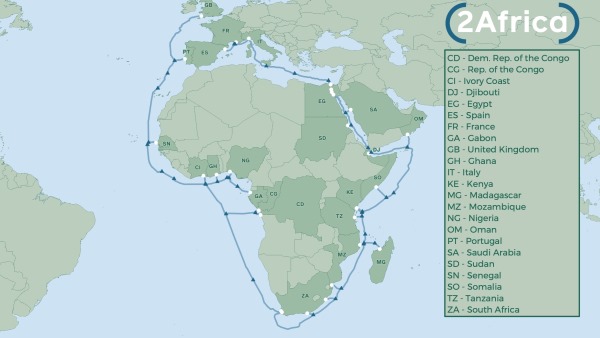
Facebook, China Mobile International, MTN GlobalConnect, Orange, stc, Telecom Egypt, Vodafone and WIOCC announced that they will partner to build 2Africa, which will be the most comprehensive subsea cable to serve the African continent and Middle East region.

The parties have appointed Alcatel Submarine Networks (“ASN”) to build the cable in a fully funded project which will greatly enhance connectivity across Africa and the Middle East.
At 37,000km long, 2Africa will be one of the world’s largest subsea cable projects and will interconnect Europe (eastward via Egypt), the Middle East (via Saudi Arabia), and 21 landings in 16 countries in Africa.
The system is expected to go live in 2023/4, delivering more than the total combined capacity of all subsea cables serving Africa today, with a design capacity of up to 180Tbps on key parts of the system.
2Africa will deliver much needed internet capacity and reliability across large parts of Africa, supplement the fast-growing capacity demand in the Middle East and underpin the further growth of 4G, 5G and fixed broadband access for hundreds of millions of people.
In countries where the 2Africa cable will land, service providers will obtain capacity in carrier-neutral data centres or open-access cable landing stations on a fair and equitable basis. This will support healthy internet ecosystem development by facilitating greatly improved accessibility for businesses and consumers alike.
The 2Africa cable has been designed to improve resilience and maximise performance, including the option of a seamless optical crossing between East Africa and Europe. The 2Africa parties and Airtel have signed an agreement with Telecom Egypt to provide a completely new crossing linking the Red Sea and the Mediterranean, the first in over a decade.
This includes new cable landing stations and deployment of next-generation fibre on two new, diverse terrestrial routes parallel to the Suez Canal from Ras Ghareb to Port Said, and a new subsea link that will provide a third path between Ras Ghareb and Suez.
The 2Africa cable will implement a new technology, SDM1 from ASN, allowing deployment of up to 16 fibre pairs instead of the eight fibre pairs supported by older technologies, bringing much greater and more cost-effective capacity.
The cable will incorporate optical switching technology to enable flexible management of bandwidth. Cable burial depth has also been increased by 50% compared to older systems, and cable routing will avoid locations of known subsea disturbance, all helping to ensure the highest levels of availability.
“The launch of 2Africa enables us to offer our customers seamless connection between Africa and Europe, together with our SEA-ME-WE 5 and AAE-1 subsea cable resources to further extend to Asia, which is an important milestone of our global development strategy,” said Jessica Gu, Director & Chief Technology Officer of China Mobile International. “The utmost capacity and faster transmission allows us to satisfy the needs of African nations today and in the future, reflecting our firm commitment to building a global digital life.”
“We’re excited to be collaborating with our 2Africa partners on the most comprehensive subsea cable that will serve the continent,” said Najam Ahmad, Vice President, Network Infrastructure at Facebook. “2Africa is a major element of our ongoing investment in Africa to bring more people online to a faster internet.
“We’ve seen first-hand the positive impact that increased connectivity has on communities, from education to healthcare. We know that economies flourish when there is widely accessible internet for businesses. 2Africa is a key pillar supporting this tremendous internet expansion as part of Africa’s surging digital economy.”
According to Frédéric Schepens, CEO of MTN Group’s wholesale operation, MTN GlobalConnect, “MTN GlobalConnect is delighted to participate in this bold 2Africa subsea cable project.
“This initiative complements MTN GlobalConnect’s terrestrial fibre strategy to connect African countries to each other and to the rest of the world. We are proud to be playing a key role in providing the benefits of a modern connected life – a core MTN belief.”
Alioune Ndiaye, CEO of Orange Middle East and Africa, said, “As one of the world’s leading multi-service telecommunications operators and present in 18 countries in Africa and the Middle East, it was natural for Orange to be part of the 2Africa project.
“This major investment will complete our existing submarine and pan-African terrestrial infrastructures to provide access to international connectivity in a redundant fashion throughout the west coast of Africa.
“It will enable Orange to securely meet the demand for increased bandwidth necessary for the continued digital development of regions throughout the 2Africa system.”
Mohammed A. Alabbadi, Wholesale VP in stc commented, “stc is delighted to be a Partner in 2Africa. The 2Africa cable will be integrated into stc’s MENA Gateway (MG1) datacentre in Jeddah, enabling customers to access our extensive international content and extend their regional connectivity through stc terrestrial geo-mesh network that extends to all neighboring countries.
“This will undoubtedly play a significant role in enhancing stc’s international network capabilities, whilst also positioning stc as a leading regional digital player in the MENA region. The partnership demonstrates stc’s commitment, in line with Saudi Vision 2030, to deliver meaningful digital transformation and build a digital society for all.”
Adel Hamed, Telecom Egypt’s Managing Director and Chief Executive Officer, commented, “Telecom Egypt’s contribution to 2Africa marks an important milestone in our endeavor to contribute to digital transformation in Africa. Egypt’s relationship with African states has and will always be one of Egypt’s top priorities,
“it extends here to align with Egypt’s strategy to contribute in the current development in Africa. We are honored to be part of such a revolutionary project alongside renowned global and African partners. For years, we have accomplished tangible steps in revamping our international infrastructure and increasing our assets’ geodiversity in order to keep pace with the rising global demand for large bandwidth and global reach. We trust that 2Africa will be a rich addition to our diversified investments in the subsea cable industry.”
“Improving connectivity for Africa is a significant step which lays the groundwork for increased digitalisation across the continent,” said Vinod Kumar, CEO Vodafone Business. “2Africa will give local businesses and consumers a better online experience while more connectivity between Africa, Europe and the Middle East will help to build a wider, more inclusive digital society across the globe. We’re delighted to work with our partners in the project to help deliver this.”
WIOCC CEO, Chris Wood, commented, “For over a decade WIOCC has been the hyperscale capacity provider for Africa, based upon a strategy of ongoing strategic investment in key subsea and terrestrial infrastructure.
“Participation in 2Africa continues this commitment to providing large capacity users with the resilient network they need to support their customers’ ever-growing bandwidth requirements. Our investment both future-proofs our network capabilities and provides additional resilience to maximise uptime for our critical infrastructure.”
Alain Biston, President of Alcatel Submarine Networks said, “We are honored by the trust of our partners and proud to have been selected for this project.
“With this state-of-the-art subsea system, Africa will take a giant leap to the digital age thanks to the best-in-class technologies. Africa is a long story for ASN: we have deployed the majority of submarine cables around the continent. 2Africa will be a great new chapter!”


Modern messengers, such as WhatsApp, Telegram, Signal and others, are often used for illicit purposes. Kaspersky Digital Footprint Intelligence has conducted an in-depth monitoring of over 800 blocked cybercriminal Telegram channels between 2021 and 2024.

While a range of illegal activities continues to be hosted on the platform, its environment has become noticeably more challenging for sustained underground operations.
Telegram’s bot framework and other built-in features make for a low-effort ecosystem for the underworld.
A single bot can simultaneously manage queries, process cryptocurrency payments, and instantly deliver stolen bank cards, info-stealer logs, phishing kits, or DDoS attacks to hundreds of buyers per day, often without operator involvement.
Unlimited, non-expiring file storage eliminates the need for external hosting when distributing multi-gigabyte database dumps or stolen corporate documents. This frictionless automation naturally favours high-volume, low-price, low-skill offerings, such as leaked bank cards or other data, hosting malware, etc.
High-value, trust-dependent deals (for instance, zero-day vulnerability information) still remain on reputation-gated dark-web forums.
Kaspersky researchers found two clear trends related to illegal activities on Telegram. The average lifespan of shadow channels has increased, with the proportion of channels surviving over nine months more than tripling in 2023-2024 compared to 2021–2022. At the same time, Telegram’s blocking activity has risen significantly.
Monthly takedown figures recorded since October 2024 – even at their lowest – are comparable to the peak levels seen throughout 2023, and the overall pace continued to accelerate in 2025. This impedes malicious activities.
Other disadvantages of Telegram for cybercriminals include the lack of default end-to-end (E2E) encryption for chats, the inability to use their own servers for communication (due to the messenger’s centralised infrastructure), and closed server-side code, which makes it impossible to verify its functionality.
As a result, several established underground communities, including the nearly 9,000-member BFRepo group and the Angel Drainer malware-as-a-service operation, have already begun shifting primary activity to other platforms or proprietary messengers, citing repeated disruptions of their activities on Telegram.
“Fraudsters find Telegram a convenient tool for many malicious activities, but the risk-reward balance is clearly shifting. Channels are managing to stay online longer than a couple of years ago, yet the dramatically higher volume of blocks means operators can no longer count on long-term stability.
“When a storefront or service disappears overnight – and sometimes reappears only to be removed again weeks later – building a reliable business becomes much harder. We’re starting to see the early stages of migration as a direct consequence,” comments Vladislav Belousov, Digital Footprint Analyst at Kaspersky.
Galaxy Backbone Limited (GBB), the Federal Government’s leading ICT infrastructure and shared services provider, will mark its 20th anniversary in June 2026 with a grand celebration that reflects two decades of innovation, resilience, and national impact.

Since its inception in 2006, Galaxy Backbone has been at the heart of Nigeria’s digital transformation journey; building the technological foundation that supports modern government operations and public service delivery. What began as a bold vision to connect government has grown into a critical national platform that drives efficiency, transparency, collaboration and innovation across the public sector.
Over the last 20 years, GBB has helped redefine how government works. By providing secure connectivity, enterprise-grade data centre services, cloud platforms, and digital collaboration tools, Galaxy Backbone has enabled Ministries, Departments and Agencies (MDAs) to move from fragmented, paper-based processes to more integrated, technology-driven systems.
This transformation has improved government-to-government coordination, strengthened engagement with businesses, and enhanced the delivery of services to citizens. Today, the digital infrastructure powered by Galaxy Backbone supports thousands of government users, hundreds of institutions, and critical national platforms that Nigerians rely on daily.
A key part of this journey has been the Federal Government of Nigeria’s investment, managed by GBB in robust national infrastructure, high-capacity and world class data centres, fibre-optic connectivity across multiple states, secure hosting services, and shared platforms that have helped government operate more efficiently and responsively. These contributions have played a pivotal role in Nigeria’s progress toward a more digital, agile and citizen-centered public service.
Galaxy Backbone’s impact has earned both national and global recognition. In 2025, the organisation was ranked first overall in the Federal Government Website Performance Scorecard, reflecting its commitment to excellence in digital service delivery. Internationally, GBB, a couple of years ago, received the prestigious United Nations Public Service Award, a testament to its leadership in promoting a whole-of-government approach to digital transformation.
As GBB celebrates two decades of service, this milestone is more than an organisational anniversary; it is a celebration of Nigeria’s digital evolution. It is an opportunity to appreciate how collaboration between government, industry partners, technology providers, and dedicated public servants has helped build a stronger, more connected nation.
The June 2026 anniversary celebration will bring together stakeholders from across the public and private sectors to reflect on the journey so far, acknowledge the partnerships that have shaped this success, and chart an ambitious course for the future. It will highlight how collective effort, shared vision, and innovation have positioned Galaxy Backbone as a strategic national asset.
Looking ahead, Galaxy Backbone remains committed to deepening digital transformation across the country; expanding infrastructure, strengthening cybersecurity, enhancing service delivery, and supporting the Federal Government’s drive for a smarter, more efficient and digitally empowered Nigeria.
At 20 years, Galaxy Backbone stands proud of its past, confident in its present, and inspired by the limitless possibilities ahead.


Galaxy Backbone Limited (GBB), Nigeria’s leading federal ICT infrastructure provider, has announced its 20th-anniversary celebration for June 2026, marking two decades since unifying government’s fragmented digital landscape into a secure national platform.

Galaxy Backbone
The announcement by Head of Media and Corporate Communications Chidi Okpala follows GBB’s top ranking in the 2025 Federal Government Website Performance Scorecard by the Bureau of Public Service Reforms, cementing its leadership in digital service delivery and transparency.
Managing Director Professor Ibrahim Adepoju Adeyanju described the milestone as celebrating Nigeria’s shift from paper-based silos to a cloud-first, integrated government. Achievements include the UN Public Service Award for 1-GOV.net, high-speed fiber deployment for G2G and G2B interactions, IPPIS payroll rollout, and pandemic-era digital support.
The June event will gather public-private stakeholders, global tech partners, and policymakers to unveil GBB’s next-decade roadmap emphasising cybersecurity, AI in public service, and rural connectivity.
GBB positions itself at the forefront of Nigeria’s 2030 digital nation drive, with 20 years of innovation signaling a smarter, connected future.

SEC Hikes Minimum Capital Requirements for Market Operators After a Decade

Study Shows Blocks in Telegram are Pushing the Underground Out

Galaxy Backbone Marks Two Decades of Powering Nigeria’s Digital Evolution

NGX Unveils Net-Zero Plan for Greener Capital Market

Galaxy Backbone Marks 20 Years, Tops FG Website Scorecard

Banks quietly move to enforce new ₦50 transfer levy from Jan. 1

FIRS says NIN, CAC Numbers to Serve as Tax IDs from 2026

FIRS Declares NIN, CAC Numbers as Tax IDs from 2026

US Begins Partial Visa Ban on Nigerians January 1

Galaxy Backbone Tops FG’s Website Performance Ranking




 E-Financial2 days ago
Paystack Expands Beyond Payments into Banking

 E-Financial2 days ago
SEC Partners Police in Nationwide Crackdown on Ponzi Schemes, Crypto Frauds

 E-Business2 days ago
Nigeria Targeted with 4,622 Cyber-attacks Per Week in December 2025

 General News2 days ago
EFCC to Use Space Technology to Boost Asset Tracking, Investigations

 E-Financial2 days ago
FG Halts Tax Guidelines Amid Uncertainty Over Final Laws – Oyedele

 E-Financial2 days ago
Paystack Buys Microfinance Bank, Enters Nigeria Banking Arena

 News2 days ago
FG Directs Banks, Fintechs to Remit VAT on Service Fees

 General News2 days ago
How to Stay Safe Online During Sales Periods