

General News
Fashola Commissions Recreation Centre

Babatunde Fashola (SAN), Lagos State governor last Wednesday handed over a sports recreation centre constructed by the Council of Wives of Lagos State Officials (COWLSO) at Oworonshoki, Kosofe local government area of Lagos State with a plea to all the 57 local governments in the state to adopt it as a model.
Governor Fashola who spoke at the handing over ceremony which took place at Oworonshoki added that each of the 57 local governments and Local Council Development Areas should provide two of such sports centre in their domain.
Fashola explained that just as the 57 Local Councils and Development areas have recently provided 2 patrol vans each to the Police, adopting same strategy with the sports facilities would ensure a commitment to a new beginning in sports development and provide Lagos with 114 sports centres.
“This park symbolizes for me a new beginning being championed by COWLSO. We must follow that new beginning. As a government, we will not only follow, but will sometimes lead because we have more resources. We will build more across Lagos”, he added.
Governor Fashola also said all local government areas, states and the federal government must commit to investing in public sports centres not only to give the poor and underprivileged a chance to excel in sports but because they are also theatres of rehearsals.
The governor emphasized that sports is a major tool to expand the economy, create jobs and fight unemployment, adding however that excellence in sports can only come from thousands of hours of practice and preparations.
He added that the exploits of Brazil in sports especially football is not an accident, but due to the prevalence of small sports parks all over the country which affords everyone the opportunity to train and practice.
Governor Fashola reminded the residents of the area that the facility is a sports facility meant for the usage of the children and which must not be put to other uses, charging the residents to always forward complaints about improper usage of the facility to his office if they occur.
He said not only the COWLSO must be involved in the management of the sports centre, but the royal fathers, landlords, CDAs and other members of the landlords association must have representatives that would ensure that it is put to proper use.
Governor Fashola reminded many of the youth who were at the event that even if they decide to embrace sports, it must be solidified by sound education, advising that sole reliance on sports is not the best because sporting prowess is determined by age.
He added that after sports, it is whatever education or trade which a sportsman has proficiency in that he will fall back on, adding: “We must ensure that this facility is used by only children of school age or those learning a trade in developing their sporting prowess”.
The governor also personally donated one generator each to the two new recreation centres as his contribution to the forthcoming National Women Conference.
Speaking earlier, Mrs Abimbola Fashola, wife of the governor and chairman of COWLSO said the Oworonshoki playing ground is one of the dividends of the 2007 and 2008 National Women conference.
She revealed that the new centre is equipped with a football field, a grandstand, a basketball court, a gym, a children’s playing arena, a sitting area for the elderly and a hall.
Mrs Fashola informed that the facility has also been secured with a perimeter fence , a gate and a gate house for the security personnel.
In his address of welcome, Prince Ademuyiwa Adedeji , chairman , Kosofe Local Government, promised that the local government would continue to do all it can within the limited available resources to better the lot of the people.


Looking for a gift for your soulmate on February 14th and think that a gift card would be a nice option? Just remember that when digital trends rapidly rise in popularity with customers, they are also gaining traction with scammers looking to use them as bait.

With Saint Valentine’s Day approaching, Kaspersky has identified several phishing and malicious campaigns targeting gift card owners and those who’re looking for a digital present for their loved ones. To help stay safe, the security experts at Kaspersky have also shared practical advice on how not to be tricked.
A “check‑your‑balance” that drains your gift card
Kaspersky’s latest global survey* shows that 80% of respondents consider giving digital presents such as subscriptions, gaming credits or gift cards. Scammers are actively exploiting this trend capitalising on well-known brands, creating fake online stores and even crafting fake verification portals designed specifically to steal gift card value.
Kaspersky’s phishing detection identified deceptive platforms offering victims a “secure” system to check their gift cards validity, status or balance. Targeting those who recently received a gift card, phishers steal the card’s identification data and get an opportunity to activate the certificate before the user themselves.
To stay protected from such scams, Kaspersky recommends double‑checking that a website is real. Look carefully at the web address, any links you’re asked to click, and spot any odd pictures or designs that might hint the site is fake.
The safest way to confirm a gift card’s balance is to go straight to the brand’s official website – don’t follow any other links. To prevent clicking on a malicious link, use a security solution such as Kaspersky Premium with a strong AI-powered anti-phishing component.
Is it a gift card for you or for cybercriminals?
As gift shoppers flood online marketplaces with flash sales and limited-time deals, cybercriminals are watching closely, ready to strike when users are most vulnerable.
Kaspersky experts detected a fake website that mimics Amazon, one of the most famous marketplaces, offering $200 gift card. With this tempting offer, scammers encourage customers to press a “Get your Amazon gift card” button. However, when the user clicks it, they get an MSI installer with a backdoor that cybercriminals use to remotely control the victim’s device.
This fraudulent scheme highlights the importance of complex cybersecurity protection, showing that clicking on a wrong link may result in not only money and data loss, but also device infection or loss of control over it. When a fake site copies the original store’s look exactly, it’s hard to tell which one is real and which is a scam.
Kaspersky Premium protects users from fraudulent online stores through advanced detection technology that analyses website characteristics and URLs to identify suspicious patterns.
For its excellent performance in AV-Comparatives Fake Shops Detection certification in 2025 Kaspersky Premium was awarded an “Approved” certificate, making it the right choice for confident online shopping.
“As Valentine’s Day approaches, cybercriminals may increase their efforts to exploit the emotional vulnerability and romantic spirit that define this holiday. They’re creating fake gift card websites, spoofing popular retailers, and launching phishing campaigns that prey on your desire to make your loved ones happy.
The best defence is to stick to well-known retailers, check URLs carefully, apply a security solution with advanced phishing detection and remember that if a deal seems too good to be true, it probably is,” comments Anton Yatsenko, Lead Web Content Analyst at Kaspersky.

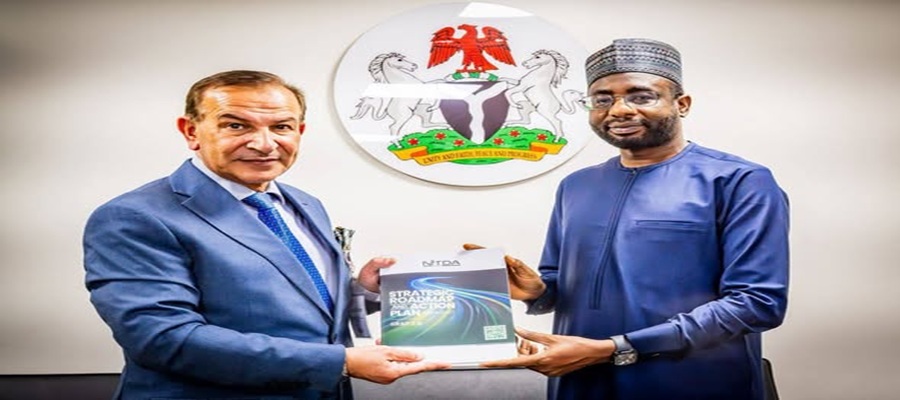
National Information Technology Development Agency (NITDA) and Wigwe University are laying the groundwork for a far reaching collaboration centred on artificial intelligence (AI) research, agricultural innovation and digital talent development, following a high level engagement between both institutions in Abuja.

NITDA
The discussions, led by Wigwe University Vice Chancellor Professor Marwan Al Akaidi and senior NITDA officials, revealed an alignment of expertise, priorities and national objectives that could accelerate Nigeria’s technological advancement.
Professor Al Akaidi, who leads the young but ambitious Wigwe University established under the vision of the late Herbert Wigwe, said the institution was created to become “the university of Africa”, providing high quality teaching and transformative research for Nigeria and the continent.
He emphasised that Nigeria has immense talent but often lacks the opportunities and platforms to channel it effectively—an issue the university intends to solve through strong industry and government partnerships.
Drawing from his long academic and research career in the United Kingdom and the Middle East, Professor Al Akaidi shared that the university is already conducting work on AI for Health in Nigeria with a team of ten researchers.
He stressed his determination to build a full AI centre in the country, similar to the one he helped establish in Abu Dhabi, noting that although funding setbacks followed Herbert Wigwe’s passing, the ambition remains intact and urgent.
According to him, Wigwe University does not seek to become a passive user of foreign AI tools but aims to “create the Nigerian AI”—a locally driven, world class AI engine that reflects the country’s needs, languages and realities.
He further explained that the university’s location in Rivers State provides a natural foundation for AI enabled agriculture and food production research.
Surrounded by extensive farming communities, the institution sees opportunities to apply AI to livestock management, land use, food processing and agricultural efficiency.
Using Nigeria’s cattle population as an example, he argued that technology can dramatically improve productivity: “In countries with fewer cattle, output is far higher because of new feeding systems and technology. If we apply AI properly, Nigeria’s agricultural wealth can multiply.”
He also pointed to AI’s potential in hospitals and medical diagnosis, especially for widespread illnesses like malaria.
NITDA’s representative, Dr Aristotle, welcomed the visit warmly, calling the Agency “Nigeria’s technology powerhouse” with mandates covering IT development, regulation, innovation, research and standards.
He said the Vice Chancellor’s proposals align strongly with NITDA’s strategic direction and existing programmes, highlighting the National Centre for Artificial Intelligence and Robotics and the National Adaptive Village for Smart Agriculture as key areas where collaboration can take shape.
He praised Wigwe University’s focus on entrepreneurship, innovation and skills development, noting that academia is a crucial stakeholder in the national tech ecosystem.
He also explained that NITDA’s work aligns closely with the government’s priority agenda and the Agency’s Strategic Roadmap and Action Plan, built on pillars such as knowledge, research and development, entrepreneurship, innovation and partnership.
He assured the visiting delegation that NITDA sees collaboration as essential and is committed to implementation rather than discussions alone: “Whatever we commit to, we will do. We understand the importance of partnership because no single institution has all the answers.”
Building on this, NITDA’s Director of Research and Development, Dr Kumo, said the Agency is working to develop a technology research ecosystem capable of moving Nigeria into the top 25 per cent of global research performance.
He noted that many of Wigwe University’s interests—AI, robotics, unmanned aerial vehicles, the Internet of Things, blockchain and additive manufacturing—mirror NITDA’s research priorities.
He also emphasised the value of virtualising education, allowing learners anywhere in Nigeria to access Wigwe University’s programmes through technology, improving national inclusivity.
From the Digital Literacy and Capacity Building Department, Dr Tambuwal stressed that NITDA prioritises building a digitally literate population and developing talent from basic education through to tertiary level.
He noted that many workers today still lack the digital skills required to use modern systems effectively, making it essential for universities to produce graduates who are digitally fluent and ready for the workforce.
He expressed readiness to partner with Wigwe University and explore shared learning opportunities.
Returning to curriculum and industry alignment, Professor Al Akaidi stressed that academia needs industry just as much as industry needs academia.
He described the need for constant curriculum review, especially in computing, engineering and technology, to ensure students are not learning outdated content.
He explained that teaching must be underpinned by active research and that the real value of education lies in producing graduates who understand the technology and can lead in their fields.
At Wigwe University, he said, students are already demonstrating remarkable capability—second year students are set to launch a major educational app, showing what young people can achieve when supported and challenged.
He insisted that Nigerian universities must produce graduates who are not only job seekers but job creators, noting that Wigwe University is building such a culture deliberately.
His call to action was clear: “We need to work together. If we combine our strengths, we can produce something real for Nigeria and beyond.”
The meeting ended with mutual assurance that the collaboration will move into concrete action. Both sides agreed to identify dedicated contact teams and map out specific workstreams for AI research, agricultural innovation, virtual learning, digital literacy, curriculum development and emerging technologies. With this shared resolve, NITDA and Wigwe University appear ready to build a partnership capable of shaping Nigeria’s technological future.

Nigeria and Kenya are the next target markets for Identy.io, a global provider of digital identities, as it expands into Africa. Facial, fingerprint, and palm identification are among the safe, mobile biometrics that the company specialises in.

According to Indenty.io, its platform runs locally on smartphones, eliminating cloud storage while maintaining security and privacy.
It goes to say this is achieved by leveraging standard smartphones for fingerprint and face scans, the company aims to bridge the continent’s digital divide, where a significant number of adults still lack basic identification.
To spearhead this rollout, the firm has appointed a specialised regional leadership team, including industry veterans from Nigeria’s Bank Verification Number programme, to integrate their automated Biometric Identification System into national digital public infrastructure.
The company says the significance of this move lies in the departure from traditional, “clunky” biometric models.
Historically, digital ID enrollment in Sub-Saharan Africa has been throttled by the high cost of specialised scanners and the logistical nightmare of deploying them to rural areas.
Identy.io notes that its approach shifts the heavy lifting to mobile software.
Identy.io is positioning itself to capture a market the World Bank’s Identification for Development initiative identifies as critical for financial inclusion.
If successful, this could accelerate government-to-person payments and healthcare access in regions where coverage currently sits below 70%.
“We are transforming the traditional industry model, which often relies on expensive and inflexible digital infrastructure,” says Antony Vendhan, Co-founder of Identy.io. “This allows our clients to reach underserved communities by providing individuals with multimodal access to secure their digital identities.”
The company will face established players like IDEMIA and Thales, who have long dominated government contracts.
Furthermore, Identy.io will face competition from up-and-coming regional fintech identity firms such as Smile ID, which already has a significant presence in Know Your Customer services throughout Africa.
To gain an edge, Identy.io has aligned itself with Modular Open Source Identity Platform (MOSIP).
By being listed on the MOSIP marketplace, the company says its tech becomes “plug-and-play” for governments building open-source national ID systems, a growing trend among nations wary of “vendor lock-in.”
While the primary focus remains on Nigeria and Kenya, Identy.io’s long-term roadmap includes a phased rollout to other emerging markets.

IGP Designates Banks National Security Asset, Orders Crackdown on Cyber Frauds

NCC Orders Telcos Inform Subscribers of Data Breach within 48 Hours

Cybersecurity Firm Warns Against Gift Card Scams @ Saint Valentine’s Day

Globacom Promotes Valentine Gifting with Huge Discounts on Smartphones

Rashidat Adebisi Unveils Strategic Roadmap for Nigeria’s Insurance Sector under NIIRA 2025

Firm Detected a Fivefold Surge in QR Code Phishing Attacks in the Second Half of 2025
Nigeria’s 9 Top FinTech Firms Valued at $10.6Bn in January 2026

DG NCC Tasks University Dons on Research Commercialization, IP Management to Build Global Competitive Ecosystems

Firm Detected a Scam Exploiting OpenAI’s Teamwork Features

Kaspersky Launches OT Calculator to Align Cybersecurity Investments with Business Goals




 E-Financial3 days ago
Billions in Nigeria’s Reserves, But Where is the Growth?

 Telecom3 days ago
QNET unveils ‘Energize Everyday’ theme, intensifies consumer protection, media partnership in 2026

 E-Financial2 days ago
NAICOM Targets Resilient, Global Competition Market in Insurance Sector Consolidation

 News2 days ago
NITDA Explores Partnership with Trust Stamp on Digital Trust and Innovation
 E-Business3 days ago
Kaspersky Reports 15% Growth in Malicious email Attacks in 2025

 E-Financial3 days ago
Adedeji, NRS Boss says Technology is Crucial to Tax Reform’s Success
 E-Financial2 days ago
IGP Designates Banks National Security Asset, Orders Crackdown on Cyber Frauds
 E-Financial2 days ago
Rashidat Adebisi Unveils Strategic Roadmap for Nigeria’s Insurance Sector under NIIRA 2025