

Telecom
FATE Foundation, Facebook to Implement AEP-Digital in Seven Cities Across Nigeria

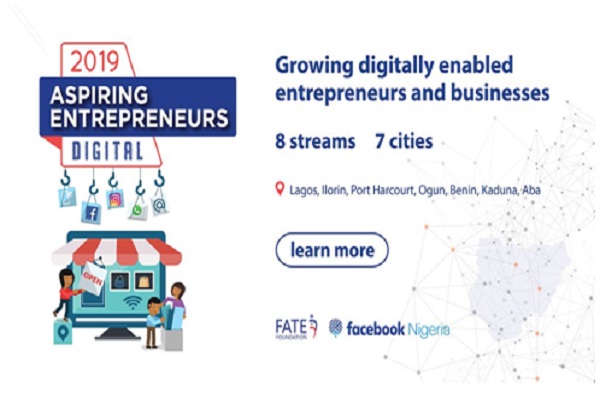
FATE Foundation, Nigeria’s foremost enterprise knowledge and development organization in collaboration with Facebook, announced the implementation of the second Series of the FATE Foundation Aspiring Entrepreneurs Digital Programme (AEP-Digital)in seven cities across Nigeria.
With the AEP-Digital program, FATE Foundation and Facebook will provide the foundational entrepreneurial knowledge that is relevant in an ever-growing digital climate, with each of the eight streams of the program running for four weeks.
Following the first stream of the program, which was completed in Lagos, the AEP-Digital train is on the move to Ilorin and will continue to all the other target cities before the end of the year.

The program is inspired by the need to contribute to wealth and job creation in Nigeria by fostering new business developments.
All this stems from the research on sustainability of startups in Nigeria which indicates that entrepreneurs struggle to survive their first five years of business because they lack the fundamental business knowledge regarding accounting, finance, marketing, human resource management and other aspect of a successful business structure.

FATE Foundation in Ilorin.
Adenike Adeyemi, Executive Director, FATE Foundation, said that, “The advent of social media and its effect on digital marketing, customer service, people management, market and competitor research, as well as other digital solutions for accounting and payment management, have added to the relevance of a digital component to the training which has only resulted in enhancing and deepening the richness and impact of the program which is one of the reasons for the partnership with Facebook”.
She added that research has shown that startup businesses are essentially in search of viable business models during the teething stage characterized by problems arising from the absence of the right processes and structures for their business.
The program goes further to provide support regarding funding linkages, access to markets, and growth strategies among others in class sessions.
The target cities; Lagos, Ilorin, Port Harcourt, Benin, Abeokuta, Kaduna and Aba, were selected to enable more entrepreneurs around Nigeria have access to these much-needed, best-practice entrepreneurial know-how particularly for businesses in the Nigerian context, as well as provide research-driven support for businesses to start, grow and scale.
Prospective applicants can visit the FATE Foundation website: www.fatefoundation.org/aep, for more information on application, commencement and closing dates and follow them on all their social media platforms for regular updates.



Airtel Nigeria has secured a fresh 10-year renewal of its spectrum licence from the Nigerian Communications Commission (NCC), reinforcing the telecom operator’s long-term commitment to expanding broadband connectivity and improving digital access across the country.

The renewed licence covers Airtel’s spectrum holdings, which are critical to the delivery of voice and high-speed data services, providing regulatory certainty for continued investments in network expansion, capacity upgrades and improved customer experience.
According to the company, the renewal underscores confidence in Nigeria’s telecommunications sector and will support its ongoing efforts to bridge the country’s digital divide by extending quality connectivity to more underserved communities.
Sunil Taldar, chief executive officer, Airtel Africa, said the renewal provides the company with the confidence to continue investing in Nigeria’s digital infrastructure.
He said, “The spectrum renewal reaffirms our long-term commitment to Nigeria, our largest market. It gives us the certainty required to continue investing in network expansion, improve service quality and accelerate digital inclusion for millions of Nigerians.”
Taldar added that Airtel remains focused on expanding broadband access and supporting Nigeria’s digital economy agenda through sustained investments in telecommunications infrastructure.
He further said, “We appreciate the Nigerian Communications Commission and the Federal Government for their continued support in creating an enabling environment for investment. We remain committed to delivering reliable and affordable connectivity while contributing to Nigeria’s socio-economic development.”
Meanwhile, Industry observers said the licence renewal removes regulatory uncertainty and allows Airtel to pursue long-term capital investments, including the expansion of 4G and 5G networks, as demand for mobile data and digital services continues to grow across Nigeria.
The renewal comes as telecom operators continue to invest heavily in broadband infrastructure to meet rising data consumption and support government efforts to achieve Universal digital access.
Furthermore, It also aligns with the NCC’s objective of ensuring efficient spectrum management while encouraging sustained private sector investment in the country’s telecommunications industry.
Telecom
GSMA Supports Abuja Declaration on Meaningful Connectivity for Africa, Joins Partners to Launch ATLAS Umoja

The GSMA supports the Abuja Ministerial Declaration on Meaningful Connectivity for Africa by Ministers and Heads of Delegation at the African Telecommunications Union (ATU) Conference of Plenipotentiaries (CPL-2026), describing it as an important milestone in strengthening Africa’s digital future through evidence-based policy, investment and regional collaboration.

The Declaration commits African governments to advancing policies that promote meaningful connectivity, digital inclusion, technology-neutral regulation, resilient digital infrastructure and locally relevant digital services. It also reinforces the importance of collaboration between governments, industry and development partners to close the continent’s connectivity and usage gaps.
Throughout the conference, the GSMA has worked alongside governments, regulators and industry leaders to support these shared ambitions through practical policy engagement, evidence-based research and new collaborative initiatives designed to accelerate Africa’s digital transformation.
Speaking during the ATU-GSMA African ICT Regulatory Leaders’ Forum, policymakers and regulators explored how stronger evidence-based regulation, greater regulatory harmonisation and future-ready policy frameworks can create an enabling environment for investment, innovation and sustainable digital growth across Africa. Drawing insights from the GSMA’s Digital Africa Index, participants also examined future-ready approaches to satellite regulation, highlighting how technology-neutral licensing frameworks can support innovation while extending connectivity to underserved communities.
Caroline Mbugua, Senior Director, Public Policy, Africa, GSMA, said: “The Abuja Ministerial Declaration sends an important signal that African governments share a common vision for delivering meaningful connectivity through modern, evidence-based and investment-friendly policy. Its emphasis on digital inclusion, technology-neutral regulation, resilient infrastructure and stronger regional collaboration reflects the practical policy foundations needed to accelerate Africa’s digital transformation.”
Launching ATLAS Umoja AI
Supporting the ambitions set out in the Abuja Declaration, the GSMA, Nigeria’s Ministry of Communications, Innovation and Digital Economy, Togo’s Ministry of Digital Economy and Transformation, Kenya’s Ministry of information, Communications and the Digital Economy, Namibia’s Ministry of Information and Communication Technology, Benin’s Ministry of Digital Transformation and Innovation, Awarri, Zindi, Pawa AI and Mozisha today announced ATLAS Umoja AI –a new pan-African initiative to strengthen collaboration on African language AI.
Designed to complement national AI programmes, ATLAS Umoja will bring together governments, industry and researchers to share expertise, datasets and best practice, helping develop trusted, scalable AI that better reflects Africa’s languages, cultures and development priorities. The initiative aims to accelerate innovation, attract investment and scale African language AI across the continent.
The launch builds on the momentum of the newly established AI for Good Global Commission. Ministers from Nigeria, Namibia and Togo, who serve on the Commission, have committed to support Africa Umoja, demonstrating how African leaders are turning global ambitions for trusted and inclusive AI into practical regional collaboration.
Angela Wamola, Head of Africa, GSMA, said: “Africa’s AI future must reflect Africa’s own languages, communities and development priorities. ATLAS Umoja brings together governments, industry, researchers and innovators to build African language AI at scale. By making AI and digital services available in the languages people speak every day, the initiative will help tackle two of the biggest barriers to internet adoption – digital literacy and locally relevant content – supporting efforts to close Africa’s usage gap and expand meaningful connectivity across the continent.”
Dr. Bosun Tijani, Honourable Minister of Communications, Innovation and Digital Economy of Nigeria said:“Artificial Intelligence will be a defining technology for Africa’s future, but its benefits must be built on our own languages, cultures and knowledge systems. Nigeria is proud to have taken the first step through N-ATLAS and is equally proud to see that vision evolve into the continental ATLAS Umoja AI.
“By working together with governments, researchers and ecosystem partners across Africa, we can build AI that is more inclusive, locally relevant and accessible to millions of people, while strengthening Africa’s digital sovereignty and creating new opportunities for innovation, education and economic growth.”
Silas Adekunle, Founder & CEO, Awarri added: “Awarri is proud to support The ATLAS Umoja AI and contribute lessons from N-ATLAS, which has demonstrated what is possible when African language data, local technical talent and practical AI applications are brought together. This is an important opportunity to help build AI systems that work for African languages and communities.”
Celina Lee, CEO & Co-Founder, Zindi concluded: “Africa’s AI future will be built by the people who best understand its languages, cultures and communities. Through ATLAS Umoja AI, we have an opportunity to empower local researchers, data scientists and developers to solve meaningful challenges, strengthen national AI capabilities and ensure African language AI is developed by Africans, for Africans.”
Alongside the launch of ATLAS Umoja AI, the GSMA continued discussions with policymakers at the ATU Conference on future-ready regulatory frameworks, including satellite connectivity, spectrum policy and technology-neutral licensing.
Drawing on the GSMA Satellite Regulatory Playbook, discussions explored how modern regulation can encourage investment, expand meaningful connectivity and support the ambitions of the Abuja Declaration.
Together, the Abuja Declaration, ATLAS Umoja and continued collaboration between governments, regulators and industry represent an important step towards expanding meaningful connectivity, accelerating digital inclusion and supporting Africa’s digital transformation.

Samsung has unveiled its most advanced foldable smartphone lineup yet, the Galaxy Z Fold8 Ultra, Galaxy Z Fold8, and Galaxy Z Flip8. The tech conglomerate now sets a new benchmark for premium mobile innovation.

Konga
Nigerian customers can now pre-order the new devices on Konga, Samsung’s trusted e-commerce partner, and stand a chance to receive Samsung gift items worth up to ₦1 million, making this one of the most rewarding smartphone launches of the year.
Designed for productivity, creativity, and everyday convenience, the new Galaxy Z series introduces Samsung’s most refined foldable experience to date.
The Galaxy Z Fold8 Ultra combines an expansive display with AI-powered productivity, a powerful 200MP camera, an ultra-thin design, and enhanced durability for users who demand the very best.
The Galaxy Z Fold8 delivers immersive entertainment and seamless multitasking in a lighter, wider form factor, while the Galaxy Z Flip8 elevates self-expression with its sleek design, smarter FlexWindow, and intelligent Galaxy AI features for effortless interaction on the go. Powered by Samsung’s latest AI experiences, the new devices redefine how users create, communicate, and stay productive.
The availability of the new Galaxy Z Fold8 series on Konga further reinforces the long-standing partnership between Samsung and Konga, built on trust, authenticity, and a shared commitment to delivering genuine technology to Nigerian consumers. Through Samsung’s official store on Konga, customers are assured of authentic products, reliable after-sales support, and a seamless shopping experience.
The pre-order offer is available for a limited period. To be one of those who get to experience the new device, tech enthusiasts are encouraged to visit Konga’s Samsung Official Store to reserve their preferred Galaxy Z Fold8 or Z Flip8 device and qualify for exclusive Samsung gifts worth up to ₦1 million, while stocks last.

HURIWA, CLO Protests Bill Asking Social Media Firms’ to Open Shops Nigeria

Anambra Govt Bans Graduation Ceremonies in Anambra Schools

Airtel Secures Another 10-year Spectrum Renewal in Nigeria

Moniepoint as a Key Driver in Expanding Financial Access for Businesses in Nigeria

Nigeria, Israel Strengthen Research, Technology Collaboration

NRC, Ponzi Scheme Collapses Resulting Loss of Billions of Naira

NASENI Moves to Digitize CCB’s 5m Assets Declaration and Operations

Tokenization, Blockchain Technology will Transform Financial Institutions – IMF

EFCC Busts NIS Visa Overstay Racket, Uncovers N700m in an Account

From Scarcity to Scale: What Africa Can Learn from India’s Agricultural Transformation




 E-Financial2 days ago
FG Says Rumours, Fear, Can Crash Banks

 Telecom2 days ago
Court Dismisses Pan African Towers’ Bid to Halt Ex-CEO’s Suit, Awards ₦500,000 Costs

 E-Business2 days ago
Kaspersky Warns of a Phishing Campaign Abusing Microsoft Authentication Mechanism

 Telecom2 days ago
Telcos Seek Clear Regulatory Framework on Airtime Credit Services

 Telecom2 days ago
MTN Nigeria Announces 2026 mPulse Spelling Bee, Opens Entries for Students Nationwide

 Telecom2 days ago
MTN Warns Customers against Fake Promo

 News2 days ago
IMF Sees 4% AI Growth Boost for Africa

 E-Financial2 days ago
EU Debunks Fake Compensation Scheme Targeting West African Bank Customers