

E-Financial
FG Borrows N473Bn in 4 Months to Finance Budget

Federal government has borrowed the sum of N473 billion in the past four months to finance this year’s budget and not released any funds for capital expenditure, as lower oil prices eat into its revenues.
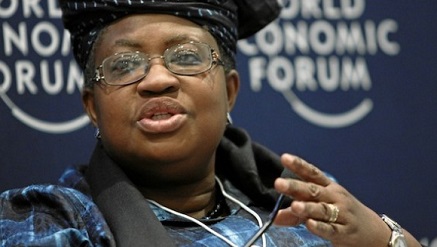
Dr. Ngozi Okonjo-Iweala, minister of Finance, who stated this during a media briefing on the budget, which was passed by the National Assembly last week said that despite the fact that the budget had not been signed into law by President Goodluck Jonathan, the constitution allowed the Executive to incur expenditure within the first six months into the fiscal year.
Later in an emailed statement to Reuters, the minister said that “We have serious challenges,”
“Things have been tough since the beginning of the year and they are likely to remain so till the end of the year.”
The borrowed money has been spent to cover overhead, including salaries, the minister said.
Lawmakers in Africa’s biggest economy and oil producer last week passed a 4.49 trillion naira ($23 billion) budget for 2015, 3.2 percent lower than last year’s spending plans. It was forced to cut spending after global oil prices slumped.
The budget took longer than usual getting through parliament, worsening the cash squeeze, because of the closely fought general elections in March, which saw incumbent President Goodluck Jonathan defeated.
“As a result of the 50 percent decline in oil revenues, the country has faced a difficult cash crunch … Out of the 882 billon naira budgetary provision for borrowing, the government has borrowed 473 billion naira to meet up with recurrent expenditure,” the finance ministry said.
Okonjo-Iweala had projected annual domestic borrowing last year would fall to below 500 billion naira from 577 billion naira in 2013.
The borrowing requirement this year could crowd out lending to the real economy, raising domestic interest rates and yields on government bonds, which could hurt growth. Forecasts for growth have already been lowered twice this year.
The ministry said that inflation is still in single digits and that the Nigerian economy is projected to grow by 4.8 percent this year.
Government revenues have shrunk sharply since oil sales account for up to 80 percent of them and its currency, the naira, has weakened drastically, despite the central bank’s spending billions of U.S. dollars to prop it up.
The lack of funds for capital expenditure means badly needed infrastructure development will be put on hold. Funding for large projects such as bridges and roads had already begun to dry up in 2014, forcing construction firms companies with government contracts to cut back and fire thousands of workers.


Polaris Bank has joined the global community in celebrating International Women’s Day 2026, reaffirming its commitment to promoting gender equality, empowering women, and supporting initiatives that foster inclusive growth across society.

Polaris Bank
International Women’s Day, celebrated annually on March 8, provides an opportunity to recognize the achievements of women across all sectors while highlighting the need to accelerate action towards gender equality. At Polaris Bank, the day serves as a reminder of the vital role women play in driving economic growth, innovation, and community development.
Speaking in commemoration of the day, the Managing Director/CEO of Polaris Bank, Kayode Lawal, emphasized the Bank’s commitment to creating an enabling environment where women can thrive professionally and financially.
“Polaris Bank remains dedicated to fostering a culture of inclusion, opportunity, and empowerment for women. From supporting female entrepreneurs to ensuring equal opportunities within our workforce, we believe empowering women is not only the right thing to do but also a key driver of sustainable development,” the CEO stated.
Over the years, Polaris Bank has implemented several initiatives aimed at supporting women-led businesses, promoting financial inclusion, and strengthening leadership opportunities for women within the organization. These efforts align with the Bank’s broader commitment to sustainable development and inclusive economic growth.
As part of this year’s celebration, the Bank will spotlight inspiring stories of hope from women across the community, within its workforce and customer base, while encouraging meaningful conversations around leadership, financial empowerment, and gender equity.
Polaris Bank continues to champion initiatives that create opportunities for women to succeed, recognizing that empowering women ultimately leads to stronger families, thriving communities, and a more resilient economy.

Benedict Ikechukwu Anekwe, an Enugu-based lawyer, and C.K.C. Idu, a magistrate, have been accused of allegedly conspiring to fraudulently withdraw ₦3.5million from the corporate account of Ohha Microfinance Bank Limited through what the bank described as a manipulated garnishee court process.

Ohha Microfinance Bank is a financial institution based in Enugu, Nigeria, committed to providing accessible and reliable banking services to individuals and small businesses
Ohha Microfinance Bank in a petition dated March 6, 2026 and submitted to the Chief Justice of Nigeria and Chairman of the National Judicial Council, demanded disciplinary action against the lawyer and the magistrate.
In the petition signed by Philip Onwukwe, managing director of the bank, the institution accused Anekwe of “using the instrumentality of the court to steal” from its corporate account.
“We write to you… seeking your urgent intervention and action in respect of this complaint which borders on fraud, stealing and unprofessional conduct of Benedict Ikechukwu Anekwe Esq.,” the petition read.
According to the petition, the controversy began with a judgment delivered on July 11, 2025 by Chief Magistrate O.P. Okoro in Enugu in Suit No. CME/1087/2023, involving Okoye Sunday and Ifesinachi Nnam.
The court reportedly awarded ₦2.5 million in favour of Okoye Sunday.
To enforce the judgment, Anekwe filed garnishee proceedings against 14 banks, including Ohha Microfinance Bank, seeking to attach funds belonging to the judgment debtor, Ifesinachi Nnam.
On July 29, 2025, the court issued an Order Nisi directing banks to attach any money belonging to the debtor.
The order stated that: “All monies in possession of the Garnishees belonging to Ifesinachi Nnam… be attached to satisfy the judgment sum of ₦2,500,000 together with the cost of this garnishee proceedings.”
However, the bank said the order applied strictly to the account of the judgment debtor and not to the corporate account of the bank itself, moreover, the judgement debtor has no financial account with the bank.
“It is crystal clear from the wordings of the Order that the Order Absolute made by His Worship Okoro was made against the account of Ifesinachi Nnam… but not against the corporate account of Ohha Microfinance Bank Limited,” the bank said.
The bank alleged that instead of serving the order on the bank to verify whether the judgment debtor had an account with it, Anekwe allegedly initiated another garnishee action directly against the bank before a different magistrate.
The fresh suit, CME/1554M/2025, Okoye Sunday v. Ohha Microfinance Bank Ltd, was filed before Magistrate C.K.C. Idu, his close associate, after the judgement debtor had filed notice of appeal and got a stay of execution in the previous court.
The petitioner explained that despite the pending appeal and stay of execution, on October 10, 2025, Magistrate Idu granted another Order Nisi attaching ₦3.5 million from the bank’s corporate account held with Ecobank Plc.
The bank said neither the plaintiff nor the judgment debtor had any account relationship with the microfinance institution, wondering how a Magistrate could issue such an order.
“Ohha Microfinance Bank has no business relationship with the judgment creditor and the judgment debtor in the suit,” the petition stated.
It added that both Okoye Sunday and Ifesinachi Nnam “are not customers of Ohha Microfinance Bank Ltd.”
Upon discovering the court order, the bank’s lawyer filed a motion asking the court to set aside the garnishee order, arguing that it was obtained through misrepresentation.
The motion stated that the order wrongly targeted the corporate funds of the bank rather than the account of the judgment debtor.
However, according to the petition, Magistrate Idu refused to vacate the order.
Instead, on February 27, 2026, the magistrate reportedly made the order absolute and authorised the withdrawal of ₦3.5 million from the bank’s account.
The bank further alleged that after securing the court order, Anekwe personally served it on Ecobank and instructed the bank to transfer the funds to his personal account.
“That same day, the learned Chief Magistrate signed the Order Absolute and handed it over to Benedict Anekwe Esq., who rushed to Ecobank Plc and served the order,” the petition stated.
The lawyer allegedly followed up with a written instruction directing the bank to pay the money into his personal account at First Bank of Nigeria instead of a client account.
Ohha Microfinance Bank alleged that the magistrate and the lawyer acted in concert to perpetrate the alleged fraud.
“This is daylight stealing perpetrated by Benedict Ikechukwu Anekwe Esq.,” the petition stated.
The bank further alleged that Magistrate Idu ignored the clear wording of the earlier judgment issued by Magistrate O.P. Okoro, which targeted only the debtor’s account.
It also claimed that both men had previously worked together before the magistrate’s appointment to the bench.
“Our findings reveal that the learned magistrate C.K.C. Idu before his appointment worked together at CIDJAP Legal Department with Benedict Anekwe Esq., hence the reason he connived with him to perpetrate this fraud,” the bank alleged.
The bank has asked the National Judicial Council to investigate the matter and sanction both the lawyer and the magistrate.
It also demanded that the matter be referred to the Legal Practitioners Disciplinary Committee.
“We demand that this matter be referred to the Legal Practitioners Disciplinary Committee for immediate and necessary action,” the petition stated.
The bank further demanded an immediate refund of the ₦3.5 million allegedly withdrawn from its corporate account.
“We further demand that Benedict Anekwe Esq. refund immediately the sum of ₦3.5million he stole from our corporate account,” the petition added.
Efforts to reach the lawyer and the magistrate were unsuccessful, as both failed to answer multiple calls.
They also did not respond to text messages sent to their verified telephone numbers seeking their reactions.
Credit: SaharaReporters


Quest Merchant Bank Limited has successfully met the ₦50 billion minimum capital requirement mandated for merchant banks by the Central Bank of Nigeria (CBN) strengthening the Bank’s capital base and reinforcing its capacity to support Nigeria’s economic transformation.

This milestone reflects investors’ continued confidence in the Bank’s long-term strategy, strong governance, and sustainable growth outlook. It also marks an important step in the Bank’s post-divestment evolution under its new ownership, positioning Quest Merchant Bank with the balance-sheet strength needed to execute its next phase of growth.
With a significantly enhanced capital base, Quest Merchant Bank is now better positioned to underwrite larger transactions and expand its advisory, capital markets, and structured financing capabilities across priority sectors of the Nigerian economy.
The CBN’s recapitalisation directive, which sets ₦50 billion as the minimum capital threshold for merchant banks, is designed to reinforce the resilience, stability, and lending capacity of Nigeria’s financial system.
By meeting this benchmark, Quest Merchant Bank reinforces its standing as a trusted financial partner in infrastructure, energy, manufacturing, and corporate growth initiatives nationwide.
Afolabi Olorode, Acting Managing Director and Chief Executive Officer of Quest Merchant Bank, described the achievement as a defining moment in the Bank’s evolution: “This milestone marks a significant step forward for Quest Merchant Bank. Meeting the ₦50 billion capital requirement underscores investors’ confidence in our strategy and reflects the strength of our governance and franchise.
“With this strengthened capital position, we are equipped to play an even greater role in financing key sectors of the Nigerian economy, enabling private enterprise, and supporting sustainable economic expansion.
“Our focus remains clear. We will continue to continue to help our clients succeed, while serving as a trusted long-term partner in delivering sustainable growth.”
Quest Merchant Bank remains committed to responsible growth, innovation, and delivering strategic financial solutions that empower businesses and institutions across Nigeria.

First Batch of Nigerian Undergraduates Emerged in Airtel Africa Foundation Scholarships Programme

Mojisola Sayo-Kazeem Reflects on Leadership, Opportunity, Women in Tech @ IWD

Experts Weigh Blockchain Option for Nigeria’s Elections Process

CBN Affirms Alpha Morgan Bank’s Capitalisation

Dimension Data Nigeria Seals N20bn Bond Deal to Bridge Digital Infrastructure Gap

Dr. Cairo Ojougboh Foundation Bolsters Nigeria’s Education Drive with ₦2.7m Student Support

Kaspersky Brings more Transparency to Threat Detection with New Hunt Hub

Kaspersky Discovers New Phishing Campaign Exploiting Google Tasks Notifications to Steal Corporate Credentials

esentry 2025 Report Shows Healthcare, Financial Services and Telecoms as Staging Grounds for Increased Cyberattacks in Africa

AfDB, UNDP Launch $10Bn AI Initiative for Africa




 E-Business2 days ago
Police Says Victims Enable Cyber Attacks Out of Ignorance

 E-Financial2 days ago
Quest Merchant Bank Achieves CBN Regulatory Recapitalisation Milestone

 General News2 days ago
FG Launches NERD to Combat Certificate Fraud

 E-Financial2 days ago
Bank Accuses Magistrate, Lawyer of Using Fake Order to Steal N3.5m from Account

 Telecom2 days ago
Cassava Launches Sovereign Cloud for Africa’s Public Sector

 News2 days ago
FG Can Now Track, Prosecute Visa Overstayers – Interior Minister

 General News2 days ago
Goodnews Naija Launches ‘Building in Nigeria’ Series on Entrepreneurs, Real Sector Builders

 News2 days ago
NCDC Issues Public Advisory on Cerebrospinal Meningitis