

Telecom
FG Launches Capacity Building Programme for Indigenous Startups

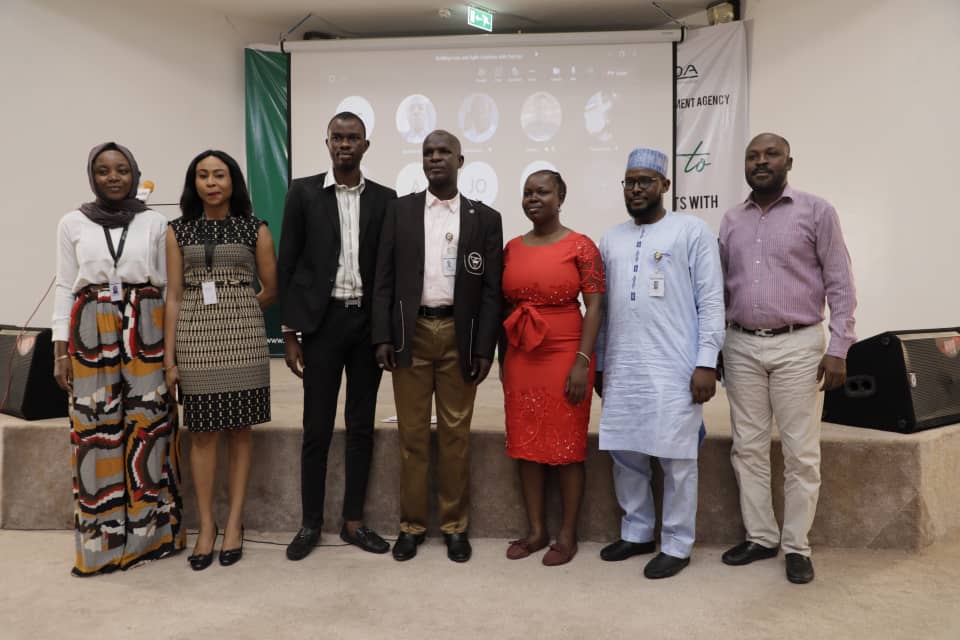
The National Information Technology Development Agency, NITDA through one of its subsidiaries, Office for Nigerian Digital Innovation (ONDI), in collaboration with Lotus Beta Analytics Nigeria Limited has commenced a Capacity Building Program for Vibrant Startups with the aim of supporting their Innovative capacities.

Representative of the Director General National Information Technology Development Agency NITDA Kashifu Inuwa CCIE, Engr Salisu Kaka flanked by some of the Participants of the Capacity Building Workshop on Lean and Agile Products with DevOps organized by the Agency.
Held at the Public Service Institute (PSIN) Kubwa, Abuja, the training centered on Modernization of Legacy Solutions, Migration of On-Premises Business Solutions to the Cloud, Development of Cloud Applications and driving exponential revenue growth.
Kashifu Inuwa, Director General of NITDA, said the Capacity Building will help the Agency achieve its goal of creating more Innovation do Enterprises (IDEs) in line with the objectives of Digital Innovation and Entrepreneurship Pillar.
Represented by Engr Salisu Kaka, Acting Director of Digital Economy Development Department, NITDA, noted that it was borne out of the Agency’s desire of ensuring the successful implementation of the Present Administration’s National Digital Economy Policy and Strategy for a Digital Nigeria (NDEPS) within the stipulated period.
Adding that, “the sudden increase in demand for software and online web-based applications among businesses as necessitated by the COVID-19 outbreak had a positive impact on the growth of DevOps market and led to the growing need of DevOps solution among businesses to streamline the process of software application development by promoting collaboration between various entities of software development lifecycle.
Additionally, the rise in need for continuous and fast application delivery and increase in focus on reducing Capital Expenditures (CAPEX) and Operating Expenses (OPEX) drive the growth of the DevOps market.
” The global DevOps market size was valued at US$6.78 billion in 2020 and is projected to reach US$57.9 billion by 2030.
“Therefore, this collaboration is apt and timely in ensuring that our startups benefit from the DevOps market growth” he explained.
He urged participants to make the best use of the opportunity to tap into the growing DevOps market by ensuring that all learnings are translated into meaningful use to scale their businesses and contribute to the nation’s economic growth.
On his part, Mr Ademola Akinbode, Managing Director, Lotus Analytics, who featured virtually said the programme will serve as a springboard to groom tech startups,is also expected to develop Nigeria’s Tech ecosystem.
Also in her goodwill message, representative of Nigeria Country Director Microsoft, Mrs Edu-Abasi Chukunweike, lauded the initiative, while pledging Microsoft’s readiness to providing the platform required to develop indigenous startups.



Bosun Tijani, minister of Communications, Innovation and Digital Economy, yesterday claimed that bandits and terrorists are able to communicate and coordinate their activities with ease because they exploit gaps in the country’s telecommunications network.

Bosun Tijani, minister of Communications, Innovation and Digital Economy,
Tijani, who spoke Politics Today, a Channels Television’s programme, on Friday, Tijani said the criminals exploit gaps in the country’s telecommunications network.
He also claimed the bandits use advanced technology to bounce calls across multiple towers in areas with poor connectivity.
“They weren’t using the normal towers; they bounced calls off multiple towers, which is why they favor areas that are largely unconnected,” he said.
When asked about reports that unregistered or fraudulently registered SIM cards are still in use despite the Bank Verification Number (BVN) and the National Identification Number (NIN)–Subscriber Identity Module linkage policies, Tijani said the issue is technically complex and the reports are not fully verified.
“Whether it’s fact or not, I do not know where you’re getting that from, and I do not know who has evidence that there are people with unregistered SIMs,” he added.
The minister stated that the federal government is investing in telecom towers in underserved regions, upgrading the country’s communication satellites to improve coverage, and expanding fiber-optic networks to strengthen the country’s digital infrastructure.
“If our towers are not working, our satellites will work. Nigeria is the only country in West Africa with communication satellites, and we are bringing new satellites to upgrade their capabilities,” Tijani said.
He added that these initiatives aim to ensure better connectivity for Nigerians while closing loopholes that criminals exploit, thereby enhancing national security.
The minister’s comments come amid rising concerns over insecurity in several parts of the North, where banditry, kidnapping, and terrorism have escalated in recent years.
There are also reports of bandits flaunting ransom payments on social media platforms such as TikTok, raising alarm among authorities and the public

Central Bank of Nigeria (CBN) on Thursday announced plans to partner with the Nigerian Communications Commission (NCC) to develop an industry-wide short code for consumers to lodge complaints with financial institutions anytime, anywhere, even without internet access.

CBN
Dr Aisha Isa-Olatinwo, CBN Director, Consumer Protection and Financial Inclusion Department, disclosed this at a virtual Consumer Protection Town Hall meeting titled “Ask the Regulator”, organised by Enhancing Financial Inclusion and Advancement (EFInA).
She said the initiative addresses challenges faced by vulnerable consumers using feature phones who often have to visit bank branches physically to report issues amid the convergence of telecom and banking services.
Isa-Olatinwo said the CBN had achieved 94 per cent month-on-month timely resolution of consumer complaints, adding that the apex bank had streamlined processes and partnered with banks to balance consumer protection with financial system stability.
An EFInA poll presented at the event revealed that 61 per cent of respondents experienced failed transactions in the past 12 months, while 26 per cent had reversals within 24 hours and 54 per cent between 24 and 48 hours.
Other complaints included six per cent for fraud, 14 per cent for hidden charges and 15 per cent for poor customer service, with 66 per cent of respondents aware of complaint escalation steps.
President of Consumer Advocacy Foundation of Nigeria (CAFON), Mrs Sola Salako-Ajulo, lamented that consumers often feel unprotected and urged introduction of fraud insurance for instant reversals, shifting the burden of proof from customers.
She said: “What is missing in our system—unlike more developed economies—is fraud insurance, where banks reverse reported fraud immediately, refund consumers, and investigate later.”
Mr Ajibade Laolu-Adewale, Chairman of Committee of e-Business Industry Heads (CeBIH), represented by Mr Adeyemi Salisu, stressed that banks must resolve disputes between acquiring and issuing banks without redirecting customers to merchants.
The short code initiative is expected to enhance financial inclusion by providing accessible redress mechanisms in Nigeria’s evolving digital payment ecosystem.

CyberSafe Foundation, with funding support from Google.org will launch Resilio Africa, a 3-year cybersecurity resilience project that aims at reducing the growing risks of cyberattack in institutions and communities across Sub-Saharan Africa.

CyberSafe
The project will strengthen the cyber resilience of 200 Critical Community Institutions (CCIs) in the region through provision of free technical tools, assessments, threat intelligence and incident response frameworks. With this intervention, Resilio Africa aims to protect over 2 million people and secure more than 15 million public records in Nigeria, Kenya, Ghana, and South Africa, marking one of the most ambitious community-building efforts in Africa’s cybersecurity ecosystem.
“At Google.org, we believe that access to secure digital systems is a cornerstone of inclusive growth,” said Haviva Kohl, Senior Program Manager, Google.org. “Our support for CyberSafe Foundation’s CCI cybersecurity efforts reflect our shared commitment to empowering communities and protecting the institutions that serve them. Resilio Africa will help ensure that essential community organizations can operate safely and confidently in an increasingly digital world.”
Identifying the challenges across sub-Saharan Africa, a brief by CyberSafe Foundation noted that critical community infrastructure in the region is increasingly targeted by cyberattacks, with inadequate resources available to tackle them. “These institutions collect, process, and store vast amounts of sensitive personal
data, yet most lack the corresponding cybersecurity maturity. Many operate on outdated systems, with limited cybersecurity capacity, low awareness of digital threats, and zero security budgets. According to INTERPOL, Africa experienced a 23% increase in ransomware attacks in 2023, with public and nonprofit institutions among the most impacted.”
Further citing data from the International Telecommunication Union (ITU)’s Global Cybersecurity Index, the statement said that more than 60% of African countries fall into the “low commitment” category regarding national cybersecurity readiness. This contributes to limited institutional cybersecurity capacity, low awareness of digital threats, and little to no dedicated security budgets.
“As services become more digitized, this creates a dangerous gap that cybercriminals are actively exploiting through ransomware, phishing, data breaches, and DDoS disruptions, compromising public services, exposing sensitive data, and eroding public trust,” it said.
“In Kenya alone, over 114 CCI-targeted cyberattacks were recorded in the first eight months of 2024, followed by a 201% increase in cyber incidents by Q1 2025. In Nigeria, key government and healthcare systems still operate over unencrypted communication protocols. Institutions in Ghana and South Africa face similar threats but often lack the capacity to respond effectively. This widespread vulnerability exposes millions of citizens to both digital and physical harm.
Despite emerging national strategies, policy formulations and growing political will in the region, most CCIs are under-resourced and under-protected. Without immediate, scalable, and context-specific interventions, the region risks a surge in cyber incidents that could significantly disrupt essential community services.
Resilio Africa will strengthen cyber resilience of 200 CCIs through technical tools, assessments, customized playbooks and incident response frameworks; provide over 10,000 hours of pro bono cyber consulting to support CCI teams, build human capacity by delivering tiered training for executives, IT teams, and general staff with over 4500 employees and decision-makers trained; protect over two million people; and secure more than 15 million public records in Nigeria, Kenya, Ghana, and South Africa.
“Africa’s digital transformation cannot succeed if our communities remain vulnerable,” said Confidence Staveley, Founder and Executive Director of CyberSafe Foundation.
“With Google.org’s support, we are scaling a proven model of capacity-building that will help critical institutions become resilient, safeguard the people they serve, and preserve trust in digital public systems.”
Application to the initiative is open and CCIs eligible to participate are to complete an online interest form guided by instructions on the website, www.resilio.cybersafefoundation.org.

NCC Blocks Piracy Sites as Nollywood Faces Rising Digital Theft

Minister Claims Bandits Exploit Poor Network, Bounce Calls Off Multiple Towers

FIRS says MOU with DGFIP Won’t Compromise Nigeria Tax Data Sovereignty

Top Nigerian Startups Secure Funding Boost @ iHatch Demo Day Awards

Four Must-Watch African Films Debut Free on Glo TV

Kaspersky Introduces Cyber Pathways to Support Career Development in Cybersecurity

Firm Urges Organizations to Check Protection of their Websites Amid Search Engine Optimisation Attack Schemes

FCCPC Sets Deadline for Digital Lending Regulatory Compliance

Hackers Breach Phones of Dangote and Otedola, Demand Ransom

Banks Lost N3.3Bn to Fraud in Q1 of 2025 – FITC




 Telecom2 days ago
Airtel Africa Foundation Opens Undergraduate Scholarship Portal in Nigeria

 E-Financial2 days ago
Ecobank Nigeria to Fully Repay $300m Eurobond Ahead of Schedule

 Broadcasting2 days ago
CKay’s “Love Nwantiti” Crosses Billion-Stream Mark on Spotify

 Telecom2 days ago
YouTube Nigeria Unveils 2025’s Top Lists and Launches New YouTube Recap Feature

 E-Financial2 days ago
Reps Give Banks Four-Day Ultimatum on Tax Deductions, Charges

 General News2 days ago
PalmPay MD Seeks Deeper Financial Inclusion @ CeBIH Annual Conference 2025

 General News2 days ago
AI-Powered Fraud Drives Global Race for Deepfake Defenses

 Telecom1 day ago
MTN Nigeria Launches Unlimited 5G Broadband Plans to Boost Digital Inclusion