

E-Financial
FG Seeks Fresh $500m World Bank Loan for MSMEs


Federal government is seeking a fresh $500m loan from the World Bank to expand access to finance for micro, small, and medium enterprises (MSMEs) across the country.

The proposed facility, titled Fostering Inclusive Finance for MSMEs in Nigeria (FINCLUDE) Project, aims to mobilise private capital and promote innovative financial products for small businesses.
According to a project document obtained from the World Bank, the loan will help deepen credit access through the Development Bank of Nigeria and its subsidiary, Impact Credit Guarantee Limited.
“The proposed FINCLUDE Project leverages the platforms of the Development Bank of Nigeria (DBN) and its subsidiary, the Impact Credit Guarantee Limited, to drive inclusive MSME finance,” the World Bank stated.
“Through these catalytic institutions, the project will deploy a package of complementary, inclusive, and innovative instruments tailored to the diverse needs of MSMEs in Nigeria.”
The total cost of the project is estimated at $2.39bn, out of which $500m will be financed by the World Bank. Of the amount, $400m will come from the International Bank for Reconstruction and Development (IBRD) and $100m from the International Development Association (IDA).
The International Bank for Reconstruction and Development and the International Development Association are the two main lending arms of the World Bank Group.
While the IBRD provides loans on near-market terms to middle-income and credit-worthy low-income countries, the IDA focuses on the world’s poorest nations by offering concessional financing and grants funded by donor contributions rather than commercial borrowing.
The remaining $1.89bn will be provided by commercial lenders as unguaranteed financing. The Federal Government will serve as the borrower, while the Development Bank of Nigeria will act as the implementing agency with overall responsibility for managing the funds.
The World Bank noted that “DBN is a partner well known to the World Bank with high implementation capacity and a proven track record in designing and executing complex, innovative projects.”
The project, which is expected to be approved on December 18, 2025, comprises three components: inclusive and innovative MSME finance products; de-risking and mobilising private capital through partial credit guarantees; and technical assistance for modernising and digitising the MSME finance ecosystem.
Under the first component, the World Bank said the project would provide Tier 2 subordinated capital to eligible financial institutions and support the establishment of an MSME investment fund to provide equity and long-term debt to small businesses.
The bank explained that the initiative would help “crowd-in private capital, test market innovations and promote financial sustainability” in Nigeria’s small business sector.
It said the project would also provide targeted technical assistance to strengthen the capacity of financial institutions, improve regulatory oversight, and modernise the MSME finance chain linking DBN, lenders, and entrepreneurs.
The World Bank appraisal report highlighted Nigeria’s ongoing economic reforms, describing the country as being “in a critical transition.” It said the removal of fuel and foreign exchange subsidies, along with the unification of exchange rates, had begun to stabilise the economy and restore investor confidence.
The report added, “These reforms have improved fiscal space, enhanced FX liquidity, and eased inflation to 18 per cent as of September 2025.
Growth prospects are strengthening, with the IMF projecting 3.9 per cent real GDP growth in 2025.”
Despite the reforms, the World Bank noted that access to finance remained uneven, particularly for small businesses, women, and agriculture.
It said agriculture accounted for just over five per cent of total bank credit in 2024, while high interest rates and limited credit penetration continued to constrain lending to smaller enterprises.
If approved, FINCLUDE will be the latest in a series of World Bank loans to Nigeria.
As of June 30, 2025, the country’s external debt stood at $46.98bn, according to figures from the Debt Management Office (DMO) .
The World Bank Group remains the country’s largest single creditor, accounting for $19.39bn, comprising $18.04bn from the IDA and $1.35bn from the IBRD.
This means the bank holds 41.3 per cent of Nigeria’s total external debt, underscoring its dominant role in financing the nation’s development programmes.


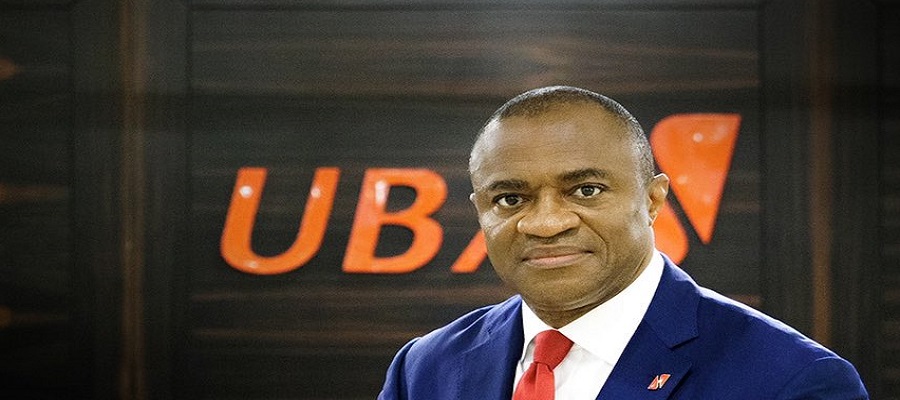
United Bank for Africa (UBA) has said that it has strengthened the security of transactions on its mobile application to stop fraudulent debits, unauthorised transfers and withdrawals.

Oliver Alawuba, Group Managing Director and CEO of United Bank for Africa
UBA announced this in a memo forwarded to its customers via email recently.
“We are pleased to inform you that we have further strengthened the security of transactions on the Mobile App.
“Updated authentication options now apply based on the value of transfers,” the memo reads in part.
UBA said in the memo that it had introduced authentication options for transactions of varying amounts to detect and prevent fraud.
According to the bank, transactions of N200,000 or more will now require customers to provide their Personal Identification Number (PIN) and a token number.
For transactions above N200,000 and N250,000, customers will be required to provide their PIN and a One-Time Password (OTP).
They can make use of their PIN and Biometric or PIN and Token numbers to authenticate such transactions.
Customers will be required to provide a PIN and OTP, or a PIN and Token number, when carrying out transactions between N250,000 and N500,000
For transactions between N500,000 and N10 million, customers must enter their PIN and Token to authenticate the transaction.
For transactions above N10 million, customers must use their PIN, Token, and Biometric to complete the transaction.
“The app will guide you, no need to memorise these thresholds,” the bank assured customers in the memo.
Central Bank of Nigeria (CBN), has said that it will be launching a new payment systems vision that will outline where the entire ecosystem is expected to be heading in the next three years.

Olayemi Cardoso, governor of the Central Bank of Nigeria
The vision was co-created with the financial technology players, the mobile money operators, payment service providers across the board.
This was announced by Muhammad Abdullahi, deputy governor, Economic Policy Directorate at the CBN, after the inaugural meeting of the Payment Service Providers Committee.
Olayemi Cardoso, governor of the Central Bank of Nigeria, inaugurated the first meeting of the Payment Service Providers Committee, to reinforce policy coordination, knowledge sharing, and also ensure collective problem-solving by the industry and by the central bank.
The committee is being chaired by Muhammad Abdullahi, CBN deputy Governor, Economic Policy, and co-chaired by Philip Ikeazor, deputy Governor, Financial System Stability Directorate.
Other members of the committee include stakeholders from all the key payment service providers that are licensed to operate in Nigeria as well as a number of regulators, the Nigerian Communications Commission (NCC), Nigeria Deposit Insurance Corporation (NDIC) and the Securities and Exchange Commission (SEC).
According to Abdullahi, the committee is expected to convene on a quarterly basis to interface with players in the industry, to ensure that they collectively solve some of the challenges that are facing the industry.
“The committee is to put Nigeria on the best footing forward in terms of payment system space. As we already know, Nigeria is a world leader in payment service provision.
“The kind of technology and fintechs deployed in Nigeria are far ahead of regional and continental peers. And what we want to ensure over the next five to 10 years is that we continue to maintain this leadership and be able to do much more for the Nigerian economy,” he said.
He stated that setting up the committee had become relevant with the remarkable growth trajectory seen in the digital payment landscape in Nigeria.
“In 2024 alone, the system processed over 11.2 billion electronic transactions, amounting to over N1.07 quadrillion. This is the first time that digital payments crossed the quadrillion naira threshold, representing significant growth.
“The momentum has continued. In 2025, we’ve seen significant growth, and of course, in the first few months of 2026 as well. This is an ecosystem that is significantly growing, that has significant implications for growth in Nigeria, for inclusive growth, for trade, and other significant positives for our country, he said.
The Deputy Governor, Financial System Stability Directorate, and co-chair of the committee, explained that the inaugural meeting, featured discussions such as preliminary issues around how participation is going to be, what the top-line issues are, and some of the committees that would be set up eventually.
He said, “What we intend to do is to be able to solve this in a much faster way. So in the past, companies would have to wait a significant amount of time to interface or lay their concerns to the central bank, and the central bank would have to do supervisory visits—on-site, off-site—to be able to carry out its responsibilities.
“But today, now, we have a platform that brings us all together, that has committees that are working towards specific mandates that can advance the payment systems space, you know, payment service provider space. So what we really have now is that a major bottleneck has been removed, which is the bottleneck of coordination, collaboration, and joint systems thinking”.
On her part, Foyinsolami Akinjayeju, chief executive officer of Enhancing Financial Inclusion and Advancement (EFInA), said that the inaugural meeting of the Payment Services Providers Committee was to ensure that innovation was not stifled.
She said, “The Payment Services Providers Committee will more importantly, allow for inclusive and sustainable growth through access, expansion, strengthening of trust to ensure that no segments of our economy is left behind”.
Also, Premier Oiwoh, managing director and chief executive, Nigeria Inter Bank Settlement System (NIBSS), lauded the initiative describing it as historic and a win for all Nigerians.
For Jay Alabraba, chairman, Association of Licensed Mobile Payment Operators, the initiative is a good one which will help sustain the nation’s growth through active participation of industry stakeholders.

Ghana becomes the first African country to integrate payment into its Citizens’ Identity Card, ditching US-based payment giants Visa and Mastercard in Africa.

The card is now widely accepted in over 190 countries for online, in-store, and ATM use.
It allows for secure purchases, international payments, and offers perks like insurance and emergency assistance.
Ghana Card holders can activate their card using the MyCitizens App or by dialling *402#
Recall that Ghana’s National Identification Authority (NIA), statutory body mandated to establish a national identification system, first announced in September 2025, that the card would allow users to make use of Automated Teller Machines (ATMs), make payments in stores and online, make international payments with over 200 countries, and access other services such as insurance and emergency assistance.
The NIA’s aim for developing this feature is to bolster financial inclusion within the country.
In Ghana, the credit card penetration rate was forecast at 0.6% in 2024 and was forecast to continuously decrease between 2024 and 2029.

UBA Beefs Up Mobile App Security to Stop Fraudulent Debits, Withdrawals

Bharti Airtel Crosses 650m Users

FG Orders Installation of 5000 CCTV Cameras for Surveillance in Plateau

CBN Plans New Payment Systems Vision

Ghana Makes History as First African Country to Integrate Payment National Identity Card

Spotify’s Loud & Clear Report Reveals Over ₦60Bn Revenue for Nigerian Artists in 2025

Madonna University Taps Tech Guru Adote for Strategic Board Role

China Threatens to Shut Nigeria’s Satellite Over $11.44m Unpaid Debt

FCCPC Bans Lagos ‘No Refund’ Policy, Vows Fines and Shutdowns for Traders

Healthcare Under Attack: Why Cybersecurity is Now Critical Care




 News2 days ago
Microsoft Revamps Copilot in Workplace AI Push

 E-Business2 days ago
Kaspersky Warns of a New Phishing Technique Leveraging Bubble, a no-code AI Platform

 Telecom2 days ago
How Recycled SIM Card Linked to N50m Kidnapping Nearly Landed me in Jail – Businesswoman

 E-Financial2 days ago
CBN Directs Banks, Fintechs to Complete Cybersecurity Audit Tool

 Telecom2 days ago
Ouranos Technologies Strengthens Board with Key Leadership Appointments

 General News2 days ago
Senate Gives Tinubu Nod to Borrow Fresh $6Bn

 E-Financial1 day ago
CBN Says 33 Banks Raise Fresh N4.65 Trillion in Recapitalisation Exercise

 E-Business1 day ago
Cybersecurity Firm Uncovers CrystalX RAT which Steals Data, Mocks its Victims