

General News
FG to Connect Schools Nationwide to Internet – Education Minister


Federal government of Nigeria has announced plans to connect schools across the country to reliable internet services as part of a major initiative aimed at strengthening digital learning and expanding access to modern educational tools.

The government said the programme will help equip students with the digital skills needed to thrive in a technology-driven global economy while ensuring that every Nigerian child has access to quality education comparable to global standards.
The development was disclosed in a statement issued on Wednesday in Abuja by Folasade Boriowo, director of Press and Public Relations at the Federal Ministry of Education Nigeria.
According to the statement President Bola Ahmed Tinubu directed Tunji Alausa, minister of Education, and Bosun Tijani, minister of Communications, Innovation and Digital Economy, to work together to implement the nationwide connectivity project.
Speaking during a high level meeting with stakeholders in Abuja, Alausa explained that the initiative builds on earlier connectivity efforts through the Nigerian Research and Education Network (NgREN), which previously supported broadband connectivity for tertiary institutions under a World Bank-funded project.

He noted that although the programme initially recorded significant progress in connecting universities and other tertiary institutions, the momentum slowed after the initial funding cycle ended, making a renewed and expanded strategy necessary.
The minister said the new effort aims to revive and strengthen the programme while extending connectivity across all levels of the education sector.
“Connectivity is not limited to broadband fibre alone. It also involves telecommunications towers, satellite systems and other digital infrastructure required to provide reliable internet access across the country,” Alausa said.
He revealed that the government is implementing major connectivity projects, including the deployment of about 90,000 kilometres of fibre optic broadband infrastructure, the installation of 3,700 telecommunications towers, especially in rural and underserved communities, and the expansion of satellite capacity to improve nationwide coverage.
According to him, the goal is to ensure that schools from primary to tertiary institutions are deliberately connected as broadband cables are deployed and towers installed across the country.
Alausa also said the meeting produced several concrete steps to accelerate connectivity within the education sector, including the expansion of the NgREN governing council to include representatives responsible for foundational and secondary education.
Two technical working groups have also been established to drive implementation one focusing on connectivity for tertiary institutions and another dedicated to foundational and secondary schools.
He expressed optimism that the first phase of the initiative would begin to deliver visible improvements within the next three months.
The minister added that improved connectivity would enable students and teachers to access digital learning platforms, global knowledge resources, and emerging technologies such as Artificial Intelligence (AI).
He further disclosed that the project would support the gradual transition of major national examinations to Computer-Based Testing (CBT), with plans for exams conducted by West African Examinations Council (WAEC) and National Examinations Council (NECO) to fully adopt CBT within the next two to three years, similar to the system currently used by the Joint Admissions and Matriculation Board (JAMB).
Also speaking, Tijani emphasized that technology-driven education cannot succeed without reliable internet connectivity.
He noted that although Nigeria hosts about eight international submarine internet cables the highest number in Africa the challenge lies in distributing that capacity inland through fibre networks capable of reaching communities nationwide.
“Most of the internet capacity enters Nigeria through submarine cables landing in Lagos, but without sufficient inland fibre infrastructure, that capacity cannot effectively reach schools and communities across the country,” he said.
Both ministers reaffirmed the government’s commitment to collaboration between the education and communications sectors to ensure that investments in digital infrastructure translate into improved learning outcomes for Nigerian students.



Police in Abuja have uncovered a criminal group making fake diplomatic and government number plates.

Ahmed Sanusi, commissioner of Police FCT, stated this during a press briefing on Friday.
He explained that criminals use these fake plates to dodge security checks and enter restricted areas.
The investigation started soon after Sanusi took office.
He noticed too many unauthorized cars driving around with official government and diplomatic tags.
“I immediately ordered a comprehensive investigation into this disturbing trend,” Sanusi said. He noted that these individuals use the plates as a cover to commit crimes and avoid arrest.
The police have already arrested several people caught using the fake plates.
They have also figured out who is making them.
The manufacturers operate outside Abuja, and police are actively hunting them down.
Sanusi kept their names secret so they would not flee.
He stressed that this is a highly profitable illegal business.
Buyers pay between N500,000 and N1.7 million for a single fake plate.
“This will tell you that they are making such huge expenditure because they have an agenda,” Sanusi explained.
“Now they will face punishment that is bigger than both the cost they incur and the agenda they are planning.”
The commissioner urged residents to report any cars with suspicious diplomatic plates.
He reminded the public that real diplomatic tags follow a very specific format.
A diplomatic number plate in Nigeria is a special vehicle identification tag issued to foreign embassies, high commissions, and accredited international diplomats.
Gavi has approved $500 million to strengthen Nigeria’s immunisation programme, primary healthcare services and long-term vaccine financing.

The move followed high-level discussions between Professor Muhammad Ali Pate, coordinating minister of Health and Social Welfare, ]and Dr. Sania Nishtar, chief executive officer, Gavi in Abuja.
The funding, approved under the Gavi 6.0 programme, will support Nigeria’s efforts to accelerate routine immunisation, sustain polio eradication, expand HPV vaccination, strengthen primary healthcare services, and improve long-term vaccine financing.
Speaking during the meeting, Pate said Nigeria was strengthening its partnership with Gavi to accelerate immunisation, expand primary healthcare services, and ensure sustainable financing for vaccines.
He welcomed Gavi’s country-focused reforms, including the introduction of a predictable five-year funding envelope.
Pate said the US$500 million allocation will enable Nigeria to plan more effectively and deliver life-saving vaccines to more children and vulnerable populations.
The minister also revealed that quarterly visits to primary healthcare centreshad increased from about 10 million in 2023 to more than 45 million, reflecting significant progress in revitalising the country’s primary healthcare system.
Pate welcomed the announcement of a US$600 million pledge by the United States government to Gavi, describing it as a strong endorsement of the alliance’s leadership and the global value of vaccines.
He also commended Nishtar for prioritising Nigeria and praised the closer coordination among Gavi, World Health Organisation (WHO), UNICEF, World Bank, Gates Foundation, and other development partners, describing it as a model that has improved efficiency and aligned support with Nigeria’s health sector reforms.
The minister expressed appreciation to Gavi and its partners for their continued technical and financial support, while calling on state governments to invest more in healthcare and immunisation to complement federal efforts.

For many women, financial independence means the freedom to provide for their families and build a better future. Yet, this remains out of reach due to limited access to opportunities, business support, and secure payment solutions.

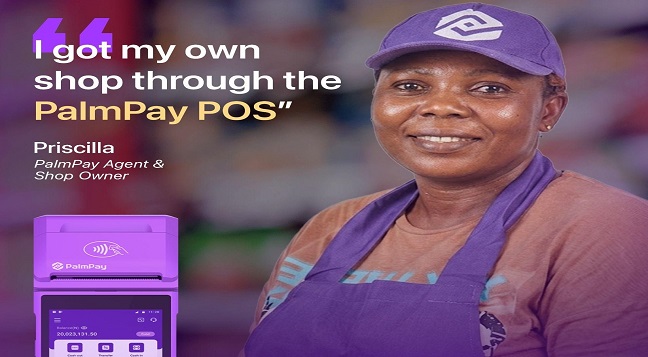
Like millions of women in Nigeria determined to be financially independent, Pricillia started with a single PalmPay POS terminal, and as an agent, every successful transaction provided a commission which brought her one step closer to achieving her dream.
Through consistency, discipline, and support from the payment platform, she reinvested her earnings and eventually opened her own provision store.
“I started as just a PalmPay agent with one POS. The consistency of the platform gave me the confidence to expand. With the income I earned, I was able to open my own provision shop.” Priscilla said.
For Priscilla, PalmPay was more than a payment platform. Its secure payment infrastructure gave her the confidence to serve her customers, build trust, and grow her income.
Today, Pricillia has joined the statistics of SMEs powering Nigeria’s economy and PalmPay continues to support her daily operations, helping her receive payments, as she works towards her next business milestone. Her journey is a reminder that when women have access to secure financial tools and opportunities, they can build lasting economic independence.
Speaking on Pricillia’s journey, Femi Hanson, Head of Marketing, PalmPay said: “Providing a secure platform that users can trust, whether for everyday payments or high-value transactions, is central to our vision of advancing financial inclusion. Priscilla’s story reflects our commitment to supporting the ambitions of Nigerians by providing a platform they can rely on to grow their finances. After all, seamless banking begins with security, and every successful transaction reinforces the trust our users place in us.”
Priscilla stands among thousands of PalmPay agents nationwide who are helping to expand financial access across Nigeria while earning commissions to create sustainable sources of income for themselves.
Every payment tells a story. It begins with trust, the confidence that your money is secure and that financial services are accessible. And when that opportunity reaches women, it creates ripple effects that transform families, strengthen communities, and drive economic growth.

Police Uncover Fake Diplomatic Number Plate Syndicate in Abuja

Davido Shares Past Suicidal Thoughts, Drops Oriadé Album

Gavi Okays $500m for Vaccines, PHCs in Nigeria

82% of Organizations Concerned about AI Risks Even as Adoption Accelerates – Survey Reveals

The Journey to Financial Freedom: Priscilla, a PalmPay Agent Now Owns a Store

NRC, Ponzi Scheme Collapses Resulting Loss of Billions of Naira

EFCC Busts NIS Visa Overstay Racket, Uncovers N700m in an Account

From Scarcity to Scale: What Africa Can Learn from India’s Agricultural Transformation

Tokenization, Blockchain Technology will Transform Financial Institutions – IMF

BON Establishes Six Ad Hoc Committees to Modernize Broadcasting




 E-Financial3 days ago
Access Bank Debunks Shutdown Report, Vows Action against Perpetrators

 E-Business3 days ago
Kaspersky Uncovers Cyber Threats Defining the First Half of 2026 in Nigeria, Others

 General News3 days ago
MENXTT TECH NG Offers Affordable Dell Laptops with Flexible Payment Plans

 Telecom3 days ago
ATU Summit Ends in Abuja with Landmark Declaration to Eradicate Continental Digital Divide

 Telecom3 days ago
Hon. Minister Dr. Kingsley T. Udeh and ASUS To Unveil First of a Kind Flagship Store in West Africa

 E-Business2 days ago
How Temu Helped a Madagascan Vanilla Family Business Sell Direct to Consumers Across Europe

 E-Financial3 days ago
$40Bn Net Reserves, Record Wealth, Relentless Poverty: Who Is Nigeria’s Economy Serving Today?

 General News3 days ago
EFCC Arraigns 4 over Alleged $5.3m Fraud Scheme