

Telecom
Pantami Says FG’s Digital Economy Policy Well-Conceived, on Track

The National Digital Economy Policy and Strategy (NDEPS) unveiled by President Muhammadu Buhari on November 28, 2019, is well-conceived, on track and built on objectives that will boost development of digital skills in both private and public sectors in Nigeria, according to Dr. Isa Ali Ibrahim Pantami, the minister of Communications and Digital Economy.

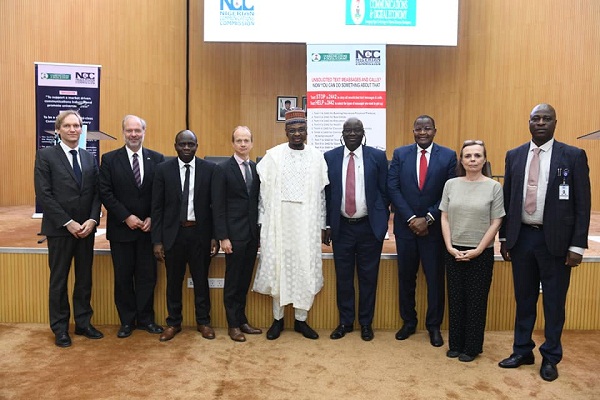
L-R: Fredrik Kapper, Senior Policy Adviser, International Affairs at the Swedish Embassy; Dr. Bo. Andersson, Chief Economist, Post and Telecom Authority, Sweden (PTS); Peter Ogundele, Director, Ericsson; Carl-Michael Grans, Swedish Ambassador to Nigeria; Dr. Isa Ali Ibrahim Pantami, the Minister of Communications and Digital Economy; Prof. Adeolu Akande, Chairman of the Board of Commissioners, Nigerian Communications Commission (NCC); Prof. Umar Danbatta, Executive Vice Chairman (EVC) of NCC; Kerston Borgon, Director, Swedish Programme for ICT Development in Emerging Regions (SPIDER) and Oluwatoyin Asaju, Director, Special Duties, NCC during the event.
Pantami, stated this at the opening of an Information and Communications Technology (ICT) regulation workshop organised by the Nigerian Communications Commission (NCC) in partnership with the Swedish Post & Telecoms Authority (PTS) – sectoral regulator for posts and telecommunication; and the Swedish Programme for ICT Development in Emerging Regions (SPIDER).
In his opening remark at the three-day workshop taking place at the Communications and Digital Economy Complex (CDEC), Mbora District, Abuja, the Minister stated that the workshop directly resonates with the first, second and seventh items of the eight pillars of the NDEPS.
The three items are developmental regulations, digital literacy and skill acquisition, as well as digital society and emerging technologies respectively.
Participants at the workshop included the staff of the Federal Ministry of Communications and Digital Economy (FMoCDE), NCC, National Information Technology Development Agency (NITDA) and the National Office for Technology Acquisition and Promotion (NOTAP).
The Minister reiterated that it is high time the country focused more on skills acquisition rather than certification in order to harness and enjoy derivable benefits from the rapid advancement in the ICT. He enjoined the participants to maximise the opportunity of the workshop to horn their digital skills for effective regulations of the ICT industry.
Pantami commended the Swedish government for its support in hosting the capacity building for the ICT industry regulators in Nigeria.
Earlier, Carl-Michael Grans, Swedish Ambassador to Nigeria, who has concurrent accreditation to Ghana, Cameroon and ECOWAS, told participants that the workshop was a follow-up to one which held in November 2019, in Stockholm, Sweden. He stated that the focus is to explore how new technologies can best be used to improve the society.
Reflecting on the history of communications technology, Grans said ever since Ericsson opened an office in Sweden in 1876 to address the challenges of telegraphy, successive Swedish authorities have tapped into advancement in ICT to enhance the growth and development of the Swedish society.
According to him, Sweden is recognised today as a global flagship in the deployment of ICT for development. He said in the Organisation for Economic Co-operation and Development (OECD) countries, Sweden is seen as a leader in digitisation because ICT has played a significant role in the advancement of the Swedish society.
“This leadership is usually measured in digital competence, digital innovation, digital security, digital infrastructure and digital management,” he said.
Grans, who was accompanied by other partners including Kerston Borgon, Director, SPIDER; Peter Ogundele, Director, Ericsson; Dr. Bo. Andersson, Chief Economist, PTS; and Fredrik Kapper, Senior Policy Adviser, International Affairs at the Swedish Embassy, also stated that across the world, the challenges of ICT deployment are basically the same with the most challenging ones being “rural infrastructure management and cybersecurity.” He, therefore, enjoined participants to be mindful of the challenges as they participate in the workshop.
Prof. Adeolu Akande, chairman of the Board of Commissioners, NCC, emphasised the significance of the workshop in the context of the recently-unveiled NDEPS and the new National Broadband Plan 2020-2024 which, he said, would soon be unveiled by the Minister.
He enjoined the participants to give the workshop rapt attention because their participation constitutes “the fulcrum of all the vision of the government for digital literacy and skills acquisition.” Akande thanked PTS, SPIDER and the Government of Sweden for the significant assistance.
Prof. Umar Danbatta, executive vice chairman (EVC) of NCC, noted that Nigeria is going through the process of digital transformation and that it is a learning curve that the country must accomplish. “I, therefore, thank the PTS. SPIDER, the Swedish Government and of course, the Honourable Minister of Communications and Digital economy for supporting the Commission in making this capacity-building workshop a reality.”


Dimension Data Nigeria has raised ₦20 billion (approximately $13.7 million) through a bond programme under Dimension Data SPV Funding Plc, following approval from the Securities and Exchange Commission of Nigeria.

This initiative aims to strengthen Nigeria’s digital infrastructure by addressing gaps in fibre coverage, limited enterprise connectivity, and increasing demand for cloud, fintech, digital services, and Artificial Intelligence.
The integrated IT solutions provider stated that the capital will be used to fund long-term investments in expanding network capacity, enhancing resilience, and supporting carrier-grade and enterprise services as data consumption continues to accelerate nationwide.
Speaking at a documentation and regulatory clearances event in Lagos, managing director, Gbenga Olabiyi, said sustained infrastructure investment is critical to maintaining competitiveness and enabling future growth.
He noted that strategic upgrades would help future-proof operations, reduce service disruptions, and allow the company to scale efficiently as business and consumer demand for cloud, fintech, and other digital services intensifies.
The bond programme is backed by private equity firm Mbavaa Partners Limited, whose managing partner, Shatse Kakwagh, described the transaction as a milestone that unlocks long-term capital for expansion.
He highlighted that strong ratings and an oversubscribed first issuance show investor confidence in Dimension Data’s execution and growth potential.
The fundraising comes as Nigeria confronts persistent infrastructure gaps, including limited metro and last-mile fibre coverage and rising enterprise connectivity needs.
Government intends to deploy 90,000 kilometres of fibre nationwide under Project Bridge aim to expand internet penetration and lower access costs.

MTN Nigeria Communications Plc has recorded a landmark turnaround in 2025, posting a pre‑tax profit of N1.70 trillion, reversing a loss of N550.3 billion in 2024 as the company emerged from a rough patch driven largely by foreign exchange volatility.

MTN Nigeria
The telecom giant said the performance reflects a “significant turning point” in its corporate and financial trajectory, underpinned by improved macroeconomic conditions, strong service‑revenue growth, and tightening operational efficiency.
Profitability, Revenue, and Dividend
For the full year 2025, MTN Nigeria reported profit after tax of N1.11 trillion, compared with a loss after tax of N400.4 billion in 2024, while earnings per share rose to N53.07 from a negative N19.05 a year earlier.
Total revenue grew 54.9% year‑on‑year to N5.20 trillion, with service revenue up 55.1% to N5.17 trillion, driven mainly by data, voice, and fintech services.
The company’s board proposed a final cash dividend of N15 per share, bringing the total dividend for the 2025 financial year to N20 per share. Dividends will be paid electronically to shareholders on the register as of April 8, 2026, subject to completed e‑dividend mandates.
This payout is one of the largest single‑year dividends in Nigerian corporate history, signalling strong cash‑flow generation and management confidence in the company’s earnings quality.
Fourth‑Quarter Momentum and Customer Base
MTN Nigeria’s fourth‑quarter performance was particularly robust, with pre‑tax profit surging 248.8% year‑on‑year to N569.6 billion, compared with N163.3 billion in Q4 2024.
The company’s mobile subscriber base reached 87.3 million at year‑end, up 7.9% from the previous year, reinforcing its position as Nigeria’s largest telecom operator by subscribers.
Active data users grew by 11.6% to 53.2 million, and smartphone penetration rose to 66.1%, reflecting the deepening shift toward data‑driven services and digital lifestyles among Nigerians.
Data, Fintech, and Voice Growth
Data was the biggest growth driver, with data revenue up 74.5% to N2.78 trillion and data traffic increasing 34.0%, amid rising demand for mobile broadband and video streaming.
Voice revenue also climbed strongly, rising 42.1% to N1.85 trillion as tariffs and usage patterns adjusted to more stable exchange‑rate conditions.
Fintech revenue surged 79.7% to N191.3 billion, underscoring the rapid expansion of MTN Nigeria’s mobile money ecosystem and the growing role of digital financial inclusion in the country’s economy.
Cost Management and EBITDA Leap
Operating leverage improved markedly, with cost of sales rising 30.3% and operating expenses up 16.7%, both growth rates below the 55% revenue expansion.
EBITDA jumped 108.9% to N2.74 trillion, lifting the company’s EBITDA margin into the mid‑to‑high 50% range, ahead of its prior guidance.
Management attributed the improvement to a more stable foreign‑exchange market, moderated inflation, and sustained demand for data and digital services, as well as disciplined cost control.
FX Recovery and Capital Expenditure
Foreign exchange performance was a major swing factor: MTN Nigeria recorded a net FX gain of N90.3 billion in 2025, compared with a N925.4 billion FX loss in 2024.
The turnaround followed settlement of outstanding letters of credit and a deliberate reduction in dollar‑denominated exposure, which helped insulate earnings from earlier currency shocks.
Capital expenditure excluding leases rose 126.2% to N1.00 trillion, as the company invested heavily in network capacity, coverage, and digital infrastructure, including fibre rollout and 4G/LTE upgrades.
Despite the higher capex, free cash flow soared 215.5% to N1.2 trillion, indicating that the expansion is being funded internally without straining the balance sheet.
Balance Sheet and Shareholder Value
The company’s balance sheet strengthened materially, with total assets up 28.7% to N5.40 trillion and shareholders’ equity turning positive after several years in deficit.
Shareholders’ funds rose 219.8% to N548.7 billion, while retained earnings closed at N400.4 billion, compared with negative N607.5 billion in December 2024.
In the stock market, MTN Nigeria’s shares recently traded around N760, making it the most capitalised company on the Nigerian Exchange with a market valuation of about N16 trillion.
The stock has gained 33% in February 2026 alone, taking year‑to‑date returns to 49%, following a 155.5% rally in 2025, which investors see as a vote of confidence in the company’s turnaround story.
Outlook and Strategic Guidance
Management maintains a medium‑term service‑revenue growth guidance of at least low‑20% annually, underpinned by ongoing data and fintech expansion as well as gradual price adjustments.
The group has also revised its EBITDA margin guidance upward to the mid‑to‑high 50% range, signalling sustained profitability even as the company continues to invest in network and digital infrastructure.
Analysts note that MTN Nigeria’s 2025 performance not only restores investor confidence but also sets a benchmark for other Nigerian corporates navigating FX‑linked risks and regulatory uncertainty.
In a bold move to future-proof Nigeria’s telecommunications infrastructure, MTN Nigeria embarked on a massive N1.0 trillion Capital Expenditure (CAPEX) drive, backed by its record-breaking 2025 financial performance.
MTN
The company’s audited results revealed a historic 108.9% increase in EBITDA to N2.7 trillion and a 215.5% rise in free cash flow to N1.2 trillion, providing the exact financial muscle necessary for this aggressive network expansion.
According to the firm’s strategic blueprint, without the ability to generate strong returns, the N1.0 trillion CAPEX required to maintain the network and deploy advanced technologies would simply not exist.
This accelerated network investment is already yielding significant dividends in consumer usage and reliability. The 2025 results showed a massive 74.5% surge in data revenue alongside a 42.1% increase in voice revenue. Furthermore, active data subscribers grew by 11.6% to hit 53.2 million, underscoring the robust commercial momentum and the continuous public demand for high-quality internet services powered by fresh CAPEX.
Speaking on the company’s trajectory, CEO Karl Olutokun Toriola confirmed that the restoration of positive retained earnings and a highly resilient balance sheet directly supported this accelerated network investment.
He said: “2025 marked a significant turning point in our business performance, with a return to profitability, stronger free cash flow, and the restoration of positive retained earnings and shareholders’ funds, enabling the resumption of dividend payments.
“Our balance sheet resilience – underpinned by robust operating performance, disciplined capital allocation, and reduced foreign currency exposure – supported accelerated network investment to enhance quality of service and user experience, positioning us to sustain growth and deliver attractive long term shareholder returns.”
The company continues to position this N1.0 trillion infrastructure spending as a cornerstone of its economic patriotism. As the largest corporate taxpayer, MTN noted that its heavy investments directly support government digital infrastructure ambitions and social welfare whilst stimulating the local tech ecosystem.

Galaxy Backbone Confirms Over 150,000 Active Official Government Email Accounts, Clarifies Status of GOVMAIL

More 14m Farmers to Benefit from AfDB-backed Initiative

Dimension Data Nigeria Secures ₦20Billion Funding Strengthen Digital Infrastructure

MTN Nigeria Posts Record N1.70 Trillion Pre‑Tax Profit, Declares N20 Dividend for 2025

Kaspersky Discovers New Phishing Campaign Exploiting Google Tasks Notifications to Steal Corporate Credentials

Kaspersky Launches OT Calculator to Align Cybersecurity Investments with Business Goals

Accidental Billionaire Opts for Jail Instead of Returning Money Credited Him by Mistake

Why the Future of PR Depends on Healthier Client–Agency Partnerships

New Horizons Nigeria Breaks Ground: First to Fuse Mandarin into ICT Curriculum

Kaspersky Brings more Transparency to Threat Detection with New Hunt Hub




 General News2 days ago
KPMG Strengthens Africa Leadership to Support Long‑term Growth Across the Continent

 E-Business2 days ago
esentry 2025 Report Shows Healthcare, Financial Services and Telecoms as Staging Grounds for Increased Cyberattacks in Africa

 News2 days ago
Nigeria, EU Ink Research, Innovation Deal Worth €100Bn

 E-Financial2 days ago
Flutterwave Rises from Lagos Startup to Africa’s Fintech Powerhouse

 General News2 days ago
PalmPay Couples Show How Love Is Funded Digitally

 News1 day ago
NITDA Equips Federal Character Commission with Data Tools to Drive Public Sector Reform

 Telecom2 days ago
Sophos Report: Identity Attacks Drive 67% of Cyber Incidents as Threat Groups Surge in 2025

 General News2 days ago
Conoil Bonanza Winners Emerge