

E-Financial
Forex Time Demo Competition Reveals Market Ingenuity

Foreign exchange-Forex (trade) is the only market that, currency, is truly open 24 hours with decent liquidity throughout the day, with almost $5 trillion traded around the world. It shows the level of enticement, but not without enterprising spirit. In forex, currency obviously follows the sun.
With a laptop and connectivity, there is no limitation to making, except the traders (un)willingness to trade, consistently.
Meanwhile certain factors like the size, volatility and global structure of the foreign exchange market have all enhanced the performances.
For instance, investors are able to place extremely large trades without affecting any given exchange rate due to high liquid state of the market.
Actually, there are gains and pains, if you like risks, associated with the forex market. How can we define the market, distancing it from other markets?
What are the benefits and risks? How can one avoid lessen the risks? What is the place of Nigeria in the global table?
To provide answers these and more, Forex Time (FXTM), an international online forex broker with presence in Nigeria, recently organized a demo competition for journalists where ingenuities of the market prevailed.
First, FXTM is the brainchild of Andrey Dashin, a man whose business insight and entrepreneurial mind were the driving factors behind the success of his first company, Alpari.
The Company is known for offeing the best possible services to its clients. No doubt, Forex is fast becoming an extremely popular trading instrument for Nigerian investors, keen to profit from what now stands as the largest and most liquid market in the world.
“From day one, we have stated that Forex Time is here to provide the ultimate trading experience for clients,” Olga Rybalkina, CEO of Forex Time said, setting the tone of the Company’s operation in Nigeria.
Secondly, the company provides services to a wide range of different customer types including retail, business to business, institutional investors, portfolio management, introducers and in the near future, affiliates. The competency of FXTM is evident in a vast amount of trading instruments, platforms and accounts, is offers and tailored to the individual needs of clients.
Setting the tone of the competition, Mr. Olumide Ladipo, marketing manager, FXTM (Nigeria), disclosed that disclosed that the demo was intended to the overwhelming growing local interest in Forex, even the Company has embarked on one-of-a-kind free training course in professional Forex trading in Lagos, Abuja and Port Harcourt.
“Forex is an exciting and dynamic asset class to trade and it is important that any investors looking to trade take the time to educate themselves and truly understand how the market works before making any financial commitments,” he said.
He added that FXTM has instituted Forex Factor, suited to new traders or those who would like to improve their skills and test their strategies in a risk free environment, while experiencing FXTM’s world class products, top quality services and multi-lingual support.
Explaining on the philosophy behind forex, he defined the market as an international currency market with the language focused on money.
Therefore, companies trade in shares, so do countries trade in currency; unfortunately, the Nigerian Naira is yet to find its entry to the market due to instability. Apparently, ten major currencies rule the market, like the United States dollar (USD), Euro (EUR), Japanese Yen (JPY), etc.
Why Forex? Ladipo enumerated reasons the market has come to stay, such as, the high level of profitability with; safer than stock market shares; high liquidity as your capital remains; low start up entry cost and price stability is maintained with no central location which eliminates manipulations.
That does not imply forex is risk-free, just as the Marketing Manager stated, “Greed is the principal reason people record losses in the market. Thus, when the market opens at Sunday night, traders are advised to buy and sell based on their capabilities to avoid loses by Friday Night”.
Olugbenga Fagbohun, trainer & consultant, FXTM Nigeria, while explaining further on the technicalities, said that the one’s capital doled out for trading is like the collateral to take a loan from a bank. On taking the “loan” the trader is left with his intellectual alertness and assertiveness to reap from the boisterous market.
Thus, “Ask Price” is what the brokers like FXTM sell to the trader, while the “Bid” is what the seller (trader) sells to the broker. For example, it is possible for a trader to control a position of US$100,000 by putting down as little as US$1,000 up front and borrowing the remainder from his or her forex broker.
This amount of leverage acts as a double-edged sword because investors can realize large gains when rates make a small favorable change, but they also run the risk of a massive loss when the rates move against them. Despite the foreign exchange risks, the amount of leverage available in the forex market is what makes it attractive for many speculators. These were explained in details during the demo competition.
Meanwhile, the participants were presented with a virtual capital of $100,000. After the keenly contest, Obinna Chima of ThisDay Newspaper came first; Odinaka Mbonu (BusinessDay) was second and Kunle Binuyo from (Connect Nigeria) came third, winning different Samsung Galaxy phones.
Madu Nwegbu, IT manager, FXTM Nigeria, who provided the technical support for the “trader” emphasized that as FXTM rapidly grows from strength to strength on a global scale, the competition is a great way for novice traders around the world to get to grips with the forex world while honing in on their talent as they give it their best shot in the fun new demo challenge.
FXTM had in November 4, 2013 commenced a demo for interested trader where a talented trader receive a prize of $3000 credit in a live FXTM trading account, while a further eight runners up were recognised with prizes of trading credit.
The initiative is one which runs in line with the overall company ethos for innovation while always trying to find new ways to engage traders and increase knowledge about what it takes to be successful in forex trading today.
The demo contest is an excellent way for new clients to learn how to use the MT4 platform, come up with a personalized workable trading strategy, and get to know FXTM’s customer centric support and services.
FXTM is fully aware that no one customer is the same, and is dedicated to ensuring that each client’s individual needs and aspirations are catered for.
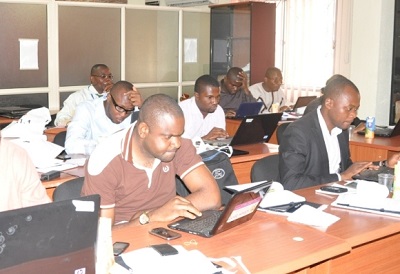
picture: contestants at the FXTM demo competition held in Lagos in December, 2013.



Polaris Bank has joined the global community in celebrating International Women’s Day 2026, reaffirming its commitment to promoting gender equality, empowering women, and supporting initiatives that foster inclusive growth across society.

Polaris Bank
International Women’s Day, celebrated annually on March 8, provides an opportunity to recognize the achievements of women across all sectors while highlighting the need to accelerate action towards gender equality. At Polaris Bank, the day serves as a reminder of the vital role women play in driving economic growth, innovation, and community development.
Speaking in commemoration of the day, the Managing Director/CEO of Polaris Bank, Kayode Lawal, emphasized the Bank’s commitment to creating an enabling environment where women can thrive professionally and financially.
“Polaris Bank remains dedicated to fostering a culture of inclusion, opportunity, and empowerment for women. From supporting female entrepreneurs to ensuring equal opportunities within our workforce, we believe empowering women is not only the right thing to do but also a key driver of sustainable development,” the CEO stated.
Over the years, Polaris Bank has implemented several initiatives aimed at supporting women-led businesses, promoting financial inclusion, and strengthening leadership opportunities for women within the organization. These efforts align with the Bank’s broader commitment to sustainable development and inclusive economic growth.
As part of this year’s celebration, the Bank will spotlight inspiring stories of hope from women across the community, within its workforce and customer base, while encouraging meaningful conversations around leadership, financial empowerment, and gender equity.
Polaris Bank continues to champion initiatives that create opportunities for women to succeed, recognizing that empowering women ultimately leads to stronger families, thriving communities, and a more resilient economy.


Benedict Ikechukwu Anekwe, an Enugu-based lawyer, and C.K.C. Idu, a magistrate, have been accused of allegedly conspiring to fraudulently withdraw ₦3.5million from the corporate account of Ohha Microfinance Bank Limited through what the bank described as a manipulated garnishee court process.

Ohha Microfinance Bank is a financial institution based in Enugu, Nigeria, committed to providing accessible and reliable banking services to individuals and small businesses
Ohha Microfinance Bank in a petition dated March 6, 2026 and submitted to the Chief Justice of Nigeria and Chairman of the National Judicial Council, demanded disciplinary action against the lawyer and the magistrate.
In the petition signed by Philip Onwukwe, managing director of the bank, the institution accused Anekwe of “using the instrumentality of the court to steal” from its corporate account.
“We write to you… seeking your urgent intervention and action in respect of this complaint which borders on fraud, stealing and unprofessional conduct of Benedict Ikechukwu Anekwe Esq.,” the petition read.
According to the petition, the controversy began with a judgment delivered on July 11, 2025 by Chief Magistrate O.P. Okoro in Enugu in Suit No. CME/1087/2023, involving Okoye Sunday and Ifesinachi Nnam.
The court reportedly awarded ₦2.5 million in favour of Okoye Sunday.
To enforce the judgment, Anekwe filed garnishee proceedings against 14 banks, including Ohha Microfinance Bank, seeking to attach funds belonging to the judgment debtor, Ifesinachi Nnam.
On July 29, 2025, the court issued an Order Nisi directing banks to attach any money belonging to the debtor.
The order stated that: “All monies in possession of the Garnishees belonging to Ifesinachi Nnam… be attached to satisfy the judgment sum of ₦2,500,000 together with the cost of this garnishee proceedings.”
However, the bank said the order applied strictly to the account of the judgment debtor and not to the corporate account of the bank itself, moreover, the judgement debtor has no financial account with the bank.
“It is crystal clear from the wordings of the Order that the Order Absolute made by His Worship Okoro was made against the account of Ifesinachi Nnam… but not against the corporate account of Ohha Microfinance Bank Limited,” the bank said.
The bank alleged that instead of serving the order on the bank to verify whether the judgment debtor had an account with it, Anekwe allegedly initiated another garnishee action directly against the bank before a different magistrate.
The fresh suit, CME/1554M/2025, Okoye Sunday v. Ohha Microfinance Bank Ltd, was filed before Magistrate C.K.C. Idu, his close associate, after the judgement debtor had filed notice of appeal and got a stay of execution in the previous court.
The petitioner explained that despite the pending appeal and stay of execution, on October 10, 2025, Magistrate Idu granted another Order Nisi attaching ₦3.5 million from the bank’s corporate account held with Ecobank Plc.
The bank said neither the plaintiff nor the judgment debtor had any account relationship with the microfinance institution, wondering how a Magistrate could issue such an order.
“Ohha Microfinance Bank has no business relationship with the judgment creditor and the judgment debtor in the suit,” the petition stated.
It added that both Okoye Sunday and Ifesinachi Nnam “are not customers of Ohha Microfinance Bank Ltd.”
Upon discovering the court order, the bank’s lawyer filed a motion asking the court to set aside the garnishee order, arguing that it was obtained through misrepresentation.
The motion stated that the order wrongly targeted the corporate funds of the bank rather than the account of the judgment debtor.
However, according to the petition, Magistrate Idu refused to vacate the order.
Instead, on February 27, 2026, the magistrate reportedly made the order absolute and authorised the withdrawal of ₦3.5 million from the bank’s account.
The bank further alleged that after securing the court order, Anekwe personally served it on Ecobank and instructed the bank to transfer the funds to his personal account.
“That same day, the learned Chief Magistrate signed the Order Absolute and handed it over to Benedict Anekwe Esq., who rushed to Ecobank Plc and served the order,” the petition stated.
The lawyer allegedly followed up with a written instruction directing the bank to pay the money into his personal account at First Bank of Nigeria instead of a client account.
Ohha Microfinance Bank alleged that the magistrate and the lawyer acted in concert to perpetrate the alleged fraud.
“This is daylight stealing perpetrated by Benedict Ikechukwu Anekwe Esq.,” the petition stated.
The bank further alleged that Magistrate Idu ignored the clear wording of the earlier judgment issued by Magistrate O.P. Okoro, which targeted only the debtor’s account.
It also claimed that both men had previously worked together before the magistrate’s appointment to the bench.
“Our findings reveal that the learned magistrate C.K.C. Idu before his appointment worked together at CIDJAP Legal Department with Benedict Anekwe Esq., hence the reason he connived with him to perpetrate this fraud,” the bank alleged.
The bank has asked the National Judicial Council to investigate the matter and sanction both the lawyer and the magistrate.
It also demanded that the matter be referred to the Legal Practitioners Disciplinary Committee.
“We demand that this matter be referred to the Legal Practitioners Disciplinary Committee for immediate and necessary action,” the petition stated.
The bank further demanded an immediate refund of the ₦3.5 million allegedly withdrawn from its corporate account.
“We further demand that Benedict Anekwe Esq. refund immediately the sum of ₦3.5million he stole from our corporate account,” the petition added.
Efforts to reach the lawyer and the magistrate were unsuccessful, as both failed to answer multiple calls.
They also did not respond to text messages sent to their verified telephone numbers seeking their reactions.
Credit: SaharaReporters


Quest Merchant Bank Limited has successfully met the ₦50 billion minimum capital requirement mandated for merchant banks by the Central Bank of Nigeria (CBN) strengthening the Bank’s capital base and reinforcing its capacity to support Nigeria’s economic transformation.

This milestone reflects investors’ continued confidence in the Bank’s long-term strategy, strong governance, and sustainable growth outlook. It also marks an important step in the Bank’s post-divestment evolution under its new ownership, positioning Quest Merchant Bank with the balance-sheet strength needed to execute its next phase of growth.
With a significantly enhanced capital base, Quest Merchant Bank is now better positioned to underwrite larger transactions and expand its advisory, capital markets, and structured financing capabilities across priority sectors of the Nigerian economy.
The CBN’s recapitalisation directive, which sets ₦50 billion as the minimum capital threshold for merchant banks, is designed to reinforce the resilience, stability, and lending capacity of Nigeria’s financial system.
By meeting this benchmark, Quest Merchant Bank reinforces its standing as a trusted financial partner in infrastructure, energy, manufacturing, and corporate growth initiatives nationwide.
Afolabi Olorode, Acting Managing Director and Chief Executive Officer of Quest Merchant Bank, described the achievement as a defining moment in the Bank’s evolution: “This milestone marks a significant step forward for Quest Merchant Bank. Meeting the ₦50 billion capital requirement underscores investors’ confidence in our strategy and reflects the strength of our governance and franchise.
“With this strengthened capital position, we are equipped to play an even greater role in financing key sectors of the Nigerian economy, enabling private enterprise, and supporting sustainable economic expansion.
“Our focus remains clear. We will continue to continue to help our clients succeed, while serving as a trusted long-term partner in delivering sustainable growth.”
Quest Merchant Bank remains committed to responsible growth, innovation, and delivering strategic financial solutions that empower businesses and institutions across Nigeria.

First Batch of Nigerian Undergraduates Emerged in Airtel Africa Foundation Scholarships Programme

Mojisola Sayo-Kazeem Reflects on Leadership, Opportunity, Women in Tech @ IWD

Experts Weigh Blockchain Option for Nigeria’s Elections Process

CBN Affirms Alpha Morgan Bank’s Capitalisation

Dimension Data Nigeria Seals N20bn Bond Deal to Bridge Digital Infrastructure Gap

Dr. Cairo Ojougboh Foundation Bolsters Nigeria’s Education Drive with ₦2.7m Student Support

Kaspersky Brings more Transparency to Threat Detection with New Hunt Hub

Kaspersky Discovers New Phishing Campaign Exploiting Google Tasks Notifications to Steal Corporate Credentials

esentry 2025 Report Shows Healthcare, Financial Services and Telecoms as Staging Grounds for Increased Cyberattacks in Africa

AfDB, UNDP Launch $10Bn AI Initiative for Africa




 E-Business3 days ago
Police Says Victims Enable Cyber Attacks Out of Ignorance

 E-Financial3 days ago
Quest Merchant Bank Achieves CBN Regulatory Recapitalisation Milestone

 General News3 days ago
FG Launches NERD to Combat Certificate Fraud

 E-Financial3 days ago
Bank Accuses Magistrate, Lawyer of Using Fake Order to Steal N3.5m from Account

 Telecom3 days ago
Cassava Launches Sovereign Cloud for Africa’s Public Sector

 News3 days ago
FG Can Now Track, Prosecute Visa Overstayers – Interior Minister

 General News3 days ago
Goodnews Naija Launches ‘Building in Nigeria’ Series on Entrepreneurs, Real Sector Builders

 News3 days ago
NCDC Issues Public Advisory on Cerebrospinal Meningitis