

E-Financial
FXTM Analysis: Nigeria Stumbles into Q4

Prolonged periods of depressed oil prices have punished most oil export dependent countries in 2016 with Nigeria being no exception.
When one factors in that the nation receives over 90% of export and 70% government revenues from oil which is currently struggling below $50 a barrel, it could be understood why the world’s second largest economy in Africa has entered a technical recession.
This has been a rough year for the economy with the CBN taking action on various occasions from the Naira de-peg, to raising interest rates to record highs in a bid to reclaim some stability.
Despite the attempts, unemployment still lingers around 13.3% while inflation skyrocketed to 17.6% in August consequently enforcing additional pressures on the nation already engaged in a painful battle with falling oil.
It has become increasingly clear that Nigeria’s illness can be diagnosed as oil reliance, but the cure can be found in diversification.

The Naira continues to be exposed to downside risks as the terrible combination of oil price volatility and Dollars potential resurgence amid US rate hike expectations entices sellers to attack.
With sentiment towards the Nigerian economy still somewhat bearish in the shorter term, further declines could be expected in the local currency as the natural forces of supply and demand determine its equilibrium value. It should be kept in mind that the ongoing forex scarcity which continues to pressure the Naira has created a firm foundation for bears to install repeated rounds of selling.
There exists a possibility of the Naira strengthening in the longer term but the currency remains heavily exposed to external risks in the short term. From a technical standpoint, the Naira is heavily bearish and this negative momentum could open a path towards 500 and potential higher against the Dollar on the black market exchange.
While the effects of the Naira floatation can be displayed with the sharp drop in currency value and rising inflation, this has also bolstered foreign investment towards the nation.
Since the introduction of the flexible foreign exchange regime, almost 1 billion dollars has entered the country from foreign direct investments with further inflows expected if the Naira continues to decline.
Market participants may focus on the pending inflation figures for September which could provide additional clarity over if the Central Bank of Nigeria takes further action in 2016. With the economy still under pressure, the CBN may be entangled in a three-way battle with attaining growth, curbing inflation while also retaining some credibility.
There have been many discussions over the record high-interest rates of 14% repelling business to borrow consequently obstructing GDP growth, but with central bank caution remaining a recurrent theme, the CBN may be on standby before taking action in November or December.
Nigeria is in need of capital to boost its economy and this has sparked talks of the nation selling its national assets to calm investors, curb currency speculations and potentially stabilize growth.
With the government receiving very little from depressed oil prices and the obstructions in the south depleting production even further, selling the assets could be a solution in the short term. Many have been against the idea of relinquishing the assets and have labelled it as a quick fix which could leave the nation under further pressure in the longer term.
With oil prices trading below $50 and the persistent uncertainty over the conflict in the south of Nigeria weighing on sentiment, this may be an unfavourable period to offload oil assets. When coupled with the state of the economy, the government could find itself in a position of weakness when selling potentially receiving a deal well below the true value.
The world’s second largest economy in Africa faces a dilemma between selling its national assets and borrowing externally to retrieve enough investments to jumpstart growth. It should be kept it mind that diversification and reinforcing infrastructure need capital which the nation does not possess consequently creating a situation where a decisive decision must be taken.
While Nigeria may be commended on its efforts to boosting foreign exchange investments via the floatation and tax reforms to bolstering government revenues, this is still far from the 15 Billion needed to fuel its structural transition.
The African Development Bank, IMF, and even China have all offered loans to help reinvigorate growth but it seems that the nation has decided to think things through before potentially taking action in 2017.
Despite the current gloom and doom, the longer term outlook for Nigeria still looks quite encouraging with the biggest challenge being how the nation weathers the uncertainty and external risks in the short term. With a population of over 180 million and fertile lands, agriculture could be the miracle pill which brings Nigeria back to health. Once the nation can feed its people, the surplus could be exported which could provide the revenues needed for the government to reinvest back into the economy.
If the infrastructure is reinforced, then tourism could receive a welcome boost as safer roads magnetize tourists to the nation. Nigeria’s untapped maritime is a hidden gem that has been estimated to generate roughly 7 trillion Naira annually if properly managed and could be one of the attributes which reflate the economy. The resources needed for Nigeria to steer away from oil dependence are present and the key may simply be proper management and time.
As Q4 commences, Nigeria may be slightly pressured if oil price volatility and a resurgent Dollar punishes the Naira further. Although OPEC shocked the global markets last week by deciding on an agreement to mitigate the oversupply woes, oil still remains somewhat pressured potentially trickling back to oil export nations.
If the Federal Reserve decides to raise US interest rates in December, then both the Naira and Oil could be vulnerable to heavy losses as bears install repeated rounds of selling.
There could be an increasing focus on key domestic economic reports such as inflation, unemployment, and GDP for further clarity on how the Central Bank of Nigeria may jumpstart growth. This is a very critical time for Nigeria and although diversification is the key for the nation to transition away from oil dependence, many will be observing where the funding will come from.


Nigeria’s Bank Verification Number (BVN) database expanded to 69.55 million as of July 5 2026 from 69.32 million in June 2026, according to latest data released by the Nigeria Inter-Bank Settlement System (NIBSS).

BVN is an 11-digit biometric identification system introduced by the Central Bank of Nigeria and managed by the Nigeria Inter-Bank Settlement System (NIBSS) to secure customer accounts and reduce fraud.
This means that BVN enrolments increased by 228,947 between June and July 5 this year.
With the BVN database standing at 67.8 million as of December 31, 2025, it also means that the database grew by 1.75 million between the end of last year and July 5, 2026.
Specifically, with less than 1.8 million BVN enrolments so far recorded for this year, it is looking highly unlikely that BVN registrations at the end of 2026 will come close to the 4.3 million total registrations recorded in 2025.
Analysts note that while the expansion in the BVN database last year was largely driven by the introduction of the NonResident Bank Verification Number (NRBVN) initiative, which enables Nigerians in the diaspora to do their BVN enrolment remotely, thereby removing physical barriers and boosting cross-border financial engagement, the Central Bank of Nigeria (CBN) in March this year, announced a revised BVN regulatory framework, that saw it introducing stricter controls on suspected fraudulent transactions, BVN enrollment, and data access within the banking system.
According to the regulator, the amendments to the BVN framework, which came into effect on May 1, 2026, were aimed at strengthening fraud monitoring, improving identity management within the financial system and safeguarding the integrity of banking transactions, by strengthening identity verification and ensuring that BVN registration aligns with legally recognised age thresholds.
Thus, under the revised BVN framework, the apex bank introduced a stricter age requirement for BVN enrolment, limiting registration to 18-year-old individuals and above.
Also, under the new framework, customers will only be allowed to change the phone number associated with their BVN once. The CBN further stated: “Under the new guidelines, financial institutions are required to establish and maintain a temporary watch-list for BVNs linked to suspected fraudulent transactions reported within the banking system.
“A BVN may remain on this temporary Watch-list for a maximum period of twentyfour (24) hours, during which the BVN owner shall be contacted to provide clarification regarding the identified transaction(s).”
Launched on February 14, 2014, by the CBN in collaboration with the Bankers’ Committee, the NIBSS, and the German firm Dermalog, the BVN scheme was designed to capture the biometrics of all bank customers and provide each with a unique 11-digit identification number that can be verified across the Nigerian banking industry.
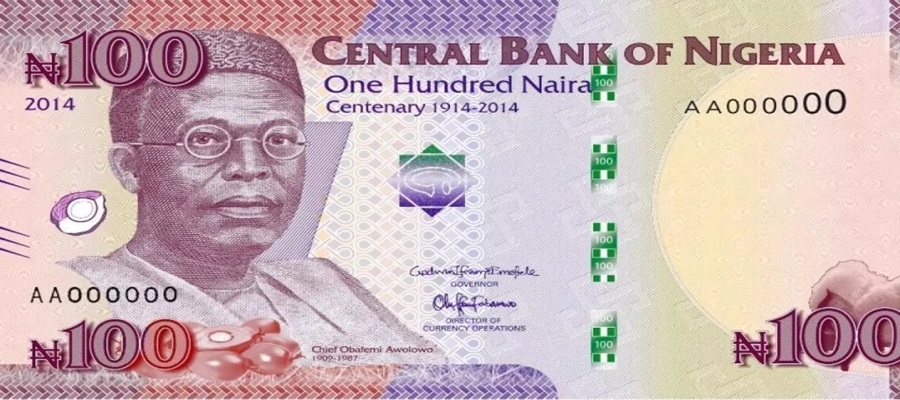
Central Bank of Nigeria (CBN) has reaffirmed that the standard N100 banknote remains legal tender across the country, warning that its rejection by individuals, businesses and institutions violates the law.

The clarification follows reports that some members of the public have refused to accept the standard N100 note over concerns about its legal tender status following the introduction of the commemorative N100 banknote issued to mark Nigeria’s centenary.
In a statement signed by Mrs. Hakama Sidi-Ali, acting director of Corporate Communications, the apex bank stressed that “both the commemorative N100 banknote and the standard N100 banknote are valid legal tender and must be accepted for all transactions nationwide.”
The CBN explained that the commemorative N100 note was introduced to celebrate Nigeria’s centenary and did not replace the existing standard N100 banknote.
The CBN cautioned individuals, businesses, financial institutions and other economic agents against rejecting the standard N100 note, noting that such action contravenes the provisions of the CBN Act and undermines public confidence in the national currency.
It warned that appropriate enforcement measures would be taken against any person or organisation found violating the law.
The apex bank reaffirmed its commitment to protecting the integrity of the naira, maintaining confidence in all duly issued banknotes and ensuring the smooth circulation of currency across the country.
The CBN also urged members of the public to continue accepting and transacting with all banknotes legally issued by the Bank and advised anyone seeking further clarification to use its official communication channels.

FCMB Asset Management Limited (FCMBAM), the asset management arm of FCMB Group Plc, has received an upgrade to its national scale long-term and short-term issuer ratings of A(NG) and A1(NG), from A-(NG) and A2(NG), by GCR Ratings, a leading pan-African credit rating agency.

The outlook on the ratings remains stable, said the rating agency.
The upgrade is anchored on FCMBAM’s competitive resilience and financial discipline, alongside the strengthened credit profile of FCMB Group.
GCR highlighted FCMBAM’s decade-long track record of strong performance, well-established brand franchise, diversified product suite and robust distribution network as key drivers of its standalone strength.
These are further supported by consistent earnings growth and a disciplined, unleveraged balance sheet, it said.
According to GCR, FCMBAM’s competitive position is supported by “its relatively long track record, strong brand franchise, established product and geographical distribution network and cross-selling opportunities,” with the rating agency noting that FCMBAM ranks among the top five asset managers in Nigeria, with an estimated five per cent share of a fragmented market as of 31 December.
The Company’s financial performance underpinned the upgrade, with revenue growing by 30 per cent and operating cash flow increasing by 13 per cent, enabling the business to be fully funded without recourse to debt.
Liquidity strengthened further, with liquidity sources versus uses improving to 5x as of December 2025, from 3.6x a year earlier, while the EBITDA margin edged up to over 58 per cent.
Commenting on the upgrade, the Chief Executive Officer of FCMB Asset Management, James Ilori, said: “This upgrade is an important external validation of a strategy we have pursued with discipline over many years: building an investment franchise that performs reliably, governs itself rigorously, and earns trust in every market cycle. It speaks to the strength of our membership of FCMB Group and to a culture that holds itself to local and global standards of risk management and capital stewardship.
“As Nigeria’s asset management industry enters a new era of higher capital thresholds and rising investor expectations, we intend to lead from the front – ahead of regulatory timelines, ahead in digital transformation and ahead in the outcomes we deliver for the clients who trust us to assist them in achieving their investment objectives.”

Court Adjourns Alleged Binance Tax Evasion Case over Settlement Talks

Fixed Wired Internet Market Lags as Mobile Gains Ground

Xenophobic Attacks: OYC Threatens to Picket MTN Nigeria Offices

New NIMC Act Strengthens Data Protection, Privacy – Director

BON Establishes Six Ad Hoc Committees to Modernize Broadcasting

NASENI Moves to Digitize CCB’s 5m Assets Declaration and Operations

Mobile Internet Gender Gap Widest in Africa – GSMA

Nigeria Launches FreeTV Nationwide

CANAL+ Partners Samsung to Pre-Load DStv Stream on New Samsung TVs In Nigeria, Other African Countries

Lebara Nigeria Launches Lebara Play, Africa’s First Telecom-Owned Micro-Drama Platform




 News2 days ago
NRC, Ponzi Scheme Collapses Resulting Loss of Billions of Naira

 News2 days ago
NSITF Partners South African Insurer on Digital Transformation

 General News2 days ago
KPMG Urges Africa’s Most Innovative Tech Entrepreneurs to Enter the Global Tech Innovator 2026 Competition

 E-Financial2 days ago
FCT-IRS Unveils New Digital Platform, Taxporta

 E-Business2 days ago
FG Suspends New Internet Regulations to Prevent Overlapping Rules
 E-Business2 days ago
NIN Enrollment Hits over 136m as New ID Law Takes Effect

 E-Business2 days ago
Plateau PCC Collects Nigerians’ Data without Privacy Policy – FIJ

 General News2 days ago
Court Declares ARCON’s N60Bn Fine against Facebook Nigeria Illegal