

Telecom
Gartner Says 4.9Bn Connected Internet of Thing Will Be in Use by 2015


Gartner, Inc. forecasts that 4.9 billion connected things will be in use in 2015, up 30 percent from 2014, and will reach 25 billion by 2020. The Internet of Things (IoT)* has become a powerful force for business transformation, and its disruptive impact will be felt across all industries and all areas of society.
“The digital shift instigated by the Nexus of Forces (cloud, mobile, social and information), and boosted by IoT, threatens many existing businesses. They have no choice but to pursue IoT, like they’ve done with the consumerization of IT,” said Jim Tully, vice president and distinguished analyst at Gartner.
This sudden expansion will boost the economic impact of the IoT as consumers, businesses, city authorities, hospitals and many other entities find new ways in which to exploit the technology. Gartner estimates that IoT will support total services spending of $69.5 billion in 2015 and $263 billion by 2020.
Consumer applications will drive the number of connected things, while enterprise will account for most of the revenue. Gartner estimates that 2.9 billion connected things will be in use in the consumer sector in 2015 and will reach over 13 billion in 2020. The automotive sector will show the highest growth rate at 96 percent in 2015.
From an industry perspective, manufacturing, utilities and transportation will be the top three verticals using IoT in 2015 – all together they will have 736 million connected things in use.
By 2020, the ranking will change with utilities in the No. 1 spot, manufacturing will be second and government will be third, totaling 1.7 billion IoT units installed. “Government will take the No. 3 spot as it invests in smart street and area lighting for energy saving reasons,” said Mr. Tully. “Utilities will move to the No. 1 position because of investment in smart meters.”
Connected things, such as automated teller machines and airline check-in machines, have previously existed.
But, new and novel devices, and many ordinary objects, are also being reinvented with digital sensing, computing and communications capabilities.
This functionality provides both new and previously passive objects with a “digital voice”, and the ability to create and deliver an information stream reflecting their status and that of their surrounding environment.
Such developments radically change the value proposition, creating new services and usage scenarios and driving new business models.
It is likely that within the next few years, some level of built-in intelligence and connectivity will be regarded as standard, and this will rapidly filter down to mainstream products and services.
“However, CIOs must understand that the most disruptive impact and competitive threats — and, equally, the greatest competitive opportunities — arise not from simply digitalizing a product or service, but from creating a new business model and value proposition,” said Steve Prentice, vice president and Gartner Fellow.
“Organizations must straddle the tension of all the information available from smart things by balancing their desire to collect and analyze it with the risk of its loss or misuse,” Mr. Prentice said.
The IoT highlights the tight linkages between information security, information technology security, operational technology security and physical security like never before.
Executives now face a decision regarding the future of security in their enterprise and who governs, manages and operates it. Gartner said that by the end of 2017, over 20 per cent of organizations will have digital security services devoted to protecting business initiatives using devices and services in IoT.
The IoT will bring into the digital security architecture dozens of new platform options, hundreds of variations on hybrid IT/IoT integration, new standards per industry, and a new view of an application.
IT leaders will have to accommodate the differences in technologies across those areas and develop a multifaceted technology approach to IoT risk and security. In addition, with some machines producing enormous amounts of data and other sensors sending a handful of bits per day or week, IT leaders will need to balance digital business requirements with digital security realities.
“The number of connected intelligent devices will continue to grow exponentially, giving ’smart things’ the ability to sense, interpret, communicate and negotiate, and effectively have a digital ‘voice’,” said Mr. Prentice. “CIOs must look for opportunities to create new services, usage scenarios and business models based on this growth.”


The Airtel Africa Foundation has opened applications for its Undergraduate Tech Scholarship in Nigeria, inviting first-year university students with strong academic potential to apply for financial support aimed at accelerating their studies in technology and related fields.

The scheme provides full tuition, accommodation support, and essential study materials for eligible 100-level students. It forms part of the Foundation’s F.E.E.D. agenda, which promotes Financial Empowerment, Education, Environmental Protection, and Digital Inclusion, with a focus on creating pathways for talented young people who face financial barriers.
Airtel Nigeria CEO, Dinesh Balsingh, encouraged students to take advantage of the opportunity. He noted that, “Education is one of the most powerful tools for national development,” adding that “as an organisation, Airtel is determined to build a platform for aspiring young Nigerians to learn, innovate and lead in the country’s expanding technology landscape.”
Applications are open to students pursuing courses such as Information Technology, Computer Science, Software Engineering, Data Science, Cyber Security, Artificial Intelligence, and other ICT-related disciplines at participating universities: University of Lagos, University of Nigeria Nsukka, Ahmadu Bello University, University of Benin, Obafemi Awolowo University, University of Ilorin, and Tai Solarin University of Education.
Dr Segun Ogunsanya, Chairman of the Airtel Africa Foundation, said the scholarship demonstrates the organisation’s commitment to nurturing Africa’s next generation of digital leaders. “Young Africans are brimming with talent and ambition. What many need is a fair chance to pursue their education without financial pressure. This scholarship reflects our belief that investing in their growth will strengthen communities, empower families, and expand the continent’s digital future,” he said.
Applicants must be enrolled in 100-level, have scored at least 230 in JAMB, and hold a minimum of five credits in WAEC, including English and Mathematics, in a single sitting. Required documents include Joint Admissions and Matriculation Board (JAMB) results, university admission letter, West African Examination Council (WAEC) certificate, student identity card, and academic transcript or university results.
The Foundation encourages qualified students across the listed institutions to apply and position themselves for a stronger start in the technology sector. Applications can be submitted at candidate.scholastica.ng/schemes/airtelfellowship2025.

YouTube Nigeria on Wednesday released its official 2025 Top Lists, celebrating the nation’s leading music videos and creators, while also unveiling a new personalized feature called YouTube Recap.

YouTube
The lists highlight the explosive growth of Afrobeats, gospel, and Nollywood storytelling, underscoring Nigeria’s rising influence in global entertainment.
According to YouTube, the most-watched music video in Nigeria this year was No Turning Back II by Gaise Baba and Lawrence Oyor, followed by Shallipopi’s Laho and Davido’s With You featuring Omah Lay. Other artists on the Top 10 include Olamide, Asake, Rema, Chella, Wizkid, and Burna Boy.
On the creators’ side, Nollywood channels such as Omoni Oboli TV, Itelediconstudio, and Uchenna Mbunabo TV dominated the rankings, alongside comedy sensation Brain Jotter, who continues to attract millions of viewers with his skits.
Addy Awofisayo, YouTube’s Head of Music for Sub-Saharan Africa, said the lists reflect Nigeria’s “undeniable creative energy” and the global resonance of its artists and storytellers.
“From chart-topping music to must-watch Nollywood dramas, we’re proud that YouTube is the place where this talent can shine,” Awofisayo said.
The newly launched YouTube Recap feature offers users a personalized year-end summary of their viewing habits. It includes highlights such as top-watched channels, favorite topics, and a “Personality Type” card that categorizes viewers into one of 14 personas. It also reveals whether users rank among the top 25 per cent of fans for their favorite creators.
YouTube said the recap is accessible via a banner on the homepage of the app.
The company noted that the initiative aims to give Nigerians a fun and shareable way to celebrate the videos that defined their year
Telecom
COUCH 2025 Grand Finale Highlights Student Breakthroughs, Secures Government Pledge for University Research Commercialization

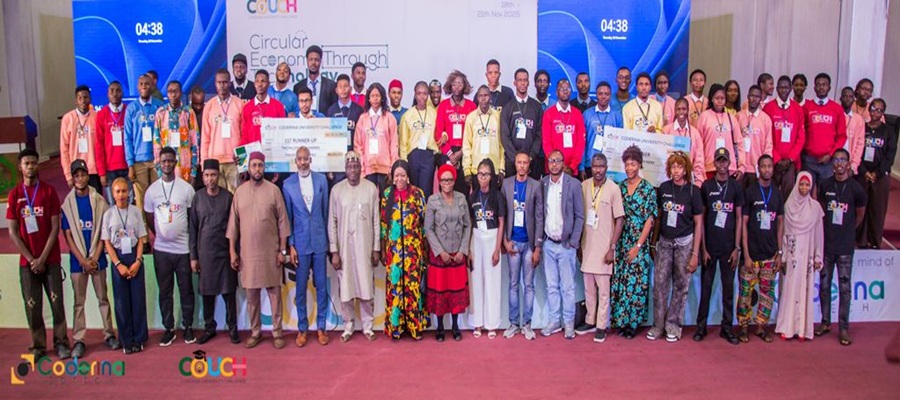
Coderina Education and Technology Foundation, in partnership with the National Universities Commission (NUC), successfully hosted the Grand Finale of the Coderina University Challenge (COUCH) 2025 at the NUC Auditorium, Abuja.

A cross section of attendees
The event gathered top government officials, university leaders, industry partners, and the ten finalist teams selected from over sixty-two initial entries nationwide.
This year’s challenge, themed “Circular Economy Through Technology” spotlighted the potential of Nigerian university students to develop scalable, tech-enabled solutions that address pressing national issues in sustainability, waste management, energy transition, and the circular economy.
The Grand Finale reaffirmed a consistent message shared across all keynote addresses: Nigeria must accelerate the movement of university research from shelves into practical innovation, commercialization, and industry adoption, a key driver of national development and economic growth.
In his opening address, Mr. Olufemi Niyi, chairman, Coderina Board of Directors, emphasized that university projects must not remain buried in archives.
He highlighted COUCH as a platform proving that research can become functional innovation.
Mr. Niyi called on donors, development partners, and private sector stakeholders to support COUCH as a sustainable national innovation pipeline and encouraged investors to channel resources into skills development and technology innovation among youth.
In his keynote address, Dr. Kingsley Tochukwu, the minister of Innovation, Science and Technology, commended the COUCH programme for its role in moving research “from the shelves to the marketplace,” a key priority under the ministry’s national innovation agenda.
He noted that the initiative exemplifies the type of collaboration and commercialization pipeline needed to unlock Nigeria’s scientific and technological potential.
He highlighted several priority areas critical to advancing the country’s innovation landscape:
“Strengthening Nigeria’s innovation ecosystem through coordinated national frameworks and partnerships; expanding digital innovation pathways to accelerate the adoption of emerging technologies, and building a tech-driven economy that delivers measurable value and global competitiveness”.
The Minister added that “Creating new opportunities for youth innovators, ensuring they are empowered to participate in and drive the innovation economy, are part of the key focus areas of the Ministry
He also expressed the Ministry’s readiness to partner with COUCH, Coderina, and the NUC to incubate and scale these student-led innovations.
Mallam Abdullahi Yusuf Ribadu, the executive secretary of NUC acknowledged the twelve universities nominated for the pilot edition by the commission.
He urged the finalists to use their prize money to advance entrepreneurship and technical skill development, reinforcing the NUC’s commitment to fostering innovation-driven learning across tertiary institutions.
In a remarkable commitment, the Minister donated five million naira to ‘Waste2Light’ from FUT Minna and announced an intention to collaborate with all ten finalist universities to support commercialization.
Dr. Tope Kolade Fasua, special address to the President on Economic Affairs, stated that technology remains the largest driver of global economic growth, stressing that Nigeria’s economic transformation is intertwined with youth innovation.
He commended Coderina and advised for greater visibility and national media outreach; creation of an innovation “museum or archive” for brilliant ideas, and the establishment of centers where theories and research can be turned into products.
He concluded that the future of Nigeria’s economy lies in the hands of today’s young innovators.
Professor Sa’adatu Hassan Liman, special guest at the programme and vice-chancellor, Nasarawa State University, delivering her address on “Sustainable National Transformation,” emphasized the need for stronger industry–university collaborations.
She also emphasized need for entrepreneurial university culture; digital literacy in emerging technologies such as AI, blockchain, IoT; adoption of virtual learning and remote laboratories, and inclusive innovation for underserved communities.
She highlighted AI as a catalyst for reimagining teaching and learning, including teacher retraining and curriculum enhancement.
The competition had two categories of prizes recognizing both technical excellence and public engagement.
Winners of the first category, The Challenge, based on pitch and prototype presentation was Team IMSU – Imo State University , taking home the star prize of ₦5,000,000; 2nd Place winners: Team Neuronaut Nile University Prize, ₦2,500,000, and 3rd Place – Team Waste2light from the Federal University of Technology, Minna: ₦1,500,000.
The People’s Choice Awards winners, based on social media engagement and public voting, are Team ADSU Innovators – Adamawa State Uni.: ₦250,000; 2nd Place -Team Scraplink, Lagos State University: ₦150,000, and 3rd place – Team Circle from the Federal University of Technology, Akure, took home ₦100,000.
Giving COUCH overview, Ms. Christiana Anthony, the Project Lead, reaffirmed that COUCH is not merely a competition but a structured innovation development program.
She highlighted the strong collaboration between Coderina and the NUC, noting that the program has created a national pathway for students to design, build, test, and pitch solutions with real potential for commercialization.
The COUCH 2025 grand finale demonstrated Nigeria’s readiness to harness university-driven innovation as a catalyst for economic growth, job creation, and sustainable development.

Ecobank Nigeria to Fully Repay $300m Eurobond Ahead of Schedule

PalmPay MD Seeks Deeper Financial Inclusion @ CeBIH Annual Conference 2025

Airtel Africa Foundation Opens Undergraduate Scholarship Portal in Nigeria

YouTube Nigeria Unveils 2025’s Top Lists and Launches New YouTube Recap Feature

Reps Give Banks Four-Day Ultimatum on Tax Deductions, Charges

Kaspersky Introduces Cyber Pathways to Support Career Development in Cybersecurity

NITDA DG Tasks Youths to Drive Africa’s Digital Transformation

Firm Urges Organizations to Check Protection of their Websites Amid Search Engine Optimisation Attack Schemes

Hackers Breach Phones of Dangote and Otedola, Demand Ransom

FCCPC Sets Deadline for Digital Lending Regulatory Compliance




 Telecom3 days ago
Nigeria Dominates 2025 TikTok Sub-Saharan Africa Awards with Six Wins

 E-Business3 days ago
Report Reveals Half of 2025’s Compromised Passwords were Already Leaked

 E-Financial3 days ago
FG, SEC, NGX Group Agree on Capital Gains Tax Reform

 Broadcasting3 days ago
EFCC Arik Case: Witness Testifies on Receiver Manager Nominee’s Role in NG Eagle Shareholding

 E-Financial3 days ago
A Nation on Alert: Is FIRS’ Xpress Payments Move Consolidating a Revenue Cartel?

 E-Financial2 days ago
CBN Rejigs Financial Inclusion Strategy to Boost Economic Growth

 Telecom3 days ago
Airtel Africa Foundation Celebrates International Volunteer Day, Honours Employee Volunteers

 E-Business3 days ago
UBA Wins Africa’s Bank of the Year for Third Time in Five Years