

General News
Genesys Ignite Pledges Technological Revolution in Nigeria

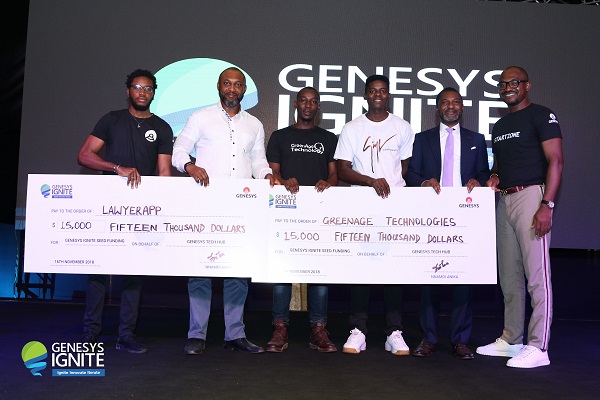
Technology has the capacity to help leapfrog our National development but it takes a number of initiatives to make this a reality, especially for a country like Nigeria with so much human potentials.
One of such initiative is Genesys Tech Hub by Tenece Professional Services, set up with the aim of developing software talents, as well as incubating and funding start-ups.
It is in furtherance of this objective that Genesys Tech Hub kicked off an annual conference tagged Genesys Ignite which aims to bring together start-ups, academia, software developers, students, policy makers, tech enthusiasts etc. to the beautiful city of Enugu.
This year’s event had over 1,000 people in attendance from across Nigeria and abroad. Speakers at the event included a two-time federal minister and former Director General of the Nigeria Economic Summit Group, Frank Nweke Jnr. who doubled as the chair the event.
The keynote address was delivered by former Corps Marshal and Minister of Aviation, OsitaChidoka while the CEO of Nextzon, Mac Atasie presented a paper titled how to ‘Create a Knowledge-driven Economy’. Rapper M.I. (Jude Abaga) used his song, “One Naira”, as context for his presentation titled, ‘Collaboration: A Tool for National Development’.

The panel session on ‘human capital development and innovation was moderated by the Co-Founder of GoDo.ng, Chukwuemeka Fred Agbata Jnr.
According to the Founder,Genesys Tech Hub, Kingsley Eze, ‘when we first conceived the idea of Genesys Ignite, we wanted to have an annual gathering that truly serves as a convergence of the ecosystem and we are happy that two years on, the impact keeps growing.
“Our commitment is to contribute to deepening the start-up ecosystem and we are confident of achieving this with the right support and partnerships.’ He added.
Three categories of awards were presented, beginning with two out of the 12 start-ups that made it to the final stage and pitched their ideas before a panel of judges.
Two start-ups, GreenAge Technologies and LawyerApp received $15,000 each as seed investment and both of them will be incubated at Genesys Tech Hub Enugu.
Similarly, university undergraduate students participated in “Hacktober”, a software development hackathon that sought to build their skills in software engineering, and create a community of young developers in the region.
The top three winning universities were Federal University of Technology, Owerri (First prize – N200,000), University of Nigeria, Nsukka (Second prize – N100,000), and Michael Okpara University of Agriculture, Umudike (Third prize – N100,000).
The winners of the Young Innovators Challenge were University Secondary School, Enugu Campus (first prize), Shalom Science and Technical Academy, Enugu (second prize), and Command Secondary School, Enugu (third prize).

The winners received prizes ranging from laptops, desktop computers and free coding training for their schools.
Nnamdi Anika, Managing Director, Genesys Tech hub, is of the opinion that Nigeria and Africa at large stands to gain a lot from an event like GenesysIgnite.
According to him, ‘this is not designed to be just another technology event, no, far from it.
“Our ultimate goal is to create a platform that will lead to new ideas and solutions, which will solve problems and ultimately contribute to National development.
“This is our hope and we are focused on making this a reality, hence, the investment in the 2018 edition’. He concluded.
One thing is clear; Genesys Ignite has truly joined the league of world-class annual technology events that have come to stay.



Nnimmo Bassey, environmental activist and food sovereignty advocate has raised concerns over the growing influence of junk food culture and global food politics on Nigeria’s food systems.

Nnimmo Bassey, environmental activist
Bassey warned that the increasing consumption of highly processed foods poses serious risks to public health, cultural identity, and national food security.
He made these remarks on Thursday while speaking at the Sustain-Ability Academy lecture on Food, Power and the Politics of Hunger, organised by the Health of Mother Earth Foundation in collaboration with the University of Port Harcourt.
“Food is not just for sustenance; it is central to our identity, our relationships, and our traditions,” he said.
He explained that traditional diets reflect the diversity of Nigeria’s ethnic groups and have historically fostered unity within communities.
Bassey traced the evolution of food systems in Nigeria, highlighting how colonialism, commerce, and conflict have reshaped local diets.
He referenced the Nigerian Civil War as a turning point when food was weaponized, leading to widespread malnutrition and long-term dietary changes, particularly in the Eastern region.
The activist criticized the rapid rise of fast food consumption, describing it as a product of modern society’s demand for instant gratification.
According to him, fast food outlets use sensory stimulation, bright lighting, loud music, and constant visual entertainment to distract consumers from questioning the nutritional value of what they eat.
“People leave with more than just a full stomach, they carry heavy metals, artificial colourings, and harmful substances in their bodies,” he said.
Bassey also expressed alarm over the increasing presence of genetically modified organisms (GMOs) in Nigeria’s food system.
He argued that such products, often introduced without sufficient scrutiny, could have long-term health and environmental consequences.
He further cautioned against the role of political leaders in normalizing unhealthy consumption patterns.
“When top politicians publicly consume junk food and sugary drinks, they send a dangerous message that such habits are acceptable or even desirable,” he said.
At the heart of his argument is what he described as “food colonialism” a system driven by global power dynamics, where economic pressures, debt, and cultural influence shape local food choices to benefit multinational corporations at the expense of local farmers.
Bassey called for a “decolonization” of food systems across Africa, urging governments and citizens to prioritize indigenous foods, protect seed-sharing traditions, and resist policies that undermine local agricultural practices.
He also challenged prevailing narratives around hunger, questioning whether food insecurity is truly a result of low productivity.
“In countries like Nigeria, nearly half of all food produced goes to waste. The issue is not just production, but distribution, policy, and power,” he explained.
The session concluded with a call for urgent reforms to ensure fairness, resilience, and sustainability in food systems, with a focus on supporting smallholder farmers and addressing the structural causes of hunger.


At least 80% of governments will deploy artificial intelligence (AI) agents to automate routine decision-making, enhancing efficiency and service delivery by 2028.

This is according to market research firm Gartner, which highlights a growing shift toward digital governance, where AI-powered systems will increasingly handle repetitive administrative tasks, such as processing applications, managing public records and responding to citizen queries.
“Government chief information officers are under growing pressure to embed AI into decision-making capabilities rapidly and responsibly,” says Daniel Nieto, senior director analyst at Gartner. “The rise of multimodal AI, alongside conversational and agentic systems, has expanded what public organisations can automate, understand and anticipate.”
The Gartner report comes as South Africa is moving to embed AI into public administration, with early use cases emerging across service delivery, disaster response and internal operations, even as full-scale deployment of autonomous “AI agents” remains some years away.
The country’s National AI Policy Framework, released in 2024, has set the direction for adoption, with a comprehensive national policy expected by 2027.
Implementation is likely to follow from 2027 onwards, positioning the country for a more structured and regulated rollout of advanced AI systems across departments.
While South Africa has yet to deploy AI agents at scale, government and research initiatives indicate that agent-like systems are already taking shape.
Global use cases
Globally, governments are rapidly deploying AI agents to automate public services and internal operations, shifting from simple chatbots to systems that can execute tasks and coordinate workflows.
In the US, federal and city agencies are using AI agents to handle citizen queries, draft documents and manage call centres, while in China, autonomous systems are being integrated into administrative processes and urban management.
European governments are piloting AI-driven tools in policing and public service delivery, and in emerging markets, agentic platforms are being used to improve disaster response, financial inclusion and digital identity systems.
However, Gartner notes that fragmentation is one of the most persistent barriers to AI value in government.
According to a Gartner survey of 138 respondents from government organisations worldwide between July and September 2025, 41% of respondents cited siloed strategies and 31% cited legacy systems as key challenges to adopting and implementing digital solutions.
“Technology modernisation alone has not resolved these issues,” says Nieto.
The market analyst firm says as AI transitions from experimentation to being deeply embedded in decision-making, governance approaches must also evolve. It points out that traditionally, AI governance has centred on managing models, data and algorithms.
However, it states that decision intelligence (DI) shifts this focus towards the governance of decisions themselves; for example, on how they are designed, executed, monitored and audited. This shift in governance is especially critical in government, where public legitimacy relies on transparency and fairness, the firm explains.
Measurable impact
The Gartner survey found that 39% of respondents cited improved service and citizen satisfaction as primary reasons to invest in building citizen trust.
The firm notes that DI offers a structural foundation for operationalising this trust by making decision pathways explicit and auditable.
“By governing decisions, rather than just isolated AI components, governments can better balance automation with human judgement, particularly in high-stakes or rights-impacting contexts,” says Nieto. “Regulated industries and governments cannot rely on opaque ‘black box’ systems for consequential decisions. DI elevates explainability from a technical requirement to a governance imperative.”
Because of the need for transparency in decision-making, Gartner predicts that by 2029, 70% of government agencies will require explainable AI (XAI) and human-in-the-loop (HITL) mechanisms for all automated decisions that impact citizen service delivery.
Gartner explains that XAI and HITL designs are foundational to public-sector DI. These mechanisms ensure decision logic can be inspected, explained and challenged. Because of XAI and HITL, humans also retain authority over exceptions, appeals and high-risk cases, and accountability is preserved even as automation increases, it adds.
While efficiency remains important, Gartner says citizen trust in government’s ability to provide effective services is becoming a key driver of digital transformation. Fifty percent of government respondents cited improved citizen experience as one of their top three priorities.
“As AI and decision intelligence increasingly automate and streamline service delivery, the traditional notion of ‘citizen experience’ evolves,” says Nieto.
“When citizens receive what they need from the government automatically, direct interactions may decrease, making trust in the system’s reliability, fairness and transparency even more critical. Because trust is so imperative in these situations, the predictive capacity to anticipate potential needs could reshape how government digital services are delivered.”

Telegram has unleashed its most sweeping enforcement campaign yet in 2026, deleting millions of illicit channels and groups while boosting daily takedowns from 10,000 to 140,000—with peaks surging past 500,000 in a single day—yet cybercriminal ecosystems remain stubbornly resilient, rapidly reorganising and exploiting the platform’s scale to sustain operations undeterred.

Telegram
The paradox is stark: despite blocking over 43.5 million channels in 2025 alone and achieving record transparency in moderation reports, the threat landscape shows no contraction, as fraudsters deploy sophisticated evasion tactics like pre-built backup channels, “Request to Join” gating to thwart bots, bio disclaimers tagging Telegram leadership for plausible deniability, and floods of forwarded messages that preserve criminal knowledge even after originals vanish.
Check Point Exposure Management data reveals 20 percent of removals targeted business-impacting crimes—carding, Fullz trading, hacking services—with communities often reloading audiences instantly from preloaded backups, ensuring operational continuity amid the friction.
For Nigeria, home to Africa’s largest Telegram user base of eight million aged 16-64 per Statista, the stakes are acute: the platform dominates crypto trading, mining schemes, online betting, and gambling hubs, leaving traders, youth, and startups vulnerable to scams that evolve faster than platform defenses.
Kingsley Oseghale, Check Point Software Technologies’ West Africa country manager, warns that “enforcement is real and growing, but criminals adapt quicker—security teams must hunt entire networks, not just channels, via continuous exposure management to dismantle operations at the root.”
Migration to rivals like Discord (just 6% of underground invite links), Signal, SimpleX, or Matrix remains negligible—3 million Telegram invites circulated underground in three months alone—proving its 800 million users, speed, anonymity, and network effects keep it the premier broadcast, recruitment, and marketplace layer, even as high-profile groups like AKULA tested alternatives before reverting.
Spikes in forwarded content during February-April 2025 peaks extended fraud data lifecycles, mirroring broader cybercrime redundancy where attackers assume disruption and build in failover.
This persistence demands proactive vigilance: SOC teams ignoring Telegram risk blind spots in brand protection and threat detection, as evasion now standardises across underground forums—underscoring that while Telegram’s crackdown marks progress, true eradication hinges on intelligence beyond takedowns.

CBN Introduces Stricter BVN Rules to Curb Fraudulent Transactions

Binance is Missing from Ghana’s Crypto Sandbox

Canal+ to Cut Jobs as Part Sweeping Restructuring

Activist Warns against Rising Junk Food Culture in Nigeria

World Bank Debars 3 PwC Subsidiaries for 21 Months over Alleged Project Fraud

Kaspersky Discovers New Phishing Campaign Exploiting Google Tasks Notifications to Steal Corporate Credentials

esentry 2025 Report Shows Healthcare, Financial Services and Telecoms as Staging Grounds for Increased Cyberattacks in Africa

AfDB, UNDP Launch $10Bn AI Initiative for Africa

Mutual Benefits Assurance Settles ₦5.9bn Claims in January 2026

MultiChoice Suspends Yearly DStv Price Hike as Canal+ Pushes Growth




 E-Financial1 day ago
Kuda MFB Increases Kuda for Her Business Grants to ₦10 Million

 News2 days ago
Kaspersky Discovers Infostealers Mimicking Claude Code, OpenClaw and Other AI Developer Tools

 General News2 days ago
Banks, Offices to Close for Thursday and Friday for Eid-el-Fitr

 Telecom2 days ago
Nigeria, Ghana Trigger Stunning 45 Percent Surge in MTN Dividends

 E-Financial2 days ago
SEC Shuts Over 400 Fraudulent Investment Schemes, Arrests Operators

 Telecom2 days ago
ATCIS Urges FG to Ensure Safety of Consumers Data

 Telecom1 day ago
Vitel Wireless Lures Subscribers with “Data that Never Expires” Campaign

 News3 days ago
Breaking…….Nigerian Firms Pledge Millions, Create UK Jobs