

General News
German Varsities Welcome Pan-African University Students for Summer School

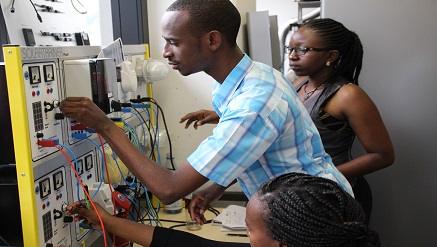
The first cohort of students of the Pan African University Institute of Water and Energy Sciences, including Climate Change (PAUWES) attended a Summer School in Germany organized from July 17 to 31.
The summer school was organized in partnership with the Deutsche Gesellschaft fuer Internationale Zusammenarbeit (GIZ), the German Academic Exchange Service (DAAD), the Institute for Technology and Resources Management in the Tropics and Subtropics (ITT) at the Cologne University of Applied Sciences, the United Nations University Institute for Environment and Human Security (UNU-EHS) and the Center for Development Research (ZEF) of the University of Bonn.
During these two weeks, the 26 African students were given the opportunity to receive training from highly qualified faculty and had access to the state-of-the-art facilities of the German partner universities.
In addition, the students visited significant sites for the water and energy sector, including the Jülich Solar Tower, the Heimbach Hydropower Plant and Cologne Flood Management Center (SteB).
Furthermore, the German-Algerian Chamber of Commerce and Industry (AHK Algérie) also organised a range of activities including a visit of Protarget, one of the numerous German companies which are active in the energy and water sectors and are looking to future recruits from the next generation of experts.
For Djamel, 23, from Algeria, this Summer School has been the most rewarding experience of his entire academic journey.
“This study trip to Germany exceeded my expectations. The programme was very intense but it was worth it. All the professors were very friendly and the workshops, the excursions and lab experiments were really interesting”, said the young Algerian. Djamel is one of the three students staying in Germany after the Summer School as they were offered internship positions at ITT.
“In Africa and in the rest of the world, we can clearly observe the effects of climate change. Replacing fossil fuels by renewable energy is part of the solution. In that respect, Africa has an important role to play as it has significant renewable energy resources. However, in order for the continent to harness its green energy potential, it needs to have highly qualified young people who have the capacity to use the latest technologies and who share an ambitious vision for their continent. This is the role of PAUWES within the African continent: we are training the next generation of global-minded experts to tackle local and global problems, such as climate change, energy and water supply.
“It is this constant exchange of people and ideas that makes our Institute so unique on the continent. Of course, this amazing project would not have been possible without the unwavering support of our African and international partners. As Kofi Annan said, “cooperation and partnership are the only routes that offer any hope for a better future for all humanity”. At PAUWES, we are fortunate enough to be supported by Germany and Algeria, which are among the most advanced countries in the sectors of renewable energy and water science, as well as climate change,” said Professor Abdellatif Zerga, Director of PAUWES Institute.
Earlier this year, PAUWES held its first International Symposium which was attended by academics and researchers from all over Europe, Africa and beyond.
Further activities are already scheduled for the next academic year, including the organisation of events (webinars, open lectures, etc.) and the introduction of the social and professional exchange platform.
A winter school is even planned in Tlemcen, Algeria for November.
PAUWES currently has 26 students from 12 African countries studying as part of the first cohort on its MScs in Water and in Energy.
These world-class graduate programmes, which will from next academic year offer dual tracks in engineering and policy, provide students with a broad foundation in theory and practical skills which equip them to continue to PhD level or pursue a career in water, energy or climate change solutions.
The next academic year will start in September 2015 with a new class of 50 students in both the engineering and policy tracks.
The Pan African University Institute of Water and Energy Sciences (including Climate Change) (PAUWES) is hosted by the University of Tlemcen, Algeria.
The institute was founded by the African Union Commission as part of PAU. In partnership with the German government, the Institute offers graduate students access to leading academic research and the latest theoretical and hands-on training in areas vital to the future of African development – water, energy and the challenge of climate change.
Supported by the integrated PAU network, which include PAU institutes in Kenya, Nigeria, Cameroon and Southern Africa, PAUWES attracts renowned international faculty and highly qualified students from across the African continent.
The German Government (with GIZ, KFW and DAAD) is the Key and Thematic Partner, providing financial, technical and administrative support to the project.


Nigeria powered Jumia Technologies AG’s strongest growth in 2025, cementing its position as the company’s most important market as rising consumer demand, SME activity and logistics expansion boosted performance across the e-commerce platform.

In the fourth quarter of 2025, Jumia’s Nigeria operations recorded a 50% year-on-year increase in Gross Merchandise Value (GMV) and a 33% rise in orders. The performance highlighted growing adoption of online shopping and Jumia’s increasing relevance to African consumers.
Nigeria’s momentum helped drive 36% year-on-year GMV growth and 34% revenue growth across the group in the quarter, alongside a 26% increase in quarterly active customers. Growth was supported by stronger customer retention and higher order frequency.
Beyond sales growth, Jumia said its Nigeria operations are delivering wider economic impact. The platform supports thousands of local SMEs, enabling them to reach customers nationwide, while continued investment in fulfilment centres and last-mile delivery is creating income opportunities for logistics partners and sales agents.
Efficiency gains were also evident. Fulfilment costs per order declined 12% year-on-year, contributing to a 39% reduction in operating losses and a 47% drop in adjusted EBITDA losses in the fourth quarter. Cash used in operating activities fell sharply to $1.7 million, compared with $26.5 million a year earlier, while liquidity stood at $77.8 million at year-end.
Temidayo Ojo, Chief Executive Officer of Jumia Nigeria, said the results reflect growing trust from consumers and businesses. “Nigeria is central to Jumia’s growth,” Ojo said. “Each order supports local sellers, delivery partners and jobs, while improving access to affordable products for consumers.”
For the full year, Jumia reported 14% GMV growth and 13% revenue growth, with losses narrowing significantly. Looking ahead, the company expects Nigeria to remain a key growth driver as it targets 27–32% GMV growth in 2026 and aims to reach adjusted EBITDA breakeven by the fourth quarter of 2026.

This Valentine’s Day, PalmPay is celebrating love in all its forms with the launch of #LoveWithPalmPay, a campaign highlighting how simple, everyday shared money moments can bring relationships closer.

Valentine’s Day is more than grand gestures; it’s built on the small, meaningful actions that shape relationships, sending timely support, saving together, or managing shared responsibilities. PalmPay encourages users to share 30–60 second real-life stories, either solo or duet style, showing how PalmPay always works and has helped them support or stay connected with someone they love.
The campaign runs from February 9th to 21st across Facebook, Instagram, X (formerly Twitter), and TikTok. Four winners will receive ₦100,000 each week for two weeks, totalling a prize pool of ₦800,000.
Entries can take many forms, including couple videos, solo stories, split-screen duets for long-distance couples, or voiceover narratives with photos or clips, making the campaign inclusive for married couples, parents, and long-term partners.
How to Participate:
- Share an authentic love story about your partner
- Clearly show PalmPay in action (transfers, savings, or other in-app activities)
- Be creative and emotionally engaging
- Post between February 9th – 21st with the hashtag #LoveWithPalmPay
- Share on any of PalmPay’s social media platforms
“Love evolves, and so do relationships,” said Olorunfemi Hanson, Head of Marketing and Communication, PalmPay. “From dating to parenthood, the small money moments we share every day play a big role in keeping us connected. With #LoveWithPalmPay, we want to celebrate those stories and show how PalmPay always works, making everyday love simpler, reliable, and meaningful.”
This Valentine’s Day, PalmPay celebrates love as it truly is real, intentional, and built on shared moments.
PalmPay is a leading digital banking platform driving financial inclusion and economic empowerment in underserved emerging markets. Through its secure, user-friendly, and inclusive suite of financial services, PalmPay empowers individuals and businesses with tools to manage and grow their money.
PalmPay offers a comprehensive range of products, including mobile payments, savings, and micro-insurance via its app and mobile money agent network.
Since launching in Nigeria in 2019 under a Mobile Money Operator license, the platform has grown to over 35 million app users and processes up to 15 million transactions daily. PalmPay has operations in Nigeria, Ghana, Tanzania, and Bangladesh. For more information, visit www.palmpay.com


Central Bank of Nigeria (CBN)and the Nigerian Communications Commission (NCC) have proposed that customers must receive refunds within 30 seconds for failed airtime and data purchases to curb persistent billing complaints in the telecommunications sector.

This was indicated in the Exposure Draft of the Joint CBN–NCC Framework for Resolution of Failed Airtime and Data Purchase Transactions, which was published on the website of the CBN on Monday.
The landmark exposure draft, dated 5 February 2026, seeks to “institutionalise clear accountability” and establish a “coordinated approach to consumer redress” across the financial and telecommunications sectors.
The most significant shift in the proposed framework is the introduction of standardised, automated timelines for resolving failed transactions.
Currently, Nigerians often face long delays when airtime purchases fail at the bank, aggregator, or Mobile Network Operator level.
To solve this, the regulators have proposed a 30-second window for automated reversals. Section 6.0 (ii) of the draft exposure, which dwelt on failed transactions, especially as it relates to unfulfilled airtime/data delivery, proposes a time to refund the purchaser of 30 seconds “if the transaction failed at the bank level… Failed transaction delivery from NCC Authorised Licensees… Failed transaction delivery from MNO to the NCC Authorised Licensee.”
The draft emphasised that stakeholders must “automate reversal processes across all stakeholders” to ensure that refunds require no human intervention from the customer.
The draft exposure also stated that “all parties involved in airtime and data transactions shall take the following actions to ease usage and facilitate consumer satisfaction: a. Stakeholders must immediately connect ONLY to relevant authorised licensees of the NCC and CBN. b. MNOs and banks must only connect to NCC Authorised Licensees/MNO digital channel partners for airtime and data vending… Notifications of failure create final settlement obligations between MNO and NCC-authorised licensees… The NCC and CBN will audit stakeholder compliance jointly or individually at quarterly or other intervals as may be determined.”
From a business and oversight perspective, the regulators are proposing a Central Monitoring Dashboard to be hosted jointly by the CBN and NCC, which will track reversals, Service Level Agreement breaches, and customer complaints in real-time.
“There shall be a Central Monitoring Dashboard hosted by CBN/NCC for tracking reversals, SLA breaches, and customer complaints. This will facilitate the establishment of a real-time national ‘Failed Transactions Dashboard’ with a uniform error code with end-to-end visibility across the value chain’, read the draft exposure.
This is designed to eliminate the “unclear ownership of liability” that often occurs when banks and telcos blame each other for failed recharges. To support this, banks and MNOs will be required to maintain and share daily reports of successful and failed cases.
The proposed framework also addresses the common problem of “lost” money when customers recharge ported phone numbers. The draft mandates that MNOs must validate a phone number against the ported number database before processing any recharge. If the system identifies a number as ported out or invalid, it must “proactively stop recharges” and send a failure code back to the bank to ensure the customer is not debited.
For erroneous recharges sent to the wrong person, the framework sets clear protocols: below N20,000, MNOs will request the recipient’s consent before a reversal, and when it is above N20,000, an affidavit of indemnity or notarised letter is required to process the recovery.
The CBN and NCC in the exposure draft signalled they will take a firm stance on compliance. Both agencies will conduct joint quarterly audits of all stakeholders, including banks, payment service providers, and MNOs, to verify compliance with the new rules. The regulators have warned they will “impose penalties for any breach” of the framework’s provisions.
Banks and other financial institutions have until 10 February 2026 to submit their inputs on the draft before it is finalised. Once implemented, the framework is expected to significantly restore “subscriber trust” in Nigeria’s digital financial ecosystem.

UBA Revamps Agency, Unveils Enhanced Value on RedPay Terminals

FG Seeks Private Sector Partnership to Bridge Broadband Gap

Nigeria Market Powers Jumia’s Momentum as E-commerce Platform Demand Accelerates

Cybersafe Foundation Partners Google to Strengthen Cybersecurity Among CCIs in Africa

Kaspersky Brings more Transparency to Threat Detection with New Hunt Hub

Firm Detected a Fivefold Surge in QR Code Phishing Attacks in the Second Half of 2025

US invests $115m in counter-drone tech for World Cup security

Nigerian Terra Industries Secures $11.8m for Expansion

Nigeria Targeted with 4,622 Cyber-attacks Per Week in December 2025

Firm Detected a Scam Exploiting OpenAI’s Teamwork Features




 General News3 days ago
CBN, NCC Propose Instant Refunds for Failed Airtime, Data

 Telecom3 days ago
Safer Internet Day: Sophos Warns – 42% Attacks Hit Stolen Logins in 2025

 Telecom2 days ago
Inside Nigeria’s Telecom Exploitation Crisis Draining Household Budgets

 News3 days ago
Ecobank Nigeria to Host Customer Forum on Strengthening Regional Integration for Economic Transformation

 Telecom3 days ago
Airtel Achieves 99 Per cent 4G Coverage across Nigeria

 News3 days ago
Lagos to Establish West Africa’s Premier International Financial Centre

 General News3 days ago
FG Launches the Happy Woman App Platform

 News3 days ago
Lasaco Assurance Gets Shareholders Approval to Advance Capitalization Plans