

Telecom
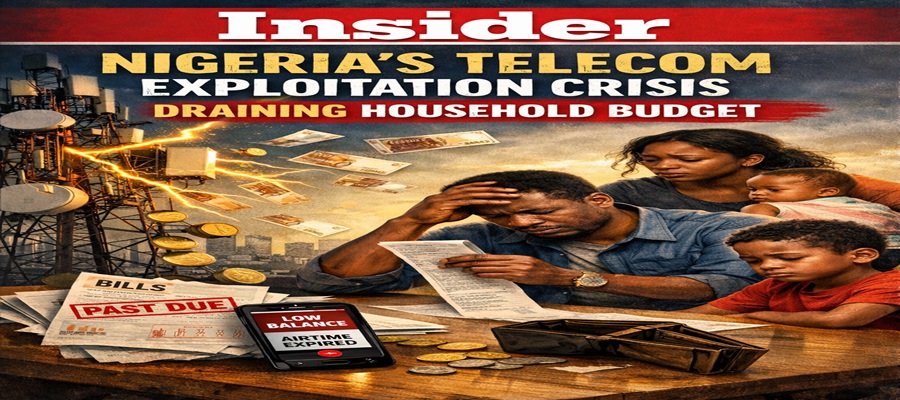
Inside Nigeria’s Telecom Exploitation Crisis Draining Household Budgets

By Blaise Udunze
For about a year now, millions of Nigerians relying on the internet to make a living have been groaning over the manipulation of airtime and data consumption that has turned into a relentless drain on household budgets. Painfully, individuals and businesses buying airtime or data increasingly feel less like paying for a service and more like entering a wager whose odds are permanently stacked against the consumer. Around the nooks and crannies of the country, across cities and rural communities alike, subscribers tell the same weary story of data that evaporates mysteriously, airtime consumed faster than reason allows, and customer care responses that sound rehearsed rather than responsive.

Inside Nigeria’s Telecom Exploitation Crisis Draining Household Budgets
The majority will agree that this collective frustration is not a coincidence, nor is it merely the product of careless smartphone use, because others might argue that there are several technical factors inducing rapid mobile data usage. Leave it or take it, it is the outcome of a broken ecosystem where multinational telecom companies wield immense power in an environment marked by weak institutional checks, limited transparency, and a population stretched thin by economic hardship.
The recent 50 per cent upward adjustment of telecom tariffs, later revised in policy conversations to 35 per cent, has intensified this tension, though it is not justifiable as exploitation. For millions of Nigerians already battling inflation, currency volatility, and shrinking purchasing power, the hike landed not as an economic necessity but as an additional burden. When communication costs begin to claim up to 15 per cent or, in some cases, nearly 30 percent of the national minimum wage, something fundamental has gone wrong. Access to communication is no longer a luxury; it is the infrastructure of modern survival. Yet the price Nigerians are now paying for this access is becoming socially and economically unsustainable.
A published report showed that as of January 2025, statistics from the Nigerian Communications Commission (NCC) disclosed that there were 141 million Internet users via the narrowband (GSM), while broadband penetration stood at 45 per cent. Data consumption has increased to 1,000,930.6 terabytes.
A review of the multinational telecom companies indicated that the new tariff for MTN’s revised data prices showed the 1.8GB monthly plan now goes for N1,500, against the previous 1.5GB plan priced at N1,000. The 20GB plan has been adjusted to N7,500, up from N5,500, while the 15GB plan now costs N6,500, rising from N4,500.

Under this new pricing regime, the same would be said of Airtel as it has replaced its cheapest monthly data plan of 1.2GB plan for N1,000 with 2GB plan for N1,500. For 3GB for N2, 000 (from 1.5GB at N1, 200), 4GB for N2, 500, formerly 3GB at N1, 500, and 8GB for N3, 000 (formerly 4.5GB at N2, 000). Other adjustments include 10GB for N4, 000 (formerly 6GB at N2, 500), 13GB for N5, 000 (from 10GB at N3, 000), 18GB for N6, 000 (formerly 15GB at N4, 000) and 25GB for N8, 000 as this replaces 18GB at N5, 000.
Further, the 75GB monthly bundle, which costs N16, 000 has been renamed as plan, costing N20, 000; 100GB for two months, costing N20, 000 have been upgraded to 150GB to cost N40, 000, while 400GB for three months, which cost N50,000 is now upgraded to 480GB to cost N120,000.
The bubble burst was further complicated tariff increase, which is the resurgence of widespread complaints about rapid data depletion. The issue is that businesses, students, families, and professionals are now raising alarms that data bundles, which previously lasted weeks, now disappear in days or even hours, which is questionable. Another critical area affected is small and medium-sized enterprises that rely on cloud services, digital marketing, logistics platforms, and online payments are finding their operating costs spiraling without any justification. For many, the crux of the matter is that profitability is being quietly eroded, not by poor business decisions, but by the rising cost and unpredictability of connectivity.
The telecom operators, backed by the regulator, have responded with familiar explanations that have always favoured their unscrupulous and illicit activities, with the explanation that data, they say, depletes faster because of background applications, automatic updates, high-definition streaming, malware, faster networks, and users’ failure to manage device settings. Technically, these explanations are not false because modern smartphones are indeed data-hungry, and digital behaviour has evolved. But this defence, repeated endlessly, misses the deeper issue, as the fact is that the problem Nigerians are confronting is not simply that data is consumed; it is that the system governing how data is measured, billed, and explained is not transparent, hard to understand, unaccountable, and tilted entirely in favour of the service providers.
In Nigeria’s telecom market, operators are both the umpires and the players. They measure usage, bill customers, interpret anomalies, and adjudicate complaints, which does not create ground for fair play. Subscribers, on the other hand, are expected to accept consumption figures hook, line, and sinker, which they cannot independently verify. An unacceptable fact is that there are no universally accessible, third-party audited data meters that allow users to confirm what they have truly consumed in real time. Customers and service providers do not have equal access to information; this asymmetry creates fertile ground for silent overbilling, whether intentional or structural, and it erodes trust in a sector that should be built on transparency not obscurity.
One critical aspect that must be addressed squarely is that the regulatory weakness compounds the problem. While the Nigerian Communications Commission possesses statutory authority, enforcement has often appeared slow, reactive, and insufficiently punitive. Penalties imposed on multinational firms with billion-dollar balance sheets rarely feel consequential. Investigations drag on, public disclosures are limited, and even when infractions are established, consumers seldom receive refunds. In such an environment, corporate restraint becomes optional. Where regulators lack teeth, corporations inevitably test boundaries.
The market structure itself offers little relief as the market setup does not protect consumers. Nigeria’s telecom sector is effectively oligopolistic, dominated by a few large powerful players with similar pricing models and limited incentive to compete on fairness. Tariff structures are deliberately complicated and complex, with multiple conditions and layered with bonuses, rollover conditions, expiry clauses, and promotional data that behaves differently from paid data. For the average subscriber, understanding these distinctions is exhausting. Complexity becomes a strategy, not an accident, reducing accountability while increasing revenue certainty for operators.
Though economic pressure on the telecom companies is real, and it must be acknowledged, knowing fully well that exchange rate volatility, energy costs, vandalism, and inflation have hurt profitability. Airtel’s revenue decline and MTN’s reported losses underscore the financial strain facing operators in Nigeria’s macroeconomic climate. It must be understood that corporate hardship does not justify consumer exploitation. The risk arises because multinational firms are subjected to pressure to meet global revenue targets and repatriate profits, adopt aggressive monetisation strategies in markets where regulation is weak and consumer resistance is fragmented.
From experiences thus far, the human cost of this imbalance is becoming impossible to ignore. From students like Abiodun Yusuf, who spends most of his allowance on data that barely supports his academic needs, and also to small business owners like Cynthia Jude, whose online shop struggles to stay viable, the stories repeat themselves with unsettling consistency and outcomes. Families ration children’s screen time not out of discipline, but out of financial desperation. The adverse part that has continued is the widening of an already dangerous digital divide, as rural communities withdraw from digital platforms altogether because of exploitation.
Perhaps most telling is how quickly exploitation has been normalized in Nigeria. Many Nigerians now shrug and say, “That’s how it is.” This resignation is the greatest victory for an unfair system and when people stop believing that fairness is possible, for this reason, exploitation becomes invisible, and abuse thrives without resistance.
Consumer advocacy groups like NATCOMS have begun to signal a shift in posture, including the possibility of court action. Labour unions have threatened boycotts. Civil society organisations warn of social and economic repercussions. These responses indicate that public patience is wearing thin. If left unaddressed, subscription apathy, however gradual, could ultimately undermine the very growth the telecom sector seeks to protect.
For a better understanding of what Nigeria faces is not merely a dispute over megabytes and tariffs, for clarity, it is a governance challenge that cuts across corporate ethics, regulatory independence, consumer empowerment and economic justice. A digital economy cannot thrive on distrust. Transparency and easily understandable data billing must become mandatory, not an aspirational goodwill promise. Independent audits should be public, regular, and credible. Complaint resolution mechanisms must be simplified, fast, and binding. Regulators must act not as mediators between equals, but as defenders of the public interest in an asymmetrical power relationship.
Equally important is consumer education, but awareness campaigns alone cannot substitute for structural reform. Digital literacy must go hand in hand with corporate accountability because the better it is understood that teaching users how to conserve data does not absolve operators from the responsibility to bill fairly and transparently.
At its core, the telecom debate reflects a large Nigerian dilemma, if not a broader problem in Nigeria, as corporate power has grown faster than institutional strength. Until regulators are truly independent and totally free from corporate and political influence, transparency is enforced by law, and consumers are recognized and treated not as passive revenue streams but as stakeholders with rights, exploitation will remain systemic rather than accidental or a series of isolated mistakes.
Communication is the bloodstream of modern society. When access to it becomes exploitative, the cost is paid not only in naira but in opportunity, dignity, and trust. Nigeria must decide whether its digital future will be built on fairness that respects consumers or allow it to rest on fatigue, frustration, and exploitation of users. The choice Nigeria makes will make more impact and the answer will shape not just the telecom sector, but the credibility of governance in an increasingly connected nation.
Blaise, a journalist and PR professional, writes from Lagos and can be reached via: [email protected]


Airtel Nigeria has secured a fresh 10-year renewal of its spectrum licence from the Nigerian Communications Commission (NCC), reinforcing the telecom operator’s long-term commitment to expanding broadband connectivity and improving digital access across the country.

The renewed licence covers Airtel’s spectrum holdings, which are critical to the delivery of voice and high-speed data services, providing regulatory certainty for continued investments in network expansion, capacity upgrades and improved customer experience.
According to the company, the renewal underscores confidence in Nigeria’s telecommunications sector and will support its ongoing efforts to bridge the country’s digital divide by extending quality connectivity to more underserved communities.
Sunil Taldar, chief executive officer, Airtel Africa, said the renewal provides the company with the confidence to continue investing in Nigeria’s digital infrastructure.
He said, “The spectrum renewal reaffirms our long-term commitment to Nigeria, our largest market. It gives us the certainty required to continue investing in network expansion, improve service quality and accelerate digital inclusion for millions of Nigerians.”
Taldar added that Airtel remains focused on expanding broadband access and supporting Nigeria’s digital economy agenda through sustained investments in telecommunications infrastructure.
He further said, “We appreciate the Nigerian Communications Commission and the Federal Government for their continued support in creating an enabling environment for investment. We remain committed to delivering reliable and affordable connectivity while contributing to Nigeria’s socio-economic development.”
Meanwhile, Industry observers said the licence renewal removes regulatory uncertainty and allows Airtel to pursue long-term capital investments, including the expansion of 4G and 5G networks, as demand for mobile data and digital services continues to grow across Nigeria.
The renewal comes as telecom operators continue to invest heavily in broadband infrastructure to meet rising data consumption and support government efforts to achieve Universal digital access.
Furthermore, It also aligns with the NCC’s objective of ensuring efficient spectrum management while encouraging sustained private sector investment in the country’s telecommunications industry.
Telecom
GSMA Supports Abuja Declaration on Meaningful Connectivity for Africa, Joins Partners to Launch ATLAS Umoja

The GSMA supports the Abuja Ministerial Declaration on Meaningful Connectivity for Africa by Ministers and Heads of Delegation at the African Telecommunications Union (ATU) Conference of Plenipotentiaries (CPL-2026), describing it as an important milestone in strengthening Africa’s digital future through evidence-based policy, investment and regional collaboration.

The Declaration commits African governments to advancing policies that promote meaningful connectivity, digital inclusion, technology-neutral regulation, resilient digital infrastructure and locally relevant digital services. It also reinforces the importance of collaboration between governments, industry and development partners to close the continent’s connectivity and usage gaps.
Throughout the conference, the GSMA has worked alongside governments, regulators and industry leaders to support these shared ambitions through practical policy engagement, evidence-based research and new collaborative initiatives designed to accelerate Africa’s digital transformation.
Speaking during the ATU-GSMA African ICT Regulatory Leaders’ Forum, policymakers and regulators explored how stronger evidence-based regulation, greater regulatory harmonisation and future-ready policy frameworks can create an enabling environment for investment, innovation and sustainable digital growth across Africa. Drawing insights from the GSMA’s Digital Africa Index, participants also examined future-ready approaches to satellite regulation, highlighting how technology-neutral licensing frameworks can support innovation while extending connectivity to underserved communities.
Caroline Mbugua, Senior Director, Public Policy, Africa, GSMA, said: “The Abuja Ministerial Declaration sends an important signal that African governments share a common vision for delivering meaningful connectivity through modern, evidence-based and investment-friendly policy. Its emphasis on digital inclusion, technology-neutral regulation, resilient infrastructure and stronger regional collaboration reflects the practical policy foundations needed to accelerate Africa’s digital transformation.”
Launching ATLAS Umoja AI
Supporting the ambitions set out in the Abuja Declaration, the GSMA, Nigeria’s Ministry of Communications, Innovation and Digital Economy, Togo’s Ministry of Digital Economy and Transformation, Kenya’s Ministry of information, Communications and the Digital Economy, Namibia’s Ministry of Information and Communication Technology, Benin’s Ministry of Digital Transformation and Innovation, Awarri, Zindi, Pawa AI and Mozisha today announced ATLAS Umoja AI –a new pan-African initiative to strengthen collaboration on African language AI.
Designed to complement national AI programmes, ATLAS Umoja will bring together governments, industry and researchers to share expertise, datasets and best practice, helping develop trusted, scalable AI that better reflects Africa’s languages, cultures and development priorities. The initiative aims to accelerate innovation, attract investment and scale African language AI across the continent.
The launch builds on the momentum of the newly established AI for Good Global Commission. Ministers from Nigeria, Namibia and Togo, who serve on the Commission, have committed to support Africa Umoja, demonstrating how African leaders are turning global ambitions for trusted and inclusive AI into practical regional collaboration.
Angela Wamola, Head of Africa, GSMA, said: “Africa’s AI future must reflect Africa’s own languages, communities and development priorities. ATLAS Umoja brings together governments, industry, researchers and innovators to build African language AI at scale. By making AI and digital services available in the languages people speak every day, the initiative will help tackle two of the biggest barriers to internet adoption – digital literacy and locally relevant content – supporting efforts to close Africa’s usage gap and expand meaningful connectivity across the continent.”
Dr. Bosun Tijani, Honourable Minister of Communications, Innovation and Digital Economy of Nigeria said:“Artificial Intelligence will be a defining technology for Africa’s future, but its benefits must be built on our own languages, cultures and knowledge systems. Nigeria is proud to have taken the first step through N-ATLAS and is equally proud to see that vision evolve into the continental ATLAS Umoja AI.
“By working together with governments, researchers and ecosystem partners across Africa, we can build AI that is more inclusive, locally relevant and accessible to millions of people, while strengthening Africa’s digital sovereignty and creating new opportunities for innovation, education and economic growth.”
Silas Adekunle, Founder & CEO, Awarri added: “Awarri is proud to support The ATLAS Umoja AI and contribute lessons from N-ATLAS, which has demonstrated what is possible when African language data, local technical talent and practical AI applications are brought together. This is an important opportunity to help build AI systems that work for African languages and communities.”
Celina Lee, CEO & Co-Founder, Zindi concluded: “Africa’s AI future will be built by the people who best understand its languages, cultures and communities. Through ATLAS Umoja AI, we have an opportunity to empower local researchers, data scientists and developers to solve meaningful challenges, strengthen national AI capabilities and ensure African language AI is developed by Africans, for Africans.”
Alongside the launch of ATLAS Umoja AI, the GSMA continued discussions with policymakers at the ATU Conference on future-ready regulatory frameworks, including satellite connectivity, spectrum policy and technology-neutral licensing.
Drawing on the GSMA Satellite Regulatory Playbook, discussions explored how modern regulation can encourage investment, expand meaningful connectivity and support the ambitions of the Abuja Declaration.
Together, the Abuja Declaration, ATLAS Umoja and continued collaboration between governments, regulators and industry represent an important step towards expanding meaningful connectivity, accelerating digital inclusion and supporting Africa’s digital transformation.

Samsung has unveiled its most advanced foldable smartphone lineup yet, the Galaxy Z Fold8 Ultra, Galaxy Z Fold8, and Galaxy Z Flip8. The tech conglomerate now sets a new benchmark for premium mobile innovation.

Konga
Nigerian customers can now pre-order the new devices on Konga, Samsung’s trusted e-commerce partner, and stand a chance to receive Samsung gift items worth up to ₦1 million, making this one of the most rewarding smartphone launches of the year.
Designed for productivity, creativity, and everyday convenience, the new Galaxy Z series introduces Samsung’s most refined foldable experience to date.
The Galaxy Z Fold8 Ultra combines an expansive display with AI-powered productivity, a powerful 200MP camera, an ultra-thin design, and enhanced durability for users who demand the very best.
The Galaxy Z Fold8 delivers immersive entertainment and seamless multitasking in a lighter, wider form factor, while the Galaxy Z Flip8 elevates self-expression with its sleek design, smarter FlexWindow, and intelligent Galaxy AI features for effortless interaction on the go. Powered by Samsung’s latest AI experiences, the new devices redefine how users create, communicate, and stay productive.
The availability of the new Galaxy Z Fold8 series on Konga further reinforces the long-standing partnership between Samsung and Konga, built on trust, authenticity, and a shared commitment to delivering genuine technology to Nigerian consumers. Through Samsung’s official store on Konga, customers are assured of authentic products, reliable after-sales support, and a seamless shopping experience.
The pre-order offer is available for a limited period. To be one of those who get to experience the new device, tech enthusiasts are encouraged to visit Konga’s Samsung Official Store to reserve their preferred Galaxy Z Fold8 or Z Flip8 device and qualify for exclusive Samsung gifts worth up to ₦1 million, while stocks last.

HURIWA, CLO Protests Bill Asking Social Media Firms’ to Open Shops Nigeria

Anambra Govt Bans Graduation Ceremonies in Anambra Schools

Airtel Secures Another 10-year Spectrum Renewal in Nigeria

Moniepoint as a Key Driver in Expanding Financial Access for Businesses in Nigeria

Nigeria, Israel Strengthen Research, Technology Collaboration

NRC, Ponzi Scheme Collapses Resulting Loss of Billions of Naira

EFCC Busts NIS Visa Overstay Racket, Uncovers N700m in an Account

Tokenization, Blockchain Technology will Transform Financial Institutions – IMF

From Scarcity to Scale: What Africa Can Learn from India’s Agricultural Transformation

Spotify partners Afro Nation Portugal to expand African music experience




 E-Business3 days ago
Kaspersky Warns Mobile‑data Buyers about Scammers Posing as Telecoms Operators

 General News3 days ago
Three Entrepreneurs Secure ₦5 Million at The Gathering on 100 Pitchathon

 E-Financial3 days ago
ChatPay Unveils Public Waitlist for WhatsApp-Based Banking Platform

 News3 days ago
African Judges Pledge Support for AfCFTA’s Success

 Telecom2 days ago
GSMA Supports Abuja Declaration on Meaningful Connectivity for Africa, Joins Partners to Launch ATLAS Umoja

 Telecom3 days ago
Airtel Africa Backs London Listing

 Telecom2 days ago
MTN Nigeria Warns Customers Against Fake ‘One Month Free Data’ Promotion

 Telecom3 days ago
GSMA Says High Smartphone Costs Threatens Africa’s AI Future