

Telecom
GSMA Highlights Key Trends Shaping the Future of Mobile


The GSMA has published its second annual ‘Global Mobile Trends’ report, which provides exclusive data and analysis on the key trends shaping the future of the mobile ecosystem.
Published at Mobile World Congress Americas being held in San Francisco this week, the 2017 edition of this flagship report series compiles data on mobile subscriber growth trends across both developed and emerging markets, plus insight on: device innovation beyond the smartphone; the evolution from 4G to 5G networks; industry financial performance and growth outlook; competition and convergence; and statistics for every region worldwide.
“Our latest Global Mobile Trends report provides a comprehensive view of the opportunities and challenges facing the mobile industry as we move into a new era of ubiquitous connectivity,” said Laxmi Akkaraju Chief Strategy Officer at the GSMA.
“Built on best-in-class GSMA Intelligence data and produced by our in-house team of industry analysts, today’s report maps out how future networks and operator business models are evolving within a rapidly shifting industry landscape.”
Key takeaways from the 2017 edition of the Global Mobile Trends: Connecting the next billion: Five billion people are now connected to mobile networks, representing two-thirds of the world’s population. However, growth is slowing; it took four years to move from 4 billion to 5 billion subscribers and connecting the next billion will take longer still. Meanwhile, smartphone and mobile broadband growth is driving mobile internet usage and engagement, and new form factors are emerging beyond the smartphone.

Rapid 4G growth: Industry excitement around 5G overlooks the fact that 4G still has plenty of headroom for future growth. 4G is forecast to account for two-thirds of global mobile connections by 2025 (up from around a quarter today), driven by increasing 4G adoption over this period in major emerging markets such as Brazil, India and Indonesia.
The pathway to 5G: Early 5G deployments will likely target high-bandwidth applications as an extension to 4G, notably 8K ultra-HD video and VR/AR apps, although the US will focus initially on using 5G as a last-mile technology for home broadband. South Korea and Japan are likely to be among the first 5G markets, showcasing the technology at the Olympics in 2018 and 2020, respectively.
However, on a global basis, it’s expected that 5G networks will be rolled out at a slower rate than 4G and adoption is therefore also likely to be slower.
Transforming the network: A paradigm shift in network architecture is required to support the shift to 5G and Internet of Things that requires the creation of decentralised networks that combine a number of network technologies (e.g. small cells, LPWA), using software-controlled network functions, and running over both licensed and unlicensed spectrum. Edge computing and network slicing will be needed to support major 5G applications.
Telecoms and media converging: Convergence is now occurring at an industry level, as evidenced by the recent M&A boom that is creating telco-media conglomerates that seek to unlock new opportunities by combining content offerings with core network services; examples include Verizon/AOL/Yahoo and the proposed tie-up between AT&T and Time Warner.
However, investors have yet to price in a growth premium for converged telco-media plays, which continue to be valued significantly below major tech players.
The quintet of Apple, Amazon, Facebook, Google and Netflix have collectively grown enterprise value 3.5x since 2010, with large telecoms operators remaining relatively flat over this period.


Samsung Electronics has laid off hundreds of employees in its United States consumer electronics business as part of a headquarters relocation from New Jersey to Texas, amid mounting pressure on its mobile and home appliance divisions.

The South Korean technology giant said Samsung Electronics America (SEA) would relocate its headquarters to Texas, a move affecting 739 positions in Englewood Cliffs, New Jersey.
The company said most affected employees had been offered relocation packages, while others were laid off.
In Plano, Texas, about 100 employees, including workers in Samsung’s mobile division, were also dismissed, according to a source familiar with the development.
Samsung said the relocation could lead to workforce changes involving employees unable to relocate and the restructuring of certain functions to align with business priorities.
Documents cited by Reuters indicated that affected employees were informed on June 30 of an enterprise-wide workforce reduction that would have a significant impact on staff.
Several employees also disclosed their departures through posts on LinkedIn, including senior sales and marketing executives based in Texas and New Jersey.
The layoffs come despite Samsung’s semiconductor division recording strong growth driven by rising global demand for artificial intelligence (AI) chips.
The company recently projected a 19-fold increase in second-quarter profit, supported by booming AI-related chip sales, and announced plans to invest hundreds of billions of dollars in expanding chip manufacturing.
However, Samsung’s consumer electronics business continues to struggle with higher semiconductor costs and increasing competition.
Its mobile division is expected to record its first-ever operating loss as it faces stiff competition from Apple, while Chinese brands, including TCL and Hisense, continue to gain market share in the television and home appliance segments.
Industry observers say the contrasting performance highlights Samsung’s growing reliance on its semiconductor business as consumer electronics revenues weaken.
Samsung denied reports of a broader global restructuring, insisting there was no company-wide overhaul of its consumer products division.
According to the company, relocating its U.S. headquarters is intended to improve collaboration and strengthen operations within Texas’ expanding technology and AI ecosystem.
Texas has increasingly attracted major technology companies due to its lower taxes and business-friendly environment, with firms such as Tesla and Oracle also relocating significant operations to the state.
Samsung already operates semiconductor manufacturing facilities in Texas, alongside its mobile operations hub in Plano.
As of the end of 2025, Samsung Electronics employed about 11,770 workers across the United States, including staff in its semiconductor business.
Meanwhile, Samsung SDS America, the company’s IT services affiliate, has also notified authorities that 179 positions could be affected by the relocation of its North American headquarters, although Samsung said the move was unrelated to layoffs or corporate restructuring.
Telecom
NCC Urges African Unity Ahead of ITU 2026 Conference, Calls for Stronger Telecom Collaboration

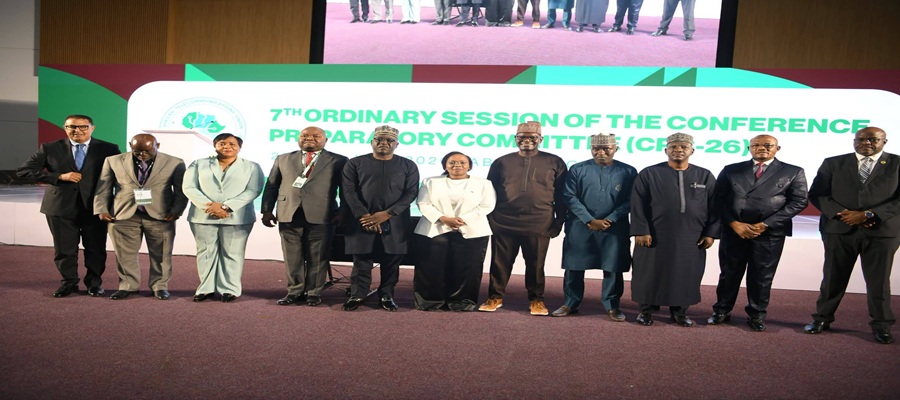
Nigerian Communications Commission has urged African countries to adopt a unified and technically coordinated position ahead of the 2026 International Telecommunication Union Conference, saying stronger regional collaboration is essential for the continent to influence global telecommunications and digital economy policies.

The Executive Vice-Chairman of the NCC, Dr Aminu Maida, made the call on Monday in Abuja while declaring open the African Telecommunications Union Conference Preparatory Committee meeting.
Maida said Africa must strengthen cooperation to shape global telecommunications and digital economy policies, noting that the two-day meeting was expected to produce greater continental alignment ahead of ITU 2026, establish practical collaboration mechanisms between conferences and sustain Africa’s technical participation in ITU processes.
“Preparation is not a procedural step; it is the place where coherence is built,” he said. “Africa must prepare together, work together and arrive at global forums with solutions that are both coherent and technically compliant.”
He said the committee would review the ATU’s activities between 2023 and 2026 and prepare agenda items, resolutions, decisions and recommendations for the 18th Conference of the Union.
According to him, while the forthcoming ATU conference will determine the direction of the continental body, the ITU conference will shape global telecommunications leadership and priorities.
Maida stressed that Africa’s influence at international forums would depend less on the size of its delegations than on the quality of its preparation, the coherence of its positions and consistency in advancing them.
He identified spectrum management, artificial intelligence governance, data protection, universal access, cybersecurity and digital infrastructure development as priority areas requiring stronger collaboration among African countries.
“No administration can address these challenges effectively in isolation. Our regulatory cooperation must therefore become more continuous, more technical and more institutionalised,” he said.
The NCC boss also called for greater support for African experts to participate actively in technical discussions where international standards and frameworks are developed.
“Our objective in Africa is not to resist global standards. It is to help shape standards that are globally sound and sufficiently informed by African realities,” he added.
He commended the leadership of the African Telecommunications Union for strengthening the coordination of Africa’s positions at the ITU and other international platforms.
Maida reaffirmed Nigeria’s commitment to supporting the ITU process through technical expertise, regulatory experience sharing and peer learning among African administrations.
Earlier, the Permanent Secretary of the Federal Ministry of Communications, Innovation and Digital Economy, Nadungu Gagare, described the meeting as critical to advancing Africa’s digital transformation agenda.
He said the committee’s recommendations would provide the foundation for decisions at the forthcoming ATU Conference of Plenipotentiaries and expressed confidence that the deliberations would strengthen the union’s capacity to promote inclusive and sustainable digital development across the continent.
“As we navigate an era of rapid technological advancement and digital innovation, the importance of collaboration among member states has never been greater,” Gagare said.
Also speaking, the Secretary-General of the ATU, John Omo, said the Conference Preparatory Committee plays a vital role in processing documents and proposals ahead of the main conference to enable member states to adopt common positions.
Omo disclosed that the union’s membership had increased from 49 to 52 countries, while associate membership had risen from 50 to 56, with 18 African academic institutions now participating in its activities.
He said the ATU had recorded progress in broadband development, satellite communications, spectrum coordination, internet governance, rural broadband, standardisation and digital infrastructure resilience.
However, he expressed concern over irregular financial contributions by some member states, warning that predictable funding remained essential for implementing the union’s programmes effectively.
Omo added that the forthcoming conference would elect members of the Administrative Council and a Secretary-General for the 2027–2031 tenure.
He commended the Federal Government, the NCC and the Ministry of Communications, Innovation and Digital Economy for hosting the preparatory meeting, which brought together representatives of African countries, academia, sector members and development partners to discuss the continent’s telecommunications and digital future.
News
NITDA Communications Director Hadiza Umar Named in 2026 PR Power List, Graces Glazia Magazine Cover
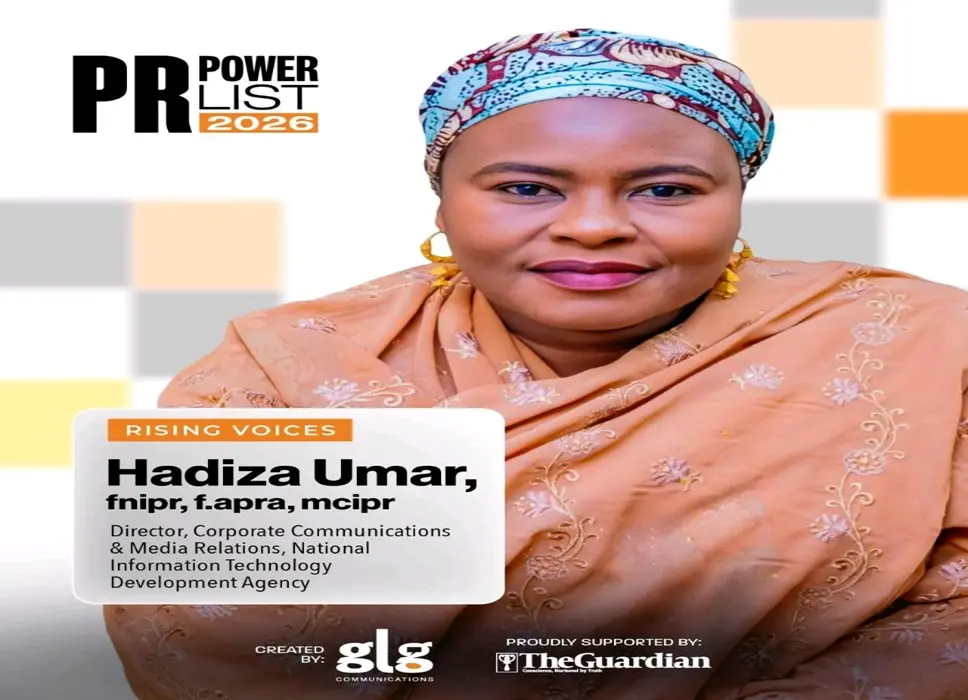
Mrs. Hadiza Umar, Director of the Corporate Communications and Media Relations Department at the National Information Technology Development Agency (NITDA), has been officially recognised as one of Nigeria’s top public relations professionals in the prestigious 2026 PR Power List.

The definitive annual list, compiled by GLG Communications in partnership with The Guardian, was unveiled to commemorate World PR Day.
It celebrates 50 outstanding professionals within Nigeria and the diaspora whose strategic communication strategies have significantly shaped organisations, influenced public discourse, and advanced the profession over the past 12 months.
Adding to the momentous milestone, Mrs. Umar was hit with a major surprise at the exclusive PR Power List Soirée and Awards ceremony held at the Alliance Française in Ikoyi, Lagos, where she was unveiled as a front-cover personality for the Glazia Magazine PR Power List Special Issue.
The double recognition highlights her exceptional distinction and impact in public sector communications and narrative management.
Speaking on the dual achievement, Mrs. Umar expressed profound gratitude for the honours, describing the magazine cover appearance as a breathtaking surprise.
“I am deeply humbled and honored to be recognized on the 2026 PR Power List and to feature on the cover of Glazia Magazine alongside other exceptional industry titans,” Umar said.
“This milestone is a testament to the enabling environment and visionary leadership of the Director General of NITDA, Kashifu Inuwa Abdullahi, CCIE, which has allowed us to strategically drive the narrative of Nigeria’s digital economy and technological innovation.”
Mrs. Umar, a highly respected corporate communications strategist, holds professional fellowships in the Nigerian Institute of Public Relations (Chartered), the African Public Relations Association (APRA), and the Institute of Corporate Administration (CICA).
Under her supervisory role, NITDA’s media relations have consistently projected national information technology frameworks, start-up support frameworks, and digital literacy initiatives, to position Nigeria competitively on the global stage.
The 2026 PR Power List selection process involved a rigorous, independent evaluation led by a distinguished international jury.
The organisers noted that the class of 2026 represents professionals raising the standard of strategic communications and introducing new ideas to the industry.

YEDC Warns Customers, Says 20 Percent Electricity Bonus is Scam

FG to Support 12 Tech Startups with N482m under iDICE

NBC, INEC, Plan Joint Broadcast Monitoring Framework ahead of 2027 Elections

No Going Back on July 31 Deadline for Insurance Firms’ Recapitalisation – NAICOM

Court Affirms FCCPC’s Power to Regulate Digital Lending

NRC, Ponzi Scheme Collapses Resulting Loss of Billions of Naira

NASENI Moves to Digitize CCB’s 5m Assets Declaration and Operations

Lebara Nigeria Launches Lebara Play, Africa’s First Telecom-Owned Micro-Drama Platform

CANAL+ Partners Samsung to Pre-Load DStv Stream on New Samsung TVs In Nigeria, Other African Countries

Tokenization, Blockchain Technology will Transform Financial Institutions – IMF




 News1 day ago
NIMASA Unveils Accelerator Scheme to Drive Innovation, Sustainable Growth

 E-Financial1 day ago
Access Holdings Sells 7.44% Stake in Ghana Unit

 E-Financial1 day ago
NRS Issues July 31 Deadline for e-Invoicing Compliance

 E-Business1 day ago
SERAP to Sue NASS over Bill Empowering NDPC to Regulate Social Media

 E-Financial1 day ago
NDIC Urges Youths to Shun Ponzi Schemes, Embrace Savings

 News1 day ago
ICPC Secures Final Forfeiture of N941m Linked to IPPIS Fraud

 News1 day ago
Adebutu, PDP Chieftain Accuses Nigerian Governors of Embezzling LG Allocations

 News1 day ago
eBusinessLife Advocates Greater Support for Girls in ICT as Students Showcase AI Innovations