

E-Financial
Heritage Bank Supports Over 500 Widows, Receives UN Award for Humanitarian Service

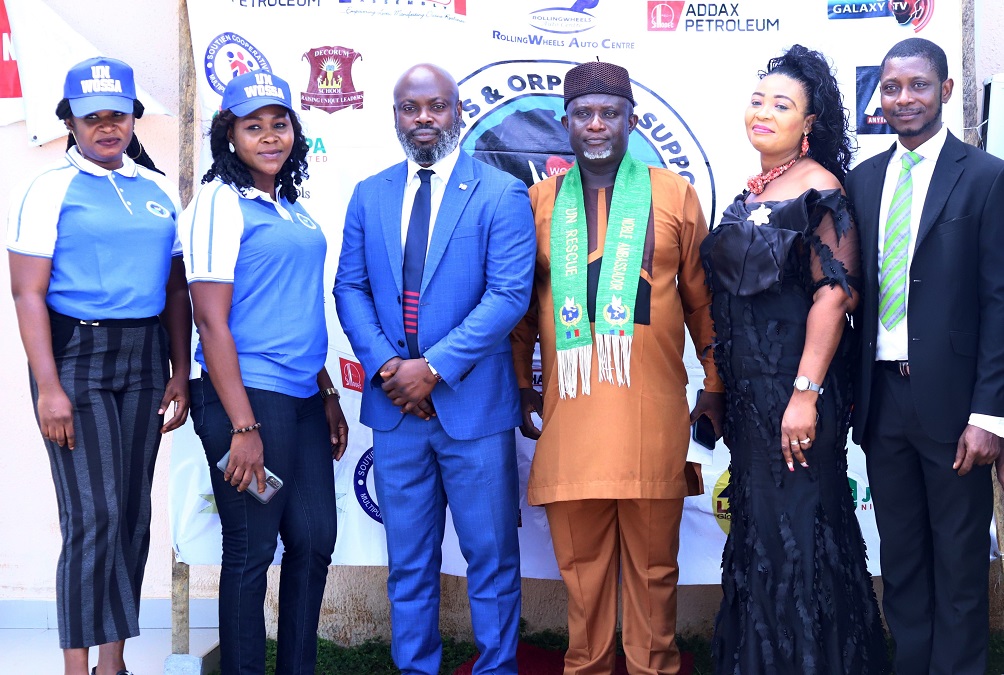
Heritage Bank received the 2022 United Nations Award for Humanitarian Service by the Widows & Orphans Support Society of Nigeria (WOSSA), as no fewer than 500 widows and orphans in Lagos State benefitted from the Bank’s supports.

L-R: GoodLuck Linda, WOSSA Chief Welfare officer; Helen Unabor, WOSSA Chief Protocol officer; Olawale Osundele, Regional Head, Lagos Island 1, Lagos Island 1 Zone, Heritage Bank; Amb. Tayo Thomas, President of WOSSA; Dame Jennifer Omotayo-Thomas, Vice president, WOSSA and John Adah, Team Member, Corporate Communications, Heritage Bank, during the award ceremony held in Lagos to mark this year’s International Widows Day themed: Gender Equality Today for a Sustainable Tomorrow.”
This was made known during the award ceremony held in Lagos to mark this year’s International Widows Day themed: Gender Equality Today for a Sustainable Tomorrow”.
The event was opportunity to recognize Heritage Bank’s Corporate Social Responsibility (CSR) roles to widows, their children and other less privileged within the society.
Speaking during the awards presentation, Founder, Widows & Orphans Support Society of Nigeria (WOSSA), Ambassador Tayo Thomas, said Heritage Bank is one of the group’s key partners and has for years shown massive support to the widows.
He said: ” Basically, we are giving this award to people and organizations that have been supporting the less privileged widows. These are our partners, they have been doing great service to humanity, especially service the less privileged widows in meeting their financial needs and those of their children”.
Continuing, he said: “The United Nations Humanitarian Award is to appreciate and acknowledge them for their support to the less privileged widows.
“The United Nations Humanitarian Award is an award we give every 24th of June to those who have really supported the widows. Those who have joined us to fight against injustice against the widows. That is the reason for today”.
Speaking at the event, Heritage Bank Regional Head, Lagos Island 1, Olawale Osundele, said the bank has for years, remained committed to improving people’s lives.
He said: “It has always been one of our front liners to always improve the quality of people’s lives right from childhood. And today that they are marking the International Widow’s Day, we are also part of the support team to WOSSA in various aspects.”
“We have been supporting them in terms of providing quality education for children of widows to ensure that life after the death of their husband is still good to them and their children. We also support the children and orphan and the less privileged in the society,” he added.
According to Osundele, the bank’s support to the widows has always been a source of joy to them. “It means that life still means a lot to them. You can see the joy in their faces. Despite what they are going through, they are still very happy and relevant in the society,” he said.
One of the widows at the event, Mrs. Felicia Ugwunwanne thanked Heritage Bank and WOSSA for their continuous support to the widows and less privileged.
She said that WOSSA is through the support of partners such as Heritage Bank, making life better for the widows and their children.
“The WOSSA has for years, been assisting so many of us, including our children and orphanages. WOSSA gives us cash, help some widows to pay their house rent, school fees for widows’ children, among other things,” she said.
Ugwunwanne said the widows under WOSSA are being trained for skills acquisition to improve the quality of their lives.
“I am aware that the WOSSA is working on securing loan from Microfinance Bank, and we have completed forms to achieve the purpose. Our members are prepared to access the loans. Some of the widows have gone to learn some skills that will enable them to invest and succeeded in whatever craft or business they are doing, so that they will not continue to depend on people,” she said.


E-Financial
#IWD2026: Kuda MFB Offers Millions In Grants To Women-Led Food And Hospitality Businesses

As part of its Kuda for Her campaign for this year’s Women’s Month, Kuda Microfinance Bank (MFB) is inviting Lagos-based women entrepreneurs in the food and hospitality sector to pitch their businesses for a chance to receive ₦1 million in funding.

Kuda MFB
The Kuda for Her Pitch Challenge, which launched on March 10, 2026, will award ₦1 million each to four women-led businesses, giving them capital to scale.
According to the Small and Medium Enterprises Development Agency of Nigeria (SMEDAN) and the National Bureau of Statistics (NBS), women own about 43% of micro and small enterprises in Nigeria, many of which are in the food, catering, and hospitality sectors. Yet, women entrepreneurs continue to face barriers to growth, particularly in accessing capital, with only about 23% of women-owned businesses in Nigeria currently having access to formal credit.
Women who run food or hospitality businesses can submit a pitch outlining their business and how the funding will help them grow. Applications are open until March 15, 2026.
The four grant recipients will be announced on March 27, 2026.
Emmanuel Femi-Adejobi, Senior Brand Manager at Kuda, mentioned that the campaign is designed to recognise and support women whose businesses shape everyday life in Nigerian cities.
“Many of the food and hospitality businesses that Nigerians rely on every day are built and run by women,” he said. “Through Kuda for Her, we’re supporting these hardworking entrepreneurs directly while also shining a light on the ambition and creativity behind the businesses they’ve built”
Women entrepreneurs who run food or hospitality businesses in Lagos can submit their pitches before March 15, 2026, at kuda.com/kuda-for-her/.

Thrifto, a new Nigerian fintech, is modernizing age-old group savings like ajo (Yoruba), esusu (South-West), and adashe (North) with a bank-integrated web app, slashing risks of defaults, disputes, and lost funds.

Sulaimon Biodun Durojaiye
Founded by Sulaimon Biodun Durojaiye, media entrepreneur, Thrifto lets users create or join groups, set contributions, cycles, and payouts.
It tracks records transparently, preserving cultural collaboration while adding tech accountability. “We’re providing structure and transparency without replacing the spirit of ajo,” Durojaiye said.
Early users—salary earners, entrepreneurs, small businesses—form groups for school fees, rent, or capital. The platform eliminates friction like poor bookkeeping and payout fights, driving organic growth nationwide.
Launching next week, a self-saving feature lets users automate fixed amounts (e.g., ₦5,000 daily or ₦50,000 weekly) toward goals, enforcing consistency solo.
A Trust Rating Score, based on participation history, rewards reliable users, aiding smarter group choices and fostering responsible behavior.
Tailored for Nigerian realities, Thrifto taps informal savings to expand inclusion. Observers see it strengthening networks and discipline in Nigeria’s fintech landscape.


Central Bank of Nigeria (CBN) has issued new baseline standards requiring banks and other financial institutions to deploy automated anti-money laundering systems capable of detecting suspicious transactions and financial fraud risks in real time.

The directive, contained in a circular released yesterday, mandates banks, mobile money operators, international money transfer operators and other regulated institutions to implement automated solutions that strengthen monitoring, detection and reporting of suspicious financial activities.
According to the apex bank, the framework establishes minimum technical, governance and operational standards for automated systems used to combat money laundering, terrorism financing and proliferation financing within Nigeria’s financial system.
CBN said the move was necessary as the financial services sector becomes increasingly digital and complex, making manual monitoring methods inadequate for managing evolving financial crime risks.
Under the new framework, deposit money banks (DMBs) are expected to achieve full compliance within 18 months from the date of issuance, while other financial institutions will have 24 months to comply.
Institutions are also required to submit detailed implementation roadmaps to the CBN’s compliance department within three months.
The standards apply to all institutions operating under the CBN’s regulatory purview, although the depth and sophistication of implementation will depend on each institution’s size, transaction volumes, operational complexity and risk exposure.
The framework outlines several minimum capabilities that automated anti-money laundering (AML) systems must possess, including customer identification and verification, sanctions screening, transaction monitoring and case management for suspicious activities.
Financial institutions are also expected to ensure their systems integrate customer data with transaction patterns so that suspicious behaviour can be assessed in the context of a customer’s risk profile.
The CBN said institutions should strengthen identity verification processes by integrating onboarding systems with national databases such as the Bank Verification Number (BVN) and National Identification Number (NIN) platforms to support real-time identity checks.
The framework permits the use of emerging technologies such as artificial intelligence and machine learning to improve the detection of unusual financial patterns.
However, the regulator said such technologies must operate under strict governance frameworks, including independent validation and human oversight.
Institutions deploying AI-based monitoring models will be required to conduct periodic validation to ensure accuracy, reliability and fairness in the detection of suspicious transactions.
The standards also require financial institutions to maintain secure data protection controls, including encryption, role-based access and multi-factor authentication, in compliance with Nigeria’s data protection regulations.
In addition, the systems are to maintain comprehensive audit trails of transactions, alerts, investigations and system activities to support regulatory supervision and forensic investigations.
The CBN said compliance with the framework will be monitored through off-site surveillance, on-site examinations and thematic reviews, warning that institutions that fail to implement the standards may face regulatory sanctions under existing banking and financial crime laws.

Court Freezes Bank Accounts of Petrocam, Founder over Alleged N9Bn Zenith Bank Debt

FG Approves First National Policy on Cosmetic Safety, Health

FCCPC Says Telcos, Energy Firms Lead Consumer Complaints in Nigeria

Microsoft Expands Africa AI Push while DeepSeek Gains Users

Mobile Phones Used by Food Vendors Could Spread Infections- Experts

Dr. Cairo Ojougboh Foundation Bolsters Nigeria’s Education Drive with ₦2.7m Student Support

Kaspersky Brings more Transparency to Threat Detection with New Hunt Hub

Kaspersky Discovers New Phishing Campaign Exploiting Google Tasks Notifications to Steal Corporate Credentials

esentry 2025 Report Shows Healthcare, Financial Services and Telecoms as Staging Grounds for Increased Cyberattacks in Africa

AfDB, UNDP Launch $10Bn AI Initiative for Africa




 Telecom2 days ago
China Threatens to Shut Nigeria’s Satellite Over $11.44m Unpaid Debt

 Telecom2 days ago
US Court Dismisses All Claims Against Binance in Major Anti-Terrorism Lawsuit Victory

 Telecom2 days ago
TikTok Pumps $200k into AI Media Literacy for Sub-Saharan Africa at Nairobi Summit

 General News2 days ago
More Nigerians Emerge Millionaires in Week 9 of NIVEA’s Consumer Campaign

 E-Business2 days ago
NITDA, Nkenne AI Seek to Localise AI for Nigerians

 E-Business1 day ago
FG Moves to Strengthen Children’s Online Safety

 Telecom2 days ago
NCC Orders Telcos to Report Cyberattacks Within 4 Hours from 2027

 E-Business2 days ago
Meta to Charge Location Fees on Ads to Six Countries from July 1, 2026