

E-Financial
Heritage Bank To Disburse CBN’s N100bn Loan, Sell Forex To SMEs, Others

Heritage Bank is set to disburse the N100billion set aside by the Central Bank of Nigeria (CBN), as part of proactive measures to cushion the effect of the COVID-19 and revamp the nation’s dwindling economy.

This is in line with the apex bank’s policy to introduce another intervention scheme directed to the health sector, which is known as the NGN100 Billion Credit Support for the Healthcare sector (the Scheme).
Specifically, the scheme is to provide credit to indigenous pharmaceutical companies and other healthcare value chain players intending to build or expand capacity.
Also, the CBN resumed provision of foreign exchange to all commercial banks for onward sales to parents wishing to pay schools fees and small medium enterprises (SMEs) with plans to make essential imports needed to revamp economic activities across the country.
In particular, the CBN is resuming the provision of over US$100 million per week for both categories.
Meanwhile, Heritage Bank serves as a conduit which will assess and channel the profiles of interested applicants to the CBN while using its platforms to create awareness for the scheme.
The CBN has also made complete arrangements to resume foreign exchange sales to the BDC segment of the market for business travels, personal travels, and other designated retail uses, as soon as international flights resume.
To access the N100bn loans provided by the CBN for firms in the healthcare sector, a corporate entity must submit its application to a participating financial institution (PFI) which could be either a Deposit Money Bank or a Development Finance Institution of its choice with a bankable business plan.
It stated in its latest guidelines that the PFI must appraise and conduct due diligence on the application; and upon approval by the PFI’s credit committee, the application would be submitted to the apex bank with relevant documents attached.
The CBN would process and disburse funds to the PFI for onward release to the project, it added.
The CBN stated that the PFI must receive and review applications submitted by its customers; undertake due diligence based on normal business considerations, and bear the credit risk.
They must also issue offer letters and forward qualified applications to the CBN; disburse the released funds to successful applicants; monitor the project and recover the loans from the beneficiaries, and maintain adequate records of all beneficiaries and facilities.
It requires the PFIs to register all movable assets with the National Collateral Registry; forward periodic returns in the prescribed format on the scheme to the CBN; comply with the guidelines, and carry out any other duties as the CBN may prescribe from time to time.
According to the CBN, eligible participants under the scheme comprise healthcare product manufacturers – pharmaceutical drugs and medical equipment; and healthcare service providers/medical facilities – hospitals/clinics, diagnostic centres/laboratories, fitness and wellness centres, rehabilitation centres, dialysis centres and blood banks, among others.
Others include pharmaceutical/medical products distribution and logistics services; and other human healthcare service providers as may be determined by the CBN from time to time.
Eligible activities under the scheme would include manufacturing of pharmaceutical drugs and medical equipment; establishment/expansion/upgrade of basic and specialised healthcare facilities; and medical/pharmaceutical supplies.
Others are medical/pharmaceutical research and development; distribution of medical/pharmaceutical drugs and supplies; Manufacturing of medical/pharmaceutical drugs distribution technology; and any other healthcare value chain activity as may be prescribed by the CBN.
The CBN said the term loan had a maximum of N2billion per obligor; and the interest rate under the intervention would not be more than five per cent per annum up until February 28, 2021; and that interest on the facility would revert to nine per cent as from March 2021.


Securities and Exchange Commission (SEC) has announced that Capital Market Operators (CMO’s) are to renew their registration from January 1 to 31, 2026.

In a bid to make the process seamless, the Commission says it will commence electronic receipt and processing of applications for registration and updates of registration information in the first quarter of 2026.
Dr. Emomotimi Agama, director general of the SEC, stated this during an interview in Abuja.
According to Agama, “These initiatives reflect our commitment to leveraging technology for faster, more transparent, and efficient regulatory processes. The Commission is taking deliberate steps to make regulatory processes faster, more transparent, and technology-driven. We are investing in automation, databased supervision, and secure infrastructure to improve how we interact with the market.
The SEC Boss stated that through its Digital Transformation Portal, the Commission has automated registration and licensing end-to-end as operators can now submit applications, upload documents, and track approvals online, cutting down manual processing time and reducing the need for physical visits.
Commercial Paper Issuance Module
He said the Commission has also rolled out the Commercial Paper issuance module, which allows operators to file documents, monitor progress, and receive approvals electronically while feedback from early users shows a clear improvement in turnaround time.
“Work is ongoing to automate quarterly and annual returns submissions, with structured templates and system checks to ensure accuracy. A returns analytics dashboard is also in development to support risk based supervision and exception reporting.
“To back these changes, we have started upgrading our IT infrastructure, servers, storage, networks, and security layers, to boost speed and reliability. Selective cloud migration is underway for platforms that need scalability and external access, while core internal systems remain on premisev5p for now as we assess security and cost implications.
“At the same time, we are strengthening data integrity and cybersecurity with vulnerability assessments and planned penetration testing once automation and migration phases are stable. These efforts show our commitment to building a modern, resilient regulatory environment that supports efficiency, investor confidence, and market stability.
Agama affirmed that the Nigerian Capital Market is clearly on a path toward digital transformation, therefore, there is an urgent need for regulatory clarity on advanced technologies, targeted support for smaller firms, and capacity-building initiatives.
He said, “A phased and proportionate approach to regulating emerging technologies such as AI is essential, complemented by internal readiness through supervisory technology tools. Furthermore, investor education, particularly among younger demographics, will be critical to future-proof participation and drive fintech adoption.
“Innovation is vital, but it must be accompanied by responsibility. As operators embrace automation, artificial intelligence, and data-driven tools, they bear a duty to ensure ethical, secure, and compliant deployment. Safeguarding investor data, preventing market abuse, and maintaining operational resilience are non-negotiable.”
The SEC DG said that ultimately, responsible technology adoption is about building trust, the cornerstone of our markets saying that trust thrives on fairness, transparency, accountability, and regulatory compliance.
He therefore urged operators to uphold these principles adding that it would not only protect investors and systemic stability but also strengthen the long-term credibility and competitiveness of the Nigerian Capital Market.


The naira is projected to remain largely stable in the coming months, while borrowing costs are expected to ease as inflation moderates, according to the Central Bank of Nigeria’s (CBN) latest Business Expectations Survey (BES).

CBN
The survey, which polled about 1,900 businesses nationwide, revealed that confidence in the local currency has strengthened. Respondents expect the naira to rise from an index of 28.8 points to 42.2 points by May 2026, extending the rare period of stability recorded throughout 2025.
Borrowing rates are also forecast to decline, with the index dropping from 15.4 points to 11.7 points, reflecting expectations of softer monetary conditions as inflationary pressures ease.
“Respondents expect the naira–US dollar exchange rate to steadily appreciate across the review periods, as indicated by the positive indices. They also anticipate a continuous positive outlook for borrowing rates during the same periods,” the BES report stated.
The naira has enjoyed an unusually long stretch of stability after losing about 41% of its value in 2024 following the unification of exchange rates. Analysts attribute the current calm to the CBN’s calibrated interventions and steady inflows from foreign portfolio investors.
Inflation, which stood at 14.45% in November 2025, is projected to fall to single-digit levels in 2026. This outlook could give monetary authorities room to begin a gradual easing cycle, potentially improving credit access for businesses.
Despite the improving macroeconomic environment, businesses continue to grapple with structural constraints. The survey highlighted insecurity (70.1 points), high/multiple taxation (69.7 points), and insufficient power supply (69.3 points) as the most pressing challenges. Other concerns include poor infrastructure and an unfavorable political climate, both scoring 57.7 points.
While optimism surrounds the naira and borrowing costs, the BES underscores the need for sustained reforms to tackle deep-rooted operational challenges. Analysts say that without addressing insecurity, taxation burdens, and infrastructure gaps, Nigeria’s businesses may struggle to fully benefit from the improving macroeconomic outlook.
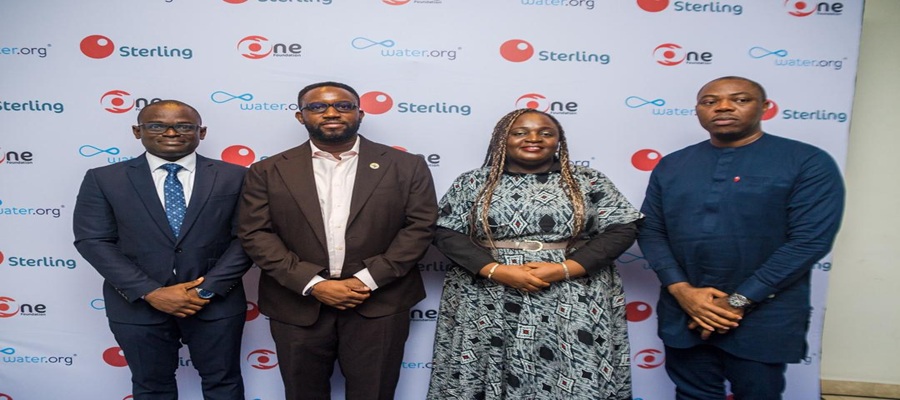
Sterling Bank, in partnership with nonprofit Water.org and Sterling One Foundation, has launched the Sterling WASH Business Loan to empower WASH businesses and scale sustainable access to safe water and sanitation for millions of Nigerians.

L-R: Gilbert Okpono, Snr. Partnership Account Manager, Water.org; Engr. Mukhtaar Temitope Tijani, Managing Director, Lagos State Water Corporation; Mrs. Olapeju Ibekwe, CEO, Sterling One Foundation; Akporee Idenedo, Divisional Head Commercial Banking, Sterling Bank, at the Sterling Bank Water Credit Proposition held in Lagos recently.
The catalytic financing solution addresses daily struggles with clean water and safe sanitation, which impact health, livelihoods, and well-being, while strengthening delivery systems for WASH solutions.
Launched on Monday, November 24, 2025, at The Wheatbaker Hotel, Ikoyi, Lagos, the initiative signals a shared commitment to tackling one of Nigeria’s most pressing development challenges.
Abubakar Suleiman, Managing Director of Sterling Bank, said sustainable development hinges on collaboration and targeted investment in frontline businesses and people.
“By providing accessible financing to entrepreneurs in this critical social sector, we ensure progress reaches communities that need it most. This product aligns with our HEART strategy and commitment to improving quality of life through impact-driven initiatives,” Suleiman stated.
Gilbert Okpono, Nigeria Senior Partnership Account Manager at Water.org, stressed the transformative power of financing WASH businesses.
“Financial inclusion is critical to solving the global water and sanitation crisis. By expanding access to affordable financing, we enable households and WASH entrepreneurs to improve services, reach more communities, and transform lives,” Okpono said.
He added that the partnership reflects a belief in rippling benefits across health, education, and economic opportunity, marking a major step toward sustainable scaling.
The loan supports WASH entrepreneurs, small business owners, and community service providers with flexible financing to expand operations, boost health, livelihoods, and educational outcomes.
Olapeju Ibekwe, CEO of Sterling One Foundation, linked the initiative to the foundation’s mission of catalysing lasting social impact across Africa.
“Our Foundation catalyses initiatives that deliver real, lasting change. Access to safe water and sanitation is one of the most powerful investments in community well-being. We are proud to partner with Water.org and Sterling Bank for inclusive, scalable, and sustainable solutions,” Ibekwe affirmed.
The launch event gathered development partners, WASH entrepreneurs, media, policymakers, and community organisations to discuss coordinated financing, supportive policies, and market-driven solutions to close Nigeria’s WASH access gap.
Interested beneficiaries can visit the initiative’s website for more details.

US Begins Partial Visa Ban on Nigerians January 1

Glo Extends Christmas Greetings, Urges Unity and Care for Others

Galaxy Backbone Tops FG’s Website Performance Ranking

SEC Says CMOs Must Renew Registration in January

Naira Stability, Lower Borrowing Costs Expected in 2026 — CBN Survey

Nigeria Records Highest Weekly Cyberattacks in Africa — Report

Cyber Tsunami Hits Nigeria as Breaches Surge 1,047%, esentry Q3 Report Reveals

GenAI Adoption Among African workers Outpace Global Peers

Jumia’s Data Shows Nigerians Turning to Digital Retail to Navigate Inflation Pressures

Minister Claims Bandits Exploit Poor Network, Bounce Calls Off Multiple Towers




 General News1 day ago
The Mood Market to Light Up Lagos with a Rooftop Gifting, Food & Lifestyle Fair this Christmas
 News1 day ago
US Okays $2.1Bn for Christian Healthcare in Nigeria

 Broadcasting1 day ago
Tim Akano Recounts 20-Year Growth, Media Support at NITRA End-of-Year Meet

 News1 day ago
SERAP Asks Tinubu to Release CTC of Tax Bill

 E-Financial1 day ago
Sterling Bank, Water.org, Sterling One Foundation Partner on WASH Loan for Millions

 General News1 day ago
Leo Stan Ekeh: A “Rare Avis”, an Unconquerable Entrepreneur

 General News1 day ago
FCCPC Forces Ikeja Electric Into Compliance, Unseals Headquarters After Rights Breach

 General News1 day ago
NITDA Wins Triple SERVICOM Honours for Citizen-Centred Service Delivery