

Telecom
How Telcos Cheat, Frustrate Subscribers


Despite increasing customers’ frustration, telecom companies continue to push for more revenue, according to a report published in the Guardian.
Yearly, telecommunication companies in Nigeria generate revenues that surpass their returns in other African countries.
In 2012 alone, the telecoms industry, which is controlled by four major companies – MTN Nigeria Communications Limited, Airtel Networks Limited, Emerging Market Telecommunications Services Limited (Etisalat) and Globacom Limited – generated N1.5 trillion ($9.3 billion) in revenue out of the total N6.7 trillion ($41 billion) generated in Sub Sahara Africa, according to Analysys Mason.
But as the market continues to expand and the companies’ profits climb in Nigeria, there are growing concerns about the quality of service MTN and the others offer and as well as their marketing campaigns, which have left consumers frustrated.
The rise and rise of telecom firms in Nigeria

With a population of about 167 million, demand for telecoms services in Nigeria is the largest in Africa. Nigeria is also in the top 10 of the fastest growing telecom markets in the world.
According to the Nigerian Communications Commission (NCC), as of June 2014 active GSM mobile subscriptions in Nigeria stood at a little over 130 million, representing 98.31 per cent of the market share of the telecoms industry.
MTN leads the market with 58.5 million subscribers, followed by Globacom with 27.3 million; Airtel with 25.3 million; and Etisalat with 19.3 million.
In 2013, MTN generated N775.3 billion in Nigeria against N638.6 billion generated in South Africa, the home country of MTN. The difference represents 21 per cent revenue gain in its Nigerian market.
The company’s turnover in other Africa countries is even far lower than what they make in Nigeria – Ghana (N133.5b); Cameroon (N83.7b); Ivory Coast (N88.5b) and Uganda (N72.4b).
Though similar data for the three other telecoms companies are not available, the growing number of their subscribers both for voice and data service, as captured by NCC, is a reliable indicator of their significant turnover in Nigeria.
As the revenues of these ‘big four’ continue to grow, due to growing numbers of subscribers, the frustrations of mobile phone users in Nigeria also continue to grow.
The problems experienced by users are multiple: dropped calls, failed calls, network interruption, network congestion, failed attempts to load recharge payment, inability to change their tariff plan, inability to activate the offered service, inability to send or receive SMS, unsolicited messages without an option to opt out, and call misdirection to an unintended number, among other difficulties.
In spite of these challenges, GSM operators continue to attract more subscribers to their networks through all manner of promotions, without simultaneously expanding their network capacity.
Many unsatisfied subscribers who have tried to report the problems to their service providers have reported that it is nearly impossible to get through on the busy telephone line provided, and that they are constantly put on hold. Some say their inquiries go unanswered for days. Consequently, most Nigerians are compelled to own more than one mobile phone.
According to a Telecommunications Poll Report by NOIPolls Limited released in November, higher proportion of Nigerians use 2 mobiles phone lines.
Violating consumers’ rights
Many customers have therefore had experiences that have made them feel that they do not get value for money, while the telecom companies’ profits surge.
Some believe that the service constitutes a breach of consumer rights as guaranteed by the Nigerian Communication Act 2003 and the Consumer Protection Council Act, LFN 2004. The law mandates the NCC to promote the provision of a modern, universal, efficient, reliable, affordable and easily accessible communications service.
Section 4 (1b-d) and 104 of the Nigerian Communication Act give telecoms subscribers a right to high-quality service and value for money. Similarly, section 2 of the Consumer Protection Council Act, LFN 2004, and Regulations 2(a-c), 3 and 8 of Quality of Service Regulations 2012 made by NCC emphasised the same rights of telecom subscribers.
Customers are legally protected under the United Nations Guidelines for Consumer Protection, otherwise known as the Consumer Bill of Rights. This legal instrument prescribes a fair settlement of just claims, including compensation for misrepresentation, shoddy goods or unsatisfactory services. This requirement is also found in sections 53, 70, 104, and 106 (3) of the Nigeria Communication Act (2003).
But Nigerian subscribers report that seeking compensation from telecom companies for providing a poor service is a difficult task. As one subscriber puts it: “It is like asking the Sahara desert to bring forth ice-cold water.”
Some subscribers believe that the regulatory system is too weak to come to their rescue. For instance, National Association of Telecommunications Subscribers (NATCOMS), a body representing telecom subscribers in Nigeria, has made several appeals to telecoms firms to work out fair compensatory plans for subscribers. However the body says it is yet to hear back from the telecoms companies.
As a result, NATCOMS has itself decided to take the four telecom companies, including NCC, to court for violation of consumers’ rights.
The group wants N10, 000 worth of airtime to be given to each subscriber for use in 2013, and N15, 000 for subsequent years, until the quality of service improves. NATCOMS lodged the case in court more than a year ago but no conclusion has been reached.
The only compensation paid were the fines ordered by NCC for poor service delivery. Three telecoms firms – MTN, Airtel and Globacom – paid fines of N647 million due to the poor service they provided between July 2013 and January 2014.
For March and April 2012, the ‘big four’ paid another fine of N1.17 billion for failing to meet the standard performance required.
NATCOMS believes that making this payment is an admission on the part of the telecoms companies of their poor performance. But instead of compensating their subscribers directly, the companies paid fines to the regulatory agency, NCC.
The Director of Publicity at NCC, Tony Ojobo, justified the action by saying that the NCC Act does not provide for direct compensation to be paid to subscribers.
NATCOMS president, Chief Deolu Ogunbanjo, takes the opposite view. He argues that the payment of the fines to NCC is a subversion of legal principle that guarantees remedy for a person whose rights are violated.
Customers’ complaints
The Guardian’s investigation shows that customers’ complaints about poor telecoms services are widespread. Customers who spoke to The Guardian also questioned the methods used by telecoms companies to market their products.
Ganiyu lives in the Ikotun area of Lagos, and subscribes to one of the ‘big four’ telecoms companies.
He complained of continued poor reception on his phone.
“You can hardly have a successful conversation without three to four breaks in transmission,” he said. “Sometimes you don’t even hear anything, or the other person does not hear you. Yet the network providers charge for this failed call. And the situation appears to be getting worse by the day.”
Complaints like this one are not only commonplace in Lagos, but have almost become the permanent experience of Nigerian mobile phone users. Operators have consistently blamed the poor state of infrastructure in Nigeria for the bad call quality and unreliable connection.
Subscribers that responded to The Guardian’s investigation also complained about hidden charges passed on to the customer.
Damilola subscribes to one of the four large providers. She told The Guardian that the company signed her up for caller tunes at a rate of N50 per month without her consent.
A second individual, who subscribes to another of the main telecoms providers, said that the company signs its customers up to certain services. James, who lives in Lokoja, Kogi state, said that the company in question charges subscribers N100 for a service “that you did not request for in the first place”. However he said though there is an option to unsubscribe by texting a certain number; this is hardly ever successful.
Caller tunes have inconvenienced other subscribers too. In an account reported by The Guardian recently, subscriber Funmi Owolabi described her experience. “I returned from work on a particular night with an urgent need to call my mother. I had to get airtime to make the important call; unknown to me I was on a caller tune to which I cannot recall when I subscribed.
“I had no cash but the call was important, hence I pleaded with my neighbour to transfer N100 to my line. But my account was cleared a few seconds after it was credited. I felt like weeping when customer care informed me that the account was cleared to pay a monthly subscription for a tune I never ordered.”
Similarly frustrating experiences have prompted many customers to switch providers.
Dumping one network for another seems a reasonable step, yet the experience of many shows that such a move makes little difference. Mr. Bayo Omotubora, Secretary General at NATCOMS, described it as “moving from the frying pan to the fire”, because the ‘big four’ are all “in hot pursuit of undue profit maximization at the expense of quality of service.”
Other subscribers have told of marketing techniques that have left them feeling short-changed or, at best, confused.
Olajumoke described one experience where she loaded credit onto her phone on the understanding that the operator would double her balance at the weekend. “By Monday all my credit was gone without me having used the airtime at all,” Olajumoke told The Guardian. “[The company] said I should have used it all up on the weekend. This they had conveniently forgotten to mention in all their promos. So, I lost all my recharge and the promo extra credits given to me.”
Olajumoke said she lost N19, 000 after she subscribed to a call plan with terms and conditions not been fully explained to her beforehand. Her efforts to get compensation from the company that sold her the call plan were not successful.
In order to verify Olajumoke’s claim, The Guardian’s reporter responded to a promotional message from the same company that offered 1Gb of data for N2000. But when the data was loaded, only 500 Mb of data was registered on the phone.
When The Guardian’s reporter called the company’s customer care unit, he got assurance that his account with the network still showed 1GB, but repeated checks from the customer’s end only showed a credit of 500Mb.
Experiences like these force subscribers to question the way telecoms firms advertise their products and the level of care provided to their customers.
Besides direct marketing, customers are dissatisfied with the deluges of SMS messages and automated calls that have become part of their daily experience. Mr. Bolanle Hassan, a lawyer, described the sending of unsolicited messages by telecoms service providers as “acts of nuisance.”
According to Hassan, he has received unsolicited messages from a particular company for more than a year, despite several efforts to stop them.
Hassan has started the process of seeking redress in court.
The experiences of these customers capture only a fragment of the glitches associated with service delivery by telecoms firms in Nigeria. One subscriber, Solomon, from Lagos, said the problem shows that the regulatory agencies – NCC and Consumer Protection Council (CPC) – “are not pulling their weight appropriately”.
How telecom companies rip off their customers
The Guardian sought to interview staff members of the big four telecoms companies, including customer care centre staff in Lagos and other states in Nigeria’s southwest. Many employees spoke off the record, because they are not authorised to talk to the media.
But former employees, especially the contract staff members, went on record with their comments.
A former staff member, who had worked at one of the providers for more than six years, told The Guardian that most adverts for telecoms products come with conditions. The source said that customers often discovered this only after they had already subscribed. At that point, despite feeling cheated, they cannot hold the company liable for the misleading information.
“Any advert you see in the newspapers bears the clause ‘terms and conditions apply’,” the source said.
“But many subscribers don’t see it because the proviso is printed faintly. Even if they do, not many can figure out the meaning of the legalese.”
The former employee gave an example of how some promotions work. “If you buy any of our mobile devices we promise you a one-year subscription, but the one-year subscription is actually dependent on if you exhaust N1000 subscription every month,” he said. “Which means you must exhaust the N1000 every month before we can give you the bonus for the next month. If you don’t, you may not get it. And if you exhaust it faster, you won’t get another bonus for that month.
“Promotional messages do not provide complete information,” the staffer warned. “And the ‘terms and conditions’ clause is always faintly written at the corner far below.”
He added that companies roll out different plans without giving the detail of the cost implications. He gave a second example of a deal where a company “promises to give you 200 percent bonus of all your recharge. So, when you recharge 200 [Naira] worth of airtime, we give you N400 worth of bonus, which is stored in your bonus account. But the tariff is higher. You won’t see or hear that in the advert message.”
He said that if a company has an ongoing promotion, it might decide to limit the validity of the offer in order to save costs. This can lead to customers losing the airtime they are expecting to benefit from.
“The snag here is when they review this plan, they don’t place advert to inform the subscribers just as they did when they introduced it. So many subscribers would not immediately know of the downward review. Therefore, once a subscriber exhausts his or her bonus, we will be deducting from his or her main credit.”
But as Damilola, another former employee of one of the big companies, noted, customer care centres are rarely notified immediately when there is a product review. When customers discover what has happened, many prefer to unsubscribe, but this is sometimes difficult to accomplish. “I have made three attempts to unsubscribe to Facebook Weekly offered by one the Network providers, all to no avail,” said Busola, a polytechnic lecturer in Ogun State.
Another complaint concerns Value Added Service providers (VAS) that provide applications and additional phone content such as mobile entertainment, caller-tune, ring-back tunes, music download, news breaks, Biblical and inspirational quotes, flight information, telemarketing and others. In Nigeria the VAS subsector provides non-core telecoms services, and is currently worth over $200 million annually. It has the potential to accelerate to a worth of $500 million over the next five years, according to industry statistics.
Though NCC had in 2013 directed all the network operators to disengage unlicensed VAS providers as a way of sanitizing the system. This directive seems to have been ignored because the monitoring exercise carried out in March showed that mobile service providers still have some unauthorized VAS Providers on their networks.
VAS providers are largely responsible for most of the unsolicited messages, said Mr. Osho Saheed, a former contract staff of a telecoms company.
“They are the owner of the application that is used for generating short code messages, and they do not surrender this code to telecoms operators. Therefore the customer service centres cannot unsubscribe customers because they do not have control. We can only refer customers’ complaints to the VAS providers who have control. But they may not want to opt you out for commercial reasons.”
Osho said telecoms firms configure their system in such a way to bring in more revenue for the company, even at the expense of the subscribers.
“For example, if you subscribe for a plan that terminates in 24 hours, you might activate that plan by 11:59pm. At the count of 12am, you lose your money if the airtime is not used up within that one minute. Whereas, people tend to think that the 24 hours begins at the time of your subscription. This is not so. The system is configured in a way that favours telecoms companies at the expense of the subscribers. But it shouldn’t be so.”
Constraints against quality service
Telecoms firms frequently blame a poor quality of service on infrastructural challenges in Nigeria. Unlike other African countries such as South Africa, Egypt and a few others where government have created a relatively enabling environment for the telecoms industry to thrive, Nigeria lacks basic telephone infrastructure.
A senior official at NCC described the infrastructure of NITEL – former Nigerian flagship telecoms company –as ‘analogue’, compared to the new technology being deployed in the industry today.
Similarly, the electricity shortage in the country constitutes a great barrier to the growth of the telecoms industry. While Nigeria can only boast 4,000 megawatts (MW) of electricity supply in 2014, South Africa’s electricity capacity is about 45,700 MW and Egyptian power generation capacities stand at 30,000 MW, according to official figures.
In 2013, MTN Nigeria reportedly spent 12 per cent of its total operating costs on diesel, which amounted to N34 billion. The industry workers The Guardian spoke to maintain that the huge gap in infrastructure is the major reason why service is poor.
According to the Public Relations Manager at Etisalat, Ms Chineze Amanfo, building a telecoms network is capital-intensive, and the telecommunications industry is constantly evolving.
“The Nigerian market is, however, peculiar because operators also have to invest in infrastructure such as power and security, resources which should have been channeled into core telecoms infrastructure and products.”
Because of this challenge, MTN Nigeria, in a statement sent to The Guardian recently, said it has been investing approximately $1.5 billion annually in the last 13 years in order to increase capacity. In spite of this ‘aggressive’ drive for investment, the demand for telecoms services – driven by the sharp decline in tariffs over the last three years – continues to outstrip supply and overwhelms whatever new capacity is created, MTN Nigeria said.
The Public Relations and Protocol Manager of MTN Nigeria, Mr. Funso Aina, explained that the drop in tariffs has been stimulating increasing minutes of usage and activity on the networks by a growing number of people, with a telling effect on the networks.
This situation, Aina noted, is further exacerbated by other underlying environmental challenges. These include short supply of power, vandalism and theft of network infrastructure, insecurity in certain parts of the country, multiple taxation and over-regulation. He said this catalogue of drawbacks leads to interference with critical network infrastructure by unauthorized persons and disruption to services.
The industry challenge highlighted by MTN Nigeria seems to be not unknown even by the regulators. In fact, NCC has often come to the defence of the ‘big four’, to the surprise of subscribers. More than this though – they seem to actively support the telecoms companies in these cases?
The Executive Vice Chairman of NCC, Dr. Eugene Juwah, once disclosed that business is not as profitable for the operators as many consumers and stakeholders would like to believe. But with the increasing number of data users, in addition to voice calls, it is unlikely any of the companies will go bankrupt.
In an interview, an NCC spokesperson told The Guardian that:“Telecoms companies are working in an environment that is challenging and this is affecting the quality of service”. He added, “Quality of service would only improve if the environment improves.”
These statements underscore the level of neglect of infrastructural development in Nigeria, and implicitly point an accusing finger at the government, which NCC often nonetheless supports, despite purportedly being independent.
But Mr Ojobo of the NCC was swift to lay the blame at the doorstep of the state governments, which often, he said, prevent the telecoms companies from building infrastructure in their jurisdiction.
According to Ojobo, the issue of right of way is one of the major constraints against the telecoms service providers. He said that many state governors are making it difficult for telecoms operators to put infrastructure in place. “In Abuja for instance, in the last two years, no new base station has been put on ground, the FCT authorities says it is defacing the city. They (network providers) are also having similar challenges in other states of the federation. These are part of the challenge.”
Ojobo added that all lines in Nigeria today are mobile communication, and this puts enormous pressure on the network.
This defense notwithstanding, NCC has, on a number of occasions, sanctioned telecoms firms for not meeting the Key Performance Index (KPI). Fines running to billions of Naira have been paid by the ‘big four’ in the last couple of years (See figure above).
Observers of the industry think that the government should have provided the necessary telephone infrastructure before imposing sanctions on the network providers because of poor service. Alternatively, some reasoned that NCC should have stopped all the networks from further sales of SIM cards, since the network capacity is already strained by excess demand. NCC is not persuaded by this argument.
“We can’t stop them (telecoms firms) from selling SIM cards because it is a liberalised market. It is a demand and supply thing. The demand we have is greater than what the infrastructure can cope with. And to put infrastructure on ground, operators are having challenges because of the restrictive measures introduced by state governments,” Mr. Ojobo explained.
Weak justification
Plausible as this explanation may sound, customers who are forced to experience poor service with no compensation remain unsatisfied.
The Consumer Protection Council (CPC), the agency responsible for the protection of consumers’ rights, has said it is no longer impressed with reasons offered by telecoms service providers for poor service delivery. It says the lack of infrastructure may not have affected the networks as much as companies want subscribers to believe.
Therefore the Council wants the providers instead to make a greater effort to assuage the feelings of their displeased customers.
Recently, the Director General of CPC, Mrs. Dupe Atoki, advised NCC to look beyond the imposition of fines in their efforts to ensure that consumers get value for their money, since the fines that have been given seem not to be producing the expected results.
“The fines are legal… but we want to move this beyond fines to see what we can do to ensure that consumers get value for money,” she said.
“From the consumer side, we say it is not fair because providers are in business and are making profit, and that profit emanates from the resources that consumers put into that business. As long as they are in business, it means it is profitable; as long as no operator has filed for bankruptcy, it means business is good.”
While CPC appears to support what is right for the consumers, it often fails to carry out its duty because of its own limitation, as pointed out by one of its workers, who spoke to The Guardian off record.
First, CPC is just a department under the supervision of the Federal Ministry of Trade and Investment. Its mandate covers various sectors of the economy; but the Council has limited human resources to carry out its multiple functions, one of which is to provide redress to consumers’ complaints. And its inability to effectively discharge this responsibility explains why subscribers do not depend on CPC for redress.
One subscriber, Mr. Hassan, who complained of being harassed with a deluge of unsubscribed messages, said that CPC is in fact the last organisation he would think of approaching to lodge a complaint.
CPC has publicly faulted this attitude of subscribers. The Council blames subscribers for their reluctance to complain against abuse of rights. Therefore, on the last World Consumers’ Day, the Council launched a compendium on the rights of the telecoms consumers with the theme: ‘Fix our phone rights’. In this compendium, it states that the first step to obtaining redress for an aggrieved consumer is to empower the consumers by letting them know their rights.
The NCC spokesperson has also advised subscribers to always seek compensation from their service providers, when they are dissatisfied with the service they receive. He however disagreed with the idea of subscriber groups such as NATCOMS approaching NCC for compensation instead of approaching the telecoms providers, describing such action as taking NCC for granted.
“If your flight to Abuja is cancelled or your flight delayed for four hours, do you demand compensation from Federal Airport Authority of Nigeria (FAAN)? Or if you go to the bank to ask for your money and the bank did not treat you well, do you go to Central Bank of Nigeria (CBN) to complain? If you are not given regular supply of power, do you go to Nigerian Electricity Regulatory Commission (NERC) to ask for compensation? Subscribers should learn to demand their dues from their network providers.”
But subscribers like Mr. Hassan think this advice is unlikely to help them, especially when consumers such as he have had little success approaching their network providers in the past.
“I have complained several times to [the company concerned] to stop sending me unsubscribed messages without any action,” he said.
Way forward
Nonetheless, industry watchers think that the service could improve if NCC prioritised subscribers.
A Senate Committee member on Telecommunication wants NCC to see its duty to Nigerian consumers as its primary duty, than to see it as a service to telecom companies.
“The problem of poor service arose in the first instance because NCC fails in its duty to protect the subscribers,” said Mr. Bayo Omotubora.
Telecoms experts at different conferences on the state of Nigerian telecoms services have suggested that the issue of poor networks can be partly resolved, if NCC gives more license to companies with regional coverage. With many more players in the industry and with effective deployment of broadband, competition would bring greater improvement, they argued.
“The effective deployment of broadband in Nigeria will unleash a new phase of competition in the telecommunications sector… and ensure availability of broadband services at affordable prices,” said the Executive Vice Chairman of NCC, Dr. Eugene Juwah.
Customers also believe that telecoms companies can invest in infrastructure to prevent unsolicited messages.
“With N775.3 billion as revenue only in 2013, MTN Nigeria should be able invest in infrastructure that will prevent unsolicited message,” Mr. Omotubora insisted.
Meanwhile CPC and NCC have constituted a joint committee to work out ways to appease consumer concerns in the telecoms sector. In particular, NCC has assured subscribers that new regulations against the sending of unsubscribed messages will be released before the end of the year.
“Though some of those things come from outside the country via the internet, and the internet is not yet controlled or regulated. But we shall find a way around it,” an NCC spokesperson said.
As a way of improving quality of service, MTN Nigeria said that it has outsourced parts of its network to third party specialist vendors, for greater efficiency. It added that the recent decline in quality in particular areas could be attributed to the transition to the new vendors.
“But there will be a sharp improvement very shortly, once the lapse has been bridged,” the company has assured subscribers.
In addition, the MTN Nigeria management said it has reached an agreement in principle with IHS Holding Limited for the transfer of its mobile network towers business, comprising up to 9,151 of MTN’s towers in Nigeria. This transaction will drive network efficiencies and further improve MTN’s voice and data capacity.
NCC has however advised subscribers to be patient with telecoms firms as they continue to strive to get it right. In response, NATCOMS said its members are prepared to be patient, but telecoms companies must be prepared to compensate subscribers while they wait for the service to improve. This compromise may look like a fair deal, but will telecoms companies accept the proposition?
Postscript:
There were five dropped calls during The Guardian reporter’s ten-minute conversation with NCC spokesperson Mr. Ojobo.
There were three dropped calls and one undelivered message during the reporter’s conversation with a source in the Senate Committee on Communication. The source sent the GSM number of the secretary to the Senate Committee Chairman twice before it delivered on the reporter’s phone.
The Guardian’s reporter received more than 300 unsubscribed messages on his three lines within two months of investigating this story.
The chairman of the Association of Licensed Telecoms Operators of Nigeria (ALTON), Mr. Gbenga Adebayo, did not respond to the questions sent to him. Neither did he return The Guardian’s calls.
Gloworld and Airtel did not respond to The Guardian’s request for comment.
Ajibola Amzat produced this report with support from Partners for Democratic Change and from the Institute for War & Peace Reporting. It is part of the Access Nigeria/Sierra Leone Programme funded by the United States Department’s Bureau of International Narcotics and Law Enforcement.”



Nigerian Communications Commission (NCC) has said that more than 5,000 fibre-optic cable cuts linked to road construction, excavation and related civil works were recorded in the first six months of 2026.

The commission said that the damage is disrupting telecommunications services, increasing operators’ costs and exposing businesses and essential public services to avoidable interruptions.
Aminu Maida, executive vice chairman, NCC, disclosed the figure at a stakeholders’ workshop on the protection of fibre-optic infrastructure during road construction and rehabilitation.
He said the scale of the incidents showed the need to prevent damage rather than wait to repair networks after they had been cut
Maida said fibre networks support banking, healthcare, education, government services, commerce, security and emergency communications.
He recalled the widespread telecommunications disruption in February 2024, when fibre cuts affected millions of Nigerians and caused congestion on alternative networks as subscribers switched providers.
He said a Standing Committee on the Protection of Fibre Optic Cables had been established by the Federal Ministries of Works and Communications, Innovation and Digital Economy to improve coordination before, during and after road construction.
The committee was later expanded to include the Office of the National Security Adviser and the Nigeria Security and Civil Defence Corps because of the critical nature of telecommunications infrastructure.
Raphael Adelador, permanent secretary of the Federal Ministry of Works, said road construction and telecommunications infrastructure often occupy the same physical space, making coordination essential.
Adelador called for better mapping of fibre routes and improved information sharing so contractors and consultants know where telecommunications infrastructure is located before excavation begins.
He said damage to fibre networks could lead to service disruptions, lost productivity, financial losses and inconvenience to citizens.
Representing Nadungu Gagare, permanent secretary, Federal Ministry of Communications, Innovation and Digital Economy, Stanley Musa, director of Telecoms and Postal Services, said the protection of telecommunications infrastructure was a shared national responsibility.
The Permanent Secretary said that the government was working with relevant stakeholders to strengthen compliance with technical standards and right-of-way requirements, improve information sharing and develop clearer procedures for infrastructure protection.
Air Vice Marshal Effiom Ewa, director of Critical National Standards and Infrastructure Protection at the Office of the National Security Adviser, said fibre-optic infrastructure had been designated as critical national information infrastructure and warned that damage caused by negligence, interference or actions that expose the infrastructure to damage could attract legal consequences.
Air Vice Marshal Ewa called for strict compliance with established procedures during construction and maintenance activities.
The two-day workshop brought together representatives of government ministries and agencies, security organisations, telecommunications operators, contractors and other stakeholders to develop practical measures for reducing fibre damage during construction projects.
The stakeholders are expected to strengthen coordination, information sharing and accountability so that road development does not undermine the digital infrastructure supporting Nigeria’s economy.
Telecom
ipNX Joins Calls for Innovation-Friendly Ecosystem and Stronger Local Opportunities at Regenesys AI Summit


ipNX Nigeria has joined stakeholders at the Regenesys AI Summit to call for innovation-friendly regulations and stronger local opportunities. Chief Technology Architect, ipNX Nigeria, Oluwaseun Oluboyo, made the call for a collaborative approach to advancing Artificial Intelligence (AI) in Nigeria, and emphasized the need to foster innovation while developing enabling frameworks that support responsible adoption and sustainable growth.

Speaking during a panel session at the summit themed “The Future of Nigeria in the Age of AI,” Oluboyo encouraged business leaders, policymakers and technology stakeholders to create an environment where innovation can flourish through experimentation, collaboration and continuous learning.
“If you don’t try new things, if you only stick to what is familiar, we are not going to go progress as a society or an ecosystem,” he said. “Innovation requires the confidence to explore new ideas, while ensuring that customers remain protected.”
Reflecting on the rapid evolution of AI technologies, Oluboyo noted that governance frameworks should remain adaptable to accommodate emerging innovations and evolving industry needs.
“As technology continues to evolve, it is important that we focus on the outcomes we want to achieve while creating room for innovation. Organisations naturally build on what works, but continuous improvement is essential to unlocking new possibilities.”
He observed that creating a supportive innovation ecosystem will enable organisations to deploy AI responsibly while accelerating digital transformation across industries.
Oluboyo also highlighted the importance of strengthening Nigeria’s technology ecosystem by creating more opportunities for local talent to innovate, build and thrive within the country.
“We should continue creating the environment that makes Nigeria an attractive destination for innovation and enables our brightest talents to contribute meaningfully to national development.”
He noted that sustained investment in digital infrastructure, skills development and innovation ecosystems will be instrumental in positioning Nigeria to maximise the economic and societal benefits of Artificial Intelligence.
Held recently in Victoria Island, Lagos, the Regenesys AI Summit convened technology leaders, policymakers, entrepreneurs and industry experts to examine how Artificial Intelligence is transforming industries, reshaping business models and redefining leadership priorities.
Other speakers on the panel were Ugo Umeseaka, COO, Redtech Limited; Oladele Adedoyin, Partnership Development Manager, Liquid Intelligent Technologies, and Dr Oluwatomi Kogo, Managing Director, Iwosan Lagoon Hospitals.
The summit, themed “The Future of Nigeria in the Age of AI,” provided a platform for meaningful dialogue, knowledge sharing and practical insights into the opportunities AI presents for economic growth, business innovation and national development.
As AI adoption continues to accelerate across Nigeria, conversations such as these remain essential in fostering collaboration among industry, academia and policymakers to ensure Artificial Intelligence is deployed responsibly, inclusively and for the benefit of society.

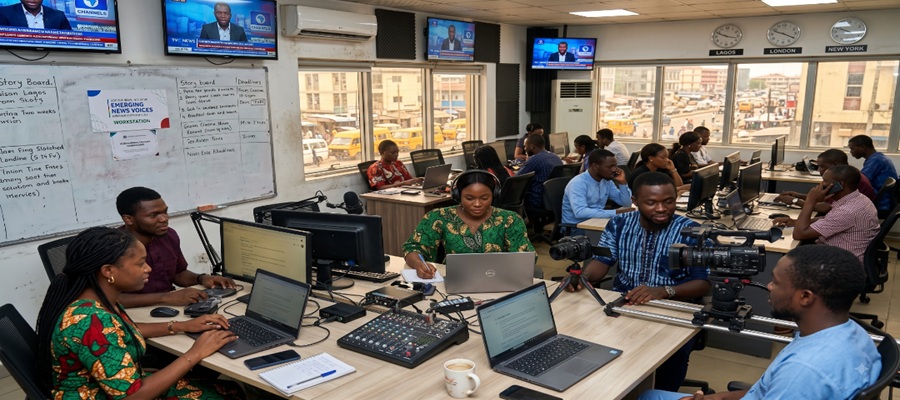
Google News Initiative (GNI) has selected six Nigerian independent news creators to participate in its Emerging News Voices Growth Lab for Sub-Saharan Africa.

The selected Nigerian creators are Onlinebanker, Adetunji Films, More Branches TV, Wearegst, Iswellthecapitalist and The Republic.
They are part of a cohort of about 20 emerging news creators from across Sub-Saharan Africa participating in the multi-month virtual programme, which runs through September 2026.
The initiative is designed to strengthen the capacity of creator-led and digital-native newsrooms through practical training in artificial intelligence, video production, audience development, direct reader engagement and sustainable revenue strategies.
The GNI said the programme was developed in response to the changing way Nigerians, particularly younger audiences, discover and consume news through social-first channels and digital platforms.
According to the initiative, while creator-led journalism is expanding rapidly, many independent newsrooms operate with limited resources and do not have the same access to technology, training and revenue expertise available to established media organisations.
Participants in the Growth Lab will work with Google trainers and product experts across four key areas.
The first is AI in the newsroom, where participants will receive hands-on guidance on integrating tools such as Gemini, NotebookLM, Google Trends and SynthID into newsroom workflows for research, transcription, translation and verification.
The programme will also focus on video and audience growth, providing practical strategies for building YouTube channels and using both Shorts and long-form video to reach new audiences.
Another area is direct reader relationships, with participants expected to strengthen their open-web presence and newsletters in order to develop first-party audiences that newsrooms can directly engage.
The fourth area is sustainable revenue, with sessions covering monetisation strategies, product differentiation and audience growth models.
Marianne Erasmus, News Partnerships Lead, Middle East and Africa at Google, said independent news creators and digital-native newsrooms were increasingly shaping how Africans, particularly Nigerians, find and understand news.
“Independent news creators and digital-native newsrooms are shaping how Africans, and Nigerians in particular, find and understand the news,” Erasmus said.
She said the Growth Lab would equip emerging newsrooms with practical AI skills, video and audience strategies, direct relationships with readers and approaches to sustainable revenue.
Erasmus added that strengthening the capabilities and financial independence of emerging news voices would contribute to a more resilient, diverse and sustainable news ecosystem.
Wale Lawal, Founder and Editor-in-Chief of The Republic, said the programme was providing practical ways for the publication to combine audience insights, product thinking and responsible AI use.
“Google’s Emerging News Voices Growth Lab is giving us practical ways to combine audience insight, product thinking and the responsible use of AI as we build a more sustainable future for The Republic’s journalism,” Lawal said.
Similarly, Nasir Achile Ahmed, Editor-in-Chief and Co-founder of MoreBranches, said the programme had provided practical resources, new tools and opportunities to connect with experts and fellow journalists.
Ahmed said the initiative had also provided information that validated some of the newsroom’s previous observations while equipping its team with knowledge on how to use new tools effectively.
He said the engagement with experts and fellow journalists had created a supportive environment for strengthening storytelling.
The Growth Lab emerged from the Global News Gap Project, a continent-wide mapping initiative conducted with Project Oasis and Code for Africa to identify independent African news creators and areas where emerging newsrooms require additional support.
The programme is part of Google’s broader support for the Nigerian media industry.
Since 2018, Google has supported newsroom transformation projects through the Google News Initiative and provided publishers with opportunities to strengthen their advertising revenue capabilities through the Ad Manager Academy.
Google said that since 2024, it had trained more than 1,500 Nigerian journalists and editors in areas including online safety, advanced Search, digital verification and audience analytics.
It also supports media skills development through its collaboration with the MTN Media Innovation Programme, where fellows receive practical training on AI as a productivity partner and newsroom technologies, including News Consumer Insights and Gemini.
The latest initiative reflects the growing importance of digital-native journalism as news consumption continues to shift towards social media, video platforms and other online channels.
Through the Growth Lab, GNI is seeking to help emerging news creators build stronger digital operations, expand their audiences and develop sustainable business models while responsibly adopting emerging technologies.

NUPRC Warns of Counterfeit, AI-Generated Appointment Letters

KudiWave Asks for Clarification over N750m Transfer from PalmPay Account

NCC Reports over 5,000 Fibre Cuts in 6 Months

PalmPay Reinforces Commitment to Youth Empowerment on International Youth Day

ipNX Joins Calls for Innovation-Friendly Ecosystem and Stronger Local Opportunities at Regenesys AI Summit

EFCC Busts NIS Visa Overstay Racket, Uncovers N700m in an Account

Fact-Check: Elon Musk’s “Tesla Pi Phone” is Internet Rumor

NBC Tasks Broadcasting Stations over 2028 DSO Global Deadline

NBC Scraps Annual Digital Access Fee on DSO

Glo Sponsored African Voices to Feature Netflix’s “The Polygamist” Stars




 E-Business3 days ago
X Replaces Revenue Sharing wit New Creator Rewards Programme

 Telecom3 days ago
MTN Alerts Subscribers over Fake 25GB Anniversary MTN Data Giveaway

 E-Financial3 days ago
Interswitch, Temenos Commit to Advancing Nigeria’s Digital Banking Technology

 E-Financial3 days ago
FG Spent N3.1 Trillion on Domestic Debt Servicing in Q1- DMO

 General News3 days ago
Fake Agency: ICPC Indicts NITDA, Others over Inadequate Due Diligence

 General News3 days ago
UNESCO Taps Oguamanam,Nigerian Scholar to Advisory Body on Science, Tech Ethics

 General News3 days ago
Tax Reform Built on Taxing Prosperity, Not Poverty– Adedeji

 Telecom2 days ago
MTN Nigeria Clocks 25, Connects over 90m People