

News
Huawei Climbs to Number 72 on Interbrand’s Best Global Brands Report

Global smartphone company, Huawei, has ranked 72 on the Interbrand’s 2016 Best Global Brands report, moving up 16 spots from its ranking in 2015.
This is the second consecutive year Huawei has risen on Interbrand’s list since the company became the first mainland Chinese brand to be recognized as a Best Global Brand in 2014.
According to Interbrand, “Huawei is once again a highlight in the 2016 Best Global Brands report released by Interbrand. Its brand value, increased by 18% compared to a year ago.
In Interbrand’s annual report, Huawei is also one of the fastest rising brands in the technology sector, climbing from #88 to #72 in ranking.
Huawei’s consumer business group has maintained steady global growth.
Its flagship products, such as the P9, Mate 8 smartphones, as well as the MateBook, Huawei’s first 2-in-1 laptop, have all seen significant adoption by consumers around the world.
Huawei has become one of the top device brands in nearly 30 countries.
The MateBook is now available in dozens of countries, and Huawei shipped 108 million smartphones in 2015, surpassing the 100 million benchmark for the first time.
Strong growth in shipment forecasts through 2021 is also reinforcing the company’s position as a leading global smartphone brand.
Commenting on the new development,Mr Leo Jiang, managing director, Devices, Huawei Nigeria, said: “We are very proud of this achievement especially with our improved ranking because it shows us that people all around the world are recognizing Huawei for being able to produce uniquely distinct and brilliant devices, and increases our zeal to continue innovating and providing customers with unmatched user experience”.
As a leading technology company, Huawei earmarks more than 10 percent of its annual sales revenue to research and development efforts, and has established 16 research centers around the world.
Among these facilities is the innovation and experience center in Nigeria, where consumers can witness global best practice, exchange ideas, and explore business solutions through innovation.
The company is also leading development of cutting-edge technologies such as 5G network for smartphones.
Through its continued innovation and non-compromise on quality, Huawei illustrates how innovative products, services and solutions help customers do more.


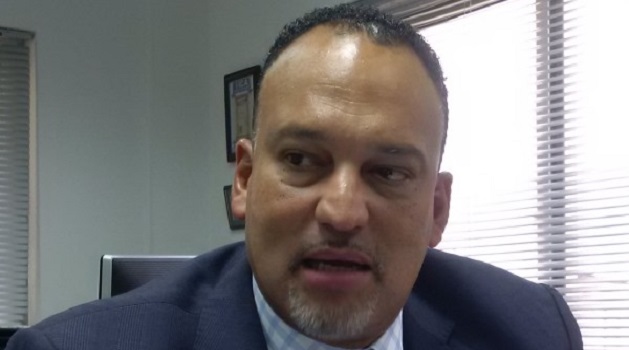
Open Access Data Centres (OADC), Africa’s fastest-growing data centre company, has officially announced the strategic acquisition of seven NTT data centres across South Africa.

The acquisition, which concluded on 31 December 2025 following approval by the Competition Commission, will significantly expand OADC’s national data centre footprint by adding seven facilities and increasing total capacity to more than 25 megawatts.
With a presence in South Africa, Nigeria and the Democratic Republic of Congo (DRC), OADC is already one of the largest and most influential data centre operators on the African continent. By adding these new facilities, OADC reinforces its ‘core-to-edge’ proposition and is uniquely positioned to meet the growing demand for digital services across Southern Africa, while strengthening its leadership in Africa’s digital transformation.
Dr Ayotunde Coker, CEO of OADC, commented: “This acquisition represents a significant step forward in expanding our ability to deliver scalable, resilient colocation solutions where they are needed. It strengthens our market value proposition, positioning OADC as a critical partner in growing Africa’s digital economy. We can provide clients with a wider range of comprehensive resilience solutions, delivering geographically separated primary and disaster recovery data centre infrastructure for their businesses.”
OADC’s acquisition of these seven data centres underscores the company’s long-term vision to enable Africa’s digital ecosystem, drive economic growth, enrich society, and reinforce its role as a pivotal enabler of digital connectivity and technological advancement across the continent.
Dr Coker added: “Looking ahead beyond the immediate expansion of our operational presence, OADC plans on enhancing all of its data centres as part of its continuous facility enhancement process, bringing the introduction of advanced operational measures to ensure peak efficiency and reliability.”


Hussaini Magaji (SAN), registrar-general of the Corporate Affairs Commission, (CAC) has accused some banks and financial institutions of undermining Nigeria’s anti-corruption and compliance framework by allowing inactive and non-compliant companies to continue operating and transacting freely.

Magaji also disclosed that the commission reported 248 fake company registrations to the Economic and Financial Crimes Commission (EFCC) for investigation and prosecution, while three CAC staff members were handed over to the Independent Corrupt Practices and Other Related Offences Commission (ICPC) over alleged internal misconduct.
The CAC boss made these disclosures on Tuesday in Abuja during an Anti-Corruption Day presentation and panel discussion held as part of activities marking the commission’s 35th anniversary. He spoke on the topic, “Transparency for Development: The Nigeria Experience.”
Speaking before representatives of key anti-corruption and law-enforcement agencies, Magaji warned that Nigeria’s corporate regulatory system would remain vulnerable unless all institutions enforced compliance uniformly.
“Let me state clearly: at CAC today, no company without full disclosure of its Persons with Significant Control is recognised as compliant. Companies that fail to disclose their PSC are flagged as inactive, and such status renders them unfit for credible transactions,” he said.
However, he expressed concern that this regulatory sanction was being routinely ignored by some financial institutions.
“However, we face a serious challenge. While CAC may flag such companies as inactive, some financial institutions, particularly banks, continue to allow these inactive companies to operate, open accounts, and transact freely. This is a major weakness in our national compliance chain. We must join hands to stop it,” Magaji added.
According to him, Nigeria’s regulatory ecosystem must speak with one voice, stressing that non-compliant companies should not enjoy the privileges of legality. “If a company is non-compliant, it must not enjoy the privileges of legality. Our collective success depends on enforcing this principle across the board,” he said.
To deepen compliance, Magaji said the Commission had taken decisive steps to clean up its internal processes and demonstrate zero tolerance for corruption.
“In the year under review, I had cause to surrender three members of staff to the ICPC for alleged misconduct involving suspicious and unauthorised tampering with company records. This was done to eliminate the chances of compromise and strengthen integrity within our processes,” he said.
He further revealed that 248 fake company registrations were discovered to have been illegally inserted into the CAC system and subsequently reported to the EFCC.
“Within the same period, I submitted to the EFCC a list of 248 fake company registrations illegally inserted into our system through unlawful means, for investigation and prosecution,” Magaji disclosed.
According to him, the entities operated without traceable corporate identities and failed to contribute to national revenue through taxation. An additional 15 such entities were also submitted for further investigation.
“Notably, despite these actions, no legitimate legal challenge has been brought against CAC regarding the removal and reporting of these illegal registrations,” he said.
The CAC Registrar-General also renewed calls for the establishment of a single, harmonised national register for beneficial ownership information, warning that Nigeria’s current fragmented system created loopholes that could be exploited for corruption, money laundering, and illicit financial flows.
He noted that while Nigeria had made progress in beneficial ownership transparency, multiple sector-specific registers operated outside the central CAC database.
“At the moment, we operate a fragmented system where certain sectors maintain separate beneficial ownership registers, such as the Extractive Industry and NEPZA, outside the central national register managed by CAC. This situation creates duplication, inconsistencies, and regulatory loopholes. It weakens our national integrity framework and complicates law-enforcement efforts,” he said.
Magaji stressed that CAC was legally and structurally positioned to serve as the central repository for beneficial ownership data in the country.
“There is therefore an urgent need for a single, harmonised national register for beneficial ownership in Nigeria. CAC is positioned by law and structure to serve as the central repository for beneficial ownership information. We need your support, your voice, your advocacy, and your institutional backing to push for this reform in the national interest,” he pleaded with stakeholders.
According to him, a single register would improve verification, enhance transparency, and strengthen Nigeria’s compliance with global anti-money laundering and counter-terrorism financing standards.
Magaji further described beneficial ownership disclosure as a growing global imperative, citing recent international developments, including court decisions in the United Kingdom involving property ownership linked to Nigerians.
“Beneficial ownership disclosure has become one of the most topical and critical issues in global governance today. The world is moving rapidly towards transparency, and Nigeria cannot afford to lag behind,” he said.
He called for the elevation of the Persons with Significant Control Rules into an Act of the National Assembly to provide a stronger legal foundation for enforcement.
“We must now push strongly for the passage of the Persons with Significant Control Rules into an Act of the National Assembly. We need a stronger, more comprehensive legal framework that will checkmate sophisticated abuses of the corporate vehicle,” he added.
The CAC boss also raised concern over the practice by some large corporations of declaring other companies, rather than individuals, as beneficial owners. “This defeats the purpose of beneficial ownership transparency. It creates layers of concealment and undermines accountability,” he warned.
Magaji concluded by urging sustained collaboration among Nigeria’s anti-corruption and law-enforcement agencies, describing the fight against corruption as a collective national responsibility. “The fight against corruption is not the responsibility of one agency. It is a national duty requiring coordination, trust, and shared resolve,” he said.
He called on agencies including the EFCC, ICPC, Nigeria Financial Intelligence Unit, and the National Drug Law Enforcement Agency to deepen information sharing, joint investigations, and real-time verification with the CAC.
“Our collaboration must not be episodic. It must be sustained, structured, and institutionalised so that our collective efforts translate into measurable outcomes for Nigeria,” he added.
By Oluwole Alao
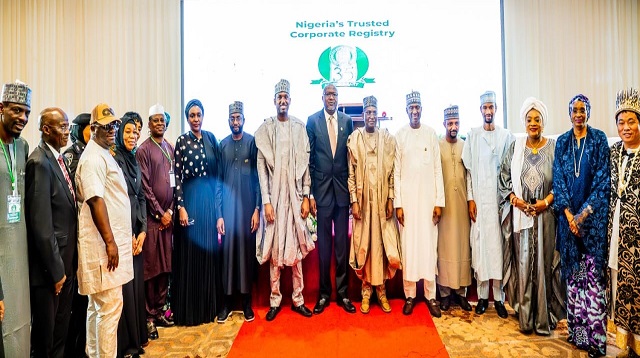
Kashifu Inuwa CCIE, the Director General of the National Information Technology Development Agency (NITDA), has pledged the Agency’s full support for the Corporate Affairs Commission’s (CAC) artificial intelligence–driven transformation as the Commission marked its 35th anniversary in Abuja.

Delivering a goodwill message at the celebration, which was held at the Ladi Kwali hall of the Abuja Continental Hotel, Inuwa commended CAC for its uncommon consistency and resilience, noting that while many organisations rise and fall after initial success, CAC has continued on a steady growth trajectory.
“We know organisations go up and come down, but some will keep thriving, thriving, and thriving, and today, this is what we are witnessing for CAC,” he said.
Reflecting on his early engagement with the Commission, the NITDA boss recalled that the Registrar General made organisational transformation a priority from the very start of his leadership, particularly in embracing digital innovation.
According to Inuwa, the current era demands more than basic digitisation, stressing that meaningful transformation can only be achieved through the integration of artificial intelligence into core operations.
“We are in the AI era, and the only way to transform today is to embrace and integrate AI into your operations. This is exactly what the Registrar General is doing,” he stated.
He assured CAC of NITDA’s commitment to working closely with the Commission to embed AI across its numerous processes, explaining that the technology would infuse intelligence into workflows, simplify company registration and business management, and strengthen cybersecurity.
“We will make sure you integrate AI into CAC processes. With AI, it will infuse intelligence in everything you do and make things easy for Nigerians to register companies and manage businesses,” Inuwa averred.
The NITDA DG added that deploying advanced AI tools would help CAC staff stay ahead of fraudsters and curb hacking and fraudulent alterations of company records, while also safeguarding the system through responsible deployment.
“At NITDA, we will make sure you deploy ethical and responsible AI in your operations, with the right guardrails in place,” he assured.
He further described CAC’s digital reforms as bold and impactful, noting that the Commission has reduced company registration timelines from several months to as little as 24 hours. He added that further integration of AI would enhance name search and reservation, automate filings, improve corporate governance, and significantly reduce fraud.
He also highlighted NITDA’s ongoing role in reviewing CAC’s digital and AI transformation roadmaps, providing guidelines, standards, training support, and safeguards to ensure sustainable, people-centred, and secure digital services.
The NITDA DG congratulated CAC management, staff, and members of the National Assembly for their support, expressing confidence that the partnership would further strengthen Nigeria’s digital business environment in the years ahead.

FG Seeks Private Sector Partnership to Bridge Broadband Gap

Nigeria Market Powers Jumia’s Momentum as E-commerce Platform Demand Accelerates

Cybersafe Foundation Partners Google to Strengthen Cybersecurity Among CCIs in Africa

Kaspersky Brings more Transparency to Threat Detection with New Hunt Hub

NDIC Intensifies Failed Banks Debt Recovery to Accelerate Depositors Payout

Firm Detected a Fivefold Surge in QR Code Phishing Attacks in the Second Half of 2025

US invests $115m in counter-drone tech for World Cup security

Nigerian Terra Industries Secures $11.8m for Expansion

Nigeria Targeted with 4,622 Cyber-attacks Per Week in December 2025

Firm Detected a Scam Exploiting OpenAI’s Teamwork Features




 General News2 days ago
CBN, NCC Propose Instant Refunds for Failed Airtime, Data

 Telecom2 days ago
Safer Internet Day: Sophos Warns – 42% Attacks Hit Stolen Logins in 2025

 News2 days ago
Ecobank Nigeria to Host Customer Forum on Strengthening Regional Integration for Economic Transformation

 News2 days ago
Lagos to Establish West Africa’s Premier International Financial Centre

 General News2 days ago
FG Launches the Happy Woman App Platform

 News2 days ago
Lasaco Assurance Gets Shareholders Approval to Advance Capitalization Plans

 E-Financial2 days ago
NDIC Says No Customer Loses Deposits in Failed Banks

 Telecom1 day ago
Inside Nigeria’s Telecom Exploitation Crisis Draining Household Budgets