

E-Business
IBM Boss Says “New Collar” Jobs to Transform Skills Market

Africa has approximately 200 million people between the ages of 15 and 24. By 2040, the continent is expected to be home to the world’s largest labor force, with an estimated working age population of 1 billion.
Meanwhile, the Continent’s economies grapple with economic development challenges and the quest for growth and a new social order driven by technology, they will also need to make corresponding qualitative investments in their abundant human resource – or skills markets.
But, IBM boss has identified “new collar” jobs as the transformational.
The Continent’s economies continue to struggle with numerous development challenges and opportunities, underpinned by shifting commodity trade flows, global realignment of capital flows and the emergence of a new class of businesses and citizens keen on exploiting the latest technology tools and trends.
There is also a growing awareness that successive generations of Africans will need new skills sets which will enable them to compete globally.
This local-to-global mindset exists in Africa as well as in societies grappling with social and economic development across the world.
Analysts have referred to this trend as the arrival of economic globalization. Whether we realize it or not, economic globalization is real.
It brings with it advanced technologies, global value chains and pent up demand for a new caliber of technology-aware, mentally agile work force.
A raft of public and private sector initiatives seem poised to radically change the way companies calibrate job specifications and engage the job market for requisite skills and competencies.
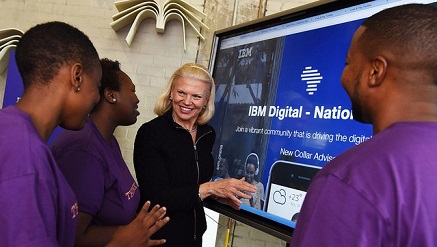
Dipo Faulkner, IBM’s country general manager for West Africa said IBM’s new “Digital – Nation Africa” initiative is a direct response to this unfolding scenario, as it seeks to transform Africa’s skills landscape, beginning with the fast-growing economies of Nigeria, South Africa, Kenya, Egypt and Morocco.
Findings by Nigeria CommunicationsWeek, has also revealed that Ghana, Mozambique and Mauritius will also be rolling out versions of this ground breaking initiative next year.
“You’ve obviously heard about white collar jobs, and blue collar jobs. This traditional classification was probably sufficient for the old era of work and industrialization. We are now in the new era of the knowledge-based economy and this unfolding era requires new skills sets, something we like to refer to as new collar jobs,” Faulkner says.
“New Collar” is a term used by IBM to describe new kinds of careers that do not always require a four-year college degree but rather sought-after skills in cybersecurity, data science, artificial intelligence, cloud, and much more.
Faulkner explained that as part of IBM’s global agenda to build the next generation of skills required for the “new collar” careers, IBM is investing $70 million in much-needed digital, cloud, and cognitive IT skills to help support Africa’s 21st century workforce.
The initiative will provide a cloud-based learning platform designed to provide free skills development programs for up to 25 million African youths over five years, enabling digital competence and nurturing innovation in Africa.
“Investing in human capital development and equipping the work force with relevant skill sets for fast changing world of work is crucial for economic growth,” Faulkner said. “In Nigeria, specifically, IBM will be partnering with government bodies and agencies, institutions in academia, civil society, technology incubators and development agencies including the United Nations Development Program (UNDP), which has a special focus on fostering market-driven ICT skills in Africa and the Middle East.”
From all indications, the IBM initiative aligns with and supports the Nigerian government’s social investment programs, as outlined in the proposed 2017 fiscal budget. The Nigerian authorities plan to create jobs for 350,000 unemployed graduates as well as 50,000 non-graduate youths who will be engaged as artisans and in other creative fields.
This plan is under the N-Power Volunteer Corps, a component of the government’s Social Investment Programme. Of the N157.75bn reportedly being appropriated for the N-Power Volunteer Corps scheme in the 2017 budget, N4.5bn is expected to be earmarked for science, technology, engineering and mathematics program to support young Nigerians in building skills in those disciplines.
IBM’s big picture perspective is that for the youth of Africa to be able to benefit from a cognitive future there needs to be a much higher level of digital literacy. The global technology firm says that at the top of the skills pyramid are developers, who need to know how to create solutions that can leverage the power of cognitive, and entrepreneurs who are aware of marketplace opportunities and potential.
Experts in technology and academia say that the “IBM Digital – Nation Africa” scheme should help raise the continent’s overall digital literacy, increase the number of skilled developers able to tap into cognitive engines and enable entrepreneurs and would be entrepreneurs grow businesses around the new solutions.
Through a free, cloud-based online learning environment delivered on IBM Bluemix, the premier cloud platform for business, the initiative will provide a range of programs from basic IT literacy to highly sought-after advanced IT skills including social engagement, digital privacy, and cyber protection.
Advanced users will be able to explore career-oriented IT topics including programming, cybersecurity, data science and agile methodologies, as well as important business skills like critical thinking, innovation, and entrepreneurship. The initiative aims to empower African citizens, entrepreneurs, and communities with the knowledge and tools to design, develop, and launch their own digital solutions.
IBM’s latest skills initiative for Africa will provide access to thousands of resources, in English, free of charge, including: Ready-to-use mobile apps; Guides – web guides, demonstrations, interactive simulations, video series, and articles; Online Assessments – A range of self-assessment tests to track the progress of individuals, together with industry recognized ‘Open Badges’ aligned to digital competencies.
The badges can then be shared with prospective employers: Volunteers – Creation of a volunteer program to support and promote digital literacy within their communities and App Marketplace – Provision of a platform on which new applications can either be made freely available or sold.
Faulkner was exchanging views with tech industry experts and media at IBM’s Client Innovation Center in Lagos, Nigeria’s commercial hub.
“The demand for new collar skills will continue to grow, and we need to increase the number and nature of opportunities made available to workers,” he said.


E-Business
Kaspersky Discovers New Phishing Campaign Exploiting Google Tasks Notifications to Steal Corporate Credentials


Kaspersky has uncovered a new phishing scheme that abuses legitimate Google Tasks notifications to trick corporate users into revealing corporate login credentials.

By leveraging Google’s trusted @google.com email domain and notification system, attackers bypass traditional email security filters and exploit users’ trust in familiar services.
In this campaign, victims receive an authentic-looking notification from Google Tasks with the subject line “You have a new task.” The message creates the illusion that the recipient’s company has adopted Google’s task management tool, pressuring them to act quickly. The notification often includes elements of urgency, such as a high-priority flag and a tight deadline, to prompt the victim’s immediate response.
Upon clicking the embedded link, users are directed to a fraudulent form disguised as an “employee verification” page, where they are asked to enter their corporate credentials under the pretense of confirming their status. These stolen credentials can then be used for unauthorised access to company systems, data theft, or further attacks.
“Google’s vast ecosystem of services gets exploited by scammers. The scheme with Google Tasks is part of a broader trend observed before and continuing into 2026, where cybercriminals misuse legitimate platforms to distribute scams and phishing.
Notifications originating from legitimate domains naturally evade many spam and phishing filters, while the social engineering aspect – making it seem like an internal company process – lowers the victim’s guard,” comments Roman Dedenok, Anti-Spam Expert at Kaspersky.
E-Business
esentry 2025 Report Shows Healthcare, Financial Services and Telecoms as Staging Grounds for Increased Cyberattacks in Africa

Cyber adversaries targeting African organisations are increasingly shifting away from opportunistic attacks toward deliberate, sector-specific campaigns aimed at the continent’s most critical digital infrastructures, according to the esentry 2025 Annual Report released by esentry, Lagos-based Africa’s leading indigenous Managed Security Service Provider (MSSP).

The report identifies healthcare, financial services, and telecommunications as the primary staging grounds for high-velocity cyberattacks, reflecting a growing focus on sectors that underpin economic stability, public welfare, and digital connectivity across Africa.
The findings are drawn from one of the largest cybersecurity datasets analysed in the region. Over the course of 2025, esentry processed more than 31 billion security events, generating 3.5 million alerts and successfully blocking over 15,000 malicious attempts. This monitoring scale shows that, while traditional financial institutions remain a core target, the threat landscape has expanded to include digital lending platforms, healthcare systems that store sensitive personal data, and telecom operators responsible for national and regional connectivity.
Within the healthcare sector, the report highlights ransomware as the most acute risk, with attackers frequently exploiting exposed Remote Desktop Protocol (RDP) services to compromise patient data and disrupt essential medical operations. In financial services, organisations are facing a surge in credential abuse, insider-related threats, and info-stealer malware designed to enable fraud and unauthorised access. Telecommunications providers are increasingly targeted by highly tailored phishing campaigns and attacks on exposed web services, which aim to harvest credentials and compromise customer data.
Commenting on the findings, Gbolabo Awelewa, Chief Business Officer at esentry, said the nature of cyber threats across Africa has evolved significantly. “The threats we are seeing today are deliberate, informed, and carefully tailored to local enterprises. Attackers are exploiting trusted access and moving quietly within networks, which makes early detection critical. Our coordinated cybersecurity model, spanning Defence, Intelligence, Offence, and Security Engineering, allows us to combine scale, speed, and deep contextual insight to detect and neutralise threats before they escalate,” Awelewa said.
A defining trend identified in the report is the shift from overt system exploitation to the abuse of legitimate access. By leveraging compromised credentials and ‘living-off-the-land’ techniques, attackers can blend into routine enterprise operations and significantly delay detection. This approach has compressed the attack lifecycle, enabling adversaries to move from initial access to full operational impact in fewer than 15 days.
To counter this acceleration, the report emphasises the importance of early detection and automated response. esentry says it currently contains low-complexity incidents in under 90 seconds, using a combination of structured threat hunting and centralised telemetry to anticipate and absorb attacker pressure rather than reacting after damage has occurred.
As African organisations continue to digitise, the esentry 2025 Annual Report positions itself as a critical reference point for understanding the continent’s evolving cyber threat environment. The report concludes that protecting Africa’s digital trust will require a shift away from fragmented security tools toward disciplined, coordinated defence frameworks, what esentry describes as a unified Phalanx formation.

The African Development Bank Group (AfDB) and the United Nations Development Programme (UNDP) have launched an ambitious $10 billion project to support the adoption of Artificial Intelligence (AI) across the continent.

The 10 Billion Initiative intends to accelerate ethical AI adoption and inclusive digital economic growth in Africa.
The initiative follows the Nairobi AI Forum, which took place earlier this month in Kenya and brought together governments, private sector leaders, development partners, and tech innovators to define pathways for impactful AI adoption.
According to the organisations, the strategy is a co-designed collaboration between the Bank Group, UNDP, and commercial partners that aims to raise up to $10 billion by 2035.
The resources will be used to create up to 40 million new jobs across the continent by 2035, through targeted investments that provide the groundwork for AI and accelerate widespread adoption in everything from entrepreneurship and regional data infrastructure to policy frameworks and skill development.
Nicholas Williams, AfDB Group ICT operations division manager, commented: “As a leading multilateral development institution, the bank is leveraging its comparative advantage to ensure Africa is not left behind in the AI era.
“The AI 10 Billion Initiative paves the way for expanded partnerships and sustained investments that will accelerate AI entrepreneurship, strengthen data and infrastructure ecosystems, and support inclusive growth across the continent.”

Galaxy Backbone Confirms Over 150,000 Active Official Government Email Accounts, Clarifies Status of GOVMAIL

More 14m Farmers to Benefit from AfDB-backed Initiative

Dimension Data Nigeria Secures ₦20Billion Funding to Strengthen Digital Infrastructure

Newmark Webinar Explores How AI Could Transform Healthcare in Africa

Alerzo Liquidates Delivery Fleet as N4.38bn Moniepoint Loan Row Deepens

Accidental Billionaire Opts for Jail Instead of Returning Money Credited Him by Mistake

New Horizons Nigeria Breaks Ground: First to Fuse Mandarin into ICT Curriculum

Kaspersky Brings more Transparency to Threat Detection with New Hunt Hub

NDPC Commits to Balancing Data Privacy, Protection Information

OADC Lagos Reinforces Commitment to Local Data Hosting and Digital Transformation @ NDPC’s National Privacy Week Summit




 Telecom3 days ago
Telecom Giant MTN Injects N1.0 Trillion CAPEX into Network Expansion

 E-Financial3 days ago
History is Watching: Tinubu’s Moment to Rescue Nigeria’s Stolen Future

 News3 days ago
NITDA Equips Federal Character Commission with Data Tools to Drive Public Sector Reform

 E-Business3 days ago
Kaspersky Discovers New Phishing Campaign Exploiting Google Tasks Notifications to Steal Corporate Credentials
- Telecom2 days ago
MTN Nigeria Posts Record N1.70 Trillion Pre‑Tax Profit, Declares N20 Dividend for 2025
 General News2 days ago
More 14m Farmers to Benefit from AfDB-backed Initiative
 Telecom2 days ago
Dimension Data Nigeria Secures ₦20Billion Funding to Strengthen Digital Infrastructure
 Telecom2 days ago
Alerzo Liquidates Delivery Fleet as N4.38bn Moniepoint Loan Row Deepens