

General News
iCyrus is Furniture & Joinery Revolutionary Online Market- Imo


Mrs. Alero Imo is the Managing Director of iCyrus Online Merchants Limited. She is also the Managing Director of Cyrus Kingdom Development Company (‘Cyrus’ for short, a furniture and joinery company).
She is an architect by profession, and worked briefly at the elite architectural practice of JamesCubitt (Architects) before taking up the role of MD at Cyrus, a role she has held on to for over 20 years.
She is a regular speaker at programmes geared towards youth empowerment and mentors an average of 15/20 young boys and girls on a yearly basis. She spoke to peter oluka on the launch of iCyrus.com.ng
The Concept: iCyrus.com.ng
iCyrus is an online store, especially for ‘Do It Yourself’ (DIY) enthusiasts, project managers, contractors and supplied/produced materials for other businesses.
We are a rapidly growing business with the primary aim of supplying our customers with products and services for home improvement. We are committed to Creating a platform for DIY supplies where everything you need to improve your home or complete your building project will be found.
We stock an extensive variety of products which include tools and safety equipment, furniture and joinery products, bathroom and laundry, adhesives and sealants as well as other affiliated products servicing the construction industry in Nigeria.
With our increasing range, you’ll find anything you need to complete your home or building project at a competitive price!
Online Market Mission
Our mission in the online market space is simply to be the foremost home improvement supply store in Nigeria; selling tools and safety equipment, furniture and joinery products, bathroom and laundry, adhesives and sealants as well as other affiliated products servicing the construction industry in Nigeria whilst providing our clients with the best quality at a fair price. This is summed up in our slogan: ‘One Stop Shop for Home Improvement’.
What Informed iCyrus Online Market Presence
We have been in the manufacturing sector producing furniture and joinery products. But, I have always wanted to have vendor platform which is not going to be our products alone, rather any company/body in the distribution chain. iCyrus is that platform.
iCyrus to business model entails that you do have to be a ‘great’ contractor to come and put your goods on iCyrus.
We serve small manufacturing, but you must get the procedure right such as having NAFDAC, SONCAP or SON registration.
Then, leave the product to us to vendor for you. There are a lot of suppliers that do not have the capacity to enlarge their business because they can’t go online and capture the wider market. iCyrus to customer model also depicts you need not send somebody to, probably, Mushin, whereas you reside in Surulere, to get such material.
Overseas, they have stores for DIY products. It is a luxury to pay somebody to change your electric bulb; you should be able to do that! You should be able to screw something that has gone off; assemble your table. You can decide to do your kitchen yourself; all you need is to go on iCyrus.com.ng and buy a completely knocked down material with the manual, you can do it. Everybody can have beautiful home. It is not just when you travel abroad that you seem ‘wowed’ by the furniture or joinery. You do not even need to spend so much on it.
Expansion Plans
Eventually, as we expand, we are looking at a fully automated platform which will incorporate franchises like warehousing in different States.
That is one good thing about online; you know exactly where the market is coming and create warehouses in different States to serve that niche for easier accessibility by the mass market.

Assessment Nigeria’s e-Commerce Space
I don’t think we have enough. They are not like physical stores; though it is still a new area at its rudimental stage. However, we need more because that is the place to be in the nearest future. As people are returning from work, tired, the next and closest place for them to shop is online.
As a country we need to catch on to the internet community and position ourselves as part of the growth.
iCyrus Launched in Period of Economic Recession:
There are two business models to iCyrus: Business to Business (B2B) and the Business to Customers (B2C). The B2B of iCyrus is going to create jobs for suppliers/manufacturers because what happens is that most of people do not have platforms to sell their goods.
Therefore, iCyrus is an open store to anybody/company who can manufacture quality products and less expensive, thereby, reaching the mass market.
For instance, there is a manufacturer in Surulere who is producing paint; a quality one for that matter, but this manufacturer is limited in sells.
The company would search for buyers, but online you have a catchment area of minimum of 93 million (according to Nigeria Communications Commission statistics). All you need to occupy yourself with is manufacturing and allow iCyrus to do the sales for you.
Quality Assurance
We have been in furniture and joinery business for about two decades. We manufacture and have access to the market, knowing the paths to quality products and raw materials areas.
Sometimes, we have to import the material; we know where they are, different producers. So, we hope that will help us as benchmark to good quality control.
We have people on ground in our team who are able to verify. As members of associations such as MANCAP, we can also check the quality of products before they are listed on the site.
How Furniture & Joinery Market Will Benefit
iCyrus is such a market place for the Furniture & Joinery market in Nigeria and beyond. Like I said earlier, whatever you bring to sell, we will charge only 10 per cent of the sales. The charge is just for administration and to enable site be up and running.
Plans for Delivery & Timing
It depends on the purchases. iCyrus has things like doors; you can order. But there are doors that are custom-made for you. In other words, it cannot be immediate.
We have a minimum of 14 days for certain products be produced; because it is being done to your taste. For others that are readily available, immediately the payment is made we inform you about the delivery plans.
Merchants Registration/Accreditation
To become a merchant, we have a form you have to fill; though not an online, but we can mail it to you.
The form serves as a contract agreement which we issue to vendors, because we have to be sure you have certain amount of raw material or you can be able to execute a job/an order.
There is no point listing that you have 10 units of a certain door and when about 100 people place orders you fail to deliver.
Meanwhile, on our part, we are checking the specifications for standards. The specifications are not our thinking, but as specified by Nigeria. If SONCAP decides this is how something should be, we are going to follow that format to the last.


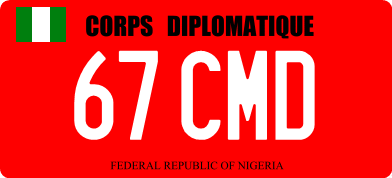
Police in Abuja have uncovered a criminal group making fake diplomatic and government number plates.

Ahmed Sanusi, commissioner of Police FCT, stated this during a press briefing on Friday.
He explained that criminals use these fake plates to dodge security checks and enter restricted areas.
The investigation started soon after Sanusi took office.
He noticed too many unauthorized cars driving around with official government and diplomatic tags.
“I immediately ordered a comprehensive investigation into this disturbing trend,” Sanusi said. He noted that these individuals use the plates as a cover to commit crimes and avoid arrest.
The police have already arrested several people caught using the fake plates.
They have also figured out who is making them.
The manufacturers operate outside Abuja, and police are actively hunting them down.
Sanusi kept their names secret so they would not flee.
He stressed that this is a highly profitable illegal business.
Buyers pay between N500,000 and N1.7 million for a single fake plate.
“This will tell you that they are making such huge expenditure because they have an agenda,” Sanusi explained.
“Now they will face punishment that is bigger than both the cost they incur and the agenda they are planning.”
The commissioner urged residents to report any cars with suspicious diplomatic plates.
He reminded the public that real diplomatic tags follow a very specific format.
A diplomatic number plate in Nigeria is a special vehicle identification tag issued to foreign embassies, high commissions, and accredited international diplomats.
Gavi has approved $500 million to strengthen Nigeria’s immunisation programme, primary healthcare services and long-term vaccine financing.

The move followed high-level discussions between Professor Muhammad Ali Pate, coordinating minister of Health and Social Welfare, ]and Dr. Sania Nishtar, chief executive officer, Gavi in Abuja.
The funding, approved under the Gavi 6.0 programme, will support Nigeria’s efforts to accelerate routine immunisation, sustain polio eradication, expand HPV vaccination, strengthen primary healthcare services, and improve long-term vaccine financing.
Speaking during the meeting, Pate said Nigeria was strengthening its partnership with Gavi to accelerate immunisation, expand primary healthcare services, and ensure sustainable financing for vaccines.
He welcomed Gavi’s country-focused reforms, including the introduction of a predictable five-year funding envelope.
Pate said the US$500 million allocation will enable Nigeria to plan more effectively and deliver life-saving vaccines to more children and vulnerable populations.
The minister also revealed that quarterly visits to primary healthcare centreshad increased from about 10 million in 2023 to more than 45 million, reflecting significant progress in revitalising the country’s primary healthcare system.
Pate welcomed the announcement of a US$600 million pledge by the United States government to Gavi, describing it as a strong endorsement of the alliance’s leadership and the global value of vaccines.
He also commended Nishtar for prioritising Nigeria and praised the closer coordination among Gavi, World Health Organisation (WHO), UNICEF, World Bank, Gates Foundation, and other development partners, describing it as a model that has improved efficiency and aligned support with Nigeria’s health sector reforms.
The minister expressed appreciation to Gavi and its partners for their continued technical and financial support, while calling on state governments to invest more in healthcare and immunisation to complement federal efforts.

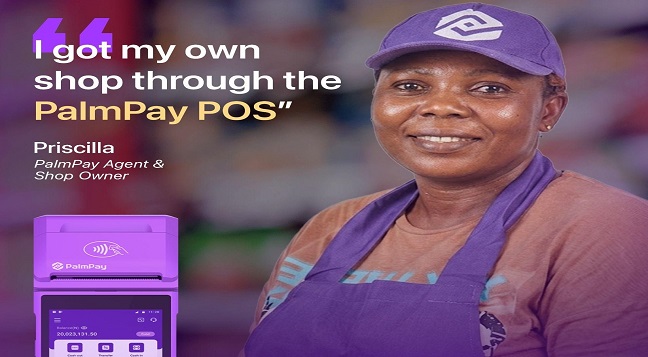
For many women, financial independence means the freedom to provide for their families and build a better future. Yet, this remains out of reach due to limited access to opportunities, business support, and secure payment solutions.

Like millions of women in Nigeria determined to be financially independent, Pricillia started with a single PalmPay POS terminal, and as an agent, every successful transaction provided a commission which brought her one step closer to achieving her dream.
Through consistency, discipline, and support from the payment platform, she reinvested her earnings and eventually opened her own provision store.
“I started as just a PalmPay agent with one POS. The consistency of the platform gave me the confidence to expand. With the income I earned, I was able to open my own provision shop.” Priscilla said.
For Priscilla, PalmPay was more than a payment platform. Its secure payment infrastructure gave her the confidence to serve her customers, build trust, and grow her income.
Today, Pricillia has joined the statistics of SMEs powering Nigeria’s economy and PalmPay continues to support her daily operations, helping her receive payments, as she works towards her next business milestone. Her journey is a reminder that when women have access to secure financial tools and opportunities, they can build lasting economic independence.
Speaking on Pricillia’s journey, Femi Hanson, Head of Marketing, PalmPay said: “Providing a secure platform that users can trust, whether for everyday payments or high-value transactions, is central to our vision of advancing financial inclusion. Priscilla’s story reflects our commitment to supporting the ambitions of Nigerians by providing a platform they can rely on to grow their finances. After all, seamless banking begins with security, and every successful transaction reinforces the trust our users place in us.”
Priscilla stands among thousands of PalmPay agents nationwide who are helping to expand financial access across Nigeria while earning commissions to create sustainable sources of income for themselves.
Every payment tells a story. It begins with trust, the confidence that your money is secure and that financial services are accessible. And when that opportunity reaches women, it creates ripple effects that transform families, strengthen communities, and drive economic growth.

Police Uncover Fake Diplomatic Number Plate Syndicate in Abuja

Davido Shares Past Suicidal Thoughts, Drops Oriadé Album

Gavi Okays $500m for Vaccines, PHCs in Nigeria

82% of Organizations Concerned about AI Risks Even as Adoption Accelerates – Survey Reveals

The Journey to Financial Freedom: Priscilla, a PalmPay Agent Now Owns a Store

NRC, Ponzi Scheme Collapses Resulting Loss of Billions of Naira

EFCC Busts NIS Visa Overstay Racket, Uncovers N700m in an Account

From Scarcity to Scale: What Africa Can Learn from India’s Agricultural Transformation

Tokenization, Blockchain Technology will Transform Financial Institutions – IMF

BON Establishes Six Ad Hoc Committees to Modernize Broadcasting




 E-Financial3 days ago
Access Bank Debunks Shutdown Report, Vows Action against Perpetrators

 E-Business3 days ago
Kaspersky Uncovers Cyber Threats Defining the First Half of 2026 in Nigeria, Others

 General News3 days ago
MENXTT TECH NG Offers Affordable Dell Laptops with Flexible Payment Plans

 Telecom3 days ago
ATU Summit Ends in Abuja with Landmark Declaration to Eradicate Continental Digital Divide

 Telecom3 days ago
Hon. Minister Dr. Kingsley T. Udeh and ASUS To Unveil First of a Kind Flagship Store in West Africa

 E-Business2 days ago
How Temu Helped a Madagascan Vanilla Family Business Sell Direct to Consumers Across Europe

 E-Financial3 days ago
$40Bn Net Reserves, Record Wealth, Relentless Poverty: Who Is Nigeria’s Economy Serving Today?

 General News3 days ago
EFCC Arraigns 4 over Alleged $5.3m Fraud Scheme