

Broadcasting
IHS Nigeria, NSCDC’s synergy on protection of critical national assets and infrastructure

By Lere Ojedokun
A secure environment is essential for political, economic and social activities to flourish in every society. It enables the government to focus on formulation of policies that can stimulate economic growth, provision of basic amenities for the citizens, and building essential infrastructure that can drive national Gross Domestic Product (GDP) growth.

Businesses and investors (local and foreign) are more likely to invest in an economy where their operations, assets and operations are protected from crimes such as theft and vandalism, terrorism, and other security threats.
Reasons include the fact that an effective and efficient security system will reduce the cost burden on the government and businesses, allowing for more funds to be directed towards product research, development projects and economic growth initiatives.
With the rising global security threats occasioned in part by the advancement in technology and increasing activities of terrorists and other non-state actors, defence and security receive huge votes in annual government budgets in many countries, including Nigeria.
In Nigeria, the protection of essential physical and virtual Critical National Assets and Infrastructure (CNAI) consisting of systems, assets, and networks are prioritised by the federal, state and local governments because they have direct and indirect impact on our daily lives. These include roads, airports, seaports, railways, electricity grids, transformers, transmission cables, oil and gas pipelines, water supply facilities, schools, hospitals, government buildings, courts, national defence and security institutions, custodial facilities, and international travel passports, among others.
Equally pivotal for Nigeria’s security and socio-economic growth are the essential physical and virtual telecommunication infrastructure that drives our nation’s functioning communication, security, and general well-being of Nigerians and foreigners resident in the country. The physical infrastructure includes telecom towers, fibre optic cables, and power generators at cell sites. The virtual infrastructure such as digital networks, information systems, and data repositories underpin crucial operations such as telecommunications, financial transactions, emergency response coordination, and national defence, and internal security.
Theft, vandalism and destruction of telecom’s physical and virtual assets ranked among the nagging challenges faced by telecom operators and infrastructure companies in Nigeria. With Information and Communication Technology (ICT), of which telecom is a significant driver, contributing 16.66% to Nigeria’s real GDP in Q4 2023 according to the National Bureau of Statistics (NBS), the protection of telecom infrastructure and assets cannot be overemphasised.
The Nigeria Security and Civil Defence Corps (NSCDC) is the lead federal government security outfit with a mandate to protect and safeguard Critical National Assets and Infrastructure across the country. Commandant General of the NSCDC, Dr. Ahmed Abubakar Audi, recently reaffirmed that any act of destruction or vandalism of our CNAI would have debilitating effects on the national economy.
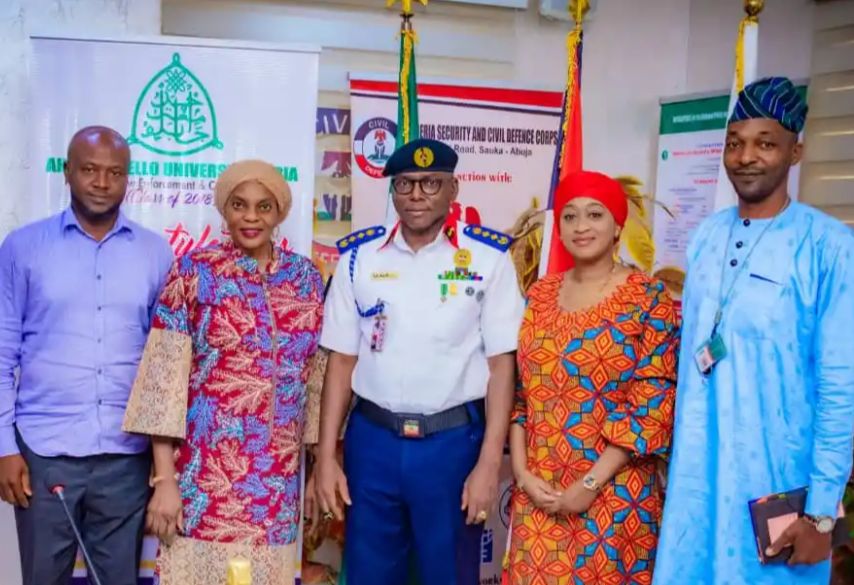
Thus, recently, IHS Towers, one of the largest independent owners, operators, and developers of shared communications infrastructure in the world by tower count, took a bold step by donating ICT equipment to NSCDC during a visit to the agency’s headquarters in Abuja.
The gesture, according to IHS Nigeria’s Associate Director, Government Relations, Fatima Ibrahim-Haruna, was to enable the security agency to scale-up effectiveness and efficiency in its operations by leveraging technology to adequately tackle insecurity challenges and threats in the country. While commending NSCDC for its efforts at protecting the nation’s CNAI, she added that the donation of the ICT equipment underscored the commitment of IHS Towers to promoting the wellbeing of people and communities, in line with the core pillars of the company’s Corporate Social Responsibility (CSR).
Ibrahim-Haruna noted that IHS Towers owns over 16,000 towers across Nigeria and pledged the company’s continued collaboration and partnership with NSCDC, as well as other strategic institutions to foster a sustainable future for Nigeria. She added that IHS Nigeria would further support the agency by upgrading its ICT Centre.
“Telecom infrastructure is integral to national security by supporting communication for defence operations and intelligence activities, financial institutions, healthcare, education, aviation, commerce and many other sectors that rely heavily on telecommunications for their daily operations. Disruptions in telecom operations can lead to significant economic losses, affecting productivity and growth. Ensuring security and protection of telecom infrastructure helps prevent espionage, cyber-attacks, and other security threats that can undermine national security and economic stability,’’ she stated.
The NSCDC Commandant General, Dr. Audi, commended IHS Nigeria for the ICT equipment and reiterated the unwavering commitment of the security outfit to ensuring adequate safety of lives and protection of critical national assets and infrastructure in the country.
“Maintaining law and order, and most importantly safeguarding all critical national assets and infrastructure in the nation is a core mandate to which NSCDC is irrevocably committed, as the lead agency in this regard,’’ he affirmed, while restating that critical assets and infrastructure were pivotal for national security, economic growth and social order.
Audi added: “It is against this backdrop that NSCDC has mapped out different strategies to nip in the bud all activities of economic saboteurs vandalising government properties and critical national assets and infrastructure. As a lead agency in the protection of CNAI as contained in the National Security Document, we remain resolute, and call on other critical stakeholders and security agencies to collaborate with NSCDC for maximum protection of CNAI.’’
The Commandant General assured the delegation from HIS Nigeria of the agency’s continued partnership with IHS Towers by ensuring there is no obstruction to its operations.
Telecom infrastructure is essential for fostering innovation and technological advancements. Telecom infrastructure provides the backbone for emerging technologies like IoT, AI and 5G, which drive economic development through creating new opportunities for individuals, businesses and countries. Critical services such as national security and intelligence, law enforcement, emergency response, healthcare, education, financial transactions, among others depend on reliable telecommunications. Therefore, protecting telecom infrastructure like other critical national assets and infrastructure will ensure these services are made available without disruptions and the economy will be the best beneficiary if this can happen.
Ojedokun, a brand strategist and development expert writes from Lagos.


Nigerian Copyright Commission (NCC) has called for urgent adoption of advanced digital protections after blocking seven piracy sites amid escalating online threats to Nollywood content.

The call was made during a webinar hosted by Greychapel Legal titled “Clicks, Streams, and Copyright: Who Owns Nollywood’s Digital Future?”, which brought together filmmakers, regulators, entertainment lawyers and media strategists to examine how content ownership and copyright enforcement are being reshaped by the digital age.
Lynda Alphaeus, director and head of the NCC Lagos Office, said the Commission has intensified its efforts to combat piracy across digital channels and is upgrading its operations to meet emerging threats.
According to her, Nigeria’s new Copyright Act was deliberately updated to strengthen creators’ rights amid the explosion of online distribution.
“NCC has worked, and is still working tirelessly to adapt Nigeria’s legal framework to cope with digital distribution challenges. We now have the power to block networks publishing illegal content, and we have already blocked seven websites distributing pirated Nigerian works,” Alphaeus said.
She revealed that the Commission has established a special taskforce known as the STOP Unit to coordinate anti-piracy operations online, alongside new awareness campaigns targeting local markets and schools to educate content creators and the public on copyright obligations.
Alphaeus urged filmmakers and producers to take ownership of their digital safety by deploying available technological protections to safeguard their intellectual property.
She explained that tools such as encryption help prevent unauthorised copying, blockchain technology offers immutable proof of ownership, digital watermarking allows creators to trace illegal uploads, while cloud security and regular offline backups protect creative files before they reach the market.
While noting that copyright in Nigeria does not legally require registration, she stressed that registering one’s work strengthens protection and provides legal presumptions that can be vital in enforcement.
“Whatever you register is presumed to be yours until proven otherwise,” she said, urging creators to invest in copyright knowledge as part of their business strategy.
Other speakers at the webinar reinforced the urgency of protecting Nollywood’s digital assets.
James Omokwe, film director, noted that while streaming platforms have created unprecedented opportunities for visibility and monetisation, they have also opened new vectors for intellectual property theft and unauthorised redistribution.
Solafunmi Laelle, media strategist, added that audience data, which streaming platforms rely heavily on, will increasingly determine leverage and value in film licensing negotiations.
According to her, creators who lose control of their intellectual property, whether through piracy or unfavourable contracts, also lose access to valuable data that could shape their long-term earnings.
Nky Ofeimun, entertainment lawyer, emphasised the need for creators to understand the contractual implications of ownership, platform exclusivity, and reversion rights.
She noted that many filmmakers still underestimate how quickly digital copies can be illegally duplicated or uploaded once control is lost.
The panelists agreed that as Nollywood deepens its digital footprint, piracy will continue to evolve and become more sophisticated.
They stressed that the industry must respond with equally sophisticated tools, stronger contract negotiation, and improved education around copyright.


Globacom, just introduced four brand new movies on its premium entertainment platform, Glo TV, and they are completely free for all subscribers. The company says the release marks another major step in its mission to enrich digital entertainment for millions of viewers across the country.

In a statement from Lagos on Wednesday, Globacom explained that the new titles feature some of Africa’s most celebrated actors and filmmakers, offering a colorful mix of romance, comedy, drama, culture, and emotional storytelling. The lineup includes Johnny Just Come (JJC), Eko Vibes, Bound, and Shifting Desire.
“Each of these movies was chosen to spotlight diverse African stories while delivering world class entertainment unavailable in cinemas, on YouTube, or on any other streaming service. Viewers do not need any subscription or extra payment. Access is completely free,” the company said.
Leading the pack is Shifting Desire, featuring Lilian Afegbai and veteran actor Majid Michel. The film is a gripping romantic drama that dives into marriage, intimacy, betrayal, healing, and the emotional journey of a couple using therapy to rebuild trust. Shifting Desire premiered on Glo TV on December 2 and is already streaming for free.
Johnny Just Come (JJC), starring Patience Ozokwor and Nancy Isime, delivers a hilarious cultural crossover story about an American man trying to navigate love and marriage in an African household. The movie explores themes of identity, family, culture, and coexistence in a warm and relatable way.
The third title, Bound, starring Rita Dominic and Eyinna Nwigwe, is a thought-provoking family drama that follows a successful career woman confronting long hidden personal struggles and the impact on her relationship. The film showcases powerful performances from some of Nollywood’s finest.
Rounding out the collection is Eko Vibes, featuring Broda Shaggi, Josh2Funny, and Nkechi Blessing. The movie captures the energy and hustle of Lagos youth culture, spotlighting ambition, humor, and the vibrant spirit of young people chasing success in the city.
Globacom noted that the new releases reinforce its commitment to delivering original African content at the highest quality. “With these exclusive titles, Glo TV is redefining digital entertainment in Nigeria by offering fresh, premium movies not available anywhere else. We remain committed to growing our catalog with rich African stories that celebrate creativity at its best,” the company added.

A new study, conducted by pan-African organisation, Paradigm Initiative (PIN), warns of an alarming surge in the prevalence of Technology-Facilitated Gender-Based violence, with 67 percent of respondents being victims of at least one or multiple forms of digital violence.

Online
Released on International Human Rights Day, the research exposes deep systemic failures, weak accountability, and unsafe online spaces driving a rapidly escalating epidemic across Cameroon, Kenya, Nigeria, Senegal, Zambia, and Zimbabwe.
PIN recognises that this gap limits both the understanding of TFGBV and the development of effective solutions. In response, this study adopts a survivor-centred approach that reframes how TFGBV is researched, discussed, and addressed. By prioritising survivors’ perspectives, the research uncovers the emotional, social, and systemic dimensions of digital violence that formal reports and statistics often obscure. It also interrogates how survivors navigate reporting systems, access justice, and play an informed role in digital spaces that are frequently hostile or unsafe.
A key finding of the study is that young people are disproportionately affected, with those aged 18–34 constituting the vast majority of survivors. Most incidents of TFGBV occurred on Facebook, WhatsApp, and X (formerly Twitter), underscoring how mainstream social media platforms continue to function as structurally unsafe spaces for many users—particularly women, activists, and advocates.
“Victims’ experiences range from sexual harassment, threats, and misogynistic attacks to severe violations such as stalking, non-consensual image sharing, hacking, sextortion, and identity-based harassment,” the report notes. “Personal testimonies reveal profound emotional, psychological, and reputational harm.”
The study also highlights that formal systems such as the police, employers, and public institutions, remain underutilised, largely due to fear, mistrust, or an expectation of inaction. While the findings expose wide-ranging gaps across platforms, institutions, and legal frameworks, they also highlight survivors’ resilience and their continued efforts to seek safer digital environments.
In light of these findings, PIN calls for urgent action to make online spaces safer for everyone, in line with this year’s Human Rights Day theme, “Human Rights, our everyday essentials.” Addressing these systemic gaps is critical to advancing democratic engagement, promoting media pluralism, fostering digital inclusion, and achieving gender equality across Africa.

NCC Blocks Piracy Sites as Nollywood Faces Rising Digital Theft

Minister Claims Bandits Exploit Poor Network, Bounce Calls Off Multiple Towers

FIRS says MOU with DGFIP Won’t Compromise Nigeria Tax Data Sovereignty

Top Nigerian Startups Secure Funding Boost @ iHatch Demo Day Awards

Four Must-Watch African Films Debut Free on Glo TV

Kaspersky Introduces Cyber Pathways to Support Career Development in Cybersecurity

Hackers Breach Phones of Dangote and Otedola, Demand Ransom

Nigeria Records Highest Weekly Cyberattacks in Africa — Report

Banks Lost N3.3Bn to Fraud in Q1 of 2025 – FITC

MTN Nigeria Has Invested Over ₦32.23 Billion in National Priorities Through Its Foundation




 Telecom2 days ago
MTN Nigeria Launches Unlimited 5G Broadband Plans to Boost Digital Inclusion

 News2 days ago
FRC, ICPC Seal Anti-corruption Alliance

 News2 days ago
Debt Rises in AI Data Centre Boom

 Telecom2 days ago
MoMo PSB Brings Relief to UNILAG Students with Ultra-Cheap Bus Fares

 E-Financial2 days ago
Sterling Bank, Pan-Atlantic University Partner to Certify Non-Oil Export Academy Graduates
 Telecom1 day ago
Minister Claims Bandits Exploit Poor Network, Bounce Calls Off Multiple Towers

 Broadcasting2 days ago
Young Africans Hit Hardest by Online Gender Violence, Paradigm Initiative Reports

 General News2 days ago
Fidelity Bank to Host Virtual Masterclass on New Tax Law