

Telecom
ITU Estimates 200m Fewer Women Online Compared to Men


The International Telecommunication Union ((ITU) said it will not relent in seeking ways to address gender digital divide, as it estimates that some 200 million fewer women are online compared to men.
Speaking at Gender Equality Mainstreaming – Technology (GEM-TECH) Award as part of prgrammes at the 2014 ITU Plenipotentiary Conference (PP-14) in Busan, Dr Hamadoun Touré, secretary-general, International Telecommunication Union (ITU) lamented that women are coming online later, and more slowly.
He said, “ITU estimates that some 200 million fewer women are online compared to men. Women are coming online later, and more slowly. And without remedial action, it is estimated that the internet gender gap could grow to 350 million within THREE or four years.
“Equality in access to broadband is not only an issue of right and wrong; it also makes commercial and economic sense. And this is why the Broadband Commission for Digital Development set a fifth advocacy target on achieving equality in broadband access by 2020.
“This is the time to get women to the tables where the decisions are being made – and we had an enriching debate on this subject during the GEM-Tech breakfast last week, with women ministers who are real role models and setting us a great example.

Speaking on the awards, he said that there were in recognition of excellence, “and they recognize outstanding performers and role models in Gender Equality and Mainstreaming in ICTs.
“We received 360 nominations from over 70 countries around the world, representing all regions, and coming from the public and private sectors as well as individuals from across the globe.
“And I have to say that choosing the WINNERS was one of the hardest things we have ever had to do, in my eight years as Secretary-General – because all of the entries we received were fantastic!
“As you know, gender equality is very close to my heart, and I passionately believe that women and men should have equal opportunities to prove their merit.
“To this end, one of my first actions as Secretary-General was to remove a single, discriminatory word from the ITU job vacancy announcements – and that word was ‘continuous’.
“Because up until then, we asked for ‘x’ years of ‘continuous experience’ – and that’s discriminatory to women, who may have taken time off to have a child, before coming back to work.
“So we removed the word ‘continuous’ from the job requirements, and I’m proud of that.
“I was also really pleased to see two highly COMPETENT women running for the Deputy Secretary General position.
“And I was even more pleased to see that yesterday the two women candidates for the Radio Regulations Board – Joanne Wilson from the United States and Lilian Jeanty from the Netherlands – both won their seats.
“So we are now back up to having two women on the RRB, and that’s a good thing – and I’m sure we will do even better NEXT time”.



Clydestone Ghana Plc has filed a writ of summons and statement of claim against MTN Ghana, MTN Group Limited and Mobile Money Fintech Limited, alleging unauthorized use of its intellectual property.

The company announced the court action at the Ghana Stock Exchange, confirming proceedings in the Commercial Division of the High Court of Ghana.
The case relates to work commissioned in 2007 that Clydestone alleges was later used without authorisation or compensation.
Clydestone said the claim involves proprietary intellectual property, confidential commercial information and operational methodology developed during the engagement. The company is seeking declarations, damages and equitable remedies.
In a statement, Clydestone said MTN Ghana engaged it in 2007 to develop a commercial and operational framework for a mobile money business.
“The work was developed and delivered by the company’s founder and Group CEO, Paul Jacquaye, and included a full mobile money ecosystem covering the commercial model, operational architecture, implementation methodology and business case.”
Clydestone said the work was commissioned on the understanding that a non-disclosure agreement and memorandum of understanding would be signed.
It alleges these agreements were not finalised despite repeated requests.
The company further alleges MTN Ghana later used its proprietary work and methodology without authorisation or compensation, including in MTN Mobile Money Ghana and other markets.
Clydestone said the alleged use has continued since the launch of MTN Mobile Money Ghana in 2009.
“The wrongful use of that work has been ongoing since 2009. What has changed is the availability of independently verifiable information that documents its scale and commercial significance,” the company said.
It cited the GSMA State of the Industry Report on Mobile Money 2026 and MTN Ghana’s 2025 annual report as evidence of the platform’s scale.
According to Clydestone, the reports show approximately 19.3 million active users and annual revenue of about GHS 6.0 billion ($516m).
The company said it reviewed its records following these publications and concluded there were sufficient grounds to initiate legal proceedings.
It added that it has received no payment or acknowledgement for the work since December 2007, and that pre-action correspondence in 2026 received no substantive response.
“The Board of Directors has unanimously authorised the commencement of these proceedings,” the company said.
Jacquaye said: “This case is about accountability for commissioned intellectual property.
“When independent publications in 2025 and 2026 revealed the scale of the mobile money business, we reviewed all documentation relating to the original engagement and concluded these proceedings were necessary.”
MTN Group Limited, named as a defendant, had not commented at the time of publication.

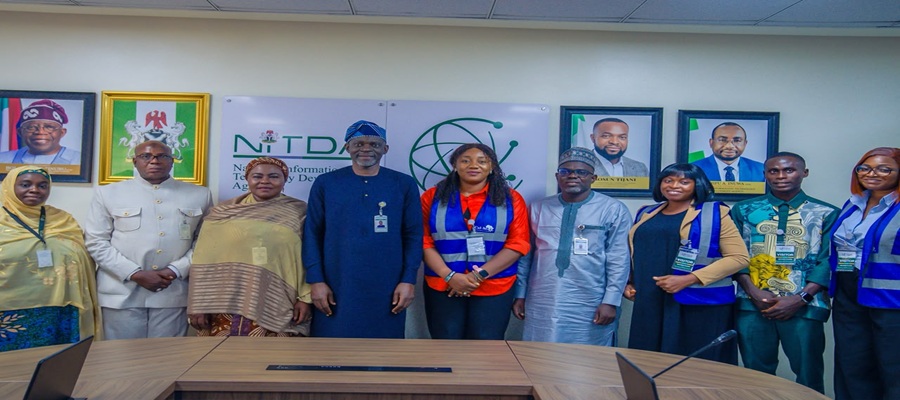
National Information Technology Development Agency (NITDA) has reaffirmed its commitment to expanding digital inclusion through strategic partnerships aimed at equipping underserved communities with digital skills and access to technology.

Mr. Oladejo Olawunmi, Director, Digital Development Services representing the Director General of NITDA, and the Executive Director of Cal-Maji Foundation, alongside members of their respective delegations, pose for a group photograph following a strategic engagement on advancing digital literacy, capacity building, and digital inclusion for women, youth, and underserved communities.
Director-General of NITDA, Kashifu Inuwa, made the commitment during a courtesy visit by the Executive Director of Cal-Maji Foundation, Mrs Faith Ayuba, to the agency’s headquarters in Abuja.
Represented by the Director of Digital Development Services, Mr Oluwunmi Oladejo, Inuwa said collaboration with community-based organisations remained central to NITDA’s vision of ensuring that no Nigerian was left behind in the country’s digital transformation journey.
He noted that feedback from beneficiary communities demonstrated the long-term impact of the agency’s interventions across the country.
“It is always gratifying to receive feedback from communities that have benefited from our interventions.
“Many of these projects were implemented years ago, and it is rewarding to know they are still creating opportunities,” he said.
The NITDA boss explained that the agency continued to monitor the performance of its intervention centres nationwide while leveraging emerging technologies to enhance digital learning and virtual capacity-building.
According to him, the National Digital Literacy Framework remains the foundation of NITDA’s efforts to equip children, students, artisans, farmers, professionals and other groups with digital competencies needed in a technology-driven economy.
Responding to requests for additional support, Inuwa disclosed that the agency would consider training community-based instructors to sustain digital literacy initiatives at the grassroots.
He encouraged the foundation to submit a formal request, accompanied by evidence of activities at its digital centre, to facilitate further intervention.
The director-general, however, acknowledged that maintaining internet connectivity across numerous intervention centres nationwide remained a major funding challenge.
He stressed the need for innovative financing models and stronger collaboration to ensure the sustainability of digital inclusion projects.
Earlier, Ayuba commended NITDA for its openness to partnerships and its commitment to supporting initiatives that deliver measurable impact in underserved communities.
She described the agency as one of the few government institutions that prioritised impactful programmes over personal connections.
According to her, the Cal-Maji Foundation focuses on improving access to education, strengthening food systems, enhancing food security and providing social protection for women and young people, particularly in remote communities.
Ayuba said NITDA’s Knowledge Access Centre, established at the foundation’s community school in a border community in Kogi State, had significantly transformed learning by providing students and residents with access to computers, internet services and digital education.
“The ICT centre became an equaliser.
“Young people who ordinarily would never have had access to computers or the internet suddenly had the opportunity to acquire digital knowledge.
“We came back simply to say thank you because this partnership has changed lives,” she said.
She disclosed that more than 1,000 children had benefited from the foundation’s educational programmes.
Ayuba also presented a former student who progressed from the community school to a Nigerian university after utilising the digital resources available at the centre.
She described the student’s achievement as evidence of the enduring impact of the collaboration.
The foundation’s executive director appealed for deeper collaboration through the training of community instructors, upgrading of computer systems and expanded access to NITDA’s digital capacity-building programmes.
She stressed that rural communities must not be left behind as Nigeria advances in emerging technologies such as artificial intelligence, cybersecurity and digital innovation.
The meeting ended with both organisations reaffirming their commitment to strengthening collaboration to expand digital opportunities, promote inclusive technology adoption and support Nigeria’s digital economy agenda.

In a development that underscores the fragile state of Nigeria’s telecommunications grid, an incident of infrastructure vandalism in Delta State has severely disrupted network connectivity, leaving thousands of subscribers stranded.

The breach, where a robber attacked the sites, occurred at an IHS-managed telecom node in the ASB region on July 8, 2026, immediately knocking 33 base stations offline across 2G, 3G, and 4G spectrums.
The situation in the region escalated drastically by morning when a separate fibre-optic cable cut severed primary transmission lines. Because the compromised node serves as a critical fibre convergence point, the secondary fibre cut triggered a cascading failure.
This secondary disruption ballooned the number of dark sites from 33 to 103, temporarily paralysing digital communications, banking, and commerce in the affected communities.
Industry sources reveal that the financial and logistical toll of such incidents is becoming unsustainable for Mobile Network Operators (MNOs).
Currently, network providers are utilising 20 per cent more spare parts than initially budgeted for the fiscal year.
This unpredictable depletion of technical reserves has stripped operators of their supply buffers, making inventory management and financial forecasting increasingly difficult for telecom executives.
Consequently, engineering teams have been forced to cannibalise materials originally designated for network expansion and new site rollouts just to perform emergency restorations on the damaged sites.
This diversion of resources significantly delays the rollout of new infrastructure, stifling the nation’s broader broadband penetration targets and stalling anticipated revenue generation for the telecom companies.
The Nigerian Communications Commission (NCC) recently noted an average of 1,744 weekly attacks on telecom infrastructure nationwide, including over 1,100 fibre cuts.
As operators endure protracted back-and-forth negotiations with insurance firms to cover these sudden hardware losses, stakeholders are intensifying calls for the strict enforcement of the Federal Government’s recent designation of telecom assets as Critical National Information Infrastructure (CNII) to safeguard Quality of Service (QoS).

Nwokolo, Nollywood Actor Claims Internet Fraud is “Keeping Economy Afloat’

SEC Begins Full e-Registration for Capital Market Operators

Elon Musk Launches Invite-only X Money with Visa Debit Card

CBN Fines Banks N430m for Ignoring Customers’ Complaints

Kaspersky Uncovers New Mirage Kitten Malware Used in Cyber-espionage Campaign Across Africa, Others

NRC, Ponzi Scheme Collapses Resulting Loss of Billions of Naira

EFCC Busts NIS Visa Overstay Racket, Uncovers N700m in an Account

From Scarcity to Scale: What Africa Can Learn from India’s Agricultural Transformation

Tokenization, Blockchain Technology will Transform Financial Institutions – IMF

BON Establishes Six Ad Hoc Committees to Modernize Broadcasting




 News2 days ago
History as Lagos Becomes First Nigerian State to Launch Greenhouse Gas Registry

 Telecom1 day ago
Fact-Check: Elon Musk’s “Tesla Pi Phone” is Internet Rumor

 E-Business2 days ago
UNN to Partner Firm on AI, Smart Mobility Innovation Centre

 Telecom2 days ago
AI Investment Gap Threatens Africa’s Future Growth

 Telecom2 days ago
AMCON Puts ntel Up for Sale, Seeks Investors

 E-Financial2 days ago
Remita Raises Alarm Over Nigeria’s Digital Divide, Calls for More Investment

 E-Financial1 day ago
Malpass, Ex World Bank Chief Raises Alarm over Nigeria’s Secretive Debt Structures

 Telecom2 days ago
Court Affirms NDPC’s Powers to Register Major Data Controllers, Processors