

E-Financial
Jaiz Bank Pledges to Support Media on Equipment Financing

Jaiz Bank, Nigeria’s premier Islamic bank has offered to finance equipment-upgrade projects of media organisations in the country.
The new Managing Director (MD), Mr. Sirajo Salisu, told journalists in Abuja, that the bank was prepared to also fund the procurement of equipment by new media organisations both in the print and the electronic media.

According to him, “the strategy was the bank’s way of strengthening its relationship with the Nigerian media, which he said would then become its ambassadors in the awareness drive.
Mr. Salisu explained that Islamic banking was purely business and that many Non-Muslim Nigerians have benefited from its large facilities, with some individuals receiving up to N1 billion and above.
His words: “The business of journalism is facing challenges of funding. We are saying that in Jaiz Bank, we are extending the business partnership to the media.
“We are ready to assist you in upgrading your equipment. We will be very proud to finance you in improving your business so that you can become our ambassadors by sharing your first-hand experience with others that what we are doing is purely business.
“If you want to upgrade your equipment, be in print media, radio or television, we are here for you.”
The MD added that Public awareness of the products of the bank and its efforts to add value to the economy remained paramount in order disabuse the minds of those who suspect the bank of being religious organisation.
His words, “A lot has been said about Islamic banking. We are confirming that Islamic banking or Non-Interest banking is purely business.
“A non-Muslim can become a shareholder of an Islamic bank. A non-Muslim can become a customer of an Islamic bank, like a lot of people are, right now.
A Non-Muslim can actually be a staff of an Islamic bank; a non-Muslim can be a part of the regulatory team of Islamic Bank. This is what we are going to emphasize in this new life of Jaiz Bank.
“We cannot names people because of the business confidentiality but I tell you that many Nigerians who are non-Muslims have received facilities from Jaiz Bank. We are talking of N100, 000; N1 million or 100 million and above.
“We want people to understand that anywhere you hear Islamic banking or Non-Interest banking, it is purely business and that business is being done on Sharia law basis.
“What does that mean? Nobody in business wants to be cheated. It is all about transparency and openness. The business is straight forward. It is a type of banking that is transaction-based.
“People would ask. How do they make their profit? We have to bring the answer closer to the people for them to understand.”
Given the transparency and transaction-based nature of No Interest banking, it could even be more profitable than a conventional bank.
Mr. Salisu said, “If you are happy as a customer, we too are happy. You cannot find anywhere that the customer is happy and the Non-Interest bank is not happy because our relationship is based on transactions.



Despite lingering regulatory uncertainty, Nigeria processed an estimated $92.1 billion in cryptocurrency transactions between July 2024 and June 2025, reaffirming its position as Sub-Saharan Africa’s largest crypto market, according to PricewaterhouseCoopers (PwC).

The figure, published in PwC’s Nigeria Economic Outlook 2026 titled “Turning Macroeconomic Stability into Sustainable Growth”, shows that Nigeria received nearly three times the crypto transaction value recorded in South Africa over the same period.
PwC attributed Nigeria’s dominance to its large population, youthful and digitally savvy users, persistent inflation, and continued foreign exchange (FX) access constraints, which have pushed many individuals and businesses toward crypto and stablecoins as alternative financial channels.
The report noted that crypto adoption in Nigeria reflects both economic necessity and structural transformation in financial behaviour.
PwC said Bitcoin continues to dominate fiat-to-crypto purchases in Sub-Saharan Africa, accounting for 89 per cent of transactions in Nigeria and 74 per cent in South Africa, underscoring its role as a default hedge and entry asset in volatile or constrained financial environments.
It added that stablecoin usage is structurally higher in Nigeria, signalling reliance on crypto rails as an informal FX market and dollar-substitute channel.
However, PwC cautioned that the data reflects only centralised exchange activity and excludes peer-to-peer transactions and informal flows, suggesting that actual volumes may be significantly higher.
PwC projected that Nigeria is likely to retain its position as the region’s largest crypto market in 2026, driven by FX access challenges, inflation sensitivity, and sustained demand for stablecoins as a store of value and settlement mechanism.
The firm also noted that Nigeria had earlier processed about $59 billion in crypto transactions, largely driven by young, tech-savvy users, highlighting deepening adoption momentum.
“The rising usage of crypto, especially among Nigeria’s youth, underscores the urgent need to accelerate regulatory cohesion in the near term,” the report stated.
PwC identified several key issues that will shape Nigeria’s crypto landscape in 2026, including industry adoption and compliance challenges, licensing and regulatory frameworks, a structural shift in crypto taxation, capital flow management, and market surveillance.
On licensing and regulation, PwC observed that progress remains slow, with only two exchanges granted provisional approval so far.
This, it said, highlights capacity and sequencing challenges within the regulatory framework. The firm warned that the planned rollout of crypto-asset taxation could outpace supervisory readiness, raising concerns about effective enforcement without a fully operational licensing regime.
In terms of taxation, PwC disclosed that the new Tax and Tax Administration Acts, effective from 2026, will treat crypto profits as income taxed up to 25 per cent, replacing the previous 10 per cent capital gains tax.
This represents a significant increase in tax burden and complexity for crypto users. It also noted that Virtual Asset Service Providers (VASPs) will face higher compliance and reporting obligations, raising operating costs for licensed platforms and potentially pushing more activity into informal or offshore channels

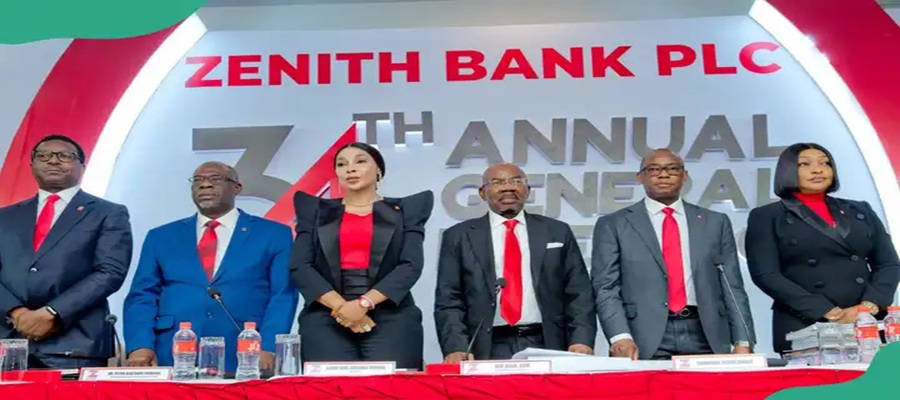
Renaissance Capital Africa (Rencap) has named Zenith Bank Plc its top conviction pick among Nigerian banks, ahead of GTCO and AccessCorp, in a fresh research report highlighting the lender’s robust balance sheet and dividend potential despite sector headwinds.

Zenith Bank
The comprehensive review of the Nigerian banking industry notes that Zenith’s current market valuation lags its improving fundamentals, even as the NGX Banking Index posts strong gains recently.
Rencap upgraded Zenith from HOLD to BUY, lifting its target price by 96 per cent based on a lower risk-free rate from falling government bond yields, refined beta estimates, and expectations of cleaner assets post-forybearance resolutions.
Balance Sheet Strength Drives Outlook
Analysts project challenges to earnings growth from anticipated Central Bank of Nigeria (CBN) rate cuts but foresee higher dividend payouts from resolved forbearance and single obligor loan (SOL) exposures alongside rising cash profits.
“Although we expect banks to face challenges in growing earnings… the balance sheet clean-up… will support higher dividend payouts relative to prior years,” the report states, ranking Zenith first, followed by GTCO and AccessCorp.
Key positives include loan write-offs that bolstered asset quality, enabling sustainable growth amid financial system reforms.
Dividend Recovery in Focus
Sector profitability from 2023-2024 was inflated by unrealised foreign exchange gains, which regulations barred from cash dividends, capping payouts despite headline profits.
Zenith historically led payout ratios in 2021-2022 via strong cash generation and capital discipline; Rencap expects a rebound as pressures ease, attracting income-focused investors.
Tier-1 Leadership Reinforced
Zenith Bank recently topped Nigeria’s tier-1 capital rankings for the 16th straight year, per The Banker magazine (Financial Times), affirming its resilience and positioning for long-term value creation.

CBN
- Access Bank Plc
- Fidelity Bank Plc
- First Bank of Nigeria Ltd
- Guaranty Trust Bank (GTBank)
- United Bank for Africa (UBA)
- Zenith Bank Plc
- FCMB (First City Monument Bank) – currently pushing to raise additional capital to secure its international licence.
- Wema Bank
- Standard Chartered Bank (Nigeria)
- Citibank Nigeria
- Stanbic IBTC Bank
- Sterling Bank
- Globus Bank
- Premium Trust Bank

Lebara Launches Agent Registration Portal

Nigeria Processed $92.1Bn Crypto Transactions in 12 Months — PwC

Zenith Bank Top Nigerian Bank Pick Ahead of GTCO, AccessCorp

Here Are Nigerian Banks That Have Secured Their Licences

ICPC Charges Ozekhome with Forgery, Corruption Over London Property

Banks quietly move to enforce new ₦50 transfer levy from Jan. 1

FIRS says NIN, CAC Numbers to Serve as Tax IDs from 2026

FIRS Declares NIN, CAC Numbers as Tax IDs from 2026

US Begins Partial Visa Ban on Nigerians January 1

Galaxy Backbone Tops FG’s Website Performance Ranking




 E-Financial2 days ago
SEC Hikes Minimum Capital Requirements for Market Operators After a Decade

 News2 days ago
Nigeria Off EU High-Risk Money Laundering List in Major Financial Win

 Telecom2 days ago
Study Shows Blocks in Telegram are Pushing the Underground Out

 News2 days ago
NGX Unveils Net-Zero Plan for Greener Capital Market

 Telecom2 days ago
Vodacom Crowned Africa’s Top Employer 3rd Year Running on Innovation, Ethical AI

 Telecom2 days ago
Galaxy Backbone Marks Two Decades of Powering Nigeria’s Digital Evolution

 Telecom2 days ago
Galaxy Backbone Marks 20 Years, Tops FG Website Scorecard
 News8 hours ago
ICPC Charges Ozekhome with Forgery, Corruption Over London Property