

Telecom
Key Into Our Digital Transformation Agenda, DG NITDA Urges NiRA

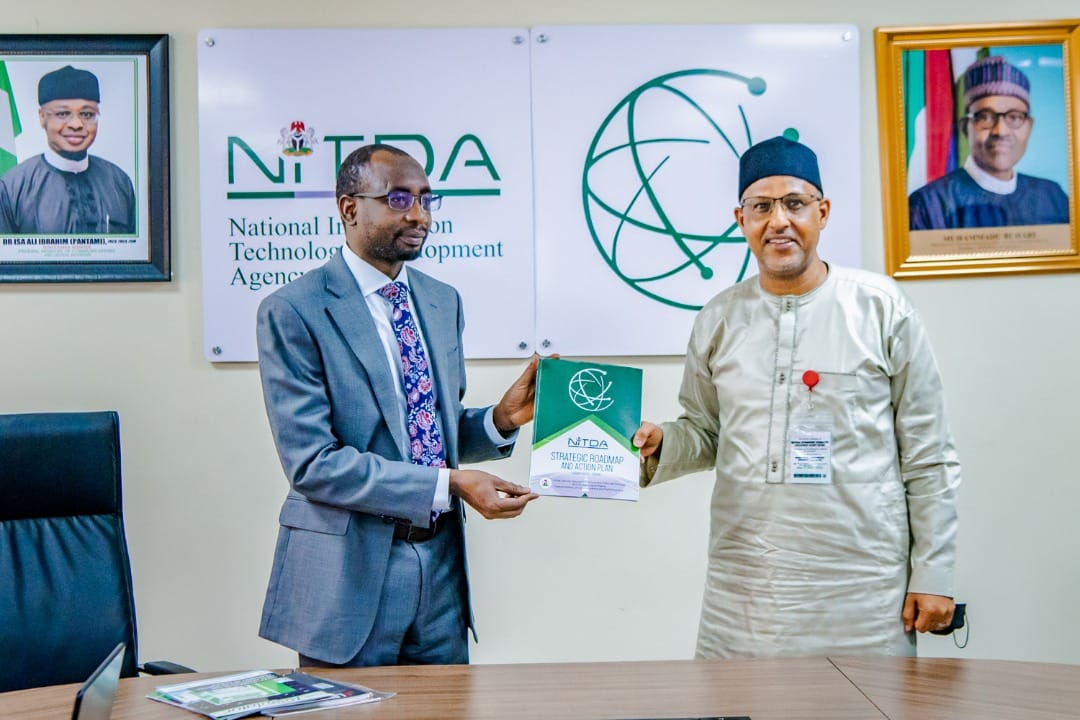
In an effort geared towards engaging the relevant stakeholders to implement the Strategic Roadmap and Action Plan (SRAP) 2021-2024 of the National Information Technology Development Agency (NITDA), the Agency’s Director General, Mallam Kashifu Inuwa Abdullahi, has urged the Nigerian Internet Registration Association (NiRA) to align with the Agency’s initiatives for them to fully enjoy its benefits.

L-R: Mallam Kashifu Inuwa Abdullahi, Director General, NITDA and Mr Muhammed Rudman, President OF NIRA, when the latter led his team on a working visit to present the Association’s annual report to the Agency in Abuja.
Abbdullahi made this call when he received the NIRA President, Mr Muhammed Rudman, and his team on a working visit to present the Association’s annual report to the Agency in Abuja.
He disclosed that NITDA, in its dynamism, has a lot of initiatives lined up for implementation and it is necessary for relevant stakeholders such as NiRA to keep up with the pace of the Agency by promptly keying into these initiatives.
“At NITDA, we are re-branding and re-calibrating ourselves with the new aspirations and realities of the digital ecosystem going through so many transformations and you really need to key in and align in what we do,” Abdullahi stated.
The NITDA DG while stating that the Agency has set targets for internal stakeholders and special purpose vehicles of the Agency to re-align them with the repositioning of the Agency, urged NIRA to come on board in the implementation of some of the initiatives of the SRAP document.
“We don’t want to come up with regulations that will take over the MoU we have with you so we really need to sit down together and put you in our plans”, he noted.
With regards to a symbiotic relationship and support to NIRA, the DG disclosed the Agency’s commitment to enhancing the promotion and adoption of the association’s policy by mandating Data Protection Compliance Organisations (DPCO’s) and public service institutions to comply with the ‘.ng’ domain policy.
“Our Digital Transformation Technical Working Group (DTTWG) committee has written to 500 Ministries Departments and Agencies (MDA’s) on the need to comply with the ‘.ng’ policy and we have inaugurated about 100,” he mentioned.
Abdullahi however, sought the association’s assistance to be encouraging their customers to comply with the provisions of the Nigerian Data Protection Regulations and urged them to actively get involved in all the Agency’s events such as the Gulf Information Technology Exhibition and Digital Nigeria.
“We need to agree on what you are going to do so that we can objectively measure and appraise your performance”, the DG concluded.
The chairman of the Association, Mr Rudman in his presentation detailing the Association’s Annual Report highlighted some of the association’s challenges and efforts in increasing their revenue for the development of the digital ecosystem and the Nation at large.
He however gave assurance of the association’s commitment to align with NITDA’s strategic initiatives.



More than $2 trillion flowed through mobile money wallets globally in 2025, found the State of the Industry Report on Mobile Money 2026, prepared by the GSMA Mobile Money programme.

This is an important threshold and exemplifies the exponential growth in transaction values the industry has experienced in recent years. It took 20 years to pass $1 trillion in annual transaction values, but just four years for this figure to double.
From its inception, only 25 years ago, mobile money has now become a mainstream financial service for underserved populations around the world, empowering those without access to traditional banking services and contributing to economic growth in countries where mobile money is present. The report also found that mobile money reached 2.3 billion registered accounts in 2025, growing by 268 million.
Vivek Badrinath, GSMA Director General, comments: “Mobile money has become one of the world’s most impactful financial services. What began as a simple way to move money has evolved into a global financial ecosystem, reshaping how hundreds of millions of people manage their financial lives. The market is reaching new heights and greater maturity. Adoption and regular use are surging, and value is scaling even faster than volume, with more than $2 trillion flowing through mobile money in 2025 – doubling from the first trillion in just four years.
“Looking ahead, the industry’s growing scale and sophistication will bring new opportunities, and new responsibilities. By prioritising interoperability and cross‑border harmonisation; engaging in digital public infrastructure; strengthening consumer protection and fraud controls; and accelerating women’s inclusion and financial health outcomes, we can ensure mobile money continues to provide safe, inclusive and sustainable digital financial services.”
Regular mobile money usage is growing, supporting financial health
Regular mobile money usage has increased worldwide over the past year, with active 30-day accounts rising by 15% to 593 million. Most new registered and active accounts came from Sub-Saharan Africa, although almost every region where mobile money is offered experienced a rise.
This has led to monthly usage of mobile money accounts growing by half a percentage point to 25.7%, the highest it has been since 2021. However, this still leaves almost 75% of accounts inactive monthly, with fraud remaining widespread and transaction taxes often encouraging users to revert to cash in the countries where they’re in effect, negatively impacting financial inclusion.
Through more frequent usage, mobile money users can improve their financial health – the capacity to manage day-to-day financial needs, withstand shocks and invest in the future – by benefiting from the increasing provision of adjacent services like credit, savings and insurance.
The report found that the number of mobile money providers offering insurance increased by one-third in 2025. Mobile-money enabled credit remains the most widely offered adjacent financial service, and this is nearly matched by those offering saving options.
Regulation is supporting mobile money in improving financial inclusion
Regulation is playing a key role in expanding the reach of mobile money, the GSMA reports. Over 60% of mobile money providers believe that interoperability, know-your-customer and consumer protection regulations have supported their operations.
Although more must be done to support the industry, significant regulatory issues remain – particularly cross-border data transfer regulations, which 24% of mobile money providers report have hindered their operations.
With a supportive regulatory environment, the mobile money industry will be able to continue growing and, in turn, advance financial inclusion, especially among groups that have traditionally lacked access to banking services.
This is vital as a wide gender gap persists in mobile money account ownership across seven out of 10 countries surveyed in the report. Aside from in Ghana, Kenya and Nigeria, women who own a mobile money account are still less likely than men to have used it within the past month.
Mobile money fosters innovation for good
In addition to accelerating financial inclusion and supporting improved financial health, mobile money usage is enabling wider social and humanitarian benefits by enabling rapid payouts during crises, particularly in remote regions. However, for these and other use cases to succeed, mobile money needs to be complemented by digital financial literacy initiatives to continue responsible growth across regions and demographics.

A Los Angeles jury has found Alphabet’s Google and Meta Platforms liable for $3 million in damages in a groundbreaking social media addiction lawsuit, a verdict expected to reverberate across thousands of similar cases against major tech firms and intensify scrutiny over addictive app designs targeting young users.

The case centres on a 20-year-old woman who alleged that Google’s YouTube and Meta’s Instagram hooked her at a young age through deliberate attention-grabbing features, with the jury ruling that both companies were negligent in their platform designs and failed to warn about inherent risks.
Judge Carolyn Kuhl noted that punitive damages remain pending, with jurors set to weigh whether the apps caused physical harm or if the firms disregarded broader user health impacts.
The plaintiffs’ lead counsel hailed the decision as a “referendum from a jury to an entire industry” signalling that accountability has arrived for tech giants long criticised for prioritising engagement metrics over youth wellbeing.
While Meta shares rose 1 per cent and Alphabet’s climbed 0.2 per cent post-verdict, both companies pushed back—Meta calling the outcome disagreeable and evaluating appeals, while Google spokesperson José Castañeda confirmed plans to challenge the ruling.
Notably, the trial sidestepped content moderation disputes by zeroing in on platform mechanics, a strategy that complicated defences; co-defendants Snap and TikTok settled pre-trial on undisclosed terms.
The ruling amplifies a decade of escalating backlash against U.S. tech behemoths over child and teen safety, shifting the battleground to courts and statehouses after federal lawmakers stalled on comprehensive regulation.
At least 20 states passed child-focused social media laws last year, including cellphone bans in schools and mandatory age verification for accounts, measures now under legal fire from NetChoice—a tech-backed group including Meta and Google—challenging verification mandates as unconstitutional.
Looking ahead, a multi-state and school district addiction suit heads to federal trial in Oakland, California this summer, while another Los Angeles state case involving Instagram, YouTube, TikTok, and Snapchat kicks off in July, per plaintiffs’ attorney Matthew Bergman.
This verdict underscores mounting parental and regulatory alarm over algorithms that keep minors scrolling for hours, fueling mental health crises from anxiety to sleep disruption, even as platforms tout safety tools like parental controls and time limits.
For Nigeria and Africa—where youth form the bulk of 300 million-plus social media users—the outcome spotlights urgent needs for homegrown safeguards amid rising app penetration and similar addiction concerns in emerging markets.
Tech accountability campaigners see the case as a potential tipping point, pressuring firms to redesign feeds, enforce age gates, and fund independent research, lest a cascade of global litigation erodes their trillion-dollar valuations.


PricewaterhouseCoopers (PwC), global professional services network, has reported that Nigerians lost about N12.5 billion from 2019 to 2023, through escalating digital fraud schemes.

AI-driven scams leverage artificial intelligence to create highly personalized and convincing fraudulent schemes, such as deepfake audio/video impersonations, automated phishing, and fake investment bots.
Globally, telecom fraud losses reached more than $38.95 billion during the same period, PwC said in its report titled “AI’s Dual Role in Telecom Fraud.”
The firm highlighted the dual nature of Artificial Intelligence (AI) in the telecom sector, warning that the technology is changing how fraud operates.
“AI has tremendous potential to drive positive change across sectors, but it also enables fraudsters to create and disseminate scams quickly and at scale,” PwC said in the report.
The report shows that telecom operators are no longer just communication providers but also critical infrastructure supporting digital banking and payments.
This shift has increased exposure to fraud. PwC noted that in Nigeria, 59 percent of e-banking customers have experienced scams, suggesting that telecom networks, which support mobile banking alerts, authentication messages, and digital payment links, are becoming attractive targets for criminals.
As telecom networks connect more closely with banks and fintech companies, fraud incidents in one sector can quickly spread to another, leading to regulatory scrutiny and loss of customer trust.
This growing overlap is creating a new risk layer in Africa’s digital economy, where mobile devices are often the main gateway to financial services.
PwC identified several common telecom fraud methods affecting operators and users, including SIM box fraud, SMS phishing, SIM swap fraud, subscription fraud, scam calls, and international revenue share fraud.
The report noted that AI could make these attacks even more sophisticated.
Criminal groups can now use AI tools to automate scam campaigns, generate convincing messages, and even create deepfake voices or identity impersonations to trick victims.
The firm warned that these capabilities could allow fraud schemes to spread across networks quickly, increasing financial losses if telecom companies fail to strengthen defenses.
Globally, the telecom, media, and technology sector already experiences the highest level of fraud, according to PwC’s 2022 Global Crime Survey. N
early two-thirds of companies in the sector reported fraud incidents, with about half involving cybercrime.
Despite the risks, PwC said telecom operators have a strong advantage in combating fraud because of the large amount of network and customer data they control.
By using AI and machine learning tools, companies can analyse network behaviour in real time and detect suspicious patterns early.
AI systems, for example, can identify unusual call patterns, abnormal message traffic, or activities occurring at odd hours that may signal fraudulent activity.
Some telecom operators have already introduced AI-powered spam detection tools that analyse hundreds of behavioural indicators before determining whether a message or call is likely to be fraudulent. According to PwC, real-time analysis could allow telecom companies to block scams before they cause significant financial losses.
However, PwC stressed that technology alone is not enough to tackle the problem.
The firm called for stronger collaboration between telecom operators, banks, and regulators to address fraud risks across the digital ecosystem.
“AI has tremendous potential to drive positive change across sectors, but it also enables fraudsters to create and disseminate scams quickly and at scale,” the report reiterated.
With millions of Nigerians relying on mobile networks for banking, payments, and identity verification, telecom companies are becoming frontline defenders against digital fraud.
PwC said a deeper understanding of how technology is changing fraud risks will be crucial for telecom operators seeking to protect customers and maintain trust in the country’s digital infrastructure.

Mobile Money Transactions Accounted for $2 trillion in 2025

MoneyMaster Enhances App, Rewards Users with Data and Airtime Bonuses

Nigeria, Finland Sign Cybersecurity Pact

Firm Shares Tips for Updating Your Digital Habits for an AI-driven World

EU Pumps €290m into Nigeria’s Digital, Health, Agri Sectors

Kaspersky Discovers New Phishing Campaign Exploiting Google Tasks Notifications to Steal Corporate Credentials

esentry 2025 Report Shows Healthcare, Financial Services and Telecoms as Staging Grounds for Increased Cyberattacks in Africa

AfDB, UNDP Launch $10Bn AI Initiative for Africa

MultiChoice Suspends Yearly DStv Price Hike as Canal+ Pushes Growth

Spotify’s Loud & Clear Report Reveals Over ₦60Bn Revenue for Nigerian Artists in 2025




 E-Financial3 days ago
DLM SPV PLC Lists ₦9.00bn AAA-Rated Medium-Term Notes on FMDQ Exchange, Sets Benchmark in Corporate Bond Market

 News3 days ago
Metaverse Collapses, Horizon Worlds Shuts Down on Quest

 E-Financial2 days ago
CBN Directs IMTOs to Open Naira Settlement Accounts

 Telecom3 days ago
Legend Internet, Spectranet in Merger Talks

 Telecom2 days ago
Nigerians Lose N12.5Bn to AI-Driven Scams- PwC

 News3 days ago
NITDA Reaffirms Commitment to Advancing Creative Economy with Digital Initiatives

 General News2 days ago
Court Remands Hacker for Allegedly Stealing N3.09Bn from FCMB

 E-Financial3 days ago
SEC Issues Six-Week Ultimatum to Market Operators to Submit Recapitalisation Plan