

News
Konga Chairman, Zinox Group ED Bow Out in Style

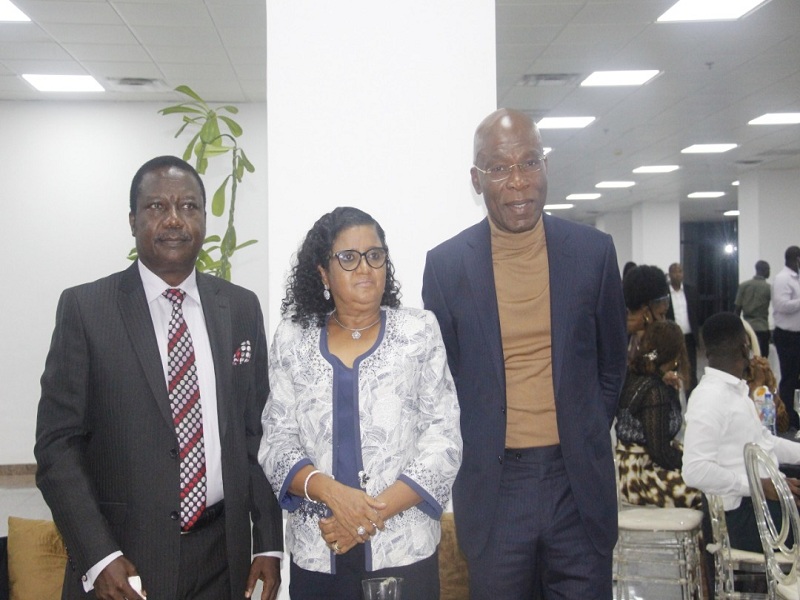
Leo Stan Ekeh, serial digital entrepreneur and chairman, Zinox Group has heaped praises on two recently retired executive management staff, Mr. Olusiji Ijogun, chairman of Konga Group, and Mr. Etiene Etukudoh, executive director, Zinox Group, for their immense contributions and years of outstanding service to the companies, even as he expressed deep gratitude to them for their invaluable efforts and sacrifices.

Chairman, Zinox Group, Leo Stan Ekeh (left) poses with the exiting Executive Director, Etiene Etukudoh (right) and his wife during a valedictory event to mark Etukudoh’s exit.
Ekeh spoke at a smart valedictory event held in honour of Ijogun and Etukudoh.
The event was held at the impressive Yudala Heights located at Idowu Martins, Victoria Island, Lagos on Tuesday, August 3, 2021.
The well-attended event, organized in strict compliance with COVID-19 regulations, saw Executive Management and staff of the Zinox and Konga groups, as well as other guests and associates of the departing staff in attendance.
While delivering his appreciation speech, Ekeh explained his many years of fruitful relationship with the two distinguished personalities and wished them greater heights in their future endeavours.
Ekeh, who described Ijogun as a brother, stated that integrity is a major quality for choice of Chairman for any organization.
“For a company to be successful, the biggest brain is the Chairman and the CEO as they prescribe and supervise the implementation of quality culture, structure and systems. It is not just the knowledge of the business, the integrity of the personality and the quality of leadership.
“The business is bound to fail if the leaders don’t believe in God and that’s a major problem with start-ups in Africa. Konga wouldn’t have survived if I hadn’t known Siji.
‘‘It is a privilege to have Mr. Ijogun as Chairman of the Konga Group and we really appreciate his many efforts,” Ekeh said.
Further, Ekeh drew rich illustrations from his many professional and personal experiences with Mr. Ijogun, noting that his time as Chairman of the Konga Group was a blessing to the entity.
Also speaking about Etukudoh, who spent many performance-filled years at TD Africa where he rose to the position of Managing Director, Ekeh described him as an ideas man who he can always vouch for.
“Etiene is an all-rounder. He worked for all the companies in the Group. He is a good Nigerian and he has style. He’s one young man I can vouch for. He’s brilliant, modern and trustworthy. I have great confidence in him and I always told him when I have new businesses.
“He’s a man of great ideas and we consider it a privilege for him to have worked with us. This relationship is for life. You have me as a father so you can call me anytime,” Ekeh assured.
The event also offered attendees the opportunity to share their goodwill messages as well as their experiences of working with Ijogun and Etukudoh. Many of the speakers were effusive in hailing both men as inspirational professionals who will be greatly missed.
Reacting to the showers of encomiums, Ijogun, a certified corporate guru with a track record of exceptional service with a host of multinationals, expressed gratitude for the opportunity to serve as the first Chairman of the Konga Group after its acquisition by Zinox.
He described Ekeh as a calculated risk taker and an unmatched incubator of businesses who can turn profit from waste.
He also predicted a progressive future for Konga and charged the Group to remain resilient by sustaining its impressive growth trajectory.
“Konga’s growth is phenomenal. Nobody knew online platforms would be the order of the day before COVID-19. To the glory of God, Konga has moved from loss-making to profit-making, with over 15 times greater in terms of revenue and I must commend Mr. Ekeh for the deep pockets.
“ Since inception, we’ve added the Health, Food, Bulk and Travel business and still have more in the offing. With influx of investors, Konga will be a major African business initiative in the nearest future,” Ijogun declared.
Also expressing gratitude for the memorable show of love, Etukudoh reaffirmed his loyalty as a brand ambassador for the Zinox Group.
“I am grateful for the honour. In everything, I just wanted a big brand. I want to celebrate everyone who has been a part of my life. It’s been a journey. I came into the Group and made up my mind to demystify what people call the ‘Oga status’.
‘‘After today, nobody remembers the title but how you treated them. I’ll recommend that every staff work closely with the Chairman for at least one year before they leave the company.
“Chairman has been a big brother and his hunger has no part two. I’m grateful to Chairman, his wife, Mrs. Chioma Ekeh and everyone else. This is a great family and we have to keep it growing forever,” he said.


Nigeria and other Sub-Saharan Africa countries rank ninth out of nine global regions as Egypt has emerged as Africa’s leading country in artificial intelligence readiness, ranking first on the continent and 51st globally in the 2025 Government AI Readiness Index published by Oxford Insights.

The impressive ranking has been lauded as underscoring North Africa’s growing influence in the global AI race.
According to Egypt’s Ministry of Communications and Information Technology (MCIT), the country scored 57.5 points out of 100, climbing 14 places from 65th in 2024.
The Nile nation also ranked fourth in the Middle East and North Africa (MENA) region, behind Saudi Arabia, Israel and the United Arab Emirates.
The Oxford Insights index assesses 195 governments using 69 indicators across six pillars, including policy capacity, governance, AI infrastructure, public sector adoption, development and diffusion, and resilience.
Egypt topped the Policy Capacity pillar globally with a perfect score of 100, tying with the UK, Serbia and Australia, an indicator of strong national AI policymaking and institutional readiness.
Oxford Insights noted that countries such as Egypt are “expanding the use of AI across national priorities while shaping policies to strengthen domestic AI ecosystems,” although gaps in infrastructure and talent development remain in some contexts.
MCIT minister Amr Talaat attributed Egypt’s strong performance to deliberate government action.
“This achievement reflects our efforts to integrate artificial intelligence into public services and accelerate digital transformation through Egypt’s second National AI Strategy. We are positioning Egypt as a regional AI hub while ensuring AI delivers real economic and social value,” he said.
Launched for 2025–2030, Egypt’s National AI Strategy targets sectors such as healthcare, justice and public administration, while aiming to train 30 000 AI specialists by 2030 and raise AI’s contribution to GDP to 7.7%.
Talaat also highlighted Egypt’s cybersecurity credentials when he highlighted that the country ranked among the top 12 globally in the ITU’s Global Cyber security Index.
Regionally, the results expose sharp contrasts across Africa. Sub-Saharan Africa ranks ninth out of nine global regions, with an average score of 28.04, reflecting persistent gaps in AI infrastructure and public sector adoption.
However, countries such as Kenya, South Africa, Mauritius and Nigeria lead the sub-region, while Rwanda and Ethiopia are gaining momentum through innovation hubs and policy reforms.
In contrast, the MENA region ranks fifth globally, buoyed by significant investment in AI infrastructure and policy capacity, particularly in Gulf states.


Socio-Economic Rights and Accountability Project (SERAP) has dragged the Independent National Electoral Commission (INEC) to court over the alleged failure to account for ₦55.9 billion reportedly meant for the procurement of election materials for the 2019 general elections.

The grave allegations are documented in the latest annual report published by the Auditor-General on 9 September 2025.
In the suit number FHC/ABJ/CS/38/2026 filed last Friday at the Federal High Court in Abuja, SERAP is seeking: “an order of mandamus to direct and compel INEC to account for the missing or diverted N55.9 billion meant to buy smart card readers, ballot papers, and other election materials for the 2019 general elections.”
SERAP is also seeking: “an order of mandamus to direct and compel INEC to disclose the names of all contractors paid the N55.9 billion for the procurement of smart card readers, ballot papers, result sheets, and other election materials for the 2019 general elections, including the names of their directors and shareholders.”
In the suit, SERAP is arguing that: “INEC must operate without corruption if the commission is to ensure free and fair elections in the country and uphold Nigerians’ right to participation.”
SERAP is also arguing that, “INEC cannot ensure impartial administration of future elections if these allegations are not satisfactorily addressed, perpetrators including the contractors involved are not prosecuted and the proceeds of corruption are not fully recovered.”
According to SERAP, “INEC cannot properly carry out its constitutional and statutory responsibilities to conduct free and fair elections in the country if it continues to fail to uphold the basic principles of transparency, accountability and the rule of law.”
SERAP is also arguing that, “These allegations also constitute abuse of public office and show the urgent need by INEC to commit to transparency, accountability, clean governance and the rule of law.”
SERAP also said, “Allegations of corruption in the supply of smart card readers, ballot papers, result sheets and other election materials directly undermine Nigerians’ right to participate in elections that are free, fair, transparent, and credible.”
The lawsuit filed on behalf of SERAP by its lawyers, Kolawole Oluwadare, Kehinde Oyewumi, and Andrew Nwankwo, read in part: “These grim allegations by the Auditor-General suggest a grave violation of the public trust, the Nigerian Constitution 1999 [as amended] and international anticorruption standards.”
“According to the recently published 2022 audited report by the Auditor General of the Federation (AGF), the Independent National Electoral Commission (INEC) ‘irregularly paid’ over N5.3 billion [N5,312,238,499.39] ‘to a contractor for the supply of Smart Card Readers for the 2019 general elections’.
“The contract was awarded without prior approval from the Bureau of Public Procurement (BPP) and the Federal Executive Council. The payment was also ‘made without any document. There was no evidence of supplies to the commission.’”
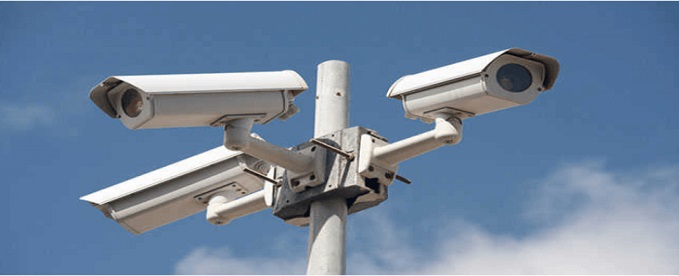
Federal government has inaugurated a ₦40 billion closed-circuit television (CCTV) control centre for the Third Mainland Bridge in Lagos.

Speaking at the inauguration on Sunday, David Umahi, minister of Works, said the project followed extensive rehabilitation works carried out on the bridge after the current administration took office in 2023.
“When we came on board in 2023, we met a very terrible Third Mainland Bridge,” Umahi said, adding that the structure, along with Carter and Iddo bridges, required comprehensive re-evaluation and repairs both above and below water level.
He said President Bola Tinubu approved the total rehabilitation of the bridge, including replacement of expansion joints, noting that the completed work had improved driving conditions and extended the bridge’s lifespan.
Umahi said the CCTV system, first announced in 2025, was designed to curb dangerous driving, prevent suicide attempts and strengthen security.
He added that security personnel would monitor live footage from the control centre and enforce speed limits on the bridge.
The minister commended the China Civil Engineering Construction Corporation (CCECC), which executed the project, for what he described as high-quality delivery. He said the contract also included a surveillance boat and two Hilux vans, which would be handed over to the police to support monitoring and rapid response.
“The idea is that we can see everything that is happening on the bridge,” Umahi said, expressing concern over excessive speeding and urging motorists to comply with traffic regulations.
Earlier, Olufemi Dare, federal controller of works in Lagos, said the facility was the first of its kind on any bridge in Nigeria.
He said the system allows real-time monitoring of activities on the bridge and surrounding waters.
Dare said the project includes 240 solar panels, 10 inverters, a 300 KVA transformer, a standby generator, multiple monitoring screens and full air-conditioning for the control centre.
He added that the contract also covers 1,268 solar-powered street lights and a borehole facility.
According to Dare, the project was awarded at a cost of ₦40.17 billion, with about ₦36 billion paid so far to the contractor. He said the current inauguration marked the first phase, with additional commissioning planned once work on the bridge’s extension is completed.
He thanked the president for approving the project and praised Umahi for ensuring due process during its execution.

Ecobank Joins Trillion-naira Club for the First Time in 20 Years
PalmPay, Premier Cool to Reward 10,000 Nigerians with ₦100 Million in “10k for 10k Campaign”

Nigerian Terra Industries Secures $11.8m for Expansion

Cybersecurity Firm Warns Telecom Threats from 2025 will Carry into 2026 as New Technology Adds New Risk

SHELT Named in Prestigious 2025 MSSP 250 List for Cybersecurity Excellence

Banks quietly move to enforce new ₦50 transfer levy from Jan. 1

FIRS says NIN, CAC Numbers to Serve as Tax IDs from 2026

Nigeria Takes the Lead in the Global WSIS+20 Digital Agenda

PalmPay Launches N400 Million World Travel Carnival, Rewarding Users with Free Global Trips

Nigeria Police Arrest Okitipi, Nigerian Allegedly Linked to Microsoft 365 Hack




 General News2 days ago
Ministry of Finance Leads FG-Backed Deal to Deliver Quality Homes and Boost Agriculture in Niger State

 News2 days ago
SERAP Sues INEC Over Alleged ₦55.9Bn Election Funds Diversion

 E-Financial2 days ago
NDIC Declares Second Liquidation Dividend for Heritage Bank Depositors

 Telecom2 days ago
FG Plans to Invest $460m World Bank Loan in Fibre Infrastructure

 News2 days ago
AI Founders and Developers to Converge in Lagos for AI in Action 2026 conference

 News2 days ago
FG Inaugurates N40Bn CCTV Control Centre for Third Mainland Bridge

 General News2 days ago
Tax Reforms Panel Rejects KPMG’s Critique of New Laws

 Telecom1 day ago
X Suspends Twitter Account for Rules Violation