

Broadcasting
Lagos Acquires 10-car Speed Trains for Red Line Project

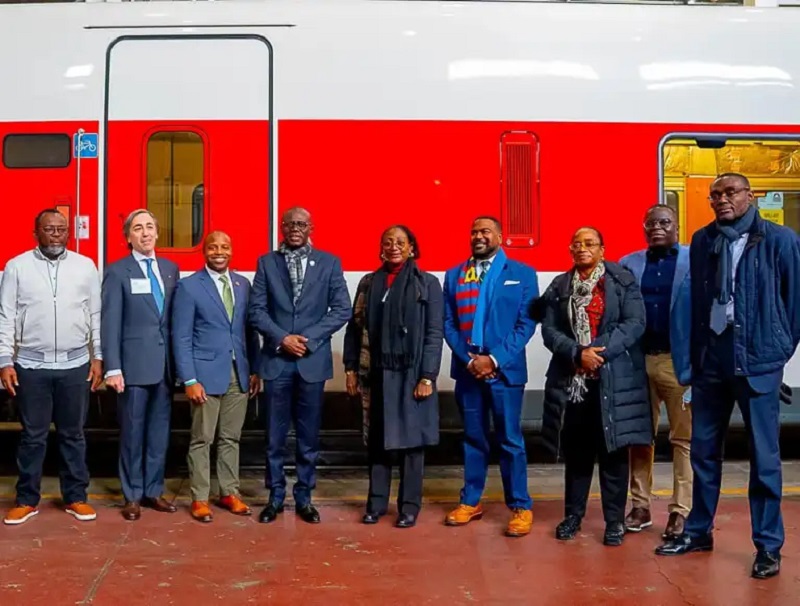
The Lagos state government has purchased two 10-car, 330 km/h Talgo speed trains for its Red Line railway project.

L-r: Member, Lagos State House of Assembly, Hon. Temitope Adewale; President & CEO, Talgo Incorporated USA, Antonio Perez; Acting Mayor of Milwaukee, Cavalier Johnson; Lagos State Governor, Mr. Babajide Sanwo-Olu; Managing Director, Lagos Metropolitan Area Transport Authority (LAMATA), Engr. (Mrs) Abimbola Akinajo, during a factory tour of high-speed train manufacturers, Talgo Incorporated Company for the acquisition of two sets of brand new 10-car Metro Trains for Lagos Rail project, in Milwaukee, Wisconsin, USA, on Tuesday, 18 January 2022. With them: Special Adviser to the Governor on Works & Infrastructure, Engr. Aramide Adeyoye (third right), Commissioner for Transportation, Dr. Federic Oladeinde (right) and others
State Governor Babajide Sanwo-Olu completed the procurement agreement for the trains on Tuesday at an event inside the Milwaukee facility of Spanish train maker Talgo Incorporated in the US.
Trains will head to Lagos for the state’s Red Line, a 37km rail project.
Once completed, the Red Line will have 11 stations and will transfer passengers from Agbado to Oyingbo.
Sanwo-Olu said the state government was excited to complete the purchase of the two new trains.
He said the acquisition was in line with his administration’s commitment to efficient traffic management and transportation system.
The governor was accompanied on the trip by the State Transportation Commissioner, Dr. Frederic Oladeinde; the Governor’s Works Advisor, Ms. Aramide Adeyoye; and the Managing Director, Lagos Metropolitan Area Transport Authority, Ms. Abimbola Akinajo.
He said that government officials inspected the trains, looked at the configuration and were satisfied that the trains would fit on the Red Line tracks.
”A train is not something that you can just go to the platform and pick up. We are very lucky to have new trains.
”We have seen our beautiful white and red trains. Coincidentally, the train line is called Red Line and you can see that they have given us the color.
“We’re just going to mark it and put our stamp on it,” he said.
Governor Sanwo-Olu talks about the fast trains purchased for the Red Line project
He hoped that the purchase of the trains would be the start of a mutually beneficial business relationship between Lagos State and the train manufacturer.
“Providing a source of livelihood for our citizens is about providing jobs for our people and that is what we are doing.
”This is about ensuring that we can build our economy; people can move from one place to another and businesses can grow,” said Sanwo-Olu.
He said that part of what the government had achieved in the past two and a half years was an integrated urban mass transit system, in which road, river and rail infrastructure would be used to move more than 20 million residents in and around of the state.
Milwaukee Mayor Pro Tem Cavalier Johnson, who hosted Gov. Sanwo-Olu in town, said it was bittersweet to have missed the opportunity to have trains operating in Milwaukee and Wisconsin.
Johnson congratulated Governor Sanwo-Olu on the acquisition of the trains and hoped it would make moving in Lagos State easier.
Mr. Antonio Pérez, CEO of Talgo, USA, said that it was important that the trains be used.
“It’s no use for the trains we build to be stored and maintained without passengers riding on them,” Pérez said.
The Lagos state delegation inspected the interior design of the newly acquired 330 km/h Talgo intra-urban metropolitan trains.
Since the beginning of his administration on May 29, 2019, Sanwo-Olu has upheld his administration’s commitment to making the Red Line dream a reality.
The governor promised Lagos state residents that the Red Line would start in the quarter of 2022 or the first quarter of 2023, with a capacity of 500,000 passengers per day.


Afro-pop star Joeboy takes centre stage this week as he features on the Easter edition of African Voices, the Globacom-sponsored magazine programme on CNN.

In this episode, the Nigeria-born singer sits down with show anchor, Larry Madowo, in Lagos, where he shares the story of his journey from a young university student with big dreams to becoming one of Afrobeats’ most recognised voices.
Long before global attention, Joeboy, born Joseph Akinwale Akinfenwa-Donus, started out experimenting with music and sharing covers online. His 2017 cover of Ed Sheeran’s “Shape of You” marked a turning point, helping him transition fully into singing and setting the stage for what was to come.
That moment soon opened new doors, including a connection with Mr. Eazi, who brought him into the emPawa Africa talent programme. This provided support and exposure for his music to reach a wider audience, laying the foundation for his professional career. The alliance also birth “Fààjí,” which featured Mr. Eazi in 2018, after which he was signed to Warner Music Africa.
Under this partnership, Joeboy released his hit single “Baby” in 2019, followed by “Beginning,” which has 23 million views on YouTube. He also released “Love & Light” the same year and featured Mayorkun in the tracks “Don’t Call Me” and “All for You”
Since then, the 29-year-old has gone on to release two albums, Somewhere Between Beauty & Magic in February 2021 and Body & Soul in 2023, while earning recognition across the continent, including awards for his contributions to African pop music. He won Best Artist in African Pop at the 2019 All Africa Music Awards and Best Pop at the 2020 Soundcity MVP Awards Festival.
The programme will air on Saturday at 7.30 a.m., with several repeat broadcasts scheduled across the weekend and into the following week. 11 a.m. on Saturday; on Sunday at 3.30 a.m. and 6 p.m. This continues on Monday at 3 a.m. and 5.45 p.m, and on Tuesday at 5.45 p.m. The schedule will be repeated next week until 3 a.m. on Monday.
The Court of Appeal sitting in Abuja has dismissed an appeal filed by the National Broadcasting Commission (NBC), seeking to overturn a Federal High Court judgement that restrained it from imposing fines on radio and television stations across the country.

NBC
Delivering the lead judgement, Justice Oyebiola Oyewumi, on behalf of a three-member panel, upheld the earlier ruling and set aside the fines imposed by the NBC on 45 broadcast stations on March 1, 2019, for alleged breaches of the Nigeria Broadcasting Code.
The panel was presided over by Justice Abba Mohammed, with Justice Donatus Okorowo as the third member.
According to a statement issued by Idowu Adewale, Communications Officer of Media Rights Agenda (MRA), the unanimous decision of the Court of Appeal stemmed from a suit filed by the non-governmental organisation in November 2021, challenging the NBC’s powers to impose fines on broadcasters.
The Federal High Court, in its judgement delivered on May 10, 2023, by Justice James Omotosho, ruled in favour of MRA after the NBC failed to defend the suit.
The court held that fines are sanctions imposed on persons found guilty of criminal offences and, under Nigerian law, only courts of law have the authority to impose such penalties.
Setting aside the fines of ₦500,000 each imposed on the affected stations, Justice Omotosho stated that the NBC “is neither a court nor a judicial tribunal to make pronouncements on the guilt of broadcast stations, notwithstanding what the NBC Code says.”
He added that the Commission’s actions violated the Constitution.
Dissatisfied with the ruling, the NBC filed a motion in July 2023, urging the same court to set aside the judgement on the grounds that it lacked jurisdiction and had reached its decision without considering relevant facts.
However, in November 2023, Justice Omotosho dismissed the application, describing it as futile and an afterthought, noting that available evidence showed the Commission had been duly served but failed to appear in court to defend the case.
The NBC subsequently approached the Court of Appeal in July 2024, seeking to overturn the judgement.
Advertisement
At the hearing on February 4, 2026, Mr Victor Ogude (SAN), leading Mr Kehinde Wilkey for the NBC, adopted his brief of argument and made additional submissions.
Counsel to MRA, Ezenwa Anumnu, also adopted his brief and responded accordingly.
In its ruling, the appellate court agreed with MRA’s position that the NBC, having failed to contest the suit at the Federal High Court, could not raise fresh challenges at the appellate level.
Justice Oyewumi held that the appeal lacked merit and accordingly dismissed it.
With this decision, MRA has secured victory in the first of two appeals involving the NBC over separate Federal High Court judgements barring the Commission from imposing fines on broadcast stations.
The second appeal, filed by the NBC against a similar judgement delivered on January 17, 2024 by Justice Rita Ofili-Ajumogobia of the Federal High Court, Abuja, is still pending. The Court of Appeal heard arguments in that matter on March 25, 2026 and has reserved judgement.
In that case, the NBC is challenging a ruling arising from a suit filed by MRA after the Commission imposed fines of ₦5 million each on a television station and three pay-TV platforms in 2022 for allegedly undermining national security through the broadcast of documentaries on banditry in Nigeria.
Dr.Shaibu Husseini, the Executive Director/Chief Executive Officer of the National Film and Video Censors Board (NFVCB), has called for stronger distribution frameworks within Nigeria’s film industry to ensure that locally produced content achieves global visibility.

He urged film festivals across the country to evolve beyond networking platforms into active marketplaces where filmmakers could secure distribution deals. He stressed that festivals must attract distributors, exhibitors, streaming platforms, and marketers to create tangible opportunities for filmmakers.
Husseini made this call while delivering the keynote address at the opening ceremony of the 2026 edition of the Coal City Film Festival held in Enugu.
“Film festivals must become gateways to distribution where filmmakers leave not just with applause, but with real opportunities,” he said.
Husseini expressed personal delight at hosting the event in Enugu, his birth state, noting the city’s rich cultural heritage and longstanding contribution to Nigeria’s creative landscape.
He commended the festival organisers, particularly the Festival Director, Uche Agbo, for their resilience and commitment in sustaining the
initiative. According to him, the Coal City Film Festival has grown into a significant cultural platform and a must-attend cinematic event in South East Nigeria.
Speaking on the festival’s theme, “Local Stories, Global Screens,” Husseini emphasised the importance of authenticity in storytelling. He noted that films rooted in local realities, languages, and cultural truth often resonate more strongly with global audiences.
He cited notable Nigerian productions such as King of Boys by Kemi Adetiba, The Wedding Party by Mo Abudu, Anikulapo by Kunle Afolayan,
“Black Book” by Editi Effiong, and “Lionheart” by Genevieve Nnaji as examples of culturally grounded stories that have gained international recognition on platforms such as Netflix and at global film festivals.
While acknowledging the growth in film production across Nigeria, the NFVCB boss identified distribution as a major bottleneck in the industry. He observed that many high-quality films struggle to reach audiences both locally and internationally due to limited distribution channels.
Reaffirming the Board’s commitment to industry development, Husseini stated that the NFVCB has continued to reposition itself as a partner in progress by engaging stakeholders, improving classification processes, and promoting a balance between creative freedom and social responsibility.
However, he raised concerns over increasing non-compliance with regulatory requirements, noting that some filmmakers bypass the Board by releasing unclassified films or operating without proper licensing.
He said all films and video works must be submitted to the NFVCB for classification and registration before being released on any platform, including digital platforms such as YouTube.
“This is a legal obligation, and the Board will not hesitate to take decisive action against defaulters,” he warned, adding that regulation is essential for protecting the industry, audiences, and national values.
Looking ahead, Husseini assured stakeholders of the Board’s continued collaboration with filmmakers and festival organisers to build a structured, sustainable, and globally competitive Nigerian film industry.
He concluded by commending the organisers of the Coal City Film Festival for their vision and contribution to Nigeria’s cultural economy, urging filmmakers to continue telling authentic stories that can resonate across global screens.

UBA Beefs Up Mobile App Security to Stop Fraudulent Debits, Withdrawals

Bharti Airtel Crosses 650m Users

FG Orders Installation of 5000 CCTV Cameras for Surveillance in Plateau

CBN Plans New Payment Systems Vision

Ghana Makes History as First African Country to Integrate Payment National Identity Card

Spotify’s Loud & Clear Report Reveals Over ₦60Bn Revenue for Nigerian Artists in 2025

Madonna University Taps Tech Guru Adote for Strategic Board Role

China Threatens to Shut Nigeria’s Satellite Over $11.44m Unpaid Debt

FCCPC Bans Lagos ‘No Refund’ Policy, Vows Fines and Shutdowns for Traders

Healthcare Under Attack: Why Cybersecurity is Now Critical Care




 News2 days ago
Microsoft Revamps Copilot in Workplace AI Push

 E-Business2 days ago
Kaspersky Warns of a New Phishing Technique Leveraging Bubble, a no-code AI Platform

 Telecom2 days ago
How Recycled SIM Card Linked to N50m Kidnapping Nearly Landed me in Jail – Businesswoman

 E-Financial2 days ago
CBN Directs Banks, Fintechs to Complete Cybersecurity Audit Tool

 Telecom2 days ago
Ouranos Technologies Strengthens Board with Key Leadership Appointments

 General News2 days ago
Senate Gives Tinubu Nod to Borrow Fresh $6Bn

 General News2 days ago
FG Launches CLHEEAN to Streamline Access to Government Services

 E-Financial1 day ago
CBN Says 33 Banks Raise Fresh N4.65 Trillion in Recapitalisation Exercise