

News
Lagos State University Gets Innovation Lab


Switchcon, an educational technology company, has launched Infinolab, a tech innovation lab, in Nigeria. The lab was launched at Lagos State University, marking a significant milestone in technological advancement and collaboration in building technological solutions.

Infinolab is an innovation tech community initiated by Switchcon, with the aim to create a dynamic ecosystem where students can come together to exchange ideas, collaborate, and collectively address real-world challenges leveraging on technology.
In an interview, Temidayo Adefioye, founder and CEO of Switchcon, emphasised the significance of the innovation hub at the university, and revealed plans to expand the project to other universities across Africa.
According to him, Infinolab has a focus on diversity and multidisciplinary collaboration.
“The lab will house students from different disciplines, encouraging them to develop technological solutions for pressing issues in their respective fields, regardless of their technical background,” he said.
He also said the lab will create a levelled playing ground for students, as well as cultivate an entrepreneurial mindset, encouraging them to turn their ideas into viable ventures that contribute to economic growth and job creation.
Additionally, the Infinolab acts as an incubator for entrepreneurs and social companies run by students. Aspiring entrepreneurs can get help from Switchcon’s mentorship programmes and industry collaborations to build their business models, create prototypes, and deal with the challenges of starting a new company.
Dr Fatai Abatan, the Dean of Student Affairs at Lagos State University, expressed his enthusiasm for the launch of the Infinolab, stating: “This project by Switchcon opens up new possibilities for our students to harness their creativity and technical skills. The lab will serve as a catalyst for innovation, empowering our students to become problem solvers and change agents.”
He also highlighted that this transformative initiative would empower students of Lagos State University to confidently compete at multiple levels by showcasing their groundbreaking and innovative ideas, positioning them as frontrunners in their respective fields.
As the lab gets going, the varsity believes it has the potential to grow into a thriving centre of creativity and innovation inside Lagos State University, developing the next wave of tech leaders and bringing about positive change both within and outside of Nigeria.



African technology start-ups will receive a $46 million (€40 million) commitment from EIB Global, the development arm of the European Investment Bank (EIB).

The funds will be deployed through the first Africa-focused investment vehicle from European venture capital (VC) firm Speedinvest.
The Speedinvest Africa Fund, which has a total target size of €200 million, targets companies across innovation hubs in Egypt, Morocco, Nigeria, Kenya, and South Africa.
It also invests in high-potential markets, including Ghana, Côte d’Ivoire, Cameroon, the Democratic Republic of Congo, Tunisia, Tanzania, and Uganda.
The investment strengthens EU–Africa ties, supports digital transformation, and promotes inclusive economic growth, says the EIB.
The strategy is designed to improve digital and financial inclusion while enabling start-ups to scale across borders by strengthening linkages between African and European ecosystems. Technology has the power to turn good ideas into real impact, says Karl Nehammer, vice-president of the EIB.
By backing this vehicle, it is enabling African innovators to scale, access new markets, and build sustainable businesses, says Nehammer.
The fund focuses on technology-enabled and mobile-based services across payments, healthcare, mobility, and education.
This aligns with the EU’s Global Gateway priorities and is expected to deliver social benefits, including job creation for youth and expanded access to digital banking for underserved communities.
At least 30% of the vehicle’s capital will support companies advancing gender equality, including those with women as founders, employees, or consumers.
With EIB Global support, the firm is deepening its long-term commitment to backing founders across Africa while strengthening enduring bridges between Africa and Europe, says Oliver Holle, CEO and managing partner of Speedinvest.
Speedinvest has previously backed African growth-stage companies, including mobility fintech Moove and digital bank FairMoney.
By combining a local presence with a European network of operators, sector expertise, and follow-on capital, the firm aims to help founders scale regionally and internationally, says Holle.
The fund will be managed by partners Deepali Nangia and Rana Abdel Latif, with a new African office planned to support its local operations.
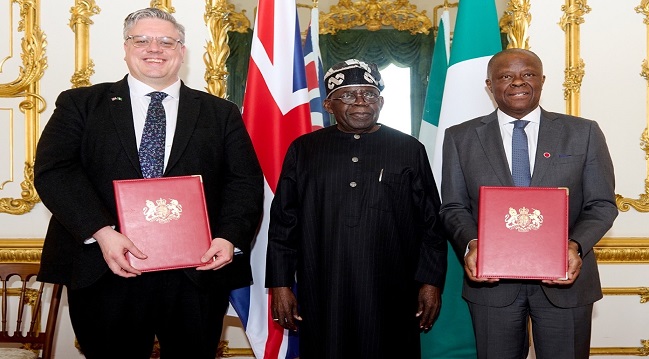
Thousands of skilled UK and Nigerian jobs will be supported and hundreds of millions invested into the economy as a historic financing deal was signed yesterday between the UK and Nigeria.

The £746 million sum will be used to support the refurbishment of two of Nigeria’s major national maritime infrastructure facilities located in Lagos, the Lagos Port Complex (Apapa Quays) and the TinCan Island Port Complex. It will be delivered through UKEF’s Buyer Credit Facility, coordinated and arranged by Citibank, N.A London Branch (“Citi”). Island Port Complex.
The agreement between UK Export Finance, the UK government’s export credit agency (UKEF), the Nigerian Ports Authority (NPA) and the Federal Ministry of Finance, will deliver significant benefits for British businesses, with at least £236 million of supplier contracts directed to British companies.
British Steel will supply 120,000 tonnes of steel billets to construction companies Hitech Nigeria and ITB Nigeria for the ports deal, amounting to a £70 million contract that represents British Steel’s largest export order backed by UKEF. It follows from the Government’s newly announced Steel Strategy which seeks to revitalise the steel sector.
Peter Kyle, Buisness and Trade Secretary said: “Hot on the heels of our landmark Steel Strategy, this is a major win for British Steel made possible by UK Export Finance which is testament to the quality of UK-made steel and the booming UK-Nigeria relationship.
“Through our new Strategy we’re backing British steelmakers for long-term success at home and abroad, and this contract will reinforce British Steel’s world-class expertise while supporting jobs and growth in Scunthorpe.”
Dr. Adegboyega Oyetola, Nigerian Minister of Marine and Blue Economy said: “The modernisation and upgrading of Nigeria’s ports represents a major step forward for the country and aligns closely with the Federal Government’s commitment to unlocking the full potential of the marine and blue economy.
“Through strategic partnerships such as this with the United Kingdom, we are laying the foundation for a new era of efficiency, transparency and competitiveness in Nigeria’s port system.
“Modern infrastructure, supported by digitalised and automated processes, will transform the way our ports operate and strengthen Nigeria’s position as a leading maritime hub in West and Central Africa.
“Nigeria’s port operations will be transformative. Turnaround times for vessels and cargo dwell times within the ports are projected to fall sharply as automated processes replace paperwork-heavy procedures and as expanded capacity removes longstanding bottlenecks.
“The modernised infrastructure will enable faster clearance of imports and exports, reduce demurrage and logistics costs for businesses, significantly improve the predictability and transparency of cargo movement and generate more revenue for national development.”
Alongside the NPA deal announcement, the UK and Nigeria will sign a Memorandum of Understanding (MOU) establishing a framework for potential future collaboration.
The MOU sets out Nigeria’s priority project pipeline, seeking UKEF finance and support, with the UK set to benefit directly through substantial supply chain participation. The signing signals a clear commitment from both governments to deepen their long-term partnership on trade, infrastructure and sustainable growth.
Hitech Nigeria and ITB Nigeria have been at the forefront of some of Nigeria’s most transformative infrastructure projects and advanced engineering.
The Steel Strategy highlights one of many initiatives that the Government is already doing including those on energy prices, skills, procurement and financing support of projects such as the Scrap Metal Taskforce and the new Trade Defence Measures.
Allan Bell , British Steel CEO said: “This is a record-breaking contract for British Steel and a major boost to our 4,000 employees and many more people in our supply chains.
“After government intervention last April, everyone at British Steel has worked hard to stabilise the company. This deal represents us moving from stabilisation to building long-term sustainability for the business.
“As one of the largest ever orders for billet in the history of this company, it marks a tremendous vote of confidence in British Steel and UK manufacturing. And as the biggest order we have ever secured with UK Export Finance, it demonstrates how we are working with the UK Government to meet the global demand for our products.
“We thank the government for its support and look forward to working with Hitech Construction Africa Ltd on this transformative project.”
Richard Hodder, Global Head of Export & Agency Financing at Citi said: “Citi has been present in Nigeria for over 40 years and is delighted to support NPA and the Federal Government of Nigeria in the financing of this critical infrastructure project which will deliver significant economic benefits to the Nigerian economy over the coming years. As the Coordinator of the transaction, we are pleased to have worked in close partnership with the team at UKEF to deliver one of the largest Export Credit Agency supported Buyer Credit Facilities ever seen in West Africa.”
Today’s milestones represent UKEF’s growing presence in the region. Since 2018, UKEF support for West and Central Africa has grown by over £3 billion, reflecting the region’s appetite for diversified trade partnerships and the UK’s commitment to being a trusted partner for long-term investment.
Tim Reid, CEO at UK Export Finance said: “This deal represents a milestone for UK-Nigeria trade relations and demonstrates the full capacity of UK Export Finance to unlock transformational opportunities for British businesses, while supporting sustainable economic growth in key markets.
“With over £200 million feeding back to British companies, including one of the largest steel billet contracts in British Steel’s history and our new Memorandum of Understanding, UKEF are laying the foundations for a deeper, long-term relationship with Nigeria, that will open doors for British exporters across the entire region.”
Together, these announcements signal to international markets that Nigeria is open for trade and investment, demonstrating credible government-to-government delivery and building wider investor confidence around Nigeria’s trade infrastructure and growth agenda.

Bank of Industry (BoI) and MTN Nigeria Foundation have launched a N1 billion Y’ellopreneur 3.0 Matching Fund to support women-owned businesses across Nigeria.

The fund was launched at the official unveiling of the BOI–MTN Foundation Y’ellopreneur 3.0 Matching Fund held in Lagos.
Dr Olasupo Olusi, managing director of BoI, said the initiative reflects a shared commitment to entrepreneurship and women’s empowerment.
Represented by Oluwatoyin Edu, executive director, MSMEs, Olusi, said the partnership has grown from a N100 million youth programme in 2018 to a N1 billion fund, financed equally by both institutions.
“Today, we are pleased to deepen this collaboration with the launch of the N1 billion Y’ellopreneur 3.0 Matching Fund.
“This programme aligns strongly with BoI’s 2025–2027 strategy for enterprise development and economic transformation,” he said.
Olusi said 1,000 women entrepreneurs would receive structured training, while 200 women-led MSMEs would access loans of up to N5 million each.
The BoI boss added that the programme targets sectors including agro-processing, light manufacturing, fashion, energy, waste management and digital services.
Mrs Mosun Belo-Olusoga, chairman of MTN Nigeria Foundation, said the initiative highlighted women’s critical role in economic development.
According to her, the foundation now treats women’s empowerment as central to nation-building, rather than a corporate social responsibility obligation.
Belo-Olusoga said over 5,700 women had been trained, with the programme designed to bridge economic gaps limiting women’s participation.
“This fund provides equipment financing, enabling women to transition from small-scale operations to industrial-level businesses,” she said.
She stressed the need for greater awareness, especially in rural communities, to ensure inclusiveness.
Mrs Odunayo Sanya, executive director of the foundation, said the initiative combined capacity building with access to capital.
Sanya said beneficiaries would undergo a five-week training programme by Pan-Atlantic University Enterprise Development Centre, ending with business growth plans.
She said the foundation aimed to build 30,000 female-led businesses in five years, with 10,000 expected to receive funding.
“We believe this partnership with BoI opens the door to scaling women-owned businesses through working capital and equipment financing,” she said.
Mrs Ibijoke Sanwo-Olu, wife of Lagos State governor, described the initiative as timely in tackling unemployment and unlocking women’s economic potential.
Represented by Mrs Oyinlola Agoro, she said equipping women with skills, mentorship and planning tools is vital for resilient enterprises.
Sanwo-Olu commended earlier phases, which trained over 5,700 women and supported 122 beneficiaries with equipment.
“This shows that when women are empowered, families thrive, communities prosper and the economy grows stronger.
“The N1 billion matching fund will deepen financial inclusion and promote women-led enterprises,” she said.
She reaffirmed her commitment to initiatives promoting women’s empowerment, economic independence and inclusive development.

Court Jails ‘Colonel’, ‘Major’ of Global Money-Laundering Ring

Court Bans Kenyan Telcos from Recycling SIM Cards

Providus Bank Fully Meets CBN Capital Requirement, Sets Record Straight

African Tech Start-ups to Receive $46m of Speedinvest Africa Fund

Binance Earn: Simple Way to Earn Rewards on Idle Crypto Holdings

Kaspersky Discovers New Phishing Campaign Exploiting Google Tasks Notifications to Steal Corporate Credentials

esentry 2025 Report Shows Healthcare, Financial Services and Telecoms as Staging Grounds for Increased Cyberattacks in Africa

AfDB, UNDP Launch $10Bn AI Initiative for Africa

Mutual Benefits Assurance Settles ₦5.9bn Claims in January 2026

MultiChoice Suspends Yearly DStv Price Hike as Canal+ Pushes Growth




 E-Financial2 days ago
Kuda MFB Increases Kuda for Her Business Grants to ₦10 Million

 Telecom2 days ago
Vitel Wireless Lures Subscribers with “Data that Never Expires” Campaign

 News2 days ago
NSIA Sign MoU with UK’s Asset Green Ltd to Develop $496M Integrated Dairy Livestock Production Platform in Nigeria

 News2 days ago
BoI, MTN Foundation Launch N1Bn Fund for Women Entrepreneurs

 General News2 days ago
One SA Bank Equals Nigeria’s Entire Banking Sector – Why Recapitalisation Is Critical for Global Competitiveness

 Broadcasting2 days ago
Nigeria tops global rankings for USDT, USDC ownership

 General News2 days ago
Luno Launches First Crypto Prediction Market in Nigeria

 E-Financial1 day ago
World Bank Debars 3 PwC Subsidiaries for 21 Months over Alleged Project Fraud