

E-Business
LASRAB, IIM-Africa, Others Seek End to Intellectual Property Theft

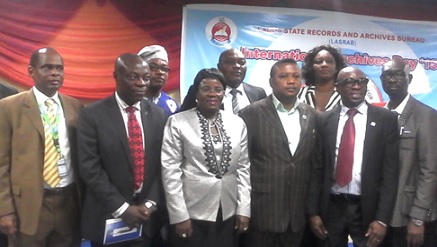
The Lagos State Records and Archives Bureau (LASRAB) on 2015 International Archives Day convened a stakeholder meeting to chat way forward to confront copyright issues in Nigeria as it relate to the law, with the theme “Copyright: Interpreting the law for Archives & Allied Institutions”.
Discussants comprising archivists, Liberians, Lawyers and academia, among others in the Copyright business said it has become expedient to stop copyright infringement in Nigeria, even as the institute of Information Management (IIM-Africa) insisted that awareness creation is key.
However, Barrister Chris Nkwocha, zonal Director, Nigeria Copyright Commission (NCC), Lagos Operational Office and guest speaker at the Forum, said that it was imperative for copyright laws to be respected and adhered to by all in order to prevent litigation.
He submitted that it’s was high time the act of piracy was stopped as it has constituted a major economic loss to millions of creative minds in the country, a factor that has further limited research works and launching of unique ideas.
Barr. Nkwocha therefore, pointed that it was time to eradicate further piracy of multimedia materials like Films, musicals and documentaries, many visible in Alaba market, Lagos and other major stores including Books piracies many surfacing in Bookshops across the country.

He added that Archivist and Records users should always adhere to the law and see that owners of a work are properly communicated and attributed if their works must be used.
However, he said they are exception to the law, which is fair use, it states that there is freedom to use part of a material for educational purposes examples are students and researchers who use an Author’s book for the purpose of learning, research or education and not for commercial gains.
Other discussants at the event, reiterated the need to create a society where copyright laws thrive and offenders are punished.
The Discussants were: Mr. Folarin Fambegbe, Director, Golden Scepter; Dr. Tajudeen Ajani Lawal, Director, Lagos State Library Board; Mr. Habeeb Sanni, Lecturer, Department of History and International Studies, Lagos State University, Ojo; Mrs Adebukola Agbaminoja, Chief Council Ministry of Justice, Lagos State; Amb. (Dr.) Oyedokun O. Oyewole,
President, RIMa Foundation/ Chairman, Board of Trustees, Institute of Information Management-Africa and Mr. Biodun Onayele, DG, LASRB.
Mrs. Oluranti Odutola, permanent secretary, Ministry of Information and Strategy, Lagos State pointed that it was important for Archivists to be conversant with the law of copyright in order to professionally operate in line with best global practices.
“Archivists or Archives operators are custodians of enduring records, who provide necessary data and information as published by creators, preserve and present them on request to researchers and the general public. It is therefore important that they are conversant with the law and comprehend its implication for their profession- especially as it affects the intellectual property Rights of the Persons who created the records and archives in their custody. It is essential to find out if they are vicariously liable for the actions for the users of the materials in their custody.”
Barr. Nkwocha further urged other states in the country to borrow a leaf from LASRB activities and successes.
LASRAB was conceived in 1995 as a Public Sector reform programme for better management of Lagos State records for planning, policy process, enhanced service delivery and heritage preservation.
In 2002, it was accepted as the Integrated Records and Archives Management Programme (IRAMP), a sub-component of the World Bank-assisted State Governance and Capacity Building Programme (SGCBP) which later became the Lagos Metropolitan Development and Governance Project (LMDGP).
A member of the panel of discussants, Dr. Oyedokun Oyewole, president/chairman Governing Council, Institute of Information Management contended that there was need for more awareness of copyright laws urging the Government to better empower NCC in discharging its duties.
His words, “You will agree that awareness is not enough. There is need for more awareness to be created. The NCC should be more empowered to embark on several initiatives and ensure that the entire nation is covered. It is very disturbing to note that many people are not even aware about the existence of Nigerian Copyright Commission”.
LASRAB formally came into legal existence as a Lagos State Government agency pursuant to Law 22 of 2007; the Bureau is under the supervision of the Ministry of Information and Strategy.
Administratively, LASRAB took-off on 1st August, 2008 but effective operation began on 1st December, 2008, with the appointment and assumption of duty of the premier Director General.


E-Business
Organizations Face New Attacks via Unpatched TrueConf Videoconferencing Servers, Kaspersky Warns


Kaspersky has discovered a new multi-stage attack by the Head Mare APT group against organisations with PhantomCore and PhantomGraph backdoors. To deliver these backdoors, the attackers exploit vulnerabilities in unpatched TrueConf videoconferencing servers and can also replace TrueConf client installers with infected ones.

Kaspersky reported the attacks to the vendor; the vulnerabilities were fixed in the latest TrueConf Server update on June 18, 2026 (versions 5.3.9, 5.4.9, and 5.5.5).
To compromise the TrueConf server, attackers exploited a combination of two vulnerabilities (assigned internal Kaspersky identifiers are KLCERT-26-057 and KLCERT-26-058), which allowed the attackers to execute any code with maximum privileges. By exploiting these vulnerabilities, they replaced one of the server’s files with their own web shell.
The attackers then used this shell to collect information about the victim organisation’s IT infrastructure, gain privileged access to the TrueConf server database, and replace the client installer with an infected one. The attack applies to TrueConf servers in versions 5.3.X prior to 5.3.9, 5.4.X prior to 5.4.9, 5.5.X prior to 5.5.5, and earlier.
For users of TrueConf software, the attack looks like this: video conference participants connecting to the compromised server are prompted to download and install an “updated version” of the client application. In reality, as a result of this, malware gets onto the device.
“Exploiting vulnerabilities in popular services is one of the most common methods used by attackers. This campaign is particularly dangerous because it puts at risk not only organisations using unpatched TrueConf servers.
“Even if a company doesn’t use this solution, its employees can connect to compromised servers at the invitation of their counterparties to participate in online meetings. As a result, they may unknowingly download infected installation packages, creating the potential for compromising a large number of enterprises across different countries,” comments Evgeny Goncharov, Head of Kaspersky ICS CERT.


The 2026 FIFA World Cup, Africa Cup of Nations (AFCON), Iran-Israel conflict, and the controversy involving social media activist VeryDarkMan and businessman Blord dominated Google searches by Nigerians between January and July.

This is contained in a review of anonymised Google Trends data released on Friday, which ranked the major stories that generated the highest search interest in Nigeria during the period.
The World Cup recorded the highest search volume, with Nigerians following the Super Eagles’ campaign, major matches, entertainment performances and developments throughout the tournament.
The data showed that searches around the tournament far exceeded those recorded for other major events during the seven-month period.
The Super Eagles’ AFCON semi-final defeat to Morocco also generated significant search interest, with “Nigeria vs Morocco” among the leading individual searches.
Senegal eventually won the AFCON title after defeating Morocco in the final on Jan. 18.
The 2026 Winter Olympics in Milan-Cortina, Italy, also attracted substantial interest from Nigerians in February, including searches around ice hockey and other events.
Google Trends data further showed increased searches around Iran and the Strait of Hormuz following the escalation of tensions in the Middle East.
Searches including “Iran news,” “Israel Iran war” and “Strait of Hormuz meaning” featured prominently as Nigerians sought information on the conflict and its possible impact on global oil prices.
The Strait of Hormuz is a major global oil transit route, carrying about one-fifth of the world’s oil supply.
The controversy involving cryptocurrency entrepreneur Blord and social media activist VeryDarkMan also maintained strong search interest for several months.
The saga peaked around Blord’s arrest and subsequent remand in Kuje prison in April, followed by his release on bail 16 days later.
Searches for “Who is Blord” also featured prominently, indicating growing interest among Nigerians seeking background information on the businessman.
The death of celebrities also generated significant search activity during the period.
Afro-fuji singer Destiny Boy, who died in January at the age of 22, remained in the news amid investigations into his death and an autopsy.
The death of American actor Eric Dane, known for his roles in Grey’s Anatomy and Euphoria, also generated substantial searches in February.
Similarly, the reported death of Nollywood actor Alexx Ekubo in May, at the age of 40, generated renewed search interest in June during his burial ceremonies.
Political and legal developments were also among the major subjects searched by Nigerians.
Former Minister of Power, Saleh Mamman, who was sentenced to 75 years in prison over an alleged N33 billion fraud, generated significant interest following his arrest by the Economic and Financial Crimes Commission (EFCC) in Kaduna in May.
The political crisis involving Mudashiru Obasa and his return as Speaker of the Lagos State House of Assembly also featured prominently.
Globally, Nigerians showed strong interest in the release of millions of pages of documents relating to the late American financier Jeffrey Epstein.
Meanwhile, internet culture accounted for some of the lighter moments in the search rankings.
The Gen Z meme “67” became one of the most searched terms in January, generating curiosity among older Nigerians over its meaning.
The trend originated from a U.S. rap song and became popular among young people, with the phrase often used without a specific meaning.
In April, the case involving Opeyemi Awodoyin, an OPay customer who reportedly received N100,000 in error and declined to return the money, also attracted widespread online interest and public debate.
The reported hantavirus outbreak aboard a cruise ship further prompted Nigerians to search for information about the disease in May.
Celebrity-related stories also featured prominently in the rankings.
Veteran broadcaster Frank Edoho’s confirmation of his divorce and subsequent allegations involving his former wife generated considerable search interest in May.
In July, music promoter Sam Larry survived a road crash on the Lagos-Calabar Coastal Road which reportedly claimed the life of his bodyguard, leading to renewed online discussions around the late singer Mohbad.
In the entertainment sector, Wizkid and Asake’s “Jogodo” dominated searches around January, while Asake’s album generated renewed interest in May.
The 2026 Grammy Awards also attracted substantial search traffic, with Nigerians searching for winners and other developments from the ceremony.
Bad Bunny’s Super Bowl halftime performance also generated significant interest, while films including Mortal Kombat 2 and Christopher Nolan’s The Odyssey featured among popular entertainment searches.
Footballer Zadok Yohanna’s reported €28 million transfer to Brighton also attracted attention, particularly among Nigerian football followers.
Commenting on the findings, Taiwo Kola-Ogunlade, Communications and Public Affairs Manager, West Africa, Google, said search data provided an insight into issues commanding Nigerians’ attention.
“Search data is the most honest record of national attention we have, because nobody performs for a search bar,” he said.
According to him, Nigerians did not only consume major stories but actively searched for explanations and context surrounding them.
The rankings were based on peak monthly search interest in Nigeria between January and July 2026, with related queries grouped together.
The top 25 trending searches during the period included the FIFA World Cup 2026, 2026 Winter Olympics, AFCON Nigeria vs Morocco, Iran and the Strait of Hormuz, Blord, Alexx Ekubo, “67”, Destiny Boy, Erling Haaland and France’s World Cup campaign.
Others were the Grammy Awards 2026, Epstein files, hantavirus, Saleh Mamman, Obasa impeachment saga, Sam Larry, Shakira and Burna Boy’s World Cup performance, Zadok Yohanna, Eric Dane, Opeyemi Awodoyin, Bad Bunny’s Super Bowl halftime show, Frank Edoho, Mortal Kombat 2, The Odyssey and “Jogodo” by Wizkid featuring Asake.
Google Trends provides access to an anonymised sample of search requests made to Google and categorises the information to show collective search interest across regions and over time.

Kaspersky’s latest survey highlights a protection gap between macOS and Windows based devices. While macOS has long been regarded as the more secure operating system, 12% of its users reported malware infections compared with 9% of Windows users. Moreover, only 35% of macOS owners install dedicated security software, versus 42% of Windows users.

According to Kaspersky’s latest global survey*, Windows users report a higher adoption rate for most security measures, while macOS users show a modest advantage in a few privacy‑focused actions. At the same time, during the past year macOS users reported higher percentages than Windows users for a number of cybersecurity incidents.
The largest gap in cybersecurity approaches appears in the habit of not opening suspicious emails or links, with 62% of Windows users following this practice compared to 51% of macOS users.
What’s more, when it comes to cybersecurity software installation, macOS users are also lagging behind. While among Windows users 42% reported using digital‑life‑protection software, for macOS this rate is only 35%, what Kaspersky security experts call a worryingly low figure.
It is noteworthy that 12% of macOS respondents said they fell victim to phishing (fake emails, websites or messages) over the past year compared with 9% of Windows users. Moreover, during this period macOS users faced more scams and investment frauds (16% vs 13%), privacy violations (11% vs 8%) and thefts of personal data (12% vs 7%).
To counter these specific threats, robust anti-malware and anti-phishing protection is essential. Malware authors put a lot of effort into developing new, more powerful and stealthier versions of stealers, spies and other classes of malicious payloads, while relying on phishing techniques that allows them to get access to user’s data.
Dedicated security solutions add a crucial layer of real-time detection and defence that complements macOS’s built-in protection – and independent tests have repeatedly shown that effective options, such as Kaspersky Premium for macOS, deliver strong protection. In 2025, AV-TEST recognised it as the top-performing macOS security solution based on consistent, reliable results across a full year of evaluations.
When it comes to credentials and passwords safety, Windows users also show better security practices’ adoption rates. They lead in using a unique password for each account (38% vs 35%) and complex passwords (52% vs 45%), two‑factor or multi‑factor authentication (51% vs 46%).
Adopting a dedicated password manager becomes a logical next step. Such tools store all credentials in a secure vault protected by a single master password, eliminating the need to remember hundreds of passwords while keeping them safe from breaches.
They also support modern authentication methods like passkeys, enabling seamless, single-tap sign-in across all devices through secure synchronisation – capabilities offered by solutions such as Kaspersky Password Manager.
“There are entrenched stereotypes that macOS is inherently more secure because its user base is smaller, leading cyber‑criminals to deem it a lower‑value target, or because the platform itself includes many robust security features. While these observations are not entirely unfounded, the threat landscape has evolved dramatically.
Attackers actively employ phishing and commit supply chain attacks, which often allow them to affect users of any operating system in a single malware campaign. Moreover, mac specific malware is not rare and there are many malware families that target macs exclusively. Consequently, any device with an Internet connection, regardless of its operating system or form factor, requires cybersecurity software to defend against a wide range of cyber threats,” comments Sergey Puzan, cybersecurity expert at Kaspersky.

FG Seeks to Half Burkina Faso’s Internet Cost while Nigerians Pay more

Cyberthreat: New Malware, Turns Phones into Tools for Card Fraud- Report

SEC Clears Blockchain for Accelerated Regulatory Incubation Programme

Union Bank Secures Global Payment Data Security Certification

NLNG, NCDMB Boost Engineering Research with Innovation Centre

EFCC Busts NIS Visa Overstay Racket, Uncovers N700m in an Account

Fact-Check: Elon Musk’s “Tesla Pi Phone” is Internet Rumor

NBC Tasks Broadcasting Stations over 2028 DSO Global Deadline

Glo Sponsored African Voices to Feature Netflix’s “The Polygamist” Stars

Access Bank Debunks Shutdown Report, Vows Action against Perpetrators




 Telecom3 days ago
Airtel Nigeria Adds Over 1,000Cell Sites in Nationwide Expansion to Surpasses 17,000

 E-Financial3 days ago
Mastercard, TeamApt Collaborate to Expand Digital Payments Across Africa

 E-Business3 days ago
MacOS Users Report More Cyber Threats than Windows Users – Survey Reveals

 News3 days ago
Access Holdings Sets New Benchmark in Nigeria’s Finance Talent Pipeline

 Telecom3 days ago
Nigerian Startup Act: NITDA Calls for Stronger Inter-Agency Collaboration

 E-Financial3 days ago
SEC Orders Immediate Freeze of Assets Linked to Six Terrorism Financiers, Three Entities

 General News3 days ago
Anambra Seeks Digital Inclusion in Rural Communities

 General News2 days ago
NITDA Seals Strategic Deals with Goose FL and Fireflies AI to Power $1 Trillion Digital Economy Vision