

E-Business
LASRAB, IIM-Africa, Others Seek End to Intellectual Property Theft

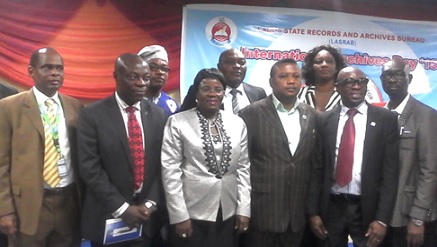
The Lagos State Records and Archives Bureau (LASRAB) on 2015 International Archives Day convened a stakeholder meeting to chat way forward to confront copyright issues in Nigeria as it relate to the law, with the theme “Copyright: Interpreting the law for Archives & Allied Institutions”.
Discussants comprising archivists, Liberians, Lawyers and academia, among others in the Copyright business said it has become expedient to stop copyright infringement in Nigeria, even as the institute of Information Management (IIM-Africa) insisted that awareness creation is key.
However, Barrister Chris Nkwocha, zonal Director, Nigeria Copyright Commission (NCC), Lagos Operational Office and guest speaker at the Forum, said that it was imperative for copyright laws to be respected and adhered to by all in order to prevent litigation.
He submitted that it’s was high time the act of piracy was stopped as it has constituted a major economic loss to millions of creative minds in the country, a factor that has further limited research works and launching of unique ideas.
Barr. Nkwocha therefore, pointed that it was time to eradicate further piracy of multimedia materials like Films, musicals and documentaries, many visible in Alaba market, Lagos and other major stores including Books piracies many surfacing in Bookshops across the country.
He added that Archivist and Records users should always adhere to the law and see that owners of a work are properly communicated and attributed if their works must be used.
However, he said they are exception to the law, which is fair use, it states that there is freedom to use part of a material for educational purposes examples are students and researchers who use an Author’s book for the purpose of learning, research or education and not for commercial gains.
Other discussants at the event, reiterated the need to create a society where copyright laws thrive and offenders are punished.
The Discussants were: Mr. Folarin Fambegbe, Director, Golden Scepter; Dr. Tajudeen Ajani Lawal, Director, Lagos State Library Board; Mr. Habeeb Sanni, Lecturer, Department of History and International Studies, Lagos State University, Ojo; Mrs Adebukola Agbaminoja, Chief Council Ministry of Justice, Lagos State; Amb. (Dr.) Oyedokun O. Oyewole,
President, RIMa Foundation/ Chairman, Board of Trustees, Institute of Information Management-Africa and Mr. Biodun Onayele, DG, LASRB.
Mrs. Oluranti Odutola, permanent secretary, Ministry of Information and Strategy, Lagos State pointed that it was important for Archivists to be conversant with the law of copyright in order to professionally operate in line with best global practices.
“Archivists or Archives operators are custodians of enduring records, who provide necessary data and information as published by creators, preserve and present them on request to researchers and the general public. It is therefore important that they are conversant with the law and comprehend its implication for their profession- especially as it affects the intellectual property Rights of the Persons who created the records and archives in their custody. It is essential to find out if they are vicariously liable for the actions for the users of the materials in their custody.”
Barr. Nkwocha further urged other states in the country to borrow a leaf from LASRB activities and successes.
LASRAB was conceived in 1995 as a Public Sector reform programme for better management of Lagos State records for planning, policy process, enhanced service delivery and heritage preservation.
In 2002, it was accepted as the Integrated Records and Archives Management Programme (IRAMP), a sub-component of the World Bank-assisted State Governance and Capacity Building Programme (SGCBP) which later became the Lagos Metropolitan Development and Governance Project (LMDGP).
A member of the panel of discussants, Dr. Oyedokun Oyewole, president/chairman Governing Council, Institute of Information Management contended that there was need for more awareness of copyright laws urging the Government to better empower NCC in discharging its duties.
His words, “You will agree that awareness is not enough. There is need for more awareness to be created. The NCC should be more empowered to embark on several initiatives and ensure that the entire nation is covered. It is very disturbing to note that many people are not even aware about the existence of Nigerian Copyright Commission”.
LASRAB formally came into legal existence as a Lagos State Government agency pursuant to Law 22 of 2007; the Bureau is under the supervision of the Ministry of Information and Strategy.
Administratively, LASRAB took-off on 1st August, 2008 but effective operation began on 1st December, 2008, with the appointment and assumption of duty of the premier Director General.



In December 2025, organisations globally faced sustained cyber pressure, as the average number of cyber-attacks per organisation per week reached 2 027, a 1% increase from the previous month and a 9% increase from December 2024.

This is according to December 2025 Global Cyber Attack Statistics by Check Point Research, the threat intelligence arm of Check Point Software Technologies.
According to the statistics, Latin America was the hardest hit, with companies experiencing an average of 3 065 cyber-attacks per week, a 26% year-over-year increase.
In contrast, Africa saw a decline in attacks, with Nigeria (4 622 attacks per week) and Angola (4 002 attacks per week) being the most targeted countries on the continent.
The report’s findings highlight the evolving cyber threat landscape, with ransomware and GenAI-driven data risks posing significant challenges to companies worldwide.
Ransomware attacks jumped 60% year over year, with 945 publicly reported incidents in December. Qilin was the most active ransomware operator, responsible for 18% of publicly disclosed attacks.
“Ransomware continues to scale through industrialised operations, while unmanaged GenAI usage is creating widespread data exposure at enterprise level,” said Omer Dembinsky, data research manager at Check Point Research.
The report noted the education sector was the most targeted industry globally, with 4 349 cyber attacks per week; followed by government (2 666 attacks per week); and associations and non-profits (2 509 attacks per week).
The widespread adoption of GenAI tools has introduced new cyber security risks, with one in 27 GenAI prompts posing a high risk of sensitive data leakage.
Experts warn that companies must prioritise prevention-first security, real-time AI threat intelligence and strong governance over AI tools to mitigate these risks.
Hendrik de Bruin, head of security consulting at Check Point Software, added: “Strengthening ransomware resilience, deploying AI-powered prevention and enforcing clear GenAI governance will be critical to reducing cyber risk in the year ahead.”
E-Business
Half of Global Companies Build SOCs to Enhance Cybersecurity, with a Focus on Human Expertise


Among the primary reasons for establishing a Security Operations Center (SOC) are strengthening cybersecurity posture, enabling faster detection and response and gaining a competitive edge.

Interestingly, despite the increasing demand for automated cybersecurity solutions, businesses rely on skilled security professionals to make key decisions, as human expertise remains essential for effective security management.
A Security Operations Center (SOC) is a dedicated organisational unit responsible for continuous monitoring and safeguarding of a company’s IT infrastructure. Its core mission is to proactively detect, analyse and respond to cybersecurity threats.
To identify the main drivers, strategic priorities, and potential challenges in SOC planning and implementation, Kaspersky has conducted a comprehensive global study involving senior IT security specialists, managers and directors from companies with 500 or more employees.
All participants operate without a SOC but have plans to establish one in the near future. The study spans 16 countries across APAC, META, LATAM, Europe, and Russia, providing valuable insights into the emerging trends and best practices in SOC development worldwide.
The findings of the research reveal that 50% of companies intend to establish SOCs to strengthen their cybersecurity posture, and 45% are motivated by the need to address increasingly sophisticated and dangerous threats.
Other drivers include budget optimisation, the necessity for faster detection and response, and the expansion of software, endpoints and user devices – factors that demand more comprehensive and layered security measures.
These are cited by 41% of organisations. Additionally, 40% seek better protection of confidential information, 39% aim to meet regulatory requirements and one-third (33%) expect SOC capabilities to provide a competitive edge. Larger enterprises tend to cite each of these reasons more often, reflecting the broader operational and regulatory pressures they experience.
Continuous monitoring becomes the leading SOC requirement
Among the key functions organisations plan to delegate, 24/7 security monitoring leads at 54%. This around-the-clock vigilance enables early detection of anomalies, prevents escalation and sustains cyber resilience in real-time. This demand highlights a strategic requirement for proactive risk management, as organisations aim to defend against persistent threats that can strike at any moment.
Companies intending to fully outsource SOC operations show a stronger interest in applying “lessons learned” methodologies, whereas those developing internal SOCs focus more on access management to maintain tighter control.
Human expertise drives SOC technology choices
While SOCs use advanced technology, the choices made by organisations show that human analysts are very important. Among the solutions that organisations plan to include in SOC are – Threat Intelligence Platforms (48%), Endpoint Detection and Response (42%) and Security Information and Event Management systems (40%) – sophisticated solutions that automate data collection and reduce operational load, however, they depend heavily on skilled security professionals who provide critical context, interpret complex findings and make final decisions when guiding appropriate responses.
Other solutions chosen include Extended Detection and Response (38%), Network Detection and Response (37%) and Managed Detection and Response (33%). Large enterprises tend to adopt more technologies (5.5 per SOC on average), while smaller ones integrate fewer (3.8).
“To successfully build a SOC, companies must prioritise not only the right mix of technology but also the careful planning of processes, clear goal-setting and effective resource distribution.
“Well-defined workflows and continuous improvement are essential to ensure that human analysts can focus on critical tasks, making the SOC a proactive and adaptable component of their cybersecurity strategy,” comments Roman Nazarov, Head of SOC Consulting at Kaspersky.

Terra Industries, a Nigerian defence technology startup, has raised $11.75 million to expand its development of defensive systems that protect critical facilities across Africa.

The fundraising round was led by Silicon Valley venture firm 8VC, which was founded by Palantir co-founder Joe Lonsdale.
Other investors in the round include Valour Equity Partners, Lux Capital, SV Angel, and Nova Global, as well as African-focused funds Tofino Capital, Kaleo Ventures, and DFS Lab.
Terra Industries, founded in Abuja by Nathan Nwachuku and Maxwell Maduka, provides multi-domain security solutions for both air and land. Its solutions are intended to detect and respond to threats including terrorism, sabotage, and armed attacks on infrastructure.
The company’s product portfolio includes surveillance drones, ground-based robotic systems, and fixed monitoring towers deployed around sensitive locations.
Co-founder and CEO Nathan Nwachuku said the company has now fully embraced its identity as a defence-focused startup, citing the growing urgency of security challenges across Africa.
He said safeguarding critical infrastructure from terrorist threats has become unavoidable.
Nwachuku argues that protecting Africa’s infrastructure requires a different approach, one that combines local manufacturing, end-to-end system control, and software capable of independently identifying and responding to threats over large areas.
The company aims to position itself as a defence prime, similar to the role played by firms such as Anduril Industries and Palantir in the United States.
Nwachuku also disclosed that the company had earlier raised $800,000 in pre-seed funding.
With the new funding, Terra plans to increase manufacturing capacity within Africa, establish additional defence production facilities, and expand its artificial intelligence and software teams.
While software offices are planned for San Francisco and London, the company said manufacturing operations will remain on the continent.

SEC Hikes Minimum Capital Requirements for Market Operators After a Decade

Study Shows Blocks in Telegram are Pushing the Underground Out

Galaxy Backbone Marks Two Decades of Powering Nigeria’s Digital Evolution

NGX Unveils Net-Zero Plan for Greener Capital Market

Galaxy Backbone Marks 20 Years, Tops FG Website Scorecard

Banks quietly move to enforce new ₦50 transfer levy from Jan. 1

FIRS says NIN, CAC Numbers to Serve as Tax IDs from 2026

FIRS Declares NIN, CAC Numbers as Tax IDs from 2026

US Begins Partial Visa Ban on Nigerians January 1

Galaxy Backbone Tops FG’s Website Performance Ranking




 E-Financial2 days ago
Paystack Expands Beyond Payments into Banking

 E-Business2 days ago
Nigeria Targeted with 4,622 Cyber-attacks Per Week in December 2025

 E-Financial2 days ago
SEC Partners Police in Nationwide Crackdown on Ponzi Schemes, Crypto Frauds

 E-Financial2 days ago
FG Halts Tax Guidelines Amid Uncertainty Over Final Laws – Oyedele

 E-Financial2 days ago
Paystack Buys Microfinance Bank, Enters Nigeria Banking Arena

 News2 days ago
FG Directs Banks, Fintechs to Remit VAT on Service Fees

 General News2 days ago
EFCC to Use Space Technology to Boost Asset Tracking, Investigations

 General News2 days ago
How to Stay Safe Online During Sales Periods