

Telecom
Lawyer Slams N1Bn Suit against NCC, Others over Network Shutdown


Gloria Ballason, a human rights lawyer, has filed a N1 billion suit at the Federal High Court in Abuja challenging the legality of the shutdown of telecommunication networks and internet services in some parts of the state.

The Kaduna State-based lawyer, said in the suit filed on December 8, 2021, that the shutdown was not backed by law or due process, just as she also contended that it impinges on her rights and other citizens.
Those sued as respondents in the suit include the Kaduna State governor, Nasir el-Rufai, the Attorney-General of Kaduna State, and the Nigerian Communications Commission (NCC).
Also sued are four major network providers in Nigeria – Airtel Networks Limited, Globacom Limited, Emirates Telecommunication Group Company (Etisalat) and MTN Group Limited.
The plaintiff, who resides in Chikun Local Government Area and operates her office in Kaduna South Local Government Area, said telecommunications and internet connection went off from early September 2021 until about November 27, 2021 “and connection has been epileptic up until the time of filing this case”.
Ms Ballasson, who recalled that security reasons were cited as the reason for the shutdown, noted that the level of insecurity in the state has not reduced in any manner.
“Rather, terrorists are still kidnapping, killing, collecting and impoverishing struggling families within Kaduna State”.
She cited media reports of an instance during the shutdown of telecom services in specified areas of Kaduna State when “bandits abducted 66 members of Baptist Church in Kakau area of Kaduna State and killed 2 out of the 66 abducted”.
According to her, sometime in early November 2021, bandits also attacked Yagbak and Abuyab communities in Atyap Chiefdom in Zangaon Kataf Local Government Area of Kaduna State wherein 11 persons were killed and several houses burnt.
“This act of the Governor and Government of Kaduna State has caused agony on me, the residents of the affected areas and citizens are compelled to embrace a retrogressive lifestyle,” she said.
She said the action “has crippled my litigation work and Radio/TV businesses as well as businesses of thousands of youths who make legitimate earnings utilizing telecommunication services as businesses that rely on telecommunications services have their means of livelihood (and those who depend on them) truncated.”
She said on a daily basis on account of the shutting down of telecommunication services, her business, economic and social life (and that of other Nigerian citizens) working and residing in the affected telecom shut down directive was seriously jeopardised.
She added that due to the telecom shutdown, House of Justice Annual Summit & Banquet with the theme, ‘Leadership, Governance & National Security,’ which was slated to hold on November 26, 2021 at Epitome Events Centre Ethiopia Road, Barnawa Kaduna had poor attendance and online participants could not connect nor have access to discussions.
“That there are no justifiable reasons for the interference with my fundamental human rights (and that of the Nigerian citizens working and residing in Kaduna state).
“That the telecommunications services shut down directive is not backed up by law or due process but was ordered vaguely,” she stated.
Among other prayers, the plaintiff urged the court to declare that the NCC as an independent national regulatory authority failed to be firm, fair and upright when it yielded to the directive of the Governor of Kaduna state which was not backed by law.
She sought a declaration that “telecommunications shutdown of telephone services and the internet not backed by law or due process impinges on the rights of the Applicant, citizens of a democratic state, is capable of consequential usurping of adjoining or corresponding fundamental rights and is hence unconstitutional.”
Another of the plaintiff’s prayer sought an order of N100million “for arbitrary use of powers to interfere with the Rights of the applicant”.
She also sought an order for specific damages in the sum of N900 million “for loss of earnings, apprehension of safety, embarrassment, discomfort and inability to host already invited and confirmed international guests at the 2021 House of Justice Summit, the creation of a frustrating work environment and the boomerang effect for the Applicant and her clients during the time of the shutdown of telephone and internet network.”
She also asked the court to order that all monetary awards made by the court against the respondents or any of them “shall attract interest at the rate of 10 per cent interest per annum until total and final liquidation of same.”
The respondents have yet to respond to the suit.



MTN Nigeria has announced the temporary suspension of its airtime and data advance service, Xtratime, following new regulatory requirements introduced by the Federal Competition and Consumer Protection Commission (FCCPC).

The telecom giant disclosed the development in a filing to the Nigerian Exchange Limited (NGX) on Thursday, stating that the move is necessary to comply with the FCCPC’s Digital, Electronic, Online or Non-Traditional Consumer Lending Regulations, 2025.
Xtratime, widely used by prepaid subscribers, allows customers to borrow airtime or data and repay on their next recharge.
In the disclosure signed by Uto Ukpanah, company secretary, the firm confirmed the halt, noting, “MTN Nigeria Communications PLC hereby notifies the Nigerian Exchange Limited and the investing public that the company has temporarily suspended its airtime and data credit advance service (‘Xtratime’).”
The company explained that the service now falls within the scope of the FCCPC’s expanded regulatory framework, which mandates fresh licensing and stricter compliance procedures for digital credit providers.
“The suspension relates to the implementation of processes under the Digital, Electronic, Online or Non-Traditional Consumer Lending Regulations, 2025, which introduced a new compliance and licensing framework for entities providing digital or non-traditional consumer credit services,” the statement added.
Despite the suspension, MTN reassured subscribers that alternative channels for purchasing airtime and data remain fully operational. It also downplayed the financial impact of the move.
“Given the scale within the revenue mix, we do not expect the temporary suspension to have a material impact,” the company said, adding that it is closely monitoring customer behaviour and will provide further updates in its first-quarter 2026 results.
The FCCPC’s 2025 regulations significantly broaden oversight of Nigeria’s digital lending ecosystem, bringing telecom operators and other providers of short-term credit services under stricter scrutiny. Companies offering such services are now required to register and obtain regulatory approval to continue operations.
The Commission had initially introduced a framework for digital lending in 2022, but expanded it in 2025 amid rising concerns over consumer debt, data privacy and lending practices.

Nokia and Orange are co-developing new strategies to maximise spectral efficiency across existing and future mobile bands, including the upper 6 GHz range, as networks transition toward 6G.

This follows an announcement of a partnership with NVIDIA to develop and evaluate Artificial Intelligence Radio Access Network (AI-RAN) technologies.
The initiative will combine the anyRAN 5G software of Nokia with the AI infrastructure of NVIDIA to improve network performance and energy efficiency.
The collaboration aims to transform service delivery for Orange across Europe, the Middle East, and Africa, says Nokia.
Under a new structured co-innovation framework, the partners will explore how GPU-based radio processors can boost performance via advanced receivers.
The goal is to integrate artificial intelligence (AI) directly into the RAN to automate environments, support sensing services and drive resource utilisation.
“By collaborating with Nokia and NVIDIA, we can better understand how the AI-native architecture enabled by AI-RAN can improve the efficiency of key radio algorithms such as scheduling, beamforming, and power optimisation — enhancing both spectral efficiency and energy performance, while also enabling advanced capabilities like predictive optimisation and radio sensing. This collaboration is an important step in our long-term network strategy,” says Laurent Leboucher, group chief technology officer at Orange.
Pallavi Mahajan, chief technology and AI officer at Nokia, comments: “AI is reshaping how networks are designed, introducing new levels of intelligence and flexibility across the radio layer.
“Through this collaboration with Orange, we are exploring how Nokia and NVIDIA’s AI-RAN solution brings advanced AI and RAN functions together in a unified architecture. This will be instrumental in enabling the industry’s transition toward cognitive, AI native networks.”
Orange is currently the fourth-largest telecoms operator in Africa with 18 markets on the continent. The partnership marks a significant attempt to leverage AI to accelerate digital transformation as the first wave of 6G approaches.

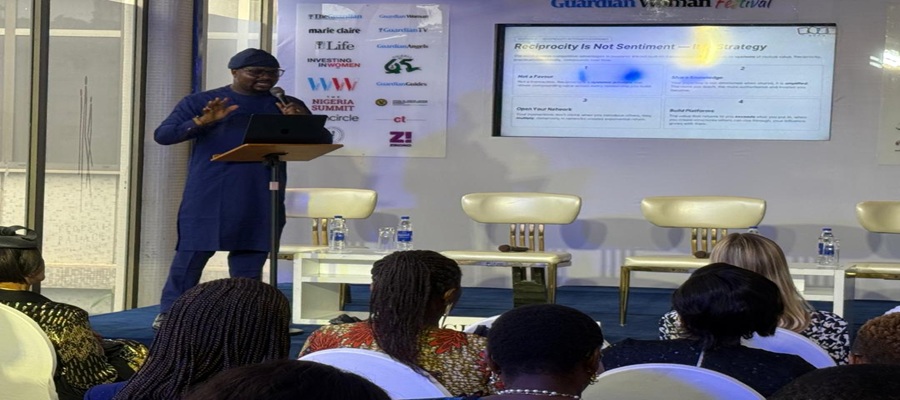
Zoho Nigeria partnered with Guardian Newspapers for the Guardian Woman Festival, a month-long initiative celebrating women’s contributions to business, governance, and social development while promoting digital empowerment for female entrepreneurs.

Kehinde Ogundare
Held at the Federal Palace Hotel in Victoria Island, Lagos, the festival focused on the theme “Reciprocity,” encouraging the exchange of value, networks, and digital innovation to strengthen women-led businesses and foster collaboration.
During the event, Kehinde Ogundare, Country Head of Zoho Nigeria, delivered a keynote address titled “Give Value, Gain Growth: Women Driving Reciprocal Innovation in the Digital Economy”. In his remarks, he highlighted the urgent need to bridge the digital gap for female entrepreneurs.
While Nigeria has the highest concentration of women-owned businesses in Africa, fewer than 30% currently use digital tools to manage or grow their operations. Ogundare noted that technology does not replace the strengths women already bring to business, such as relationship building and community engagement. Instead, it amplifies them, enabling entrepreneurs to reach wider audiences and scale more efficiently.
“The difference is not talent. Not capital. Not ambition. It is digital adoption,” said Ogundare during his keynote. “Smart tools create smart businesses. Smart businesses create strong economies. When women entrepreneurs and leaders have access to the right tools, the possibilities for growth are limitless.”
Zubaida Aliyu, Sales Manager at Zoho Nigeria, also brought her expertise to the festival’s panel session on ‘Women in the Business of Digital Innovation’. She highlighted how women are uniquely positioned to create shared value in digital spaces by building platforms that encourage knowledge sharing, mentorship, and collaboration.
Aliyu also challenged organisations that continue to view women’s digital inclusion primarily as corporate social responsibility rather than a strategic business priority.
“Tech creates a level playing field,” she said, noting that digital platforms remove limitations related to location and infrastructure size. Addressing organisations that overlook the economic value of inclusive digital strategies, she added, “They are leaving money on the table — they need to think of it as a strategy not charity”.
Through its participation in the Guardian Woman Festival, Zoho reaffirmed its commitment to providing affordable and accessible enterprise-grade technology to businesses of all sizes. By helping women transition from manual effort to digital efficiency, Zoho aims to support entrepreneurs build scalable enterprises and ensure their sustained success in Africa’s digital economy.

MTN Suspends Data, Airtime Borrowing Service over New FCCPC Lending Rules

Nigeria Customs Deploys AI to Cover Revenue Leaks

Top 7 Reliable Virtual Cards for Running Ads in Nigeria

Nokia, Orange Partner on AI-native 6G Networks

NDPC Issues Critical Advisory as Hackers Target Nigeria’s Key Digital Systems

Kuda MFB Increases Kuda for Her Business Grants to ₦10 Million

Canal+ to Cut Jobs as Part Sweeping Restructuring

Nigeria tops global rankings for USDT, USDC ownership

NBC Boss Urges Content Ceators to Participate in DSO

NITDA Takes Over National Digital Architecture System




 General News2 days ago
Guinness Nigeria Surpasses ₦1Trillion Market Capitalisation, Signalling Strong Investor Confidence and Sustained Value Creation

 News2 days ago
CISA Asks NDPC, Police to Act on Alleged Data Breach by NIPSS

 Telecom2 days ago
Amazon Satellite to Challenge Starlink in Africa with Globalstar Acquisition

 E-Financial2 days ago
FG Investigates ‘Sharp Sharp’ Loan Operators over Alleged Privacy Violations

 E-Financial2 days ago
Ecobank Delivers Strong Results, Posts $801m in Pre-Tax Profit for 2025

 News2 days ago
Tinubu Tasks NRS to Restore Public Trust Amid Fiscal Changes

 Broadcasting2 days ago
Fela Makes History as First African to be Inducted into Rock and Roll Hall of Fame

 News2 days ago
Kaspersky Reports Online Scam Exposure Remains Widespread Despite High Levels of Self-assurance