

News
Leo Stan @ 66: Africa’s Technology Miracle Child Comes Full Circle


By Henry C. Ibeakolam
Rarely in this part of the world would you find a man like Leonard Nnamdi Stanley Ekeh, better known as Leo Stan Ekeh.

Leo Stan Ekeh.
For starters, Leo Stan, as he is fondly addressed, is not your regular fellow. He ranks well and truly as an unusual entrepreneur, one who is not only absolutely outstanding at what he does, but a man who also stands head and shoulders apart from his peers.
The story of technology in Africa and in his native Nigeria would decidedly be incomplete without a mention of the many pioneering roles Ekeh played in this domain. But it is in chronicling his amazing journey of well over three decades in the field of technology that some of the exciting qualities that make Ekeh outstanding align in sharp contrast.
Born on April 22, 1956, in the rustic town of Ubomiri in Mbaitoli, Imo State, Ekeh is of the Baby Boomer generation – often defined as people born from 1946 to 1964, during the post–World War II baby boom. Remarkably, members of this generation fall among the most digitally-disadvantaged, especially when compared to their more technology-savvy counterparts in the Millennials or Gen Z generation.
In fact, research by the Pew Internet Project shows that Baby Boomers dominate globally among current Internet non-users. But it goes even beyond that. More than half of the members of this generation say the main reason they don’t go online now is because they don’t think the Internet is relevant. For these ones, take away Facebook or WhatsApp and you cut off probably their only links to the digital world.
Yet, Ekeh, who was recently honoured as the Forbes Best of Africa Leading Tech Icon, remains an outlier.
For decades here in Africa, the man has not only dominated the technology ecosystem, churning out innovations by the dozens in a sector which remains alien to many of his contemporaries, but which for him is a playground where he has continued to find relevance and expression, giving the Millennials and Gen Z something to think about and look up to.
In his words: ‘‘Despite my age, I feel very young. My eldest son will tell anyone who cares to listen: ‘Ha! Chairman is even younger at heart than many of us in the younger generation’. This is very important because I operate in a sector that is dominated by young people. I build products and solutions that are largely consumed by the youths, so I must understand their mindset and reasoning. I have to be like them in order to succeed,’’ he once stated at a public event.
But if his unusual pizazz as a technology guru ranks as a misnomer, it would be in keeping with the rest of his nature.
Restless but blessed with the brains of a genius, Ekeh’s personal life story further demonstrates the peculiarities of a maverick who stands apart and alone; a miracle child or digital orphan, as he often describes himself. He has never tasted alcohol from childhood till date, neither has he ever smoked, be it the regular cigarettes or any of the more exotic stuff that are as varied in their names or configurations that abound today.
It is interesting, while restating the unusualness that distinguishes Ekeh, to observe that unlike many Nigerian entrepreneurs whose little beginnings are often glossed over or consigned to the rubbish heap of history when they emerge, Ekeh’s remarkable rise to the pinnacle of success as a digital entrepreneur is thrown into sharp relief by the obstacles, the challenges, the struggles he faced, all of which he surmounted on his entrepreneurial journey.
It is not a secret that Ekeh used to live in the same apartment that housed his first office, or that his unerring knowledge of Lagos roads comes partly from the fact that he used to drive a commercial bus for fun with his friends.
A devout Catholic and former Mass servant, Ekeh, unknown to many, cheated death early in life, surviving a ghastly accident that left him with multiple stitches in his upper left arm while on the verge of leaving the country for studies abroad – a development which ultimately resulted in him missing resumption in the UK and eventually opting for India where he enrolled for a degree programme in Economics at the highly respected Punjab University. But the entire adventure would appear as if fate was playing a hand in forging the man’s destiny.
India, at the time Ekeh stepped foot there, was a nation struggling to convert its huge potential and undoubted human capital to wealth. Perhaps, not surprisingly, his time in India contributed a great deal in imbuing Ekeh with some of the remarkable fighting spirit and uncommon zeal to succeed he is renowned for. As he puts it, studying in India was “a great turning point in my life because I found the economy of India a realistic economy”.
Lest we forget, it was in that same India that Ekeh met the cerebral Chioma Ekeh, the love of his life and reliable sidekick, the woman who would become his wife and who at the time, turned out to be the only Nigerian studying Mathematics at the university.
Moving on from India and seeking further studies in the UK, Ekeh had his eyes opened to an environment which saw no future for Nigeria or Africa in technology back then.
His tutors at Ireland’s Cork City University, where he elected to study Computer Science, had painstakingly studied his temperament and character, correctly identifying him as a restless, smart and business-minded chap who would probably end up frustrated if he returned to his native Nigeria at the completion of his studies. But Ekeh has never been one to run from a challenge.
Armed with a postgraduate degree in Risk Management from a shared course at Nottingham University and City University, London, he had been faced with the prospect of completing a Masters’ Degree in Business Law at what is known today as London Metropolitan University or terminating the programme after eight months and converting his final school fees to return to Nigeria and launch his first company – Task Systems Ltd.
Ekeh chose the latter and the rest, as they say, is history.
For a man whose early ambition was once to own the largest transport company in Nigeria, Leo Stan Ekeh’s pivot to the technology business, as well as his subsequent dedication to creating a digital identity for Nigeria and putting the country and Africa, by extension, on the global map is the stuff of legend.
Ekeh’s many exploits – pioneering Desktop Publishing and Computer Graphics in West Africa and computerizing over 95 per cent of Media/ Multimedia houses and book publishing houses in Nigeria in 1987 through Task Systems; pioneering digital dispensing fuel pumps in partnership with Elf Petroleum and Schlumberger, France through his company Stanoil after he was cheated by a fuel attendant using the analogue pumps; launch of the first locally assembled and internationally certified computer brand in Sub-Saharan Africa – Zinox Computers; pioneering Sub-Saharan Africa’s leading and biggest technology products distribution company – TD Africa; deployment of the single largest e-Library and Wireless Cloud rollout in Africa; his status as the early pioneer of e-Commerce in Africa with Buy Right Africa DotCom; his sterling role in midwifing the biometric digital revolution in Nigeria, saving the country huge embarrassment by delivering the Independent National Electoral Commission (INEC) voters’ registration in 2006 when foreign contractors could not deliver after months of promises; repeating the feat four years later when he supervised the biggest single ICT digital rollout in Africa with the deployment of the Direct Data Capture (DDC) project with INEC in 2010 valued back then at over $170m, among many others too numerous to list out here – are well-chronicled.
But it is to the credit of his indefatigable nature and passion for Nigeria that, at an age when many of his peers were considering calling time on their careers, Ekeh decided to take on a challenge that even the most optimistic of his backers saw as a suicide attempt.
In early 2018, Ekeh and his team had announced the acquisition of Konga, a once-thriving indigenous platform which held the status of being one of the latter-day pioneers of the new wave of e-commerce in Nigeria but which, at the point of acquisition from its erstwhile owners, South African-headquartered Naspers and Swedish-based AB Kinnevik, was almost on its last days.
It was a piece of business whose echoes reverberated around the corridors of the global business world. For many, the acquisition of Konga would be the final straw that would break the irrepressible juggernaut that Ekeh represented. Such was the enormity of the task that lay in resuscitating the brand and restoring its glory days.
Or so it seemed.
Four years down the line, Konga, written off by many, has under new management, not only risen from the ashes of its near exit from the Nigerian e-commerce market, but is now the toast of desirous investors the world over and being touted as the potential leader of e-commerce in Africa.
It is proof of the magic wand that Ekeh wields, that gifted touch he brings to bear and the sagacity/mastermind at work behind his always clean-shaven pate that Konga, which reports reveal was once hemorrhaging about N400m per month, is today the first African e-commerce brand to turn a profit.
No doubt, Leo Stan, as his friends call him, is a national treasure, but he remains a man whom many believe – and rightly so, has hardly received the kind of recognition and acclaim he deserves from successive Nigerian governments. A man of extreme humility and a renowned philanthropist, Ekeh’s massive contribution in promoting digital democracy and ushering millions of Nigerians and Africans into the digital ecosystem remain unmatched across the continent.
As he turns 66 today, Tuesday February 22, 2022, it would appear Ekeh, who has never hidden his ambition of building the first and biggest 360-degrees integrated ICT conglomerate out of Africa, has come full circle on his wish, especially with the addition and impressive turnaround of Konga – now a flourishing e-commerce giant – to a formidable cast of thriving entities in the Zinox Group with proven and advanced competencies in a wide variety of tech-driven deliverables across verticals.
But it is also in keeping with Ekeh’s status as a rarefied, unusual breed of entrepreneur that one would be hugely surprised if he quits innovating, even at 66.
As he succinctly phrased it: “My strategy from childhood as a poor fellow was to cause disruptions, hence the decision to venture into technology which allows room for constant innovation…The only way I can sustain my dominance in the marketplace is through constant innovation and this is tied to sleeping less and eating healthy. It is important that in that hunger to be successful, you institute strong auditable system and structure which sustain your business.’’
At 66, Africa’s technology miracle child remains the poster child of all that is great in humanity.
By Henry C. Ibeakolam writes from Abuja, Nigeria


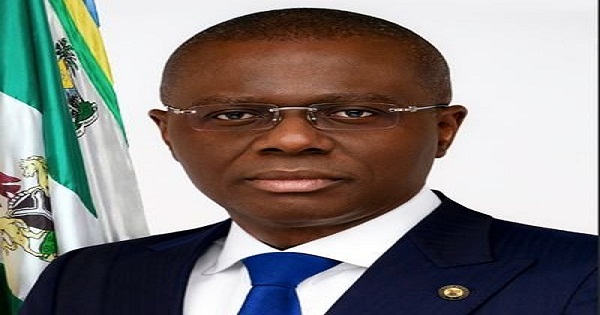
Lagos State has dragged 45 individuals and firms, including Bi-Courtney Aviation, DAAR Communications and Leaders & Company, to revenue court for tax debts running into billions of naira.

Lagos Govt
Bi-Courtney, operators of Murtala Muhammed Airport Terminal Two, faces N38.7 million claim; DAAR, behind Africa Independent Television, owes N22.4 million; ThisDay publishers Leaders & Company allegedly skip N67.1 million.
GMT Energy Resources tops corporates at N145.8 million, followed by Sheriff Deputies at N132.1 million; others like Heyden Petroleum, AA Rescue, BRT operator Primero also listed.
Individuals owe N13.5 million to N35 million each.
Attorney-General Lawal Pedro said suits followed ignored notices, aiming to enforce laws and fund infrastructure.
More defendants: IENG Nigeria, James Fisher, V Care Diagnostics, Venture Garden, Saro Africa, Barry Callebaut, Native Media, First Consulting, Eyowo Payments.
Compliant taxpayers post-notice escaped prosecution; defaulters risk penalties, interest, jail.
Pedro urged prompt filings and payments.


National Agency for Food and Drug Administration and Control (NAFDAC) has alerted Nigerians on counterfeit and unregistered Cerelac Mixed Fruits and Wheat products being sold in Lagos.

NAFDAC said Nestle Nigeria, the genuine Marketing Authorisation Holder of the product, received a complaint of suspected counterfeit purportedly manufactured by Nestlé Spain, bearing Batch Code 308002910.
It said that Nestle Nigeria reported that the complainant described that the counterfeit product emitted an odour suggestive of possible contact with fuel.
NAFDAC said that preliminary review of the product by Nestle Nigeria indicated that it had expired, in spite of the container displaying an expiry date of 10-2026, which suggested that the date coding had been tampered with (revalidated).
Nestle Cerelac Mixed Fruits and Wheat is a nutritious infant cereal, designed to be a delicious first food for infants.
NAFDAC said that its post-marketing surveillance’s directorate officers in Lagos conducted a surveillance visit to Maxland Shopping Centre, 193 Ago Palace, Okota, where the product was purchased by the complainant.
It added that the suspected counterfeit and unregistered Cerelac were found on sale at the premises and subsequently mopped up, while Nestle assisted in identifying the distinguishing features between registered and unregistered product.
According to the regulatory agency, Nestle revealed that the unregistered product used a hyphen (-) to separate the day from the year, while the registered product used a slash (/) to separate the day from the year.
“It is important to note that Nestle Nigeria is not aware of the channels through which the products are supplied into the country.
“Healthcare professionals and consumers are advised to report any suspicion of the sale of substandard and falsified regulated products to the nearest NAFDAC office, call 0800-162-3322, or send an email to [email protected],” NAFDAC said.
The agency warned that counterfeit formula often lacked essential nutrients, vitamins and minerals, leading to stunted growth or developmental issues.
It said that such formula might also contain contaminants that might lead to severe health consequences to infants or even death.
NAFDAC reiterated its commitment to safeguarding public health adding that it would continue surveillance activities to ensure the quality, safety, and efficacy of all NAFDAC-regulated products circulating in Nigeria.
It said that all zonal directors of the agency and state coordinators had been directed to carry out surveillance and mop up the revalidated product, if found within the zones and states.
The agency urged distributors, retailers, healthcare professionals, and caregivers to exercise caution and vigilance within the supply chain, to avoid the distribution, sale, and use of fake products.

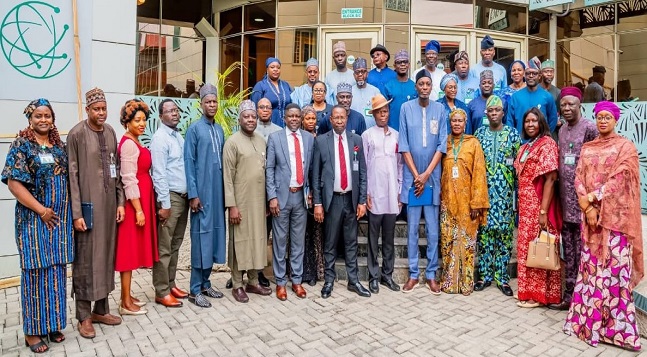
The National Information Technology Development Agency (NITDA) has reinforced its commitment to advancing Nigeria’s digital transformation agenda through strengthened collaboration with key strategic institutions, as it hosted the Director General of the National Institute for Policy and Strategic Studies (NIPSS), Professor Ayo Omotayo, alongside participants of the Senior Executive Course (SEC) 48, 2026.

The visit, which builds on an earlier strategic study tour, provided a platform for in-depth engagement on the role of digital innovation in driving sustainable economic growth, with particular focus on the Orange Economy.
Representing the Director General of NITDA, Kashifu Inuwa CCIE, the Director of Stakeholder Management and Partnerships, Dr Aristotle Onumo, highlighted the Agency’s commitment to fostering a vibrant digital ecosystem through inclusive policies, strategic partnerships, and capacity development initiatives.
“NITDA is committed to creating an enabling environment where innovation can thrive by bringing together government, private sector, academia, and creatives to drive Nigeria’s digital economy,” he stated.
Inuwa underscored the growing importance of the Orange Economy, describing it as a critical driver of innovation and economic value through intellectual property. He identified sectors such as digital content creation, film, animation, and digital art as key contributors to national development.
“The Orange Economy represents a powerful opportunity to transform our rich cultural heritage and creativity into sustainable economic growth,” he noted.
He further highlighted Nigeria’s unique advantage, particularly its youthful and creative population, while calling for stronger collaboration among stakeholders to fully harness the sector’s potential.
“With our youthful population and rich cultural assets, Nigeria is well-positioned to become a global leader in the Orange Economy if we deepen collaboration and investment across the ecosystem,” he added.
During the engagement, NITDA also presented its strategic initiatives aimed at supporting the digital and creative sectors, including digital infrastructure development, promotion of digital literacy, and implementation of policies that enable startups and innovators to scale.
Addressing challenges facing the sector, Inuwa pointed to issues such as limited access to funding, infrastructure gaps, weak intellectual property protection, and ecosystem fragmentation, while emphasising the need for coordinated action.
“Addressing challenges such as funding gaps, infrastructure deficits, and intellectual property protection is critical to unlocking the full potential of Nigeria’s creative economy,” he said.
The Agency reiterated its target of achieving 70 per cent digital literacy by 2027, noting that ongoing programmes are equipping millions of Nigerians with essential digital skills, including those in underserved and informal sectors.
In his remark, Professor Omotayo described the visit as an important opportunity to deepen understanding of how digital technologies are reshaping economic sectors, particularly the creative industry. He noted that the insights gathered would contribute significantly to policy recommendations aimed at strengthening Nigeria’s economic framework.
Participants of the SEC 48 programme engaged actively during the session, raising questions on capacity development, access to tools, and frameworks for protecting digital content. NITDA highlighted its ongoing collaborations with industry stakeholders to provide training, innovation hubs, and access to digital tools for young Nigerians.
The engagement concluded with a renewed commitment from both NITDA and NIPSS to strengthen collaboration in research, policy development, and capacity building, aimed at positioning Nigeria as a globally competitive force in the digital and creative economy.

Multichoice Bleeds Customers in South Africa, Loses 580,000 Subscribers

FG Asks MDAs to Halt New Policies Until Full Compliance with RIA

Broadcast Station Owners Reject IBAN’s Threat to Boycott Wike’s Media Engagements

BVN Database hits 68.6m – NIBSS

How Unethical Deals Triggered CBN Takeover of Union Bank -Forensic Report

Spotify’s Loud & Clear Report Reveals Over ₦60Bn Revenue for Nigerian Artists in 2025

Madonna University Taps Tech Guru Adote for Strategic Board Role

China Threatens to Shut Nigeria’s Satellite Over $11.44m Unpaid Debt

Healthcare Under Attack: Why Cybersecurity is Now Critical Care

Why JustMarkets Is a Strong Choice for Gold Trading




 E-Business3 days ago
FG to Strengthen Cybersecurity Coordination as NDPC Probes Alleged Data Breach

 Telecom3 days ago
Compensation for Poor Service Quality is Automatic- NCC

 Telecom3 days ago
FG Moves to Strengthen Cybersecurity Coordination as NDPC Probes Alleged Data Breach

 E-Business3 days ago
Offset Communications Slams N50m Suit against Qore Technologies for Alleged Copyright Infringement

 General News3 days ago
Tinubu Approves N3.3 Trillion Payment Plan to Boost Power Supply

 News3 days ago
Beware of Fake Cerelac Products – NAFDAC

 General News3 days ago
SERAP Sues CCB over Electoral Act, New Tax law

 E-Business2 days ago
Nigeria Cyberattacks: Stronger Collaboration as a Panacea