

E-Financial
Letshego MFB Unveils Brand, Key Target Sectors in Nigeria

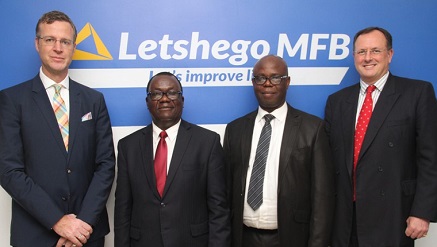
In line with its mandate: to ensure simple, appropriate and affordable financial solutions across Africa, Letshego Holdings Limited, on Friday unveiled its rebranded business after acquiring 100% stake in FBN Microfinance Bank (FBN MFB) from its parent, FBN Holdings Plc; even with a new brand promise ‘Let’s improve life’.
Letshego MFB said that the rebranding aligns the Nigeria’s operations’ brand with that of other nine operations across Sub-Saharan Africa.
The Africa-wide brand is being reinforced with equally aligned strategic imperatives, as Letshego Group continues to further its ambition to become the Continent’s leading inclusive finance group with interest in key sectors as education, agriculture and health.
The bank, established in 2009, is one of the seven Microfinance banks in Nigeria to have been awarded a national microfinance banking licence (NMFBL).
It boasts of having over 20 branches across Lagos, Oyo States and the FCT (Abuja) with over 300 team members and dedicated to core lending savings and transnational financial services to micro and small entrepreneurs (MSEs).

Speaking during a press conference to announce the new brand, Mr. Chris Low, group managing director of Letshego Holdings Limited said that with over 80,000 savers and 10,000 MSE borrowing customers, the contribution towards realising Letshego’s vision remains strong, adding that the agenda to benefit the people of Nigeria remains key imperative for the business.
“The news of the acquisition early this year is coming to life now as we see Letshego MFB take shape in a bold, purposeful new look and feel, joining a family of brands that has a clear vision and strategy for inclusive finance. This is another affirmation of our commitment to the people of Nigeria- we will continue to make every effort to ensure we deliver relevant, value adding and responsible financial solutions”.
Low said that innovation underpins the MFB’s financial inclusion agenda, “and it is innovation, partnerships and access to capita that we leverage to ensure we help deliver an enhanced customer experience to improve life. Doing so remains our goal and, indeed, our passion. Our new brand promise ‘Let’s Improve Life’, is embodied in everything that we do”.
The GMD also reiterated that in Nigeria, and building upon the infrastructure, access and heritage of the bank, Letshego offers full spectrum of financial solutions. “This covers savings, borrowing, payments, microf-insurance, with a focus on agriculture, education and health sectors.
Also speaking, Mr. Tom Kocsis, group head of East Africa and Microfinance, Letshego Holdings Limited, said that in spite of the economic situation in the country, “This is tremendous time for Letshego to thrive. As we commemorate this milestone, we remain cognisant of the our commitment to delivery of broad-based financial solutions through diversification of customer segments, products and access channels. This growth prospects in our targeted formally employed, low-and-middle income, MSE customer segments in Nigeria bring a wealth of potential.
“Our growing investment in supporting the people of Nigeria, and championing strong socio-economic development through inclusive finance, is a means for us to further improve lives. Born in Botswana, with a pan-African strategy and footprint, we remain passionate about ensuring we live true to the very meaning of ‘Letshego, which translates from Setswana to ‘Support’”.
According to Mr. John Ologe, Letshego’s CEO, expansion has been a critical growth focus for Letshego together with the areas of Micro-finance, savings and payment savings.
“In addition, using channels that allow access anytime, anywhere has been an area of strategic focus for Letshego in recent years. The re-branded Letshego FBN is envisioned to offer a well-diversified, full-service solution set, and to grow into a trusted financial services brand for the people of Nigeria.
“We are excited for the many opportunities that lie ahead and the plans we have for a truly inclusive Letshego MFB. Amongst some of the investments and advancements made by the bank are greater accessibility of products for customers as well as improvement in turnaround time on lending products. Supporting this is the greater investment into the capability of the team serving our current and future customers, as well as deeper access to necessary growth-capital. As the latest entrant into the Letshego family, we are committed to growth, diversity and improving life,” Ologe said.



Cybercriminals have developed a new Android malware that can turn victims smartphones into a bridge for stealing bank card information and carrying out contactless payment fraud, cybersecurity researchers have warned.

The malware, identified as WindRelay, operates in conjunction with a known remote-access trojan, SpyNote, to capture live information exchanged between a physical bank card and an Android phone via Near Field Communication (NFC).
NFC is the short-range technology that enables contactless payments when a bank card or smartphone is tapped against a payment terminal.
According to cybersecurity firm Group-IB, WindRelay was detected in the wild in August 2025 and has been used in a social-engineering scheme targeting victims in Czechia, Slovakia and Slovenia.
Meanwhile, the fraud begins with a phone call, text message or other communication in which criminals pretend to be bank officials.
The victim is persuaded to install an application, often personalised with the victim’s name, and once installed, SpyNote gives the criminal remote access to the phone and can silently install WindRelay, with the victim then tricked into placing a physical bank card against the infected smartphone, supposedly for identity verification, PIN change, or account resolution.
WindRelay reads the card’s NFC signals and sends the information in real time to another device controlled by the criminal, with such a device then imitating the victim’s card at a payment terminal or ATM, as the victim’s smartphone becomes a wireless bridge between the victim’s bank card and the criminal’s device.
Group-IB said it identified 23 WindRelay samples uploaded to VirusTotal between November 2025 and July 2026, with the malware samples impersonating financial institutions in Czechia, Slovakia and Slovenia.
Meanwhile, the development adds to existing concerns over the use of mobile devices in cybercrime and financial fraud in Nigeria.
In June, the Nigeria Computer Emergency Response Team (ngCERT) issued an advisory on IPIDEA malware and malicious residential proxy networks, warning that the malware could hijack consumers internet connections and use compromised devices as part of criminal proxy networks.
While the ngCERT advisory concerns a different malware and attack method, both incidents highlight a growing risk: ordinary smartphones and connected devices can be secretly turned into tools for cybercriminals.
This is particularly relevant as Nigerians increasingly rely on smartphones for mobile banking, digital payments and other financial services.
Consequently, cybersecurity experts have advised users not to install applications sent through unsolicited calls, text messages or links, especially when the sender claims to represent a bank, as users should also be suspicious of requests to place payment cards against smartphones for supposed account verification.

The Securities and Exchange Commission (SEC) has cleared additional Virtual Asset Service Providers (VASPs) for admission into its Accelerated Regulatory Incubation Programme (ARIP).

Among the newly cleared is BC Access Nigeria Limited (Blockchain), marking an important step in the company’s long-term commitment to Nigeria and its broader expansion across Africa.
Nigeria is one of Africa’s most important digital asset markets, where crypto increasingly plays a practical role in how people access, hold and move.
Value Admission into ARIP means Blockchain has satisfied the SEC’s initial requirements to participate in the programme and is authorised to operate within its defined sandbox scope, subject to the Commission’s ongoing compliance obligations, testing parameters, and regulatory conditions.
Through ARIP, Blockchain can work directly with the SEC as the Commission evaluates digital asset business models, tests. appropriate safeguards and develops its long-term regulatory framework for the market.
Speaking, General Manager for Africa, Blockchain, Owen Odia, said: “Nigeria is one of Africa’s most important digital asset markets and participating in the SEC’s ARIP is an important step forward in our long-term commitment to the country.
“The programme gives us the opportunity to work directly with the SEC in a controlled environment, bring our global experience to the Nigerian market and help support a framework that protects consumers while enabling responsible innovation. We appreciate the SEC’s proactive approach and look forward to contributing to a safe, transparent and well-regulated digital asset ecosystem.”
Blockchain’s participation in ARIP forms part of a broader global strategy to engage constructively with regulators and build within established regulatory frameworks.
Over the past year, Blockchain has secured several formal licenses and registrations globally, including the UK Financial Conduct Authority (FCA), EU Markets in Crypto-Assets (MiCA), and Cayman Islands Monetary Authority (CIMA) Virtual Asset Service Provider (VASP) License. Participating in Nigeria’s ARIP sandbox builds on that experience, bringing global standards in compliance, security and consumer protection to its local operations.
For Blockchain, ARIP provides a structured environment to test services for the Nigerian market, strengthen consumer protections and work directly with regulators and local stakeholders.
The company sees Nigeria as an important market in its African strategy, with strong existing demand for digital assets and an increasingly clear regulatory pathway for responsible operators. The company’s strategy materials specifically identify Nigeria as an important market for its African expansion.
ARIP was established by Nigeria’s SEC as a controlled regulatory sandbox for VASPs and fintech innovators. The programme allows the SEC to observe live applications of digital asset technologies, study operational risks, and establish tailored investor protection and anti-money laundering (AML) standards before final regulatory rules are codified.
Blockchain is pleased to participate in ARIP as we work alongside regulators to support responsible innovation, consumer protection and market integrity.
Founded in 2011, Blockchain is one of the world’s longest-standing digital asset companies with more than 95 million wallets, more than 44 million confirmed accounts and over $1.2 trillion processed.
Leadway Assurance has unveiled the Leadway Lifetime Plan, a one-of-a-kind whole-of-life insurance solution designed to extend financial protection beyond the immediate household to the wider family circle.

The newly introduced plan unveiled at a press briefing in Lagos reinforces Leadway’s commitment to building lasting financial security, preserving wealth, and delivering meaningful, long-term protection for the people who matter most.
The Leadway Lifetime Plan responds to the increasingly complex financial responsibilities faced by many working adults, particularly members of the Sandwich Generation individuals who simultaneously provide financial support for ageing parents while raising children and planning for their future.
With family responsibilities now extending beyond the traditional nuclear household, the Leadway Lifetime Plan is designed to offer broader, long-term protection that reflects the realities of modern Nigerian families.
Speaking on the new insurance plan, Olufunmilayo Amanwa, executive director, Technical & Operations, Leadway Assurance, said the product reflects the insurer’s recognition that family structures and financial responsibilities are evolving, and that insurance solutions must evolve with them.
“Financial responsibility no longer stops at the nuclear family. Today, one individual may be supporting children, a spouse, ageing parents, and in some cases, parents-in-law or siblings, all at once. That reality demands a different approach to protection.
The Leadway Lifetime Plan was built around this reality. It gives customers a way to extend continuous protection to the extended family, ensuring the people who depend on them are covered, while also delivering meaningful benefits to policyholders within their own lifetime. This is the Leadway way, designing solutions that respond to how people actually live, not recycling old products with new names”
Beyond traditional life protection, the Leadway Lifetime Plan incorporates a range of living benefits designed to provide financial support during critical stages of life.
Following five years of complete premium payment and subject to the policy terms, the policyholder and spouse may access up to 50 per cent of their current sum assured upon diagnosis of a covered critical illness. This benefit can provide valuable financial support at a time when a serious health event may place pressure on income, savings and overall household stability.
The plan also provides greater long-term financial flexibility. Eligible policyholders may access up to 50 per cent of the policy value for significant life goals after the premium payment term plus five years, subject to applicable policy conditions.
While Leadway’s existing Family Benefit Plan provides family-focused whole-life protection, the Lifetime Plan has been developed as a more expansive, multi-generational solution that combines lifelong protection with financial value that can be accessed during the policyholder’s lifetime.
Explaining the thinking behind the product, Rosetta Aryeetey, head, Life Underwriting and Life Business, Leadway Assurance said the solution was developed around the changing needs of customers. “The starting point for the Leadway Lifetime Plan was the customer.
We looked closely at how families are structured Today, how financial responsibilities are shared and the challenges customers face when they are responsible for several generations at the same time. What emerged was a need for a solution that does more than pay a benefit after death. Customers need protection for the people who depend on them, but they also need support when critical life events occur and flexibility as their financial priorities evolve.”
She added that the combination of multi-life protection, living benefits, long-term value and flexibility makes the Lifetime Plan relevant across different stages of a customer’s financial journey.
The plan also offers flexibility to enhance financial protection over time through an Escalation of Sum Assured feature. This allows customers to increase their benefits by a fixed percentage, giving them the flexibility to align their level of protection with their evolving financial needs and circumstances.
With the launch, Leadway Assurance is reinforcing its commitment to developing insurance solutions that respond to real-life needs while helping families build resilience, preserve financial stability and create lasting legacies.

FG Seeks to Half Burkina Faso’s Internet Cost while Nigerians Pay more

Cyberthreat: New Malware, Turns Phones into Tools for Card Fraud- Report

SEC Clears Blockchain for Accelerated Regulatory Incubation Programme

Union Bank Secures Global Payment Data Security Certification

NLNG, NCDMB Boost Engineering Research with Innovation Centre

EFCC Busts NIS Visa Overstay Racket, Uncovers N700m in an Account

Fact-Check: Elon Musk’s “Tesla Pi Phone” is Internet Rumor

NBC Tasks Broadcasting Stations over 2028 DSO Global Deadline

Glo Sponsored African Voices to Feature Netflix’s “The Polygamist” Stars

Access Bank Debunks Shutdown Report, Vows Action against Perpetrators




 Telecom2 days ago
Airtel Nigeria Adds Over 1,000Cell Sites in Nationwide Expansion to Surpasses 17,000

 E-Financial2 days ago
Mastercard, TeamApt Collaborate to Expand Digital Payments Across Africa

 E-Business2 days ago
MacOS Users Report More Cyber Threats than Windows Users – Survey Reveals

 News2 days ago
Access Holdings Sets New Benchmark in Nigeria’s Finance Talent Pipeline

 Telecom3 days ago
Nigerian Startup Act: NITDA Calls for Stronger Inter-Agency Collaboration

 E-Financial3 days ago
SEC Orders Immediate Freeze of Assets Linked to Six Terrorism Financiers, Three Entities

 General News3 days ago
Anambra Seeks Digital Inclusion in Rural Communities

 Broadcasting3 days ago
ESUT Workers Get N82,000 Minimum Wage as Enugu Approves Fresh Salary Increase