

News
LinkedIn Ranks Top in List of Brands Most Likely to be Imitated in Phishing Attempts – Report


Check Point Research, the Threat Intelligence arm of Check Point Software Technologies Ltd. and a leading provider of cyber security solutions globally, has published its Brand Phishing Report for Q1 2022.

The report highlights the brands which were most frequently imitated by cybercriminals in their attempts to steal individuals’ personal information or payment credentials during January, February and March.
Social media network, LinkedIn, dominated the rankings for the first time ever, accounting for more than half (52%) of all phishing attempts during the quarter.
This represents a dramatic 44% uplift from the previous quarter, where the professional networking site was in fifth position accounting for only 8% of phishing attempts.
LinkedIn overtook DHL as the most targeted brand, which is now in second position and accounted for 14% of all phishing attempts during the quarter.
The latest report highlights an emerging trend toward threat actors leveraging social networks, now the number one targeted category ahead of shipping companies and technology giants such as Google, Microsoft and Apple.
As well as LinkedIn being the most targeted brand by a considerable margin, WhatsApp maintained its position in the top ten, accounting for almost 1 in 20 phishing-related attacks worldwide.
The report highlights a particular example where LinkedIn users are contacted via an official-looking email in an attempt to lure them to click on a malicious link. Once there, users would be again prompted to log-in via a fake portal where their credentials would be harvested.
Shipping is now the second most targeted category, with threat actors continuing to take advantage of the general rise in e-commerce by targeting consumers and shipping companies directly.
DHL is second to LinkedIn, accounting for 14% of phishing attempts; FedEx has moved from seventh position fifth, now accounting for 6% of all phishing attempts; and Maersk and AliExpress have entered the top ten list for the first time.
The report highlights one particular phishing strategy that used Maersk-branded emails to encourage the download of spoof transport documents, infecting workstations with malware.
“These phishing attempts are attacks of opportunity, plain and simple. Criminal groups orchestrate these phishing attempts on a grand scale, with a view to getting as many people to part with their personal data as possible,” said Omer Dembinsky, Data Research Group Manager at Check Point Software.
“Some attacks will attempt to gain leverage over individuals or steal their information, such as those we’re seeing with LinkedIn. Others will be attempts to deploy malware on company networks, such as the fake emails containing spoof carrier documents that we’re seeing with the likes of Maersk.”
He continued: “If there was ever any doubt that social media would become one of the most heavily targeted sectors by criminal groups, Q1 has laid those doubts to rest. While Facebook has dropped out of the top ten rankings, LinkedIn has soared to number one and has accounted for more than half of all phishing attempts so far this year.
“The best defense against phishing threats, as ever, is knowledge. Employees in particular should be trained to spot suspicious anomalies such as misspelled domains, typos, incorrect dates and other details that can expose a malicious email or text message. LinkedIn users in particular should be extra vigilant over the course of the next few months.”
In a brand phishing attack, criminals try to imitate the official website of a well-known brand by using a similar domain name or URL and web-page design to the genuine site.
The link to the fake website can be sent to targeted individuals by email or text message, a user can be redirected during web browsing, or it may be triggered from a fraudulent mobile application. The fake website often contains a form intended to steal users’ credentials, payment details or other personal information.
Top phishing brands in Q1 2022
Below are the top brands ranked by their overall appearance in brand phishing attempts:
1. LinkedIn (relating to 52% of all phishing attacks globally)
2. DHL (14%)
3. Google (7%)
4. Microsoft (6%)
5. FedEx (6%)
6. WhatsApp (4%)
7. Amazon (2%)
8. Maersk (1%)
9. AliExpress (0.8%)
10. Apple (0.8%)



National Agency for Food and Drug Administration and Control (NAFDAC) has alerted Nigerians on counterfeit and unregistered Cerelac Mixed Fruits and Wheat products being sold in Lagos.

NAFDAC said Nestle Nigeria, the genuine Marketing Authorisation Holder of the product, received a complaint of suspected counterfeit purportedly manufactured by Nestlé Spain, bearing Batch Code 308002910.
It said that Nestle Nigeria reported that the complainant described that the counterfeit product emitted an odour suggestive of possible contact with fuel.
NAFDAC said that preliminary review of the product by Nestle Nigeria indicated that it had expired, in spite of the container displaying an expiry date of 10-2026, which suggested that the date coding had been tampered with (revalidated).
Nestle Cerelac Mixed Fruits and Wheat is a nutritious infant cereal, designed to be a delicious first food for infants.
NAFDAC said that its post-marketing surveillance’s directorate officers in Lagos conducted a surveillance visit to Maxland Shopping Centre, 193 Ago Palace, Okota, where the product was purchased by the complainant.
It added that the suspected counterfeit and unregistered Cerelac were found on sale at the premises and subsequently mopped up, while Nestle assisted in identifying the distinguishing features between registered and unregistered product.
According to the regulatory agency, Nestle revealed that the unregistered product used a hyphen (-) to separate the day from the year, while the registered product used a slash (/) to separate the day from the year.
“It is important to note that Nestle Nigeria is not aware of the channels through which the products are supplied into the country.
“Healthcare professionals and consumers are advised to report any suspicion of the sale of substandard and falsified regulated products to the nearest NAFDAC office, call 0800-162-3322, or send an email to [email protected],” NAFDAC said.
The agency warned that counterfeit formula often lacked essential nutrients, vitamins and minerals, leading to stunted growth or developmental issues.
It said that such formula might also contain contaminants that might lead to severe health consequences to infants or even death.
NAFDAC reiterated its commitment to safeguarding public health adding that it would continue surveillance activities to ensure the quality, safety, and efficacy of all NAFDAC-regulated products circulating in Nigeria.
It said that all zonal directors of the agency and state coordinators had been directed to carry out surveillance and mop up the revalidated product, if found within the zones and states.
The agency urged distributors, retailers, healthcare professionals, and caregivers to exercise caution and vigilance within the supply chain, to avoid the distribution, sale, and use of fake products.
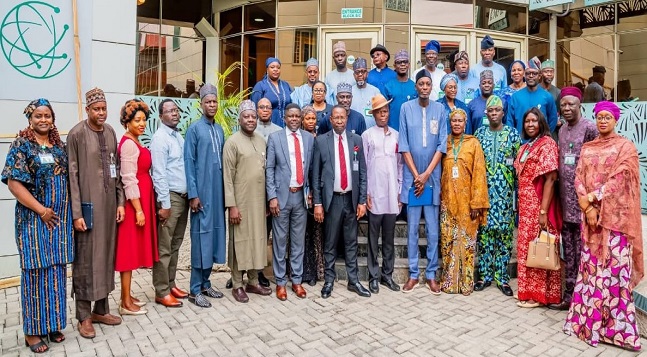
The National Information Technology Development Agency (NITDA) has reinforced its commitment to advancing Nigeria’s digital transformation agenda through strengthened collaboration with key strategic institutions, as it hosted the Director General of the National Institute for Policy and Strategic Studies (NIPSS), Professor Ayo Omotayo, alongside participants of the Senior Executive Course (SEC) 48, 2026.

The visit, which builds on an earlier strategic study tour, provided a platform for in-depth engagement on the role of digital innovation in driving sustainable economic growth, with particular focus on the Orange Economy.
Representing the Director General of NITDA, Kashifu Inuwa CCIE, the Director of Stakeholder Management and Partnerships, Dr Aristotle Onumo, highlighted the Agency’s commitment to fostering a vibrant digital ecosystem through inclusive policies, strategic partnerships, and capacity development initiatives.
“NITDA is committed to creating an enabling environment where innovation can thrive by bringing together government, private sector, academia, and creatives to drive Nigeria’s digital economy,” he stated.
Inuwa underscored the growing importance of the Orange Economy, describing it as a critical driver of innovation and economic value through intellectual property. He identified sectors such as digital content creation, film, animation, and digital art as key contributors to national development.
“The Orange Economy represents a powerful opportunity to transform our rich cultural heritage and creativity into sustainable economic growth,” he noted.
He further highlighted Nigeria’s unique advantage, particularly its youthful and creative population, while calling for stronger collaboration among stakeholders to fully harness the sector’s potential.
“With our youthful population and rich cultural assets, Nigeria is well-positioned to become a global leader in the Orange Economy if we deepen collaboration and investment across the ecosystem,” he added.
During the engagement, NITDA also presented its strategic initiatives aimed at supporting the digital and creative sectors, including digital infrastructure development, promotion of digital literacy, and implementation of policies that enable startups and innovators to scale.
Addressing challenges facing the sector, Inuwa pointed to issues such as limited access to funding, infrastructure gaps, weak intellectual property protection, and ecosystem fragmentation, while emphasising the need for coordinated action.
“Addressing challenges such as funding gaps, infrastructure deficits, and intellectual property protection is critical to unlocking the full potential of Nigeria’s creative economy,” he said.
The Agency reiterated its target of achieving 70 per cent digital literacy by 2027, noting that ongoing programmes are equipping millions of Nigerians with essential digital skills, including those in underserved and informal sectors.
In his remark, Professor Omotayo described the visit as an important opportunity to deepen understanding of how digital technologies are reshaping economic sectors, particularly the creative industry. He noted that the insights gathered would contribute significantly to policy recommendations aimed at strengthening Nigeria’s economic framework.
Participants of the SEC 48 programme engaged actively during the session, raising questions on capacity development, access to tools, and frameworks for protecting digital content. NITDA highlighted its ongoing collaborations with industry stakeholders to provide training, innovation hubs, and access to digital tools for young Nigerians.
The engagement concluded with a renewed commitment from both NITDA and NIPSS to strengthen collaboration in research, policy development, and capacity building, aimed at positioning Nigeria as a globally competitive force in the digital and creative economy.

Nigeria Revenue Service (NRS) has assumed responsibility for collecting mineral royalties from mining operators nationwide, following new tax laws effective January 1, 2026.

NRS
The shift emerged from a Thursday meeting between Solid Minerals Development Minister Dele Alake and NRS Chairman Dr. Zacch Adedeji. Their joint statement, endorsed by both, confirms NRS now administers all federally collectible revenues, including royalties.
Enacted by President Bola Tinubu on June 26, 2025, the Nigeria Tax Laws 2025 empower this transition. The Ministry of Solid Minerals Development remains a key partner, supplying pricing data, geological insights, and sector coordination.
NRS Special Adviser Dare Adekanmbi’s statement outlines collaborative steps: a nationwide sensitization program for operators on filing and payments; development of a digital royalty system; and regular joint technical sessions to address issues.
Both agencies pledge orderly, transparent implementation to boost the mining sector. Operators must comply with obligations and join upcoming programs.
The move aims to streamline revenue collection while fostering mining growth.

Offset Communications Slams N50m Suit against Qore Technologies for Alleged Copyright Infringement

Compensation for Poor Service Quality is Automatic- NCC

SERAP Sues CCB over Electoral Act, New Tax law

Tinubu Approves N3.3 Trillion Payment Plan to Boost Power Supply

NDPC Investigates Remita, Others over Alleged Data Breaches

Spotify’s Loud & Clear Report Reveals Over ₦60Bn Revenue for Nigerian Artists in 2025

Madonna University Taps Tech Guru Adote for Strategic Board Role

China Threatens to Shut Nigeria’s Satellite Over $11.44m Unpaid Debt

Healthcare Under Attack: Why Cybersecurity is Now Critical Care

Why JustMarkets Is a Strong Choice for Gold Trading




 General News2 days ago
FG, Others Say Nigeria Wastes 38m Tonnes of Food Annually

 E-Financial2 days ago
CBN, Banks, Fintechs Launch PSPC to Boost Nigeria’s Payment System

 News2 days ago
NITDA Strengthens Collaboration with NIPSS to Drive Digital Innovation, Orange Economy Growth

 E-Financial2 days ago
CycleFlow, IFC Launch Supply Chain Finance Platform in Nigeria

 E-Financial2 days ago
Anchor Gets Nigerian, Canadian Licences as Transactions Crosses $2.5Bn

 E-Financial2 days ago
Ecobank Assures of Seamless Easter Banking Services

 News2 days ago
NRS Takes Over Mineral Royalties Collection Under New Tax Laws

 E-Financial2 days ago
N4.65 Trillion in the Vault, but is the Real Economy Locked Out?