

E-Business
LIRS, FIRS Ink MoU on Exchange of Information, Joint Tax Audit

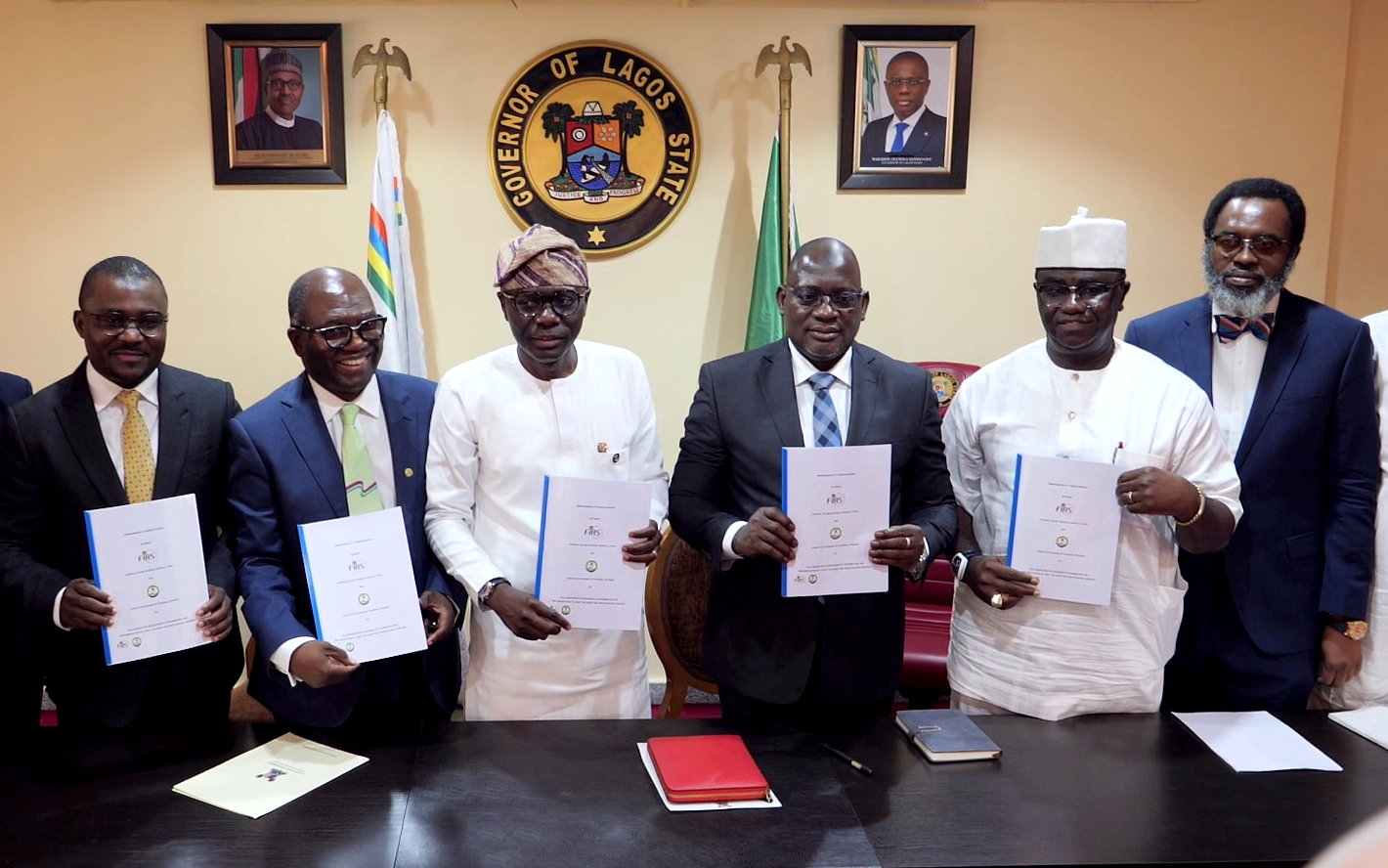
The Lagos State Internal Revenue Service (LIRS) and Federal Inland Revenue Service (FIRS) on Monday, February 6, 2023, signed a Memorandum of Understanding on the exchange of information and implementation of joint tax audit and investigation exercise.

L-R: Lagos State Commissioner for Finance, Dr Rabiu Olowo Onaolapo, Executive Chairman, LIRS, Mr Ayodele Subair, Lagos State Governor, Babajide Sanwo-Olu, Executive Chairman, FIRS, Muhammad Mamman Nami, Minister of State for Finance, Budget and National Planning, Mr Clement Agba and Lagos state Attorney-General & Commissioner for Justice, Mr Moyosore Onigbanjo SAN during the signing of MoU between the Lagos State Internal Revenue Service (LIRS) and Federal Inland Revenue Service (FIRS) held at the Lagos State House, Marina on Monday, February 6, 2023.
The agreement signing ceremony held at the Lagos State House, Marina, was witnessed by Lagos State Governor, Babajide Sanwo-Olu, Minister of State for Finance, Budget and National Planning, Mr Clement Agba, FIRS and LIRS coordinating directors, as well as some of the Lagos state exco members which included the state Commissioner for Finance, Dr Rabiu Olowo Onaolapo and the state Attorney-General & Commissioner for Justice, Mr Moyosore Onigbanjo SAN.
While the Executive Chairman, LIRS, Mr Ayodele Subair signed on behalf of Lagos State, his counterpart, Muhammad Mamman Nami, Executive Chairman, FIRS signed on behalf of the federal government.
Speaking at the signing event, Mr Ayodele Subair, Executive Chairman, LIRS, in his remarks, said the importance of the agreement was to foster greater collaboration between the two agencies.
He said though both tax agencies are not only independent of each other but different in the types of taxes they administer, the collaboration between the tax authorities was to promote the smooth operation of activities not only for the benefit of tax authorities but for improved service delivery for taxpayers.
Subair noted; “Notwithstanding its inclusion as a fundamental obligation of every Nigerian citizen pursuant to Section 24 (f) of the 1999 Constitution as amended, filing of annual income tax returns or payment of tax therefrom is not an issue that citizens are keen on. Nonetheless, citizens expect to have direct benefit of democracy and good governance without remembering that the most reliable and sustainable means of Domestic Resource mobilization for Government expenditure is taxation.
“There is no reason to debate the above as it has been established that tax compliance and good governance are expected to co-exist as the undividable social contract that binds citizens and governments anywhere in the world. Therefore, citizens and governments are expected to fulfill their end of the bargain in achieving a balance.”
“Today’s signing of this Memorandum of Understanding is in furtherance of the above bargain on the part of the tax authorities. While this initiative of a joint audit is not a new one, it is peculiar because it comes at a time when our dear nation struggles with the dwindling oil receipts and other economic woes which have affected the tax-to-GDP ratio which is currently adjudged as the lowest globally, standing at approximately 6%, compared to neighboring countries which average between 15 – 25%., Subair submitted.
According to the LIRS Chairman, some of the expected achievements from this collaboration between both tax authorities include a reduction of compliance costs for taxpayers; improved transparency in the tax administration process, which will impact tax disputes, incidences and reconciliation; reduced administration costs for both tax authorities; and elimination of hiding place for recalcitrant taxable persons and entities.
In his own remarks, Executive Chairman, FIRS, Muhammad Mamman Nami, said the essence of the collaboration between the FIRS and LIRS was to enable the two agencies to carry out joint projects together, secondly, in the course of its investigations, they both work as a team while the third and most important reason was to ensure automatic exchange of information which would enable the agency get a bigger data for seamless tax administration.
“We will work together as a team during the investigation and have an automatic exchange of information. With this, we will be able to carry out our mandate seamlessly. As part of the joint operation, we will be able to implement presumptive tax as far as issues of tax administration are concerned,” Nami said.
In his own submission, describing the collaboration as “epoch-making”, Governor Sanwo-Olu noted that the conversation for the harmonization of the two agencies’ mandates started about a year ago, based on the need to forge a common front in widening the tax net to raise the country’s tax to GDP ratio.
The Governor observed that Nigeria had maintained an unimpressive tax-to-GDP ratio of between 6 to 8 per cent, despite the yearly record-breaking turnovers by both FIRS and LIRS. This, he said, has mounted pressure on the nation’s resources and created an imbalance in Government expenditure. Sanwo-Olu said Nigeria must operate at the same level as other nations within sub-Saharan Africa doing between 14 and 15 per cent in tax to GDP ratio in order to support the Government’s development programmes and improve accountability.
He said: “We have just witnessed an epoch-making ceremony between the Federal Inland Revenue Service and Lagos Inland Revenue Service.
“This collaboration did not just happen by chance; it is a conversation we started about a year ago with the chairman of FIRS when both parties reviewed their successes and limitations. It was clear there was a need for a relationship to be consummated. Both FIRS and LIRS have been breaking records of their tax collection and administration yearly, but this is not enough. We have an unimpressive tax-to-GDP ratio, which ranges between six and eight per cent; this is totally unacceptable.
“Studies have shown that there would be better service delivery to the citizens and improvement in the efficiency of tax collection when the two agencies work together. The cost of tax collection would be reduced, we would see better customer satisfaction and more resources would be generated for the Government to deliver more dividends of democracy.
“For us as a State, we are humbled by this collaborative effort and we believe our citizens will be the ultimate beneficiaries of this initiative. The MoU is in the best interest of the public, as it affirms the reason why we need to come together and strengthen the cordial working relationship between the two agencies.”



Meta, a multinational technology company, has informed advertisers that it will begin applying new location-based fees to certain advertisements delivered in six selected jurisdictions starting July 1, 2026, as the company moves to offset costs linked to digital services taxes and other regulatory charges.

In an email sent to advertisers, the company explained that the new charges will apply to ad impressions delivered to audiences in specific countries, regardless of where the advertiser’s business is based.
“Meta will soon apply new location fees to ads delivered in specific jurisdictions to cover digital service taxes (DST) and other location-based fees imposed on Meta in those jurisdictions,” the company said in the mail.
According to the notice, the fees will be applied to ads delivered in Austria (5%), France (3%), Italy (3%), Spain (3%), Türkiye (5%), and the United Kingdom (2%).
The company added that these rates and jurisdictions could change over time.
Meta described location fees as additional charges tied to where ads are delivered rather than where the advertiser operates.
“Location fees are additional charges that may apply to ads delivered in selected jurisdictions to cover part of the costs associated with doing business in those jurisdictions,” the company said.
The company noted that the charges will be calculated after ads are delivered and will not be deducted from campaign budgets.
Meta gave an example in the email: if an advertiser spends $100 on ads delivered in Italy, where the location fee is 3%, the final cost would be $103, excluding any applicable value-added tax.
Explaining the reason for the change, the company pointed to regulatory developments affecting technology platforms.
“The cost of delivering ads in specific jurisdictions is changing due to the evolving regulatory landscape, including digital services tax legislation. Until now, Meta has covered these additional costs,” the company said.
The company added that the move aligns with broader industry practices, noting that other digital platforms may introduce similar charges linked to digital service taxes.
Meta said the location fees will apply to all ad formats, including image and video ads, as well as campaigns such as WhatsApp click-to-message ads that are billed together with advertising.
The fees will appear on invoices with clear descriptions by jurisdiction, such as “Italy digital services,” the company said, adding that taxes like VAT will still be applied on top of the total amount.
Advertisers were advised to review the affected ad accounts and share the update with their finance, procurement and marketing teams to prepare for the changes.
Tizeti Network Limited, West African broadband provider, has launched an advertising-supported internet platform across its hotspot network in Nigeria and Ghana, allowing users to watch short video adverts in exchange for data access.

The system converts advertising engagement into internet connectivity, offering users the option to view a short video advertisement to unlock data without paying upfront.
Tizeti said the platform is now active across all its hotspot locations in the two countries, covering residential areas, campuses, commercial districts and other high-traffic urban locations.
The service runs on Google Ad Manager’s rewarded web advertising technology, which allows users to voluntarily watch advertisements and receive data rewards once the video is completed.
At a hotspot location, users connect to the network as usual but are given the option to watch a short advert in exchange for a defined amount of data. Those who choose to participate can repeat the process to earn additional internet access.
The company said the approach creates a value exchange between users, advertisers and network providers.
Users gain internet access without immediate payment, while advertisers reach audiences who have actively chosen to view their messages.
“Internet access is a fundamental driver of opportunity,” said Nsikak Asuquo, West Africa manager at Tizeti Network Limited.
“By rolling out reward-based internet access across Nigeria and Ghana, we are expanding connectivity without financial barriers while offering brands a high-engagement platform to reach more than 2.5 million active users,” he added.
Tizeti said participation in the advertising programme is voluntary and operates under its privacy policies, with data handled in compliance with the Nigeria Data Protection Act and Ghana’s Data Protection Act.
The launch comes as Africa’s digital advertising market expands rapidly. Industry projections suggest programmatic advertising spending could exceed $5 billion on the continent by 2028 as brands increasingly shift marketing budgets online.
By integrating Google’s advertising infrastructure directly into its hotspot network, Tizeti aims to turn public Wi-Fi locations into scalable digital advertising channels while widening access to the internet.
Advertisers will be able to buy ad placements through Google Ad Manager’s ecosystem, including open auctions, private deals and programmatic guaranteed campaigns.
Tizeti said its hotspot network serves more than 2.5 million active users across Nigeria and Ghana.
The company provides broadband services using a mix of fibre infrastructure and public Wi-Fi networks, targeting communities, schools and businesses across the region.


National Information Technology Development Agency (NITDA) is partnering with Nkenne AI, a local artificial intelligence (AI) company, to develop language translation technologies tailored to the country’s diverse linguistic landscape.

There are more than 500 languages spoken nationwide, however many digital systems in Nigeria still operate primarily in English, leaving millions underserved.
NITDA and Nkenne AI have partnered with the ambition to improve accessibility and inclusion across Nigeria’s digital economy.
Nkenne AI’s chief executive, Michael Odokara-Okigbo, said the company is building localised AI translation tools designed for critical sectors, including healthcare, financial services and public administration.
According to him, these tools should enable users to interact with digital platforms in indigenous languages, thus improving accessibility and trust.
It’s not just a Nigerian challenge however, language barriers remain one of the biggest obstacles to technology adoption across Africa.
Beyond translation, the partnership between NITDA and Nkenne AI also seeks to strengthen Nigeria’s startup ecosystem by promoting responsible data practices and supporting emerging AI ventures.

Meta to Charge Location Fees on Ads to Six Countries from July 1, 2026

Tizeti Tests Ad-Funded Internet Access Model in Nigeria and Ghana

Court Orders Final Forfeiture of N81.1m Sterling Bank Fraud Funds

NCC Orders Telcos to Report Cyberattacks Within 4 Hours from 2027

FG Mulls Age Restriction for Kids on Social Media

Dr. Cairo Ojougboh Foundation Bolsters Nigeria’s Education Drive with ₦2.7m Student Support

Kaspersky Brings more Transparency to Threat Detection with New Hunt Hub

Kaspersky Discovers New Phishing Campaign Exploiting Google Tasks Notifications to Steal Corporate Credentials

esentry 2025 Report Shows Healthcare, Financial Services and Telecoms as Staging Grounds for Increased Cyberattacks in Africa

AfDB, UNDP Launch $10Bn AI Initiative for Africa




 Telecom3 days ago
Dimension Data Nigeria Seals N20bn Bond Deal to Bridge Digital Infrastructure Gap

 Telecom3 days ago
First Batch of Nigerian Undergraduates Emerged in Airtel Africa Foundation Scholarships Programme

 General News2 days ago
Zedvance Hits ₦96bn Lending Milestone, Eyes ₦250bn Target in 2026

 E-Business3 days ago
CBN Affirms Alpha Morgan Bank’s Capitalisation

 Broadcasting2 days ago
Madonna University Taps Tech Guru Adote for Strategic Board Role

 E-Financial3 days ago
Polaris Bank Marks IWD2026 with Renewed Pledge to Women’s Empowerment

 General News3 days ago
Mojisola Sayo-Kazeem Reflects on Leadership, Opportunity, Women in Tech @ IWD

 News3 days ago
EFCC Seals Anti-Corruption Alliance with Anambra Security Chiefs, Traditional Rulers