

Telecom
MediaTek, Ericsson Bring LTE Advanced Features in Mainstream Smartphones

MediaTek has disclosed it is collaborating with multinational telecommunications company Ericsson to make LTE -Advanced features available in mainstream mobile devices.
This partnership will ensure the affordability of devices that support LTE -Advanced technology to consumers across the region.
The announcement was made today at AfricaCom 2016, Africa’s annual telecom conference and exhibition, which promotes economic development and social empowerment through digital connectivity.
LTE-A Category 6 Carrier Aggregation allows consumers to experience a network download speed of up to 300 Mbps and a 50 Mbps upload speed. It improves coverage quality, provides enhanced HD video capabilities, offers faster data access, and reduces packet latencies.
Additionally, the same segment of devices will be capable of supporting Voice over LTE (VoLTE), Voice over WiFi (VoWiFi), Wi-Fi calling and Video calling over LTE (ViLTE), to provide operators a way to seamlessly move to all-IP connectivity on 4G networks and use their spectrum for advanced technologies.

Currently, mobile devices that can support this technology are considered ‘high–end’, costing as much as $800. MediaTek’ s smartphone chipset technology, which enables consumers to take advantage of the benefits of carrier aggregation, will be available on affordable MediaTek-powered handsets for the mass market in Africa. This is the first time that two-carrier aggregation will be available at affordable prices.
Finbarr Moynihan, general manager, Corporate Sales International, said: “By collaborating with Ericsson, MediaTek can offer a superior mobile broadband experience at an affordable price. This is another step toward MediaTek’s goal of democratizing technology – making world- class leading technology more accessible to everyone.”
This collaboration will ensure the availability of devices that will operate on a faster, more advanced 4G LTE network to users in the region transitioning from feature phones to smartphones. According to the latest sub-Saharan Africa Appendix of the Ericsson Mobility Report, there will be 720 million mobile subscriptions in the region by 2016.
That number is predicted to grow to over a billion by 2022. With about 300 million mobile internet subscribers throughout the continent, it is clear consumers rely on their smartphones to enhance how they live, work and play.
Ajay Sood, head of Network Products, Region sub-Saharan Africa, Ericsson, said: “Our research shows that today, most mobile broadband devices are, and will continue to be, smartphones. Many consumers in sub-Saharan Africa first experience the internet on a smartphone. This ability to enhance accessibility to advanced devices by making them more affordable makes this partnership even more exciting.”
At the end of 2015, there were 72 live LTE networks in 32 countries across Africa. Most -, if not all -, can expect to evolve to LTE Advanced between 2017 and 2020. Enabling these capabilities on MediaTek devices will bring a new broadband connectivity experience to millions of users, while simultaneously adding network capacity to handle increased network traffic.
In its recent Evolution to LTE report, the GSA noted 521 operators have commercially launched LTE, LTE -Advanced or LTE -Advanced Pro networks in 170 countries, 74 of which commercially launched 4G/LTE service in the past year.
A total of 192 LTE operators (37 percent%) are deploying LTE -Advanced or LTE -Advanced Pro technologies in 84 countries, of which 147 operators (28 percent%) have commercially launched superfast LTE -Advanced or LTE -Advanced Pro wireless broadband services in 69 countries



Nigerian Communications Commission (NCC) has said that more than 5,000 fibre-optic cable cuts linked to road construction, excavation and related civil works were recorded in the first six months of 2026.

The commission said that the damage is disrupting telecommunications services, increasing operators’ costs and exposing businesses and essential public services to avoidable interruptions.
Aminu Maida, executive vice chairman, NCC, disclosed the figure at a stakeholders’ workshop on the protection of fibre-optic infrastructure during road construction and rehabilitation.
He said the scale of the incidents showed the need to prevent damage rather than wait to repair networks after they had been cut
Maida said fibre networks support banking, healthcare, education, government services, commerce, security and emergency communications.
He recalled the widespread telecommunications disruption in February 2024, when fibre cuts affected millions of Nigerians and caused congestion on alternative networks as subscribers switched providers.
He said a Standing Committee on the Protection of Fibre Optic Cables had been established by the Federal Ministries of Works and Communications, Innovation and Digital Economy to improve coordination before, during and after road construction.
The committee was later expanded to include the Office of the National Security Adviser and the Nigeria Security and Civil Defence Corps because of the critical nature of telecommunications infrastructure.
Raphael Adelador, permanent secretary of the Federal Ministry of Works, said road construction and telecommunications infrastructure often occupy the same physical space, making coordination essential.
Adelador called for better mapping of fibre routes and improved information sharing so contractors and consultants know where telecommunications infrastructure is located before excavation begins.
He said damage to fibre networks could lead to service disruptions, lost productivity, financial losses and inconvenience to citizens.
Representing Nadungu Gagare, permanent secretary, Federal Ministry of Communications, Innovation and Digital Economy, Stanley Musa, director of Telecoms and Postal Services, said the protection of telecommunications infrastructure was a shared national responsibility.
The Permanent Secretary said that the government was working with relevant stakeholders to strengthen compliance with technical standards and right-of-way requirements, improve information sharing and develop clearer procedures for infrastructure protection.
Air Vice Marshal Effiom Ewa, director of Critical National Standards and Infrastructure Protection at the Office of the National Security Adviser, said fibre-optic infrastructure had been designated as critical national information infrastructure and warned that damage caused by negligence, interference or actions that expose the infrastructure to damage could attract legal consequences.
Air Vice Marshal Ewa called for strict compliance with established procedures during construction and maintenance activities.
The two-day workshop brought together representatives of government ministries and agencies, security organisations, telecommunications operators, contractors and other stakeholders to develop practical measures for reducing fibre damage during construction projects.
The stakeholders are expected to strengthen coordination, information sharing and accountability so that road development does not undermine the digital infrastructure supporting Nigeria’s economy.
Telecom
ipNX Joins Calls for Innovation-Friendly Ecosystem and Stronger Local Opportunities at Regenesys AI Summit


ipNX Nigeria has joined stakeholders at the Regenesys AI Summit to call for innovation-friendly regulations and stronger local opportunities. Chief Technology Architect, ipNX Nigeria, Oluwaseun Oluboyo, made the call for a collaborative approach to advancing Artificial Intelligence (AI) in Nigeria, and emphasized the need to foster innovation while developing enabling frameworks that support responsible adoption and sustainable growth.

Speaking during a panel session at the summit themed “The Future of Nigeria in the Age of AI,” Oluboyo encouraged business leaders, policymakers and technology stakeholders to create an environment where innovation can flourish through experimentation, collaboration and continuous learning.
“If you don’t try new things, if you only stick to what is familiar, we are not going to go progress as a society or an ecosystem,” he said. “Innovation requires the confidence to explore new ideas, while ensuring that customers remain protected.”
Reflecting on the rapid evolution of AI technologies, Oluboyo noted that governance frameworks should remain adaptable to accommodate emerging innovations and evolving industry needs.
“As technology continues to evolve, it is important that we focus on the outcomes we want to achieve while creating room for innovation. Organisations naturally build on what works, but continuous improvement is essential to unlocking new possibilities.”
He observed that creating a supportive innovation ecosystem will enable organisations to deploy AI responsibly while accelerating digital transformation across industries.
Oluboyo also highlighted the importance of strengthening Nigeria’s technology ecosystem by creating more opportunities for local talent to innovate, build and thrive within the country.
“We should continue creating the environment that makes Nigeria an attractive destination for innovation and enables our brightest talents to contribute meaningfully to national development.”
He noted that sustained investment in digital infrastructure, skills development and innovation ecosystems will be instrumental in positioning Nigeria to maximise the economic and societal benefits of Artificial Intelligence.
Held recently in Victoria Island, Lagos, the Regenesys AI Summit convened technology leaders, policymakers, entrepreneurs and industry experts to examine how Artificial Intelligence is transforming industries, reshaping business models and redefining leadership priorities.
Other speakers on the panel were Ugo Umeseaka, COO, Redtech Limited; Oladele Adedoyin, Partnership Development Manager, Liquid Intelligent Technologies, and Dr Oluwatomi Kogo, Managing Director, Iwosan Lagoon Hospitals.
The summit, themed “The Future of Nigeria in the Age of AI,” provided a platform for meaningful dialogue, knowledge sharing and practical insights into the opportunities AI presents for economic growth, business innovation and national development.
As AI adoption continues to accelerate across Nigeria, conversations such as these remain essential in fostering collaboration among industry, academia and policymakers to ensure Artificial Intelligence is deployed responsibly, inclusively and for the benefit of society.

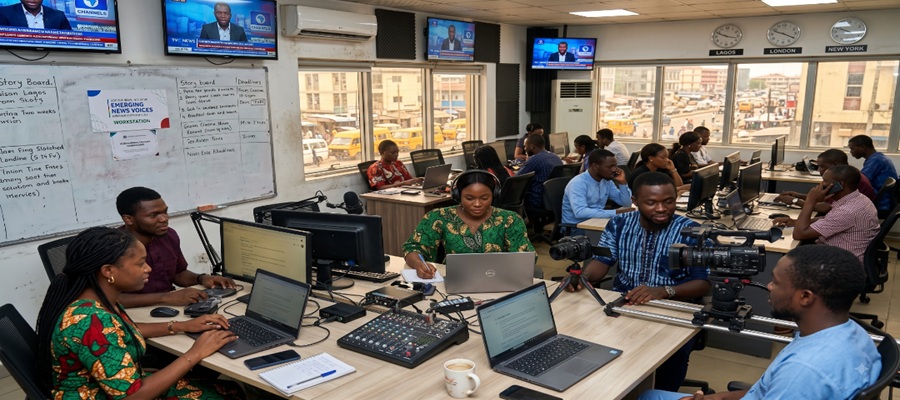
Google News Initiative (GNI) has selected six Nigerian independent news creators to participate in its Emerging News Voices Growth Lab for Sub-Saharan Africa.

The selected Nigerian creators are Onlinebanker, Adetunji Films, More Branches TV, Wearegst, Iswellthecapitalist and The Republic.
They are part of a cohort of about 20 emerging news creators from across Sub-Saharan Africa participating in the multi-month virtual programme, which runs through September 2026.
The initiative is designed to strengthen the capacity of creator-led and digital-native newsrooms through practical training in artificial intelligence, video production, audience development, direct reader engagement and sustainable revenue strategies.
The GNI said the programme was developed in response to the changing way Nigerians, particularly younger audiences, discover and consume news through social-first channels and digital platforms.
According to the initiative, while creator-led journalism is expanding rapidly, many independent newsrooms operate with limited resources and do not have the same access to technology, training and revenue expertise available to established media organisations.
Participants in the Growth Lab will work with Google trainers and product experts across four key areas.
The first is AI in the newsroom, where participants will receive hands-on guidance on integrating tools such as Gemini, NotebookLM, Google Trends and SynthID into newsroom workflows for research, transcription, translation and verification.
The programme will also focus on video and audience growth, providing practical strategies for building YouTube channels and using both Shorts and long-form video to reach new audiences.
Another area is direct reader relationships, with participants expected to strengthen their open-web presence and newsletters in order to develop first-party audiences that newsrooms can directly engage.
The fourth area is sustainable revenue, with sessions covering monetisation strategies, product differentiation and audience growth models.
Marianne Erasmus, News Partnerships Lead, Middle East and Africa at Google, said independent news creators and digital-native newsrooms were increasingly shaping how Africans, particularly Nigerians, find and understand news.
“Independent news creators and digital-native newsrooms are shaping how Africans, and Nigerians in particular, find and understand the news,” Erasmus said.
She said the Growth Lab would equip emerging newsrooms with practical AI skills, video and audience strategies, direct relationships with readers and approaches to sustainable revenue.
Erasmus added that strengthening the capabilities and financial independence of emerging news voices would contribute to a more resilient, diverse and sustainable news ecosystem.
Wale Lawal, Founder and Editor-in-Chief of The Republic, said the programme was providing practical ways for the publication to combine audience insights, product thinking and responsible AI use.
“Google’s Emerging News Voices Growth Lab is giving us practical ways to combine audience insight, product thinking and the responsible use of AI as we build a more sustainable future for The Republic’s journalism,” Lawal said.
Similarly, Nasir Achile Ahmed, Editor-in-Chief and Co-founder of MoreBranches, said the programme had provided practical resources, new tools and opportunities to connect with experts and fellow journalists.
Ahmed said the initiative had also provided information that validated some of the newsroom’s previous observations while equipping its team with knowledge on how to use new tools effectively.
He said the engagement with experts and fellow journalists had created a supportive environment for strengthening storytelling.
The Growth Lab emerged from the Global News Gap Project, a continent-wide mapping initiative conducted with Project Oasis and Code for Africa to identify independent African news creators and areas where emerging newsrooms require additional support.
The programme is part of Google’s broader support for the Nigerian media industry.
Since 2018, Google has supported newsroom transformation projects through the Google News Initiative and provided publishers with opportunities to strengthen their advertising revenue capabilities through the Ad Manager Academy.
Google said that since 2024, it had trained more than 1,500 Nigerian journalists and editors in areas including online safety, advanced Search, digital verification and audience analytics.
It also supports media skills development through its collaboration with the MTN Media Innovation Programme, where fellows receive practical training on AI as a productivity partner and newsroom technologies, including News Consumer Insights and Gemini.
The latest initiative reflects the growing importance of digital-native journalism as news consumption continues to shift towards social media, video platforms and other online channels.
Through the Growth Lab, GNI is seeking to help emerging news creators build stronger digital operations, expand their audiences and develop sustainable business models while responsibly adopting emerging technologies.

NUPRC Warns of Counterfeit, AI-Generated Appointment Letters

KudiWave Asks for Clarification over N750m Transfer from PalmPay Account

NCC Reports over 5,000 Fibre Cuts in 6 Months

PalmPay Reinforces Commitment to Youth Empowerment on International Youth Day

ipNX Joins Calls for Innovation-Friendly Ecosystem and Stronger Local Opportunities at Regenesys AI Summit

EFCC Busts NIS Visa Overstay Racket, Uncovers N700m in an Account

Fact-Check: Elon Musk’s “Tesla Pi Phone” is Internet Rumor

NBC Tasks Broadcasting Stations over 2028 DSO Global Deadline

NBC Scraps Annual Digital Access Fee on DSO

Glo Sponsored African Voices to Feature Netflix’s “The Polygamist” Stars




 E-Business3 days ago
X Replaces Revenue Sharing wit New Creator Rewards Programme

 Telecom3 days ago
MTN Alerts Subscribers over Fake 25GB Anniversary MTN Data Giveaway

 E-Financial3 days ago
Interswitch, Temenos Commit to Advancing Nigeria’s Digital Banking Technology

 E-Financial3 days ago
FG Spent N3.1 Trillion on Domestic Debt Servicing in Q1- DMO

 General News2 days ago
Fake Agency: ICPC Indicts NITDA, Others over Inadequate Due Diligence

 General News3 days ago
UNESCO Taps Oguamanam,Nigerian Scholar to Advisory Body on Science, Tech Ethics

 General News3 days ago
Tax Reform Built on Taxing Prosperity, Not Poverty– Adedeji

 Telecom2 days ago
MTN Nigeria Clocks 25, Connects over 90m People