

General News
Microsoft Delivers Best Cloud Connected Services – Makwane

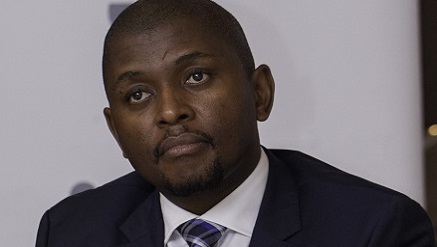
Kabelo Makwane, country manager, Microsoft Nigeria, holds BComm certificate from the University of KwaZulu-Natal, and MBA from the University of the Witwatersrand.
Prior to his present role as country manager, Makwane served as public sector director in the Microsoft South Africa subsidiary.
He had worked as the regional sales manager, Cisco Systems; portfolio sales executive, Unisys; product manager/account manager, Datacentrix and software and media product manager, Storgate Africa.
Makwane in this interview with peter ugwu, said it was a time when Microsoft can achieve real economic impact in the country based on its focus on unlocking the economic opportunities of Africa.
Microsoft’s Contribution to the Paradigm Shift in Operations of Organizations
In a mobile-first, cloud-first world, Microsoft is committed to delivering the best cloud connected services on every device.
For more than two decades, Microsoft Office has been the chosen productivity tool for consumers and businesses alike.
Our innovation in mobile and cloud scenarios ensure that Office will be the productivity service of choice for many years to come, alternatives don’t compare.
Microsoft’s Strategy
Our strategy is one that says: We want to be the do more Company that enables people to be more; which essentially means enabling high value activities irrespective of the sector, or whether people are at home, on the move or at work.
I can say that our niche is in human capacity or skills development, retail or services, because we are servicing the spectrum of the entire market.
Sectors like the public, private, consumer or enterprise, have our backing; our broad portfolio of products allows us to do that with comprehensive solution offerings in the experiences we can enable through our proportions.
BYOD Era and Helping CIOS Make It Happen
Microsoft helps enterprises address BYOD, so employees can use the devices and services they love and IT can protect company data.
Our approach is more than mobile device management. It starts with employee identity, trust, security and includes devices, apps and cloud services.
While Bring Your Own Device (BYOD) can bring potential benefits to organizations, and it also creates specific challenges, particularly regarding device management, the segregation of data and security.
There must be a balance of establishing clear policies and the right services: Companies in Nigeria need to put the proper device management systems and infrastructure in place to ensure that their company is not put at risk and at the same time benefit from a more engaged and motivated workforce by making devices and company services conveniently available.
Further, policies need to be implemented to ensure workers are using devices and services that will best enable them to do their jobs effectively.
How Has Microsoft Contributed to Skills Development in Africa
This is one of biggest focal areas, because it is typically the biggest challenge we see in unleashing and realizing the potential of the Nigerian and Africa’s ecosystem.
Broadening the skills pool is something very core to our strategy for Africa. One of the key pillars of our investing in Africa is creating 21st Century skills and those that are exportable, at par with any other skills globally.
What are we doing right now? We have launched an internship program; we have 17 interns in our Lagos office on a twelve month program.
We are planning to expand the program. These interns may not all end up only employed by Microsoft. We will make them available once they sort of on top of their program.
They will be available to our channel partners or customer who wants to employ them, because they would have become highly skilled.
We are partnering broadly with over 2000 partners in identifying strategies in which we can drive partner enablement to broaden the skills pool.
We will continue to build capacity for these partners to continue to deliver to clientele throughout the Nigerian market.
The other thing we look at is how do we tap into the academic institutions and partner with them. For example in Anambra State, we are setting up ICT Academics together with the Academic Institutions in conjunction with Anambra state.
These are ongoing projects. Essentially, we are looking at ways in which we can expand these projects to reach more youth.
In looking to reach as many people as possible the downstream economic impact could become more evident.
Various Programmes under 4afrika Initiative and their Impact
Microsoft and its partners work closely with organizations and people across Africa to fully harness the power of innovation to meet the needs of our countries and communities.
Through flexible solutions, programs and partnerships and a business model that puts people first.Our objective isn’t innovation for innovation sake, but innovation that make real impact for a better Africa.
A year after the launch of this initiative, in terms of collective African impact, we have not only laid much of the groundwork for what we will do in 2014 and beyond, but we have also successfully rolled out four White Spaces projects to provide low-cost, solar powered broadband to communities in Ghana, Kenya, Tanzania and South Africa, not just that, we have signed cooperation agreements with four innovation hubs in Africa, including CcHUB in Nigeria, DTBi in Tanzania, iHub& m:lab in Kenya, and AfriLabs, the pan-African hub network. CcHUB is Nigeria’s first innovation lab and pre-incubation space designed to catalyze creative social technology ventures.
Also, we kicked off the 4Afrika Scholarship Program providing 1,000 scholarships to young African students through our partnerships with the University of the People (online university) and Regenesys Business School (South Africa).
Microsoft further introduced the 4Afrika Advisory Council to ensure the 4Afrika initiative does in fact help Africa become and remain globally competitive for the benefit of Africa’s people.
We also announced additional four youth members to address issues facing youth in Africa, one of which is from Nigeria (Chude Jideonwo).
Today, we have provided innovation grants (seed funding via Microsoft Ventures as well as technical support and mentorship via 4Afrika) for five African startups including access.mobile LLC, Africa 118, Gamsole, Kytabu and Save & Buy, two of which are Nigerian (Gamsole and Save &Buy) .
Through the 4Afrika Interns, we have engaged over 17 interns from Nigeria to work with the Microsoft setup locally. With the aim to give them exposure to world class skills and the opportunity to better equip themselves.
The Initiatives Will Spark Intellectual Property Developments, But The Issues Of Rights And Protection, How Is Microsoft Faring In This Regard?
As a corporate entity we are working with regulatory institutions locally to provide an enabling environment for innovations and protection of their rights on their inventions, we’ve also embarked on some awareness creation campaigns through our “Play It Safe” Campaign to further drive home our message of the need to protect the rights of Intellectual Property.
Nigeria’s Rebased Economy
Perhaps, the most imposing revelations emerging from the rebasing result is the fact that the structure of the Nigerian economy is changing.
The economy is now shown to be driven largely by the services sector, which accounts for 53 percent of the GDP (vs. 29% pre-rebasing).
For the ICT Industry we see a situation where Cloud adoption in Nigeria is expected to grow from 36% to 80% by end of 2014 and with a purported $50 B foreign investment into the ICT sector from International organizations, we would continue to see the IT industry in Nigeria soar in the months.



Federal government, The European Union (EU), and the United Nations Industrial Development Organisation (UNIDO) have called for urgent and coordinated action to curb food waste and promote sustainable consumption and production practices.

They warned that when food is wasted, the water, energy, and labour invested in its production are also lost, accelerating climate change and undermining global efforts to build a zero-waste, circular economy.
Speaking in Abuja at the commemoration of this year’s International Zero Waste Day, themed “Food Waste Reduction: Minimisation and Valorisation,” Zissimos Vergos, deputy Ambassador of the EU Delegation to Nigeria and ECOWAS, disclosed that Nigeria wastes approximately 38 million tonnes of food annually, more than any other country in Africa.
He further noted that globally, in 2022 alone, nearly one billion tonnes of food—almost one-fifth of all food available to consumers—was wasted.
“This is not just a loss of food; it is a squandering of precious resources, a missed opportunity to combat hunger, and a direct threat to our planet’s health,” he said.
Vergos stressed that food loss and waste are major drivers of environmental degradation, contributing up to 10 per cent of global greenhouse gas emissions—nearly five times the emissions of the entire aviation sector—and accounting for as much as 40 per cent of global methane emissions.
Highlighting Nigeria’s ongoing efforts, he said: “The Nigeria Circular Economy Roadmap, the establishment of the Interministerial Circular Economy Committee, the push to develop a National Plastic Waste Management Regulation, these are not small gestures. These are structural shifts.
“They signal that Nigeria is not waiting for someone else to solve its problem; it is building the system to solve it from within. Now, today’s theme: food waste reduction, minimisation and valorisation, is the right conversation at the right moment.”
Vergos also shared three key lessons from the EU’s experience to support Nigeria’s efforts. First, he urged investment in rural infrastructure, including roads, storage, and cold chains, to address post-harvest losses beyond the farm gate. Second, he emphasised the need to promote agro-processing by converting fresh produce into value-added products such as tomato paste and cassava flour, while linking smallholder farmers to processors and markets.
Third, he called for embedding zero-waste principles, recycling, and resource efficiency into school curricula from the primary level to foster a culture of sustainability among future generations.
Reaffirming the EU’s commitment, he stated, “The EU stands ready to be your partner in that work, through funding, through technical cooperation, and through genuine solidarity.”
In his keynote address, Balarabe Abbas Lawal, minister of Environment, reiterated the Federal Government’s commitment to environmental protection and sustainable practices aimed at safeguarding the health and well-being of Nigerians.
“Food waste remains a significant challenge that affects not only our environment but also our economy and society. Every discarded meal represents wasted resources such as water, energy, labour, and capital, while Nigerians continue to face food insecurity.
Addressing food waste is therefore central to sustainable development and ensuring a healthier future for all,” he said.
He added: “The Federal Ministry of Environment, in this year’s national appropriation, has developed projects on food waste elimination in major markets around Nigeria. And this is to show you that the Federal Ministry of Environment is tackling the issues of food waste at its core, especially post-harvest losses.”
Stressing the broader impact, he noted that addressing food waste aligns with the Ministry’s core objectives. “Reducing food waste will not only help to lower pollution and greenhouse gases, but also conserve valuable resources and promote more efficient and responsible consumption patterns across households, businesses, and institutions,” he added.
Also speaking, Amb. Philbert Johnson, Director and Representative of UNIDO’s Sub-Regional Office in Nigeria, emphasised that food must not be wasted, especially in a country grappling with food insecurity and malnutrition.
“Food is far more than a commodity: it is a foundation of wealth, a driver of health, and a pillar of security. It sustains our homes, supports industries, and underpins the stability of our societies.
“When food systems function efficiently, they generate income, enhance resilience, and improve well-being. When food systems fail, when food is lost or wasted, the consequences ripple across our economies, our environment, and our communities.”
He reaffirmed UNIDO’s commitment to supporting Nigeria in building resilient, inclusive, and sustainable agro-industrial systems.

President Bola Ahmed Tinubu has directed the immediate installation of 5,000 CCTV cameras across identified flashpoints in Plateau State as part of urgent measures to address the worsening security situation in the state.

The President gave the directive during an emergency visit to Plateau on Thursday, where he held a brief stakeholders’ meeting at the Yakubu Gowon Airport following the recent killings in Angwan Rukuba, Jos, where at least 28 persons were killed by unidentified gunmen.
Tinubu also approved the formation of a delegation of key stakeholders to engage in further deliberations on lasting solutions to the security challenges in the state.
He condoled with families of the victims and directed that support be provided to cushion their losses.
President Bola Tinubu while expressing deep sympathy to families of victims said the installation of surveillance cameras was part of a deliberate move towards addressing the kind of attacks that befell residence of the recent attack in the State.
In his remarks, Governor Caleb Mutfwang appreciated the President’s visit and show of concern, but expressed worry over the recent wave of attacks in the state, describing the situation as disturbing and requiring urgent attention.
The meeting had in attendance, former Governors, serving and former National and State Assembly members, traditional rulers, government appointees as well as relatives of those killed in the Angwan Rukuba attack.

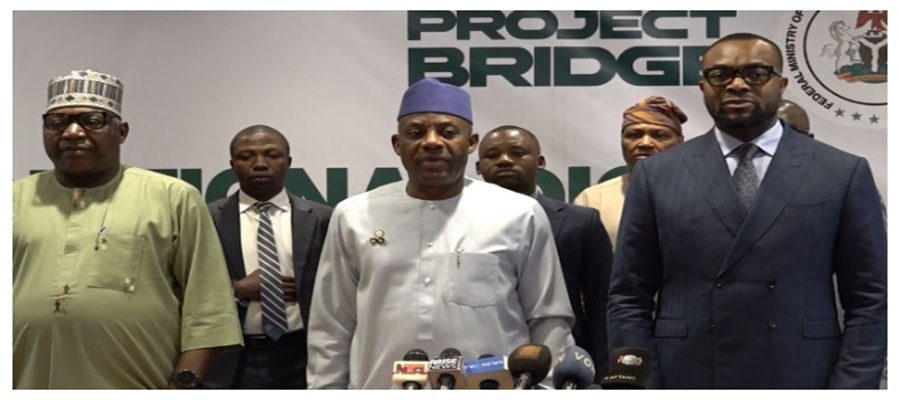
Federal Government yesterday unveiled a N12 billion investment in digital economy research, marking a strategic shift towards knowledge-driven development as Nigeria positions itself as a key player in the global digital landscape.

Declaring the launch of the National Digital Economy Research Clusters under the Building Resilient Digital Infrastructure for Growth (BRIDGE) project, Minister of Communications, Innovation and Digital Economy, Dr Bosun Tijani, said the initiative mobilises over 200 researchers from universities and research institutions nationwide to produce data-driven solutions for pressing national challenges.
Speaking at a press conference in Abuja, Tijani described the programme as an essential complement to infrastructure expansion, including the ongoing deployment of 90,000 kilometres of fibre optic cable across the country.
He stressed that sustainable growth in the digital sector now hinges on robust research, innovation and evidence-based policies rather than infrastructure alone.
“As Nigeria expands its digital economy, attention is shifting from infrastructure to the knowledge that drives it,” the minister stated, adding that the sector was emerging as a major contributor to national GDP.
The research clusters will tackle critical areas including connectivity, digital public infrastructure, skills development, job creation, online safety and emerging technologies such as artificial intelligence.
Tijani explained that the project aims to bolster Nigeria’s research capacity while ensuring local insights guide policy and technology adoption.
The Federal Ministry of Education is collaborating to synchronise academic research with national priorities and advance specialised training.
Minister of Education, Dr Tunji Alausa, underscored universities’ evolving role as hubs of innovation and problem-solving beyond traditional learning.
The BRIDGE project aligns with broader government strategies to promote digital inclusion, spur economic growth and elevate Nigeria’s competitiveness in the global digital economy.
Observers note that the programme’s impact will depend on effectively converting research findings into implementable policies across sectors.
For the administration, the message is clear: a resilient digital economy demands not just infrastructure, but the intelligence to power it.

FG, Others Say Nigeria Wastes 38m Tonnes of Food Annually

Ecobank Assures of Seamless Easter Banking Services

Anchor Gets Nigerian, Canadian Licences as Transactions Crosses $2.5Bn

CycleFlow, IFC Launch Supply Chain Finance Platform in Nigeria

NITDA Strengthens Collaboration with NIPSS to Drive Digital Innovation, Orange Economy Growth

Spotify’s Loud & Clear Report Reveals Over ₦60Bn Revenue for Nigerian Artists in 2025

Madonna University Taps Tech Guru Adote for Strategic Board Role

China Threatens to Shut Nigeria’s Satellite Over $11.44m Unpaid Debt

FCCPC Bans Lagos ‘No Refund’ Policy, Vows Fines and Shutdowns for Traders

Healthcare Under Attack: Why Cybersecurity is Now Critical Care




 E-Financial2 days ago
CBN Says 33 Banks Raise Fresh N4.65 Trillion in Recapitalisation Exercise

 Telecom2 days ago
NITDA Urges Joint Action to Drive Nigeria’s Digital Innovation

 Telecom2 days ago
NCC Insists Telcos Must Compensate Subscribers for Poor Quality of Service

 E-Business2 days ago
Cybersecurity Firm Uncovers CrystalX RAT which Steals Data, Mocks its Victims

 E-Business2 days ago
Oracle Sacks 12,000 in India, Begins Shift to AI

 Telecom2 days ago
Oracle Corporation Axes 30,000 Workers in Brutal AI Shake-Up

 E-Financial2 days ago
Nigeria, Others Lose $88bn Yearly to Illicit Flows —Edun

 General News2 days ago
DBI Unveils Nigeria Digital Economy Outlook 2026: Q1 Report Highlights Strategic Trends, Risks