

General News
Military Arrests Abductor of Chibok Girls

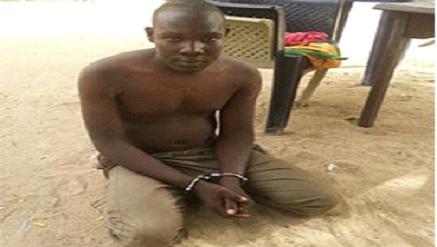
The military announced, yesterday, that it has arrested one of the sect’s leaders, who was one of the abductors of the more than 200 schoolgirls in Chibok, Borno State.
This is coming almost three months after Boko Haram terrorists abducted the schoolgirls and on a day the sect members bombed a Divisional Police Headquarters in Shani Local Government Area of Borno State and also attacked an emir’s palace.
The alleged abductor of the Chibok girls, whose name was given as Babuji Ya’ari, was also said to have led the attack in which the Emir of Gwoza, Alh. Idriss Timta, was killed a few weeks ago.
Maj. Gen. Chris Olukolade, director of Defence Information, disclosed in a statement issued in Abuja, yesterday, that Ya’ari doubled as member of the Youth Vigilante Group, popularly known as Civilian JTF.
According to the Defence spokesman, the Boko Haram kingpin used his membership of the civilian JTF only as a cover, as he has been coordinating deadly attacks in Borno State since 2011.
He added that the arrest of Ya’ari led to the arrest of several other Boko Haram intelligence cell members. Olukolade said that those arrested had confessed their involvement with the deadly sect and named several others who were being trailed.
The full text reads: “A terrorists’ intelligence cell headed by a businessman, who participated actively in the abduction of School Girls in Chibok has been busted by troops. The man, Babuji Ya’ari, who is also a member of the Youth Vigilante Group popularly known as Civilian JTF which he uses as cover while remaining an active terrorist, also spearheaded the murder of the Emir of Gwoza. His main role in the group is to spy and gather information for the terrorist group.
“Babuji has been coordinating several deadly attacks in Maiduguri since 2011, including the daring attacks on Customs and military locations as well as the planting of IEDs in several locations in the town.
“The arrest of the businessman, who is known to deal in tricycles has also yielded some vital information and facilitated the arrest of other members of the terrorists’ intelligence cell who are women. One of them, Hafsat Bako had earlier escaped to Gombe State to avoid suspicion but was tracked and arrested. Prior to her arrest, Hafsat coordinated the payment of other operatives on the payroll of the group. In her confession, she disclosed that a minimum of N10,000 is paid to each operative depending on the enormity of his task.
“Another female suspect named Haj Kaka, who doubles as an armourer and a spy for the terrorist group has also been arrested. Until their arrest, all the suspects actively operated a terrorists’ intelligence cell in collaboration with others still at large.
“In another development, troops deployed in Goniri, Yobe State, over the weekend, had an encounter with terrorists, resulting in casualties on both sides after the attack was successfully repelled”.



Kaspersky has announced a major update to Kaspersky Anti Targeted Attack 8.0 (KATA 8.0), designed to help organisations improve visibility across their networks and detect sophisticated cyberthreats earlier and with greater accuracy.

As the attack surface continues to expand and traditional network perimeters dissolve, security teams face growing challenges in controlling network traffic security. KATA 8.0 addresses these challenges with new detection technologies, broader network observability and tighter integration with Kaspersky’s security ecosystem and third-party solutions.
Advanced detection technologies for modern threats
KATA 8.0 introduces several new detection capabilities aimed at improving threat detection while reducing alert fatigue.
The new anomaly detection technology identifies suspicious network behaviour by analysing key protocols commonly abused in cyberattacks, such as DNS, HTTP and Kerberos.
Instead of inspecting all network traffic, the technology focuses on protocol-specific deviations while taking into account the organisation’s infrastructure and usage patterns. This approach significantly improves detection accuracy and helps reduce false positives.
With shadow IT detection, KATA 8.0 enables organisations to identify the use of unauthorised public services. The solution supports more than 5,000 external services, including popular cloud storage and collaboration platforms, helping security teams improve network visibility and regain control over corporate data flows.
KATA 8.0 also introduces retrospective scanning of user-uploaded traffic copies. Security teams can now upload PCAP files manually or automatically from other security systems and analyse them using the latest detection rules and updates across Kaspersky’s anti-malware, sandbox, IDS and other engines. This enables deeper investigations and the discovery of threats that may have gone undetected at the time of the incident.
In addition, KATA now can collect all the observables from the network traffic including file names, URLs and hashes – not only malicious objects, but also the safe ones. This allows analysts to identify potentially compromised users and suspicious activity even when objects initially appear clean, providing a broader and more proactive security perspective.
Stronger integrations for faster investigations and response
KATA 8.0 also enhances integration with other Kaspersky solutions and external platforms to streamline investigations and improve response times.
Integration with Kaspersky Security for Mail Server (KSMS) enables dynamic scanning of password-protected email attachments in the KATA Sandbox, while enriched KATA alerts now include full visibility into actions taken by KSMS, such as blocking or deleting suspicious content.
For organisations using Managed Detection and Response (MDR), KATA 8.0 acts as a network sensor supplying telemetry directly to the MDR cloud. MDR analysts can now also request additional context from KATA directly through the MDR interface, without involving the customer, significantly accelerating investigations.
The solution also supports automated file submission from Kaspersky Endpoint Security (KES) to the KATA Sandbox, enabling deeper analysis of suspicious files discovered on endpoints and faster response actions when malicious verdicts are confirmed.
To strengthen active response capabilities, KATA 8.0 introduces new connectors for Check Point NGFW, allowing the solution to automatically generate blocking rules based on detected malicious network activity and enforce them at the firewall level in near real time.
Ilya Markelov, Head of Unified Platform Product Line at Kaspersky, says: “Kaspersky Anti Targeted Attack 8.0 was designed to provide high level of visibility, enabling proactive threat detection, deeper investigations and more confident response decisions through advanced analytics and tight integration with endpoint protection, email security, MDR and other products and services.
“As part of its long-term development strategy, in future releases we plan to move KATA to the Open Single Management Platform (OSMP). This will enable seamless integration with multiple Kaspersky solutions and third-party components through a unified web console, supporting NDR, EDR, SIEM, XDR and more within a single security ecosystem.”
General News
Court Fines Lafarge Africa N2m for Using Ex-Employee’s Name, Details Online after Dismissal


National Industrial Court of Nigeria in Lagos has ordered Lafarge Africa Plc to pay N2 million in damages to a former employee after finding that the company unlawfully retained and continued using his personal data years after his exit.

In a judgment delivered on February 17, 2026, in Suit No. NICN/LA/60/2022, Justice Ikechi Gerald Nweneka ruled that the cement manufacturer breached the claimant’s right to privacy by listing his name and contact details in official purchase orders long after his employment ended.
Mr. Kehinde Adeniyi Johnson, claimant, had approached the court in February 2022, alleging that although he left the company in November 2019, his name, personal email address and phone number remained attached to Lafarge’s.
He sought multiple declarations and N50 million in general and aggravated damages, arguing that the continued use of his identity amounted to unlawful usage, fraudulent misrepresentation and emotional distress.
According to court filings, Johnson told the court that he kept receiving calls, emails and WhatsApp messages from suppliers and logistics agents regarding consignments intended for Lafarge.
He recounted an incident involving a shipment from India: after being contacted by a dispatcher, he accepted delivery but was denied access to company premises upon arrival.
He later alleged that he was attacked by armed robbers in the aftermath, blaming the exposure created by the company’s continued use of his identity.
Lafarge denied liability, attributing the issue to a system malfunction. The company maintained that it deactivated Johnson’s official email and server access upon his departure and notified relevant suppliers of his disengagement.
It also challenged the court’s jurisdiction, arguing that claims relating to tort and emotional distress fell outside the court’s scope.
In addressing preliminary objections, Justice Nweneka dismissed the company’s challenge to the admissibility of emails and WhatsApp messages tendered as evidence, holding that the communications were not hearsay since they involved the claimant and company representatives.
On jurisdiction, the court held that the dispute stemmed directly from the employment relationship and therefore fell within its competence.
It further clarified that the suit was not brought under the Fundamental Rights Enforcement Procedure Rules, making it properly instituted before the court.
After reviewing the evidence, the judge found that Lafarge continued to use Johnson’s name and telephone number in purchase orders well after his exit, thereby violating the Nigeria Data Protection Act and Section 37 of the 1999 Constitution, which guarantees the right to privacy.
he court also upheld the claim for intentional infliction of emotional distress, describing the company’s conduct as reckless, particularly after it had been formally notified by the claimant’s solicitors.
However, several other claims including those relating to human dignity, tortious interference, indemnification and aggravated damages were dismissed for lack of proof or improper framing.
In awarding N2 million in damages, the judge cited statutory limits under the data protection law and the principle of proportionality.
The court further directed Lafarge to permanently erase the claimant’s personal data from its servers, applications and procurement systems, and to deactivate any pre-generated codes bearing his name.

Mark Zuckerberg’s tech empire is once again under regulatory pressure in Africa after competition authorities across 21 markets launched a formal probe into changes affecting WhatsApp’s AI ecosystem.

The Common Market for Eastern and Southern Africa (COMESA) Competition and Consumer Commission has opened an investigation into Meta Platforms over amendments made in October 2025 to the WhatsApp Business Solution Terms.
At the heart of the probe is whether the updated rules unfairly restrict third-party artificial intelligence providers from accessing the WhatsApp Business API, while preserving full integration for Meta’s own AI tools, including Meta AI.
In a notice issued by the regulator, the commission said it has “reasonable cause to suspect” that Meta may hold a dominant position in the common market and that the changes could “substantially lessen competition” by excluding rival AI service providers from what it described as a crucial digital gateway.
The investigation spans 21 member states, including Kenya, Egypt, Ethiopia, Uganda and Zambia. Stakeholders have been invited to submit feedback before 16 March 2026, with regulators emphasising that the move marks the start of a fact-finding process, not a ruling of wrongdoing.
This is not the first time Meta has faced scrutiny in Kenya and East Africa. Kenyan authorities have previously examined major digital platforms over data protection, misinformation and labour practices. In Nigeria, the data protection regulator fined Meta over privacy violations, underscoring growing African oversight of global tech firms.
Globally, the company is also navigating regulatory headwinds. The European Commission and Italy’s competition authority have reviewed Meta’s AI integrations on WhatsApp amid concerns about potential restrictions on rival chatbot providers. In the United States, Meta has faced antitrust litigation over its broader market dominance.
For Africa’s digital economy, the stakes are high as WhatsApp remains one of the continent’s most widely used platforms for communication, commerce and customer engagement. Across COMESA’s 21 markets, millions of small businesses rely on WhatsApp Business to reach customers, while startups are increasingly building AI-driven services on top of the platform.
If regulators determine that access to WhatsApp’s business interface is being restricted in favour of Meta’s own AI tools, there is genuine concern that it could limit opportunities for African developers and startups seeking to innovate in the fast-evolving AI space.

Lotus Bank, REA Seal N100bn Deal to Power Rural Nigeria

DG NITDA Reaffirms FG Commitment to Responsible, Inclusive AI

AfDB, UNDP Launch $10Bn AI Initiative for Africa

Kaspersky Enhances Network Detection and Response Capabilities with KATA 8.0 Release

Kuda Bank Teams Up with Lovers & Frnds for Inclusive Valentine’s R&B Bash
Nigeria’s 9 Top FinTech Firms Valued at $10.6Bn in January 2026

CBN Upgrades Licences of Opay, Moniepoint, Kuda, Palmpay, Paga to National Status

NITDA, NBC Explore Strategic Collaboration on Digital Transformation, Media Regulation

Kaspersky Launches OT Calculator to Align Cybersecurity Investments with Business Goals

Accidental Billionaire Opts for Jail Instead of Returning Money Credited Him by Mistake




 General News2 days ago
Zinox Technologies and TD Africa Forge Strategic Partnership to Revolutionize African Tech Ecosystem

 Telecom2 days ago
Uwaje Pays Tribute to Leo Stan Ekeh @70

 E-Financial2 days ago
$214Bn Missing, Institutions Silent: Is Accountability Dead in Nigeria?

 Telecom2 days ago
Cyber Immunity Emerges as Shield for Nigerians Amid Rising Scams

 General News2 days ago
NITDA, Abia Partner on Enterprise Architecture Reform

 E-Business2 days ago
Interswitch Partners Abia to Digitise Public Hospitals

 E-Business2 days ago
WIEG 2026 Summit Shifts to April 22-23 for Maximum Impact

 News1 day ago
NITDA Urges Stronger State Partnerships as Key to Digital Economy Goals @ South-South Stakeholders Forum