

/home/kenneth/web/nigeriacommunicationsweek.com.ng/public_html/wp-content/themes/zox-news/parts/post-single.php on line 153
">
Warning: Undefined array key 0 in /home/kenneth/web/nigeriacommunicationsweek.com.ng/public_html/wp-content/themes/zox-news/parts/post-single.php on line 153
Warning: Attempt to read property "cat_name" on null in /home/kenneth/web/nigeriacommunicationsweek.com.ng/public_html/wp-content/themes/zox-news/parts/post-single.php on line 153
More Winners Emerge in DHL Destination South Africa Promo

More winners have emerged in the on-going Destination South Africa Promotion. Five winners emerged in the draw for the month of December, bringing to ten (10) the list of monthly winners recorded by the promo since it was started in November, 2009.
The latest winners are: Michael Ojo, Lawrence Lakinah, Tunde Alagbe, Oyetoro R, and Marien Hospital, all cash cutomers, among thousands of DHL customers that have so far participated in the promotion.
At a prize presentation ceremony in Lagos, Femi Owolaja, retail and agency manager, DHL Nigeria, commended the winners for believing in DHL, saying their participation in the promotion was a testimony of their affinity for the DHL brand. While describing the customers as the reason for DHL‘s continued leadership in the global logistics business, he called on the winners to keep faith in DHL by their continued patronage which he noted will motivate more people to not only patronize the brand but more so to participate in the promotion.
“On behalf of the management of DHL, I congratulate all of you for emerging winners in this promo. Your participation in the promo stems on the fact that you have been our loyal customers. We at DHL appreciate this singular honour and we urge you to sustain this relationship with us. From today, you all have become ambassadors of DHL and we count on you to remain a source of motivation for others, both existing customers and non-customers of DHL,” he said.
In their responses, Michael Ojo, Tunde Alagbe and Lawrence Lakinah commended DHL for staying true to its promise by rewarding winners in the Destination South Africa promo, while expressing optimism about their chances of picking the sole grand prize of an all-expense paid trip to South Africa.
The DHL Destination South Africa Promo is expected to produce monthly winners, determined by electronic draw and presented with various prizes ranging from DHL branded footballs and jerseys, and automatic qualification for the grand draw scheduled for May, 2010.
To participate, DHL customers are required to collect a loyalty card on which the air waybill of shipments sent will be recorded and they stand the chance of winning any of the promo prizes after every 10th shipment.


Warning: Undefined array key 0 in /home/kenneth/web/nigeriacommunicationsweek.com.ng/public_html/wp-content/themes/zox-news/parts/post-single.php on line 493
Warning: Attempt to read property "cat_ID" on null in /home/kenneth/web/nigeriacommunicationsweek.com.ng/public_html/wp-content/themes/zox-news/parts/post-single.php on line 493


PowerLabs aims to expand its platform into Nigeria’s most energy-intensive sectors with the new funding. Providing hospitals and industrial hubs with the intelligent, automated control required to ensure continuous power and operational resilience.

PowerLabs, a Nigerian energy and climate-tech startup, announced the successful close of its pre-seed funding round led by Breega, with participation from Catalyst Fund, Mercy Corps Ventures, and Kaleo Ventures.
This strategic investment will accelerate the rollout of Pai Enterprise, the company’s flagship AI-enabled energy orchestration platform across commercial and industrial enterprises in Nigeria and lay the foundation for expansion into key West African markets
For decades, Nigerian energy management has centered on basic monitoring and tracking of energy consumption. Yet for the millions of businesses dealing with unreliable power grids, diesel generators, rooftop solar, inverters, and battery banks working together to keep operations running, visibility alone delivers no real value unless it leads to resilience and continuity.
The manufacturing sector alone spent ₦1.11 trillion on alternative energy sources in 2024, which is a 42% increase from the year before. A small factory changes its work hours based on when it can get generator fuel. To keep critical care going, a hospital coordinates backup systems.
Every day, the facility team of a commercial building has to make dozens of decisions about reactive energy. Monitoring tools already in use tell you what went wrong, but they do not provide solutions or preventive measures to address the issues identified.
Pai Enterprise changes that equation. Unlike conventional dashboards, Pai Enterprise does not simply observe; it senses, communicates, and actuates across multiple distributed energy sources in real time. By continuously modelling supply, demand, and operational constraints, the platform enables organizations to run their own intelligent microgrid. As a result, the platform transforms energy from a reactive problem into a proactive, strategic resource.
This vision of a self-optimizing energy ecosystem was recently highlighted in a feature that explored how PowerLabs wants to make Nigeria’s grid think by shifting the paradigm from passive consumption to active, intelligent orchestration.
The measurable impact spans Nigeria’s most critical sectors:
- Hospitals: With intelligent monitoring across critical circuits, teams are instantly notified when there are fluctuations in supply, voltage drops, or automatic transitions to backup systems. This real-time visibility ensures that departments like intensive care, laboratories, and operating theatres remain protected, enabling faster response, reduced risk of disruption, and continued patient care.
- Data Centres: By providing continuous insight into the performance of energy assets such as solar systems and generators, operators can track efficiency, optimize usage, and reduce emissions without compromising uptime. The result is a more sustainable infrastructure that still meets the uncompromising reliability standards required for digital operations.
- Factories: Factories require more than just stable power, they need actionable intelligence to drive performance and profitability. Through detailed energy analytics, operators can identify inefficiencies, understand consumption patterns across production lines, and make informed decisions that reduce costs while maintaining output. This transforms energy from a fixed expense into a controllable lever for operational efficiency.
- Retail outlets: By analyzing consumption trends and usage behavior, retail outlets can right-size their energy assets, avoiding overinvestment while ensuring sufficient supply during peak periods. This leads to lower operating costs and improved energy efficiency across single or multi-site retail operations.
- Critical facilities: For critical facilities such as telecom towers, banks, schools etc, uninterrupted operations depend on anticipating issues before they occur. Continuous real-time monitoring enables early detection of anomalies and supports predictive maintenance strategies, reducing downtime and extending asset lifespan.
Tobe, CEO & Co-Founder, PowerLabs said: “Distributed energy resources are often seen as fragmented and chaotic, a clutter of devices that don’t speak the same language. At PowerLabs, we believe decentralization doesn’t have to mean disorder. We’re building the intelligence layer that will prove that distributed energy resources can operate as a unified source while leveraging its disaggregation to offer flexibility, cost efficiency, carbon neutrality and redundancy … more than a centralised energy system ever could. “
PowerLabs will strategically deploy the raised capital to accelerate the rollout of its flagship Pai Enterprise platform, improve its cutting-edge predictive load-management algorithms, and broaden seamless integration with distributed energy assets ranging from rooftop solar and battery storage systems to traditional grid infrastructure.
This funding round brings together a mix of global and Africa-focused investment partners with deep commitment to climate-tech and a proven track record of scaling innovation in emerging markets, all aligned on PowerLabs’ mission to solve energy resilience.
Breega is an international fund investing in digital, climatech, and deeptech companies across Europe and Africa. Mercy Corps Ventures backs market-systems solutions in fragile and frontier markets; Catalyst Fund, a leading climate-tech investor backing solutions for climate adaptation and resilience in Africa. Kaleo Ventures specializes in early-stage technology companies across high-growth African markets. With their support, PowerLabs is now positioned to scale its intelligent energy solutions, expand Pai Enterprise across sectors and geographies, and demonstrate that the era of traditional energy management is over. Personalized, decentralized, resilient, and intelligent systems are the future, and for millions of people and organizations, that future is already here.
Tosin Faniro-Dada, Partner, Breega, stated that: “We backed PowerLabs at the pre-seed stage because we believe intelligent orchestration will be essential to solving Africa’s energy reliability challenge. The team is building the software and hardware layer that enables businesses to coordinate multiple distributed energy sources in real time. We’re excited to support them as they prove the impact of this model across critical sectors over the next 12–18 months.
The closing of this investment round is therefore more than a financial milestone: it is a signal that investors, businesses recognize the need for energy systems that do not merely report, but act; that do not assume stability, but adapt in real time; and that view energy not as a static commodity, but as a platform for growth, resilience, and human potential.
“Globally, more and more businesses and critical services like data centers operate in complex energy environments where a mix of energy sources must work together. The energy users typically have to toggle between cost, quality of supply and carbon footprint. PowerLabs is starting in Africa to build the intelligence to orchestrate these systems seamlessly without sacrificing any of these critical factors.” Olúwátóyìn Emmanuel-Olúbákè, Chief Investment Officer, Catalyst Fund
Energy management alone is not enough, and for millions of users who have long struggled with outages, unreliable grids, and fragmented infrastructure, the promise of intelligent energy is not merely convenience; it is the key to unlocking their full potential and powering a new era of human progress.

Kashifu Inuwa, the Director General of the National Information Technology Development Agency, has issued a decisive mandate for African nations to establish domestic cloud infrastructure and data sovereignty or risk permanent digital subservience.

Speaking during a high-level strategic session at the GITEX Africa 2026 summit in Morocco, Inuwa argued that the continent must move beyond being a passive consumer of foreign technology to becoming a primary architect of its own digital ecosystem.
He warned that the current state of continental fragmentation leaves Africa vulnerable to external disruptions and prevents the realization of a truly integrated digital economy.
Inuwa characterised the modern global landscape as an environment defined by high-velocity data processing and pervasive intelligent systems, noting that digital integration is now a non-negotiable prerequisite for national survival.
He grounded this technical reality in a striking analogy, describing the cloud as the fundamental life-support system of the modern world. “In today’s reality, digital is no longer optional; it is a way of life,” Inuwa stated. “And the cloud is the oxygen that sustains that life.
The question we must ask ourselves is: who controls that oxygen?”
The push for cloud sovereignty represents a move toward localised data residency and autonomous computational power. Inuwa stressed that without regional data centers and unified regulatory frameworks, African nations remain subject to the policy shifts and geopolitical priorities of overseas providers.
He advocated for a shift from fragmented, siloed efforts toward a federated regional approach that pools resources and expertise to build a robust, self-sustaining African cloud. This transition is essential for ensuring that the massive datasets generated by African users are utilized to train local artificial intelligence models and catalyse internal economic growth rather than being exported for external profit.
The NITDA boss expressed concern over Africa’s limited share of global digital infrastructure, noting that while the continent accounts for between 15 to 19 percent of the world’s population, it holds only about 0.6 percent of global data centre and computing capacity.
He described the imbalance as a structural disadvantage that exposes African countries to risks around data security, economic dependency, and limited participation in the global innovation ecosystem.
“This is not just a technology gap, it is a sovereignty gap,” Inuwa stated. “We are generating data, but we are not in control of how and where that data is stored, processed, or monetised.”
He warned that over reliance on foreign owned cloud platforms could have long term implications for national security, economic competitiveness, and policy autonomy, especially as data becomes a critical resource in the global economy.
Despite these challenges, Inuwa highlighted Africa’s immense potential, pointing to its youthful population, expanding internet penetration, and fast growing startup ecosystem as key drivers of digital growth.
He said the continent is uniquely positioned to leapfrog legacy systems and build modern, scalable infrastructure that can support innovation across sectors.
However, he stressed that achieving this vision would require coordinated action among African governments, private sector players, and regional institutions.
“There is no single country in Africa that can do this alone,” he said. “We must collaborate, integrate our efforts, and build shared infrastructure that benefits the entire continent.”
Central to his recommendation is the creation of a “cloud of clouds” a federated cloud ecosystem that connects multiple national and regional cloud platforms into a unified, interoperable network.
Such a system, he explained, would allow countries to maintain control over their data while benefiting from shared standards, scalability, and cross-border collaboration.
Inuwa pointed to Europe’s Gaia-X as a useful reference model, noting that while Africa’s context is different, the principle of building a trusted and interconnected cloud ecosystem remains relevant.
He emphasised that cloud sovereignty should not be misunderstood as protectionism or digital isolation, but rather as the capacity for self determination in the digital age.
“Sovereignty is about having the ability to make our own choices, to define our own standards, and to build systems that reflect our values and priorities,” he said.
Inuwa further noted that developing indigenous cloud capacity could unlock significant economic opportunities, including job creation, local innovation, improved digital services, and increased investor confidence.
It could also strengthen Africa’s position in emerging technologies such as artificial intelligence, big data analytics, and the Internet of Things, all of which depend heavily on robust cloud infrastructure.
The DG concluded by emphasising that the quest for digital sovereignty is not merely a technical objective but a strategic imperative for long-term stability. He asserted that for Africa to achieve meaningful autonomy in an increasingly digitised world, it must secure its own computational foundations.
By establishing indigenous control over data processing and storage, the continent can insulate its critical national infrastructure from external volatility while ensuring that its digital future is determined by its own policies and priorities. The message was clear: Africa must harmonise its infrastructure and localise its computational assets now or face an era of unprecedented digital marginalisation.
As global competition in the digital space intensifies, Africa’s ability to act collectively and strategically will determine whether it emerges as a major digital powerhouse or remains on the periphery of the digital revolution.
Telecom
Digital Encode Sponsors PAFON 3.0 as CVO Prof. Adewale Set to Deliver Keynote on Cybersecurity and Trust

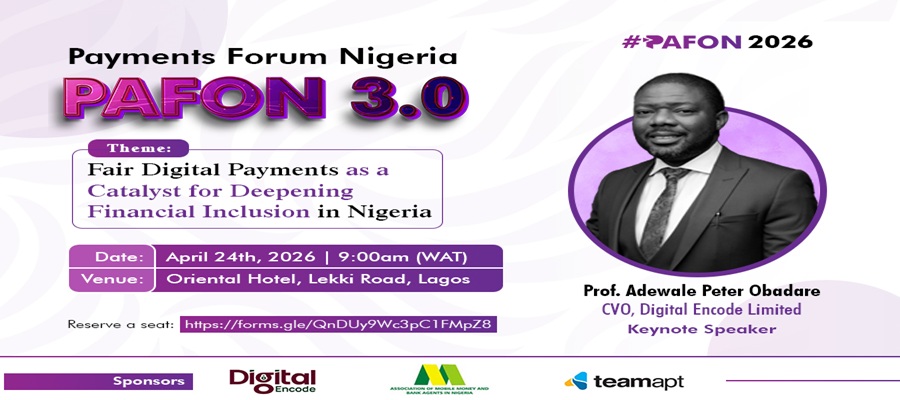
Digital Encode Limited has emerged the lead sponsor of the upcoming third edition of the forum (PAFON 3.0), the organisers have announced.

PAFON 3.0
PAFON 3.0 is scheduled to take place on Friday, April 24, 2026, at the Oriental Hotel, Lekki Road, Lagos, from 9:00 AM to 1:00 PM.
Themed “Fair Digital Payments as a Catalyst for Deepening Financial Inclusion in Nigeria,” PAFON 3.0 serves as a strategic platform for senior executives from banks, fintechs, regulatory agencies, and technology innovators to address the evolving digital payment landscape.
As Nigeria transitions toward a cash-light economy, the forum will focus on critical pillars of sustainability, including transparency, pricing integrity, and system resilience.
Bridging Cybersecurity and Financial Inclusion
Professor Adewale Peter Obadare, the Founder/chief visionary officer of Digital Encode will deliver a cybersecurity-focused keynote address that connects trust, resilience, fraud prevention, and consumer protection to financial inclusion.
His session will provide a specialized perspective on how information security serves as the bedrock of financial inclusion; exploring the vital links between building infrastructure that consumers can rely on, protecting the ecosystem to allow inclusion to scale, and ensuring equitable and secure access for all Nigerians.
Prof. Obadare is arguably the most Credentialed PAN-African Digital Trust Leader, CyberSecurity Strategist, GRC Thought Leader & Global Technopreneur.
He is a seasoned Multi-Award Cybersecurity & GRC expert with over 58 (Fifty-Eight) international professional certifications to his credit, Master of Science in Cybersecurity, Liverpool Unversity, UK, was awarded Honorarary Doctorate Degree in Cybersecurity from Trinity International University of Ambassadors Atlanta Georgia, United State of America and First Professor of Practice – Cybersecurity at Miva Open University, Abuja, Nigeria.
Prof. Obadare is a well-recognized subject matter expert with numerous successful engagements to his credit in Africa and the world. His skills and experience spans Data Privacy, Data Protection, CyberSecurity, Information Security, Vulnerability Management, Penetration Testing, Computer Forensics, Business Continuity, I T Governance, Risk Management and Compliance.
He is a Cybersecurity Advisory Board Member for Lagos State Government, a Platinum Team Member of Open-Source Security Testing Methodology Manual (OSSTMM), as well as a lifetime member of the Open Worldwide Application Security Project (OWASP). He is an alumnus of FATE Foundation and US Department of State Exchange program.
He is also a distinguished alumnus of executive education at Harvard Business School, Harvard School of Government, MIT Sloan School of Management, MIT Professional Education and Oxford University – Said Business School.
“Without trust in the security of digital payments, inclusion cannot scale. And we are happy to welcome Digital Encode as our Lead Sponsor this year. With what the company stands for and the personality of the CVO on a global scale, we have no doubt that attendees at this year’s PAFON will go home with lots of insights.”
“The theme for PAFON 3.0 was carefully selected because if digital payments are affordable, transparent, accessible, and trustworthy, more Nigerians, especially the underserved, will participate in the financial system”, Mr. Chike Onwuegbuchi, the co-convener of Payments Forum Nigeria, noted, highlighting Digital Encode distinguished leadership in Nigeria’s cybersecurity ecosystem.
Other Confirmed speakers: Dr. Jameelah Sharrieff-Ayedun, Vice President, Fintech Association of Nigeria (FintechNGR) & CEO, Credit Registry; Uche Uzoebo, MD/CEO, Shared Agent Network Expansion Facilities (SANEF Limited): Special Guest of Honour; Mojeed Abayomi Agboola, National President, Financial Inclusion Agents Multipurpose Cooperative Society (FIAMCS); Dr. Obioha Otti, National President, Association of Mobile Money and Bank Agents in Nigeria (AMMBAN); Chukwuemeka Enoch, Founder, Lagos Blockchain Week, and Sarafadeen Fasasi, National President, Association of Financial Inclusion Agents of Nigeria (AFiAN), amongst others.
The forum will feature speakers from across the financial spectrum, including mobile money operators, payment processors, and development institutions, to shape policy dialogue and industry standards.
PAFON is a premier industry gathering that aligns brand positioning with trust and innovation in Nigeria’s digital payments ecosystem. It provides a unique space for thought leadership, regulatory engagement, and market expansion within the payment infrastructure sector.

PowerLabs to Scale Intelligent Energy Orchestration Across Africa with New Funding

Nigeria Demands Cloud Sovereignty to Anchor Africa’s Digital Independence

Digital Encode Sponsors PAFON 3.0 as CVO Prof. Adewale Set to Deliver Keynote on Cybersecurity and Trust

Polaris Bank Targets Youth with Financial Literacy Drive

As Nigerians Struggle to Save, Mutual Benefits Highlights Power of Structured Financial Planning

Spotify’s Loud & Clear Report Reveals Over ₦60Bn Revenue for Nigerian Artists in 2025

Kuda MFB Increases Kuda for Her Business Grants to ₦10 Million

Why JustMarkets Is a Strong Choice for Gold Trading

Canal+ to Cut Jobs as Part Sweeping Restructuring

Nigeria tops global rankings for USDT, USDC ownership




 E-Financial2 days ago
How Sterling Bank Is Empowering 1m Women with ₦500Bn

 E-Financial2 days ago
See Key Changes in BVN Rule from May 1 by CBN

 E-Financial3 days ago
How Unethical Deals Triggered CBN Takeover of Union Bank -Forensic Report

 E-Financial3 days ago
BVN Database hits 68.6m – NIBSS

 E-Financial2 days ago
Paga Group Rejigs Leadership as Oviosu, Founder Becomes Group CEO

 Broadcasting3 days ago
Multichoice Bleeds Customers in South Africa, Loses 580,000 Subscribers

 E-Business3 days ago
Kaspersky Warns of Digital Medicine Risks on the Occasion of World Health Day

 E-Financial2 days ago
Reputation: The Real Currency Powering Fintechs