

General News
N328.5Bn Billing: How Political Patronage Built Lagos’ Agbero Shadow Tax Empire


By Blaise Udunze
Lagos prides itself as Africa’s commercial nerve centre. It markets innovation, fintech unicorns, rail lines, blue-water ferries, and billion-dollar real estate. Though with the glittering skyline and megacity ambition lies a parallel state, a shadow taxation regime run not from Alausa, but from motor parks, bus stops, and highway shoulders. They are called “agberos.” And for decades, they have functioned as Lagos’ unofficial tax masters.

What began as loosely organised transport unionism mutated into a pervasive and often violent system of extortion. Today, tens of thousands of commercial buses, over 75,000 danfos according to estimates by the Lagos Metropolitan Area Transport Authority, ply Lagos roads daily. Each bus is a moving ATM. Each stop is a tollgate. Each route is a revenue corridor.
Looking at the daily estimate from their operations, at N7,000 to N12,000 per bus per day, conservative calculations show that between N525 million and N900 million is extracted daily from drivers. Annually, that balloons toward N192 billion to N328.5 billion or more, money collected in cash, unreceipted, unaudited, unaccounted for. This illicit taxation on an industrial scale did not emerge in a vacuum.
The reality today is that to understand the scale of the problem, one must confront its political history. It was during the administration of Bola Ahmed Tinubu as Lagos State governor from 1999 to 2007, who is now the President, that the entrenchment of transport union dominance and motor park patronage deepened.

Under his political machine, transport unions became not just labour associations but mobilization structures, formidable grassroots networks capable of crowd control, voter turnout engineering, and territorial enforcement. In exchange for political loyalty, street influence translated into operational latitude.
Motor parks became power bases. “Area boys” became enforcers. Union leadership became politically connected. What should have been regulated associations morphed into revenue-generating franchises with muscle.
The system outlived his tenure. It institutionalised itself. It professionalised. It embedded into Lagos’ political economy.
And today, it thrives in broad daylight. Endeavour to visit Ajah under bridge, Ikeja under bridgeor Mile-2 along Ojo at 6:00 a.m. Watch drivers clutching crumpled naira notes. Observe men in green trousers and caps marked NURTW weaving between buses, collecting what drivers call òwò àrò, or evening as òwò iròlè money taken from passengers.
A korope driver shouts, “Berger straight!” His bus fills. The engines rumble. But before he moves, he must pay. If he refuses? The side mirror may disappear. The windscreen may crack. The conductor may be assaulted. The vehicle may be blocked with planks, and if they resist, the conductor or driver may be beaten. Movement becomes impossible. It is not optional.
This is common across Lagos, especially amongst drivers in Oshodi, Obalende, Ojodu Berger, Mile 2, Iyana Iba, and Badagry, and describes a three-layered structure ranging from street collectors, area coordinators, and union executives at each location. Daily targets flow upward. Commissions remain below.
One conductor disclosed he budgets at N8,500 daily for louts alone, excluding fuel, delivery to vehicle owners, and official tickets. Another driver says he parts with nearly N15,000 in total daily levies across routes.
Of N40,000 collected on trips, barely N22,000 survives before fuel. Sometimes, drivers go home with N3,500. Working like elephants. Eating like ants. The impact extends far beyond drivers.
Every naira extorted is transferred to commuters. An N700 fare becomes N1,500. A N400 corridor becomes N1,200 in traffic, and this is maintained even after fuel prices fall; fares rarely decline. The hidden levy remains.
Retail traders reduce stock purchases because transport eats profits. Civil servants watch salaries stagnate while commuting costs climb. Market women complain that surviving Lagos costs more than living in it.
This is not just a transport disorder. It is inflation engineered by coercion. Economists call it financial leakage, money extracted from the productive economy that never enters the fiscal system. Billions circulate annually without appearing in government ledgers. No roads are built from it. No hospitals funded. No schools renovated.
It is taxation without development. Small and Medium Enterprises form nearly half of Nigeria’s GDP and employ the majority of its workforce. In Lagos, they are under assault from informal levies layered on top of official taxes. Goods delivered by bus carry hidden transport premiums. Commuting staff face higher daily costs. Inflation ripples through supply chains.
The strike by commercial drivers in 2022 exposed the depth of resentment. Under the Joint Drivers’ Welfare Association of Nigeria (JDWAN), drivers protested “unfettered and violent extortion.” Lagos stood still. Commuters trekked. Appointments were missed. Businesses stalled.
Drivers alleged that half of daily income vanished into motor park collections.
Some who protested were attacked. Yet the collections continued.
Drivers insist daily collections at single corridors can exceed N5 million. Park chairmen allegedly control enormous cash flows. Uniformed collectors operate with visible confidence.
Meanwhile, Lagos State Government denies sanctioning any roadside extortion. Officials describe the tax system as institutionalised and structured. They promise reforms through Bus Rapid Transit, rail expansion and corridor standardisation. Yet the shadow toll persists.
Contrast this with Enugu State, where Governor Peter Mbah introduced a Unified e-Ticket Scheme mandating digital payments directly into the state treasury. Paper tickets were banned. Cash collections outlawed. Revenue flows traceable. Harassment criminalised.
Drivers in Lagos say openly that they should be given a single N5,000 daily ticket paid directly to the government, and end the chaos. Instead, they face multiple actors, agberos, task forces, and traffic officials, each demanding settlement.
The difference is in governance philosophy. One digitises and centralises revenue to eliminate leakages.
The other tolerates fragmentation that breeds shadow collectors. The uncomfortable truth is that the agbero structure is politically sensitive. Transport unions are not just labour bodies; they are political instruments. They mobilise during elections. They maintain territorial presence. They command street loyalty. In return, they are allegedly tolerated, protected, or absorbed into broader political structures as they turn into war instruments and a battle axe in the hands of the government of the day. The underlying reality is that the agbero who are the street-level power structures and the government authorities benefit from each other; the line between unofficial influence and official governance becomes unclear, making reform politically sensitive.
The issue is not merely about street disorder; it is about economic governance. Illicit taxation distorts pricing mechanisms, reduces productivity, discourages formalization of businesses, and weakens public trust. If citizens are compelled to pay both official taxes and unofficial levies, compliance morale declines. Why comply with statutory taxation when parallel systems operate unchecked?
Dismantling them is not merely administrative; it is political. Perhaps unbeknownst to the people, the cost of inaction is immense. Lagos aspires to be a 21st-century smart megacity under such an atmosphere. But investors notice informal roadblocks. Businesses factor in unpredictability. Commuters absorb unofficial taxes daily. Across Lagos roads, the script repeats “òwò mi dà,” meaning, give me my money.
Passengers plead with collectors to reduce levies so they can proceed. Conductors argue over dues before departure. Citizens feel hostage to a system they neither elected nor authorised.
Taxation, constitutionally, belongs to the state. It must be legislated, receipted, audited and deployed for the public good.
Agbero taxation is none of these. It is coercive. It is not transparent. It is extractive. Lagos has launched rail lines and BRT corridors. The Lagos Metropolitan Area Transport Authority continues transport reforms. Officials promise that bus reform initiatives will eliminate unregistered operators. But reform cannot be selective. You cannot modernise rail while medieval tolling persists on roads. You cannot preach digital governance while cash collectors flourish at bus stops. You cannot aspire to global city status while informal muscle dictates movement.
The solution is not episodic arrests. It is a structural overhaul: mandatory digital ticketing across all parks; a single harmonised levy payable electronically; an independent audit of union revenue; protection for drivers who resist illegal collections; and political decoupling of unions from patronage networks.
The agbero empire is not merely about bus fares. It is about how patronage systems, once empowered, metastasise into parallel authorities. What may have begun as strategic alliance-building two decades ago has matured into a shadow fiscal regime embedded in daily life.
The challenge is that Lagosians are left with no choice as they now pay twice, once to the government, once to the streets. And unlike official taxes, shadow taxes leave no developmental footprint. No bridge bears their name. No hospital wing testifies to their billions. No classroom is built from their collections. Only inflated fares. Broken windscreens. Frustrated commuters. And drivers who sweat under the sun, calculating how much will remain after everyone has taken their cut.
The agbero question is ultimately a governance question. Is Lagos governed by law, or by tolerated coercion? Is taxation a constitutional function, or a roadside negotiation? Is political convenience worth permanent economic distortion? What is absolutely known is that the structure has a political backing and what politics created, politics can dismantle.
Unless meaningful reform takes place, Lagos will continue to remain a megacity with a shadow treasury, where movement begins not with ignition, but with payment to men who answer to no ledger without any tangible returns. This is to say that every danfo that moves carries not just passengers, but the weight of a system that taxes without law, collects without accountability and punishes the very people who keep the city alive.
Blaise, a journalist and PR professional, writes from Lagos and can be reached via: [email protected]


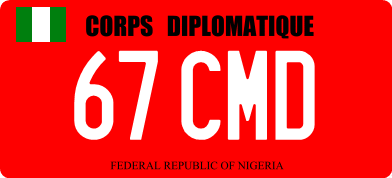
Police in Abuja have uncovered a criminal group making fake diplomatic and government number plates.

Ahmed Sanusi, commissioner of Police FCT, stated this during a press briefing on Friday.
He explained that criminals use these fake plates to dodge security checks and enter restricted areas.
The investigation started soon after Sanusi took office.
He noticed too many unauthorized cars driving around with official government and diplomatic tags.
“I immediately ordered a comprehensive investigation into this disturbing trend,” Sanusi said. He noted that these individuals use the plates as a cover to commit crimes and avoid arrest.
The police have already arrested several people caught using the fake plates.
They have also figured out who is making them.
The manufacturers operate outside Abuja, and police are actively hunting them down.
Sanusi kept their names secret so they would not flee.
He stressed that this is a highly profitable illegal business.
Buyers pay between N500,000 and N1.7 million for a single fake plate.
“This will tell you that they are making such huge expenditure because they have an agenda,” Sanusi explained.
“Now they will face punishment that is bigger than both the cost they incur and the agenda they are planning.”
The commissioner urged residents to report any cars with suspicious diplomatic plates.
He reminded the public that real diplomatic tags follow a very specific format.
A diplomatic number plate in Nigeria is a special vehicle identification tag issued to foreign embassies, high commissions, and accredited international diplomats.
Gavi has approved $500 million to strengthen Nigeria’s immunisation programme, primary healthcare services and long-term vaccine financing.

The move followed high-level discussions between Professor Muhammad Ali Pate, coordinating minister of Health and Social Welfare, ]and Dr. Sania Nishtar, chief executive officer, Gavi in Abuja.
The funding, approved under the Gavi 6.0 programme, will support Nigeria’s efforts to accelerate routine immunisation, sustain polio eradication, expand HPV vaccination, strengthen primary healthcare services, and improve long-term vaccine financing.
Speaking during the meeting, Pate said Nigeria was strengthening its partnership with Gavi to accelerate immunisation, expand primary healthcare services, and ensure sustainable financing for vaccines.
He welcomed Gavi’s country-focused reforms, including the introduction of a predictable five-year funding envelope.
Pate said the US$500 million allocation will enable Nigeria to plan more effectively and deliver life-saving vaccines to more children and vulnerable populations.
The minister also revealed that quarterly visits to primary healthcare centreshad increased from about 10 million in 2023 to more than 45 million, reflecting significant progress in revitalising the country’s primary healthcare system.
Pate welcomed the announcement of a US$600 million pledge by the United States government to Gavi, describing it as a strong endorsement of the alliance’s leadership and the global value of vaccines.
He also commended Nishtar for prioritising Nigeria and praised the closer coordination among Gavi, World Health Organisation (WHO), UNICEF, World Bank, Gates Foundation, and other development partners, describing it as a model that has improved efficiency and aligned support with Nigeria’s health sector reforms.
The minister expressed appreciation to Gavi and its partners for their continued technical and financial support, while calling on state governments to invest more in healthcare and immunisation to complement federal efforts.

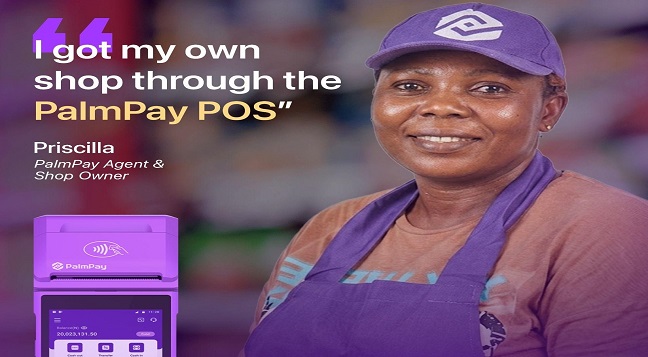
For many women, financial independence means the freedom to provide for their families and build a better future. Yet, this remains out of reach due to limited access to opportunities, business support, and secure payment solutions.

Like millions of women in Nigeria determined to be financially independent, Pricillia started with a single PalmPay POS terminal, and as an agent, every successful transaction provided a commission which brought her one step closer to achieving her dream.
Through consistency, discipline, and support from the payment platform, she reinvested her earnings and eventually opened her own provision store.
“I started as just a PalmPay agent with one POS. The consistency of the platform gave me the confidence to expand. With the income I earned, I was able to open my own provision shop.” Priscilla said.
For Priscilla, PalmPay was more than a payment platform. Its secure payment infrastructure gave her the confidence to serve her customers, build trust, and grow her income.
Today, Pricillia has joined the statistics of SMEs powering Nigeria’s economy and PalmPay continues to support her daily operations, helping her receive payments, as she works towards her next business milestone. Her journey is a reminder that when women have access to secure financial tools and opportunities, they can build lasting economic independence.
Speaking on Pricillia’s journey, Femi Hanson, Head of Marketing, PalmPay said: “Providing a secure platform that users can trust, whether for everyday payments or high-value transactions, is central to our vision of advancing financial inclusion. Priscilla’s story reflects our commitment to supporting the ambitions of Nigerians by providing a platform they can rely on to grow their finances. After all, seamless banking begins with security, and every successful transaction reinforces the trust our users place in us.”
Priscilla stands among thousands of PalmPay agents nationwide who are helping to expand financial access across Nigeria while earning commissions to create sustainable sources of income for themselves.
Every payment tells a story. It begins with trust, the confidence that your money is secure and that financial services are accessible. And when that opportunity reaches women, it creates ripple effects that transform families, strengthen communities, and drive economic growth.

Police Uncover Fake Diplomatic Number Plate Syndicate in Abuja

Davido Shares Past Suicidal Thoughts, Drops Oriadé Album

Gavi Okays $500m for Vaccines, PHCs in Nigeria

82% of Organizations Concerned about AI Risks Even as Adoption Accelerates – Survey Reveals

The Journey to Financial Freedom: Priscilla, a PalmPay Agent Now Owns a Store

NRC, Ponzi Scheme Collapses Resulting Loss of Billions of Naira

EFCC Busts NIS Visa Overstay Racket, Uncovers N700m in an Account

From Scarcity to Scale: What Africa Can Learn from India’s Agricultural Transformation

Tokenization, Blockchain Technology will Transform Financial Institutions – IMF

BON Establishes Six Ad Hoc Committees to Modernize Broadcasting




 Telecom2 days ago
Clydestone Ghana Sues MTN Over Mobile Money

 News2 days ago
IHS Nigeria Donates Business-Support Equipment to Empower People with Disabilities in Abuja Community

 News2 days ago
Africa Prudential Unveils Digital Growth Strategy

 E-Business2 days ago
Kaspersky Uncovers New Mirage Kitten Malware Used in Cyber-espionage Campaign Across Africa, Others

 E-Financial2 days ago
Afreximbank Raises $1.5b in Largest-ever Bond Issuance

 E-Financial2 days ago
CBN Fines Banks N430m for Ignoring Customers’ Complaints

 E-Financial2 days ago
SEC Begins Full e-Registration for Capital Market Operators

 E-Financial2 days ago
Elon Musk Launches Invite-only X Money with Visa Debit Card