

News
NCS @ NITMA 2013 Celebrates Outstanding Accomplishments

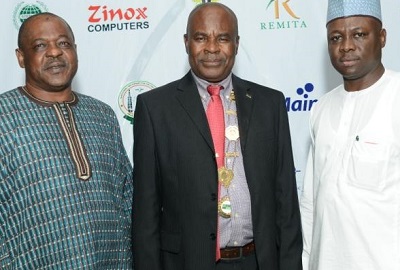
The 2013 National Information Technology Merit Award (NITMA) ceremony organized by the Nigeria Computer Society (NCS) recognized and celebrated Information Technology (IT) achievers and visionaries for their exceptional accomplishments.
December 13, 2013 was a day of honour and festivity for the tech community.
Engineer Ibrahim Shehu Gusau, chairman, House Committee on ICT, and chairman of NITMA 2013 commended NCS for its consistency in organizing the event to celebrate excellence in the sector since 2009.
His remarks highlighted the importance of interacting and engaging with critical stakeholders such as NCS in carrying out the functions of the House Committee on ICT in the development of legislation relevant to ICT and in performing the committee’s oversight functions.
He used the opportunity to inform the gathering about the progress being made in the national assembly on the Cybersecuity bill.

Loaded with excitement and meaning, dignitaries at Nigeria’s most important and recognized IT award event included Mr. Emeka Ezekwesili, director, National Information Technology Development Agency (NITDA) representing the Acting DG, NITDA, Elvis Alabegbe, special assistant to the DG, National Identity Management Commission (NIMC) representing the DG, NIMC, Immediate Past President of the NCS, Sir Demola Aladekomo, Past Presidents of NCS, Dr. Chris Nwannena, Professor Charles Uwadia and Past Provost, College of Fellows, Alhaji Ladi Ogunneye.
Professor David Adewumi, NCS President, noted in his welcome address that NCS organizes NITMA annually to celebrate and reward outstanding achievement in Information Technology (IT) by corporate organizations and individuals.
According to Adewumi, “NITMA acknowledges their exceptional hard work, contributions and excellence in accelerating IT development in Nigeria”. He charged the audience to join NCS in celebrating those making the industry and profession proud.
Professional fellowships were conferred on eleven new fellows during the fellowship award process coordinated by the Past Provost of the College of Fellows, Alhaji Ladi Ogunneye and the NCS President. Fellow is the highest grade of the NCS professional cadre, which is conferred in recognition of the significant impact an NCS member has had in the IT field.
New NCS professional fellows (FNCS) are: Mr. Oso Olugbenga Ayoola, Special Assistant to the Governor, State of Osun on planning and development at the State Planning Commission, Professor (Mrs.) Stella Chinye Chiemeke, Director of ICTU/CRPU, University of Benin, Mr. Protus Etim Akpan Amah, Executive Director and Head, Sales and Marketing, Data Sciences Nigeria Limited, and Mr. Adeolu Benedict Okanlawon, SAP Support Manager for Shell Nigeria and Gabon.
Others are: Mrs. Adijat Temilola Okunade, an Information Technology professional and an academician, Olorogun James Ono Emadoye, Chairman/CEO of BSSL Technologies Limited, Mr. Lookman Kayode Oseni, Assistant Director/Head of Software section of Data Sciences Nigeria Limited, Mr. Adetunji Micheal Adedowole, Executive Director, Technical Services and Support department, Data Sciences Nigeria Limited, Mr. Adedeji Adekunle Daramola, MD/CEO of IT & Management Solutions Limited, Dr. O. Fabian Uzoh, first Acting Head of Computer Science Department of the Federal University of Technology Owerri (FUTO) Imo State and Dr Akin Fapohunda, Executive Director of Digital Trust Ltd/Gte and Aflon Digital Institute.
INDUSTRY/ PERSONALITY AWARDS
Dr. Isaac O. Odeyemi, Managing Director, Debis Computers, was recognized for his commitment to the software profession and industry exemplified by his software leadership passion, investment in IT capacity building, youth innovation mentoring amongst other criteria and conferred with the award of “Best Software Entrepreneur of the Year 2013” by the Institute of Software Practitioners of Nigeria (ISPON). Federal University of Technology, Akure also won the ISPON National Software award for Tertiary Institutions.
Nominees for the IT Personality of the Year award were shortlisted and recognized for their industry, hard work, vision, values, ingenuity and tremendous accomplishments.
Despite the diverse and challenging obstacles in the sector, through NITMA NCS recognizes and celebrates these IT visionaries who have persevered and are breaking barriers and changing society – Andy Nwani – Managing Director, Dataflex Nigeria Limited, Austin Okere – Managing Director, Computer Warehouse Group, John Tani Obaro – Managing Director, Systemspecs Nigeria Limited and Yele Okeremi – Managing Director, Precise Financial Systems Limited.
A highlight and eagerly awaited moment therefore of the evening was the announcement by the Accenture representative of John Tan Obaro, Managing Director, SystemSpecs as the “2013 Information Technology Personality of Year” (the most outstanding IT contributor for 2013).
Also known as the President’s Award, NCS members voted online for their choice for IT’s most prestigious award. Accenture, acknowledged for its world class auditing services, confirmed the transparency and credibility of the entire voting process for the IT personality of the year award.
Other IT dignitaries who attended the event included: Mr. Chris Uwaje, President, Institute of Software Practitioners of Nigeria (ISPON), Dr. Abimbola Salako, former Provost, College of Fellows, Dr (Mrs) Adeola Ilechukwu, President, Nigerian Women In Information Technology (NIWIIT), Mr. Amos Emmanuel, First Vice President, Information Technology (Industry) Association of Nigeria (ITAN) and Sir Obi Okonkwo, Past Deputy Provost of NCS.
The event also witnessed the launching of the NCS Scholarship Fund and the NCS staff long service awards.
Jide Awe, chairman, Publicity, Events and Trade Services (NCS), NITMA beams a positive light on the IT sector to emphasize the important role IT practitioners and providers play in helping the nation attain developmental goals.
Promoting and supporting excellence strengthens the sector in particular, and the nation as a whole.



Union Bank of Nigeria has secured certification under the Payment Card Industry Data Security Standard (PCI DSS) version 4.0.1, a global standard for protecting payment card data.

The certification took effect on August 11, 2026, confirming that the bank’s systems for storing, processing and transmitting customers’ credit and debit card information meet stringent international security requirements.
PCI DSS certification is designed to reduce the risk of payment card data breaches and financial fraud while strengthening customer confidence in electronic payment systems.
The assessment covered key areas of Union Bank’s operations, including network infrastructure, card issuance, ATM and POS transactions, payment processing, reconciliation, settlement, chargebacks, dispute resolution and retail banking.
Union Bank was assessed and certified under the Service Provider category.
The certification process lasted a full year and involved quarterly assessments, with support from departmental, business and functional heads across the bank. Digital security firm Digital Encode supported the process, while the final independent audit was conducted by CyberCube, an accredited Qualified Security Assessor.
Yetunde B. Oni, Managing Director and Chief Executive Officer of Union Bank, said the certification demonstrates the bank’s commitment to protecting customer information.
“The security of our customers’ information is central to everything we do at Union Bank. This certification reaffirms that our payment systems and processes meet a rigorous global standard, and it reflects the discipline of colleagues across the Bank who work every day to keep customer data safe.”
The renewal also ensures that Union Bank maintains continuous PCI DSS certification, in line with the Central Bank of Nigeria’s requirement for banks to sustain compliance without interruption.

New data from CFA Society Nigeria is reshaping how the country’s financial sector thinks about talent development, with Access emerging as the single largest source of CFA candidates in Nigeria, distinction industry watchers say signals a deeper shift in how leading institutions are building investment expertise from within.

In its Where Nigeria’s Finance Professionals Work series, published in a national daily, CFA Society Nigeria placed Access first among employers of CFA candidates nationwide, with 82 candidates enrolled in the programme, more than double the 38 recorded at the next-placed institution and well ahead of every other bank or financial services firm on the list.
Access also ranked second among employers of CFA charterholders, with 11 professionals who have completed all three levels of the Programme and met its experience and ethics requirements.
For an industry that has long measured itself by balance sheet size and branch count, the rankings point to a different kind of competition: one over who is building the deepest bench of certified, globally credentialed talent.
CFA Society Nigeria compiled the data from its Salesforce Membership Database as at June 2026, and described the exercise as a way of recognising employers whose people “bring rigour, integrity and global best practices into the workplace every day.”
Analysts following the sector say the outcome is notable less for the ranking itself than for what it suggests about talent strategy across Africa’s financial services industry. A single institution developing more aspiring charterholders than the rest of the market combined raises the floor for professional standards nationally, not just within one balance sheet.
Every candidate who advances through the CFA Programme adds to a shared pool of ethics-trained, analytically rigorous professionals that Nigeria’s capital markets, pension funds and asset managers all eventually draw from.
Access Holdings Group Chief Executive Officer Innocent C. Ike, commenting on the rankings, framed the achievement in terms of institution-building rather than recruitment: “Every candidate on that list represents our commitment to building institutions and professionals that endure.”
The remark echoes a broader thesis increasingly voiced by market observers, that talent depth, not scale alone, is what will determine which African financial institutions earn lasting global credibility.
That distinction sits at the centre of Access’s stated ambition to become the World’s Most Respected African Financial Services Group. If the CFA numbers are any indication, the Group’s route to that goal runs less through square metres of branch network and more through the calibre of the people sitting inside it, a bet that Nigeria’s finance professionals, and the institutions that will one day hire them, are already placing alongside Access.


Nigeria Civil Aviation Authority (NCAA) has announced plans to introduce Radio Frequency Identification (RFID) baggage tracking technology across domestic and international airport terminals to tackle the growing problem of delayed, misrouted and missing luggages

Michael Achimugu, director, Public Affairs and Consumer Protection, NCAA, disclosed this at a stakeholder engagement forum in Lagos.
Achimugu said the RFID-enabled system would replace the traditional barcode-based baggage tracking framework and provide airlines and passengers with real-time visibility of checked luggage from check-in to final collection.
According to him, the technology would improve baggage traceability, reduce mishandling and strengthen accountability across the baggage-handling chain.
Unlike conventional barcode systems, RFID technology allows baggage to be automatically scanned at multiple points without requiring direct line of sight, enabling real-time tracking of luggage throughout its journey.
Achimugu said issues involving short-landed, missing, lost or damaged baggage had remained among the major complaints from air travellers, alongside flight delays.
He said the introduction of RFID technology was therefore aimed at improving baggage-handling standards and restoring passenger confidence in the aviation sector.
The NCAA said the initiative also aligns with IATA Resolution 753, which requires airlines to track baggage at key points during the passenger journey.
The authority expects the technology to provide more accurate information on the location of luggage, facilitate quicker resolution of baggage-related complaints and improve the overall passenger experience.
The NCAA said the initiative would also strengthen accountability among airlines and other stakeholders involved in baggage handling at Nigerian airports.

SEC Clears Blockchain for Accelerated Regulatory Incubation Programme

Union Bank Secures Global Payment Data Security Certification

NLNG, NCDMB Boost Engineering Research with Innovation Centre

Organizations Face New Attacks via Unpatched TrueConf Videoconferencing Servers, Kaspersky Warns

Leadway Unveils Multi-generational Insurance Plan for Nigerian Families

EFCC Busts NIS Visa Overstay Racket, Uncovers N700m in an Account

Fact-Check: Elon Musk’s “Tesla Pi Phone” is Internet Rumor

NBC Tasks Broadcasting Stations over 2028 DSO Global Deadline

NBC Scraps Annual Digital Access Fee on DSO

Glo Sponsored African Voices to Feature Netflix’s “The Polygamist” Stars




 News2 days ago
NCAA to Introduce RFID Technology to Tackle Missing Luggages

 General News2 days ago
Nigeria Not Making Progress in Fiscal Transparency –US

 Telecom2 days ago
GSMA Industry Services Unveils Circularity Services to Help Operators Reduce E-Waste and Unlock Value

 Telecom2 days ago
MTN Nigeria Unveils Y’ello Street Museum to Mark 25 Years of Connectivity

 News2 days ago
Firm Urges MSMEs to Increase Digital Payments Adoption for Growth

 E-Financial2 days ago
SEC Directs Operators to Subscribe to NigSac Alerts, Freeze Terrorists-Linked Funds

 E-Financial2 days ago
AFC Raises $430m in Digital Bond to Deepens Digital Financial Infrastructure

 E-Business2 days ago
Cyber Resilience a Critical Priority for Manufacturing Amid Rapid Digitalization – Report Shows